
Every time you run a program on your computer or phone, a magical process happens behind the scenes. Your code—written in languages like C, Java, or Python—is transformed into something your machine understands. But how does this happen?
1️⃣ What is a Compiler? 🤔
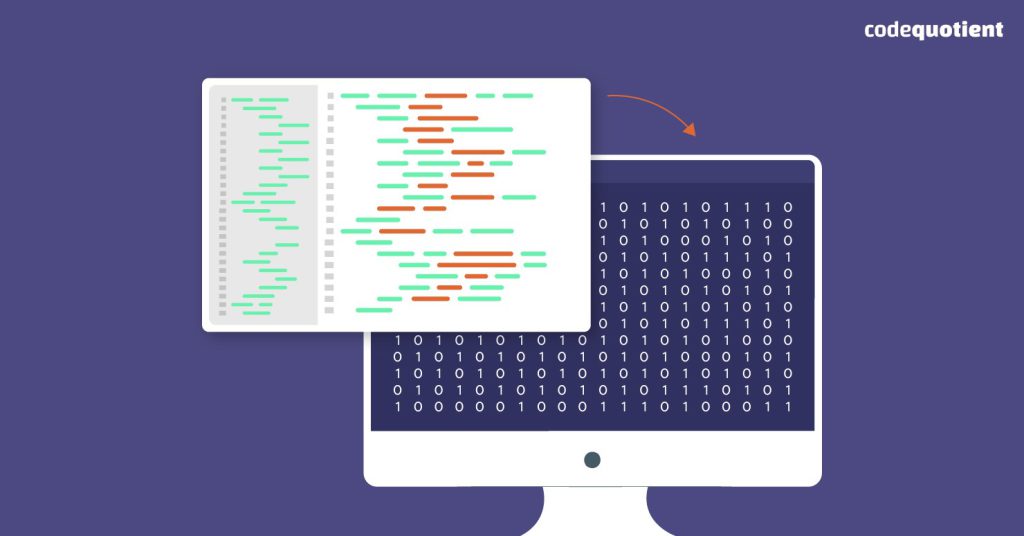
A compiler is a special program that translates human-readable code into machine code (binary instructions that a computer can execute).
- 📝 You write a program in C++
- 🔄 The compiler converts it into machine language (0s and 1s)
- 💻 The computer executes the binary code
Without compilers, we would have to write programs directly in binary, which would be incredibly difficult!
2️⃣ The Journey of Code: From Source to Execution 🚀
Step 1: Writing the Source Code 📝
The process starts when a programmer writes code in a high-level language like C, Java, or Python.
#include <stdio.h>
int main() {
    printf("Hello, World!\n");
    return 0;
}
Step 2: Lexical Analysis 🧐
The compiler breaks the source code into smaller units called tokens.
int→ Keywordmain→ Function name()→ Parentheses
Step 3: Syntax Analysis 📖
The compiler checks if the code follows correct syntax.
int main() {
    printf("Hello, World!\n")  // ❌ Missing semicolon
}
🔴 Compiler Output: error: expected ‘;’ before ‘}’ token
Step 4: Semantic Analysis 🧠
The compiler checks if the code makes sense.
int x = "Hello"; // ❌ Incorrect data type
🔴 Compiler Output: error: incompatible types when assigning to type ‘int’ from type ‘char *’
Step 5: Optimization ⚡
The compiler optimizes code by removing unnecessary steps.
int x = 2 + 3; // Compiler replaces with int x = 5;
Step 6: Code Generation 🏗️
The compiler translates the code into machine language.
1011 0001 0000 0101 // Binary representation of int x = 5;
3️⃣ Interpreters vs. Compilers: What’s the Difference? ⚖️
| Feature | Compiler (C, C++, Java) | Interpreter (Python, JavaScript) |
|---|---|---|
| Speed | Faster 🚀 | Slower 🐢 |
| Error Detection | Detects all errors before running | Stops at the first error |
| Code Execution | Transforms entire code before execution | Executes directly |
4️⃣ Real-World Examples of Compilers 🌍
| Language | Compiler Used |
|---|---|
| C/C++ | GCC, Clang |
| Java | javac |
| Python | Interpreter (CPython) |
| C# | Microsoft C# Compiler |
5️⃣ Why Compilers Matter 🏆
- ✔️ Speed & Efficiency – Optimized code runs faster 🚀
- ✔️ Error Checking – Detects mistakes before running ❌🔍
- ✔️ Portability – Enables cross-platform execution 🌎
- ✔️ Security – Prevents execution of faulty or malicious code 🔒
6️⃣ Future of Compilers: AI & Beyond 🤖
- 🔹 AI-powered compilers improve efficiency automatically
- 🔹 Just-in-Time (JIT) compilation speeds up execution
- 🔹 Cloud-based compilers allow coding in browsers
🔚 Conclusion: The Invisible Power of Compilers 💡
Compilers are the hidden engine behind modern software, translating human-readable code into machine instructions that power apps, websites, and operating systems.
Key Takeaways:
- ✔️ Compilers translate code into machine language (binary 0s and 1s).
- ✔️ They check for syntax errors, optimize performance, and generate executable files.
- ✔️ Compiled languages (C, C++) run faster than interpreted languages (Python, JavaScript).
Next time you run a program, remember the compiler working behind the scenes, making it all possible. ✨💻