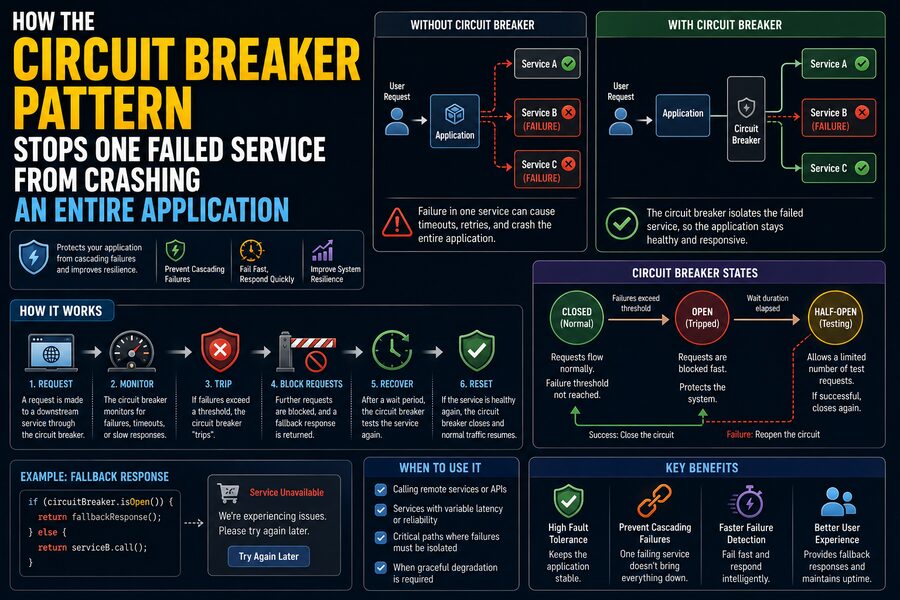

Modern applications are rarely built as one enormous piece of software. Large systems are often divided into many smaller services that communicate over networks. One service might handle payments, another user accounts, another product inventory, another recommendations, and another notifications. 🌐🧩
This architecture can make software easier to scale and maintain, but it introduces an important problem:
What happens when one service becomes slow, unavailable, or completely fails?
Without protection, the failure of a single dependency can spread throughout the system. Requests begin waiting longer. Threads become blocked. Connection pools fill up. Retries create additional traffic. Eventually, services that were originally healthy may also become overloaded.
This phenomenon is known as a cascading failure.
The Circuit Breaker Pattern is a software resilience technique designed to stop that chain reaction. Instead of repeatedly sending requests to a service that appears to be failing, the circuit breaker temporarily blocks those calls and fails quickly.
The idea resembles an electrical circuit breaker in a building. ⚡
When an electrical circuit becomes unsafe, the breaker interrupts the flow of electricity before wires or equipment are damaged.
In software, the circuit breaker interrupts calls to an unhealthy dependency before the failure spreads across the application.
🧩 What Is the Circuit Breaker Pattern?
The Circuit Breaker Pattern is a fault-tolerance mechanism that monitors calls to an external service or resource.
If enough calls fail, the circuit breaker assumes that the dependency is unhealthy.
It then stops sending new requests to that dependency for a period of time.
Instead of waiting for another timeout, callers receive an immediate failure or a fallback response.
After some time, the circuit breaker allows a small number of test requests through.
If those requests succeed, normal traffic resumes.
If they fail, the circuit remains blocked.
This behavior is usually modeled using three states:
🟢 Closed
🔴 Open
🟡 Half-Open
Understanding these states explains how the pattern works.
🟢 Closed State: Everything Is Operating Normally
When a circuit breaker is closed, requests are allowed to pass normally.
Suppose an e-commerce application has an Order Service that calls a Payment Service.
Under normal conditions:
Customer → Order Service → Payment Service
The Payment Service processes the request and returns a result.
The circuit breaker watches these calls in the background.
It may track information such as:
📊 Failure count
⏱️ Response times
❌ Timeout rate
📉 Percentage of unsuccessful requests
As long as the dependency remains healthy, the circuit stays closed.
In this state, the breaker behaves almost invisibly.
❌ What Happens When the Service Starts Failing?
Imagine that the Payment Service suddenly develops a database problem.
Its response time increases from:
100 milliseconds
to:
20 seconds
The Order Service continues sending requests.
Each request waits.
More customers arrive.
Soon the Order Service may have:
🔒 Hundreds of blocked threads
🌐 Full connection pools
💾 Growing request queues
⏱️ Increasing response times
📈 Rising memory usage
Eventually, the Order Service may become unavailable even though its own code is functioning correctly.
Other services depending on the Order Service may then begin failing too.
A single slow dependency has now created a cascading failure.
🔴 Open State: Stop Calling the Failed Service
The circuit breaker attempts to prevent this scenario.
Suppose its configuration says:
If more than 50% of the last 20 requests fail, open the circuit.
After enough Payment Service requests fail, the circuit breaker changes from:
🟢 Closed → 🔴 Open
Once open, it stops sending requests to the Payment Service.
Instead, the breaker immediately returns a controlled failure.
The path becomes:
Order Service → Circuit Breaker → Immediate fallback/error
rather than:
Order Service → Wait 20 seconds → Payment Service timeout
This concept is called fail-fast behavior. ⚡
The application accepts that the dependency is currently unavailable and stops wasting resources trying to reach it.
🛡️ Why Failing Fast Is So Important
At first, deliberately rejecting requests may sound worse than attempting them.
But in distributed systems, continuing to wait for a known-bad dependency can be much more dangerous.
Consider 1,000 incoming requests.
If each one waits 30 seconds for an unavailable service, the application may need to maintain 1,000 blocked operations simultaneously.
If the circuit breaker rejects them in a few milliseconds, those resources are released almost immediately.
Fail-fast behavior protects:
🧵 Worker threads
🌐 Network connections
💾 Memory
🗄️ Database connections
⚙️ CPU resources
This leaves the healthy parts of the system available for other work.
🟡 Half-Open State: Is the Service Healthy Again?
A circuit breaker should not remain open forever.
The failed service may recover.
Perhaps its database restarts.
Maybe network connectivity returns.
Maybe an overloaded server finishes processing its backlog.
After a configured delay, the circuit breaker enters the half-open state.
In this state, it allows a limited number of requests through as tests. 🧪
For example:
🔴 Open → wait 30 seconds → 🟡 Half-Open
Suppose three test requests are allowed.
If they succeed, the circuit breaker concludes that the service has recovered.
It transitions back to:
🟢 Closed
Normal traffic resumes.
If the test requests fail, the breaker returns to:
🔴 Open
and waits again.
🔄 The Complete Circuit Breaker Lifecycle
The basic behavior can be summarized as:
🟢 CLOSED
Requests flow normally. Failures are monitored.
⬇️ Failure threshold exceeded
🔴 OPEN
Requests are blocked immediately.
⬇️ Recovery timeout expires
🟡 HALF-OPEN
A small number of test requests are allowed.
⬇️ Tests succeed
🟢 CLOSED
or:
⬇️ Tests fail
🔴 OPEN
This simple state machine can dramatically improve system resilience.
🏢 Example: An Online Store
Imagine an online shopping application containing:
🛍️ Product Service
📦 Inventory Service
💳 Payment Service
🚚 Shipping Service
📧 Notification Service
Suppose the Recommendation Service becomes unavailable.
A product page might normally ask it:
“Which products should this customer also see?”
Without a circuit breaker, every product-page request might wait several seconds for recommendations to time out.
Soon product pages become painfully slow.
Eventually, web servers may exhaust their request threads.
Now a nonessential recommendation feature is damaging the entire store. 😬
With a circuit breaker, repeated failures cause recommendation calls to stop temporarily.
The page can instead show:
“Recommendations temporarily unavailable.”
Customers can still:
✅ Browse products
✅ Add items to carts
✅ Place orders
✅ Make payments
The recommendation feature has failed, but the core application remains functional.
This is known as graceful degradation.
🪂 What Is a Fallback?
A fallback is an alternative response used when the preferred service is unavailable.
Circuit breakers are frequently paired with fallback logic.
Suppose a Weather Service normally provides live weather data.
If it becomes unavailable, a fallback might return:
🌤️ Previously cached weather data
instead of producing a complete application error.
Other possible fallbacks include:
📦 Cached information
🧾 Default values
🚫 Feature temporarily unavailable messages
📉 Reduced functionality
📨 Asynchronous processing
🗃️ Previously stored results
The best fallback depends on the importance and nature of the dependency.
🧠 Not Every Failure Should Have the Same Fallback
Fallbacks must be designed carefully.
Returning stale product recommendations may be harmless.
Returning stale bank-account balances could be dangerous.
A payment application should not pretend a transaction succeeded simply because the Payment Service is unavailable.
For critical operations, the safest fallback may simply be:
“Service temporarily unavailable. Please try again later.”
Reliability does not mean hiding every failure.
It means handling failures in a way that preserves correctness and prevents wider damage.
⏱️ Timeouts Are Still Essential
Circuit breakers should normally be used together with timeouts.
A timeout defines how long an application will wait for a dependency.
Without a timeout, a request could remain stuck indefinitely.
For example:
Payment Service timeout = 2 seconds
If no response arrives after two seconds, the request fails.
The circuit breaker records that failure.
After enough failures, it opens.
So the two mechanisms serve different roles:
Timeout: limits how long one request can wait.
Circuit breaker: limits how long the system continues trying an unhealthy dependency.
Together, they provide much stronger protection.
🔁 Retries Can Make Failures Worse
Retries are another common resilience technique.
If a request fails because of a temporary network glitch, trying again may succeed.
But retries can become dangerous during a major outage.
Imagine:
1,000 requests × 3 retries = 3,000 dependency calls
If the downstream service is already overloaded, retries add even more pressure.
This is sometimes called a retry storm. 🌪️
Circuit breakers help prevent retry storms by stopping new calls after repeated failures indicate the dependency is unhealthy.
Good systems combine:
⏱️ Timeouts
🔁 Limited retries
⚡ Circuit breakers
📉 Backoff strategies
rather than using retries blindly.
📉 Exponential Backoff
When retries are appropriate, systems often use exponential backoff.
Instead of retrying immediately:
Retry 1 → wait 100 ms
Retry 2 → wait 200 ms
Retry 3 → wait 400 ms
The delay increases between attempts.
Random variation, known as jitter, may also be added.
Jitter prevents thousands of clients from retrying at exactly the same moment.
Circuit breakers and exponential backoff solve related but different problems.
Backoff reduces retry pressure.
Circuit breakers stop calls when the dependency appears broadly unhealthy.
📊 Failure Thresholds
A circuit breaker needs rules for deciding when to open.
One simple method is a consecutive failure count.
For example:
Open after five failures in a row.
But this may be too simplistic.
Modern implementations often use a sliding window.
For example:
Evaluate the last 100 requests and open the circuit if at least 50% failed.
This approach can better represent actual service health.
Some systems also consider slow requests.
A service that technically responds successfully after 30 seconds may still be effectively unhealthy.
Therefore, circuit-breaker logic may monitor:
❌ Failure rate
🐌 Slow-call rate
⏱️ Timeout rate
📊 Minimum request volume
🪟 Sliding Windows
A sliding window examines recent request history.
There are two common approaches.
🔢 Count-Based Window
The breaker analyzes a fixed number of recent calls.
For example:
Last 50 requests
If 30 failed:
Failure rate = 60%
If the threshold is 50%, the circuit opens.
⏱️ Time-Based Window
The breaker analyzes all calls during a recent time interval.
For example:
Requests during the last 30 seconds
Both approaches allow the breaker to react to current conditions rather than historical failures from long ago.
🚦 Why Minimum Request Counts Matter
Suppose the first request of the day fails.
Technically, the failure rate is:
100%
Should the circuit immediately open?
Probably not.
One failure is not enough information.
Circuit breakers therefore often require a minimum number of requests before evaluating failure percentages.
For example:
Minimum calls = 20
Only after 20 calls have occurred does the system consider opening the breaker.
This prevents excessive sensitivity to isolated errors.
🌐 Circuit Breakers in Microservices
The Circuit Breaker Pattern became especially important with the rise of microservices.
In a microservices system, a single user request might trigger calls through several services:
API Gateway → Account Service → Order Service → Inventory Service → Payment Service
Each network hop introduces potential failure.
Networks can experience:
📉 Packet loss
🐌 Congestion
🔌 Connection failures
💥 Server crashes
⏱️ Timeouts
A circuit breaker can be placed around each important remote dependency.
This creates isolation boundaries.
If the Inventory Service fails, the Account Service does not necessarily need to fail.
If the Recommendation Service fails, checkout should still work.
This principle is known as fault isolation.
🧱 Preventing Cascading Failures
The most important purpose of a circuit breaker is preventing a local problem from becoming a system-wide problem.
Consider this sequence without protection:
- Database becomes slow.
- Payment Service requests begin waiting.
- Payment Service thread pool fills.
- Order Service waits on Payment Service.
- Order Service thread pool fills.
- API servers wait on Order Service.
- User requests pile up.
- Entire application becomes unavailable.
One database problem has cascaded through several layers. 💥
With a circuit breaker:
- Database becomes slow.
- Payment calls begin failing.
- Circuit breaker detects failure threshold.
- Circuit opens.
- New payment calls fail quickly.
- Upstream resources remain available.
- Other features continue functioning.
The failed component is effectively quarantined.
🧵 Protecting Thread Pools
Thread exhaustion is a common cause of cascading failures.
Suppose a web server has:
200 worker threads
If 200 requests become stuck waiting for an unhealthy downstream service, no worker threads remain for new requests.
Even requests that do not need the failed dependency may be unable to proceed.
A circuit breaker limits the amount of time workers remain blocked.
Other resilience patterns, such as bulkheads, can provide additional protection by allocating separate resource pools to different dependencies.
🚢 Circuit Breakers and the Bulkhead Pattern
The Bulkhead Pattern takes its name from ships.
Ships are divided into sealed compartments.
If one compartment floods, water cannot necessarily spread throughout the entire vessel. 🚢
Software bulkheads work similarly.
For example:
Payment calls: maximum 50 concurrent requests
Recommendation calls: maximum 20
Inventory calls: maximum 30
If Recommendation Service becomes overloaded, it consumes only its allocated resources.
Circuit breakers and bulkheads work extremely well together.
The circuit breaker detects unhealthy dependencies.
The bulkhead limits how many resources those dependencies can consume.
🧑💻 A Simplified Code Example
Conceptually, an application without a circuit breaker might do:
function getRecommendations(user):
    return recommendationService.call(user)
With a circuit breaker:
function getRecommendations(user):

    if circuitBreaker.isOpen():
        return cachedRecommendations(user)

    try:
        result = recommendationService.call(user)
        circuitBreaker.recordSuccess()
        return result

    catch error:
        circuitBreaker.recordFailure()
        return cachedRecommendations(user)
Real implementations are significantly more sophisticated, but the central idea remains the same.
The circuit breaker tracks health and decides whether the call should be attempted.
🐍 Circuit Breakers Are Not Only for HTTP
Circuit breakers are commonly associated with HTTP microservices, but the pattern can protect many types of dependencies.
Examples include:
🗄️ Databases
📨 Message brokers
💳 Payment gateways
🌐 External APIs
☁️ Cloud services
📦 Object storage
🔐 Authentication providers
📡 Remote procedure calls
Any operation involving a remote or potentially unreliable dependency may benefit from circuit-breaking behavior.
☁️ External APIs
Third-party APIs are especially important candidates.
Suppose a travel application depends on an external currency-conversion API.
If that provider experiences an outage, your application cannot repair it.
Continuing to send thousands of requests may accomplish nothing.
A circuit breaker can open and temporarily return:
💱 Cached exchange rates
or:
“Live conversion temporarily unavailable.”
This protects your infrastructure while giving the external provider time to recover.
📈 Circuit Breakers Improve Recovery
Circuit breakers do more than protect the caller.
They can also help the failed service recover.
Suppose a database is overloaded because it can process:
1,000 queries per second
but is receiving:
5,000 queries per second
If every client continues hammering it with requests and retries, the database may never catch up.
Opening circuit breakers reduces incoming load.
The dependency gets a period of relative quiet.
It may then:
🧹 Clear queued work
💾 Recover memory
🔄 Restart connections
📉 Reduce load
This can shorten outages.
🔭 Observability Is Critical
Circuit breakers generate valuable operational information.
Engineering teams should monitor metrics such as:
🟢 Number of closed circuits
🔴 Number of open circuits
🟡 Half-open transitions
❌ Failure rates
🐌 Slow-call percentages
⚡ Rejected calls
🪂 Fallback usage
A sudden increase in open circuits may indicate a broader incident.
These metrics can feed:
📊 Monitoring dashboards
🔔 Alerts
📜 Logs
🔍 Distributed tracing systems
Circuit breaker state should usually be visible to operations teams rather than hidden inside application code.
🚨 What Does an Open Circuit Tell You?
An open circuit does not necessarily mean the circuit breaker itself has failed.
Quite the opposite.
It often means the breaker is doing its job.
The important question becomes:
Why is the downstream dependency unhealthy?
Possible causes include:
💥 Application crashes
🗄️ Database problems
🌐 Network failures
🐌 Resource exhaustion
📈 Unexpected traffic
🔐 Authentication failures
An open circuit is therefore both a protective mechanism and a useful operational signal.
🧠 Choosing the Right Recovery Timeout
How long should a circuit remain open?
There is no universal answer.
If the timeout is too short, the system may repeatedly send test traffic to a service that has not recovered.
If it is too long, traffic may remain blocked after the service becomes healthy.
The ideal value depends on:
⏱️ Typical outage duration
📊 Request volume
🛠️ Dependency recovery behavior
⚡ Application latency requirements
Some sophisticated systems use adaptive strategies rather than a fixed timeout.
⚠️ Circuit Breakers Can Be Misconfigured
A badly configured circuit breaker can create problems of its own.
If the failure threshold is too low, normal temporary errors may repeatedly open the circuit.
If it is too high, the application may continue hammering a broken dependency for too long.
If fallback behavior is incorrect, users may receive misleading information.
Good circuit-breaker configuration therefore requires:
📊 Production metrics
🧪 Load testing
🔥 Failure testing
🔍 Observability
⚙️ Careful tuning
The pattern is powerful, but it is not automatic reliability magic.
🧪 Chaos Engineering and Circuit Breakers
One way to test resilience mechanisms is through chaos engineering.
Engineers deliberately introduce controlled failures, such as:
🐌 Added network latency
🔌 Simulated service outages
📉 Packet loss
💥 Process termination
They then observe how the system behaves.
A well-designed application should:
✅ Detect failures
✅ Open appropriate circuits
✅ Preserve unrelated functionality
✅ Recover when dependencies return
Testing circuit breakers under controlled failure conditions is much safer than discovering configuration problems during a real production outage.
🛍️ Example: Checkout With Graceful Degradation
Consider an online checkout system.
The checkout request may depend on:
💳 Payment Service
📦 Inventory Service
🎁 Loyalty Service
📧 Notification Service
Payment and inventory are essential.
Loyalty points and email confirmation might be less critical.
If Loyalty Service fails:
Circuit opens → skip loyalty calculation → checkout continues
If Email Service fails:
Circuit opens → queue email for later → checkout continues
If Payment Service fails:
Circuit opens → return controlled payment-unavailable message
The application remains operational while preserving correctness.
This illustrates an important principle:
Different dependencies deserve different failure strategies.
🔁 Circuit Breaker vs. Retry
These patterns are related but not interchangeable.
Retry asks:
“Could this temporary failure succeed if I try again?”
Circuit breaker asks:
“Has this dependency become unhealthy enough that I should stop trying?”
Retries are useful for brief transient errors.
Circuit breakers are useful when repeated attempts are likely to fail.
A robust application frequently uses both—with strict limits.
⏳ Circuit Breaker vs. Timeout
A timeout protects an individual request.
A circuit breaker protects the system from repeatedly performing unhealthy requests.
For example:
Timeout: stop this call after 2 seconds.
Circuit breaker: stop making new calls after recent requests repeatedly time out.
Timeouts provide the evidence the circuit breaker may use to make broader decisions.
🚦 Circuit Breaker vs. Rate Limiting
Rate limiting controls how frequently requests are accepted.
For example:
Maximum 1,000 requests per minute
A circuit breaker instead reacts to the health of a dependency.
A service could be under its rate limit but still fail because of a database outage.
Similarly, a healthy service may need rate limiting even though its circuit is closed.
These mechanisms solve different reliability problems and can be combined.
🛡️ Circuit Breaker vs. Load Shedding
Load shedding intentionally rejects some traffic when a system is overloaded.
Circuit breakers reject calls because a dependency appears unhealthy.
Both techniques aim to preserve overall system stability.
For example, during extreme traffic:
📈 Load shedding may reject low-priority requests.
Meanwhile:
🔴 Circuit breakers may isolate failing dependencies.
Together they prevent limited failures from turning into complete outages.
🏗️ Where Should the Circuit Breaker Live?
A circuit breaker can be implemented in several places.
It may exist:
💻 Inside application code
🌐 Inside an API gateway
🧩 Inside a service mesh
☁️ Within cloud middleware
📚 Inside networking libraries
Application-level breakers allow detailed business-specific fallback logic.
Infrastructure-level breakers can provide centralized behavior across many services.
Modern architectures may use both.
🕸️ Circuit Breakers in Service Meshes
A service mesh provides networking features between microservices through infrastructure components.
Depending on the platform, it may offer capabilities such as:
🔁 Retries
⏱️ Timeouts
📊 Telemetry
⚡ Circuit breaking
🔀 Traffic routing
This allows some resilience policies to be configured without rewriting every application’s code.
However, business-specific fallback behavior often still belongs inside the application itself.
Infrastructure can decide whether to send traffic.
Application code decides what the user should experience when that dependency is unavailable.
🧠 Why Circuit Breakers Improve User Experience
Circuit breakers may seem like backend engineering details, but users directly benefit from them.
Without circuit breakers, an unhealthy dependency might make a page wait 30 seconds before eventually failing.
With a circuit breaker, the application may respond in:
50 milliseconds
with a useful fallback.
For the user, the difference is enormous.
Instead of:
🐌 Slow entire application
they may experience:
⚠️ One temporarily unavailable feature
Fast, controlled failure is often much better than unpredictable waiting.
📱 Example: A Social Media Feed
Imagine a social network whose home feed includes:
📝 Posts
👤 Profiles
📊 Like counts
🎯 Ads
📈 Trending topics
Suppose the Trending Service fails.
Without isolation, every feed request may wait for it.
With a circuit breaker, trending data can simply be omitted.
The main feed still loads.
This is a core resilience principle:
Optional dependencies should not be allowed to destroy essential functionality.
📐 Designing Good Circuit Breakers
A well-designed circuit breaker usually requires answering several questions:
- Which failures count toward opening the circuit?
- How many requests should be observed?
- What failure percentage is unacceptable?
- How long should the circuit stay open?
- How many half-open test calls are allowed?
- What fallback should callers receive?
- Which metrics and alerts should be recorded?
These decisions should be based on the behavior and importance of the dependency.
🚀 Circuit Breakers in Cloud-Native Systems
Cloud environments make resilience patterns particularly important.
Instances can:
🔄 Restart
📈 Automatically scale
🌐 Move between networks
💥 Fail unexpectedly
🛠️ Undergo deployments
Applications must assume that remote dependencies may occasionally disappear.
Modern distributed-system design therefore treats failure as a normal operating condition rather than a rare exception.
Circuit breakers fit perfectly into this philosophy.
Instead of assuming:
“This service will always work.”
the architecture assumes:
“This service will eventually fail, so what should happen when it does?”
That mindset produces more resilient systems.
🌟 Conclusion
The Circuit Breaker Pattern prevents one failed service from crashing an entire application by detecting repeated failures and temporarily stopping calls to the unhealthy dependency. ⚡🛡️
When everything is functioning normally, the breaker remains closed, and requests flow normally.
When failures exceed a configured threshold, it becomes open, causing new requests to fail quickly rather than wasting threads, connections, memory, and time.
After a recovery period, it becomes half-open and allows a small number of test requests.
If those tests succeed, normal traffic resumes.
If they fail, the circuit opens again.
This simple three-state mechanism prevents:
💥 Cascading failures
🧵 Thread exhaustion
🌐 Connection starvation
🌪️ Retry storms
🐌 Extreme latency
📈 Unnecessary pressure on failing services
Circuit breakers are most effective when combined with other resilience techniques such as:
⏱️ Timeouts
🔁 Carefully controlled retries
📉 Exponential backoff
🚢 Bulkheads
🪂 Fallbacks
📊 Monitoring
The most important idea behind the pattern is that distributed systems should not continue treating an obviously unhealthy dependency as though everything were normal.
Sometimes the safest action is to temporarily stop trying.
In that sense, the software circuit breaker behaves exactly like its electrical namesake:
⚡ Detect trouble.
🛑 Interrupt the dangerous flow.
🛡️ Protect the rest of the system.
🧪 Test for recovery.
✅ Restore normal operation when conditions are safe again.
That is how one small architectural pattern can prevent a single failed service from becoming a full-scale application outage.