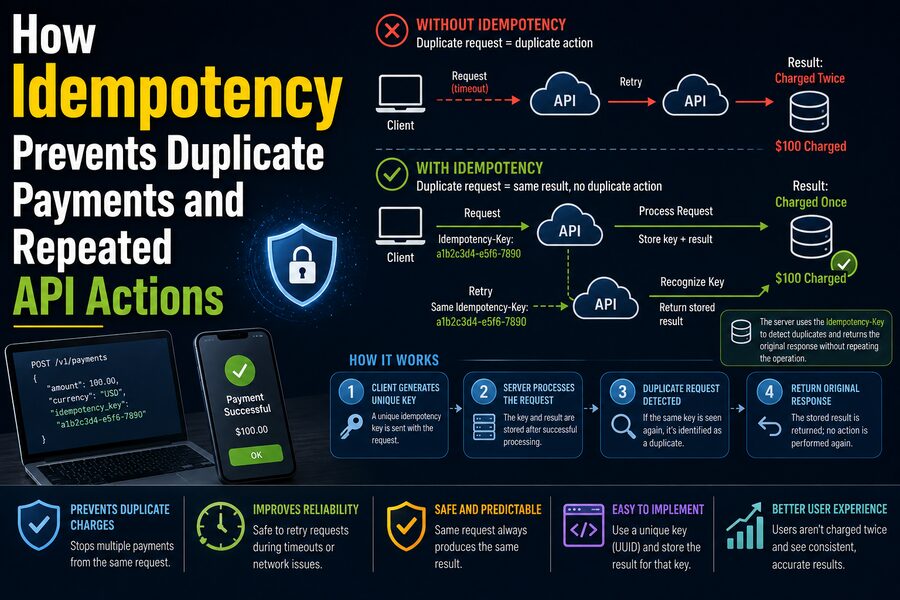

Modern software systems constantly send requests across unreliable networks. A mobile app may ask a payment server to charge a card. An online store may ask a warehouse service to create an order. A banking system may request a money transfer. A cloud application may instruct another service to create a virtual machine or send a notification.
Most of the time, these requests succeed normally.
But networks are not perfect. 📡⚠️
A client may send a request, the server may successfully process it, and then the response may be lost before reaching the client. From the client’s perspective, it looks as if nothing happened.
So the client tries again.
That retry can be harmless if the action merely requests information. But if the request means:
“Charge this customer $100”
then retrying could accidentally charge the customer twice. 💳💥
To prevent this kind of problem, distributed systems use a powerful concept called idempotency.
Idempotency allows an operation to be repeated safely without causing the intended effect to happen multiple times. It is especially important in payment systems, financial APIs, order-processing platforms, messaging systems, and any application where duplicate actions could create serious consequences.
🧠 What Does Idempotency Mean?
In computing, an operation is idempotent if performing it multiple times produces the same intended result as performing it once.
For example, imagine an API request that says:
“Set account status to ACTIVE.”
Sending this once changes the status to active.
Sending it five more times still leaves the status as active.
The final result is the same.
That operation is naturally idempotent.
Now consider:
“Add $100 to this account.”
Sending it once adds $100.
Sending it twice adds $200.
Sending it three times adds $300.
That operation is not naturally idempotent.
Payment APIs often deal with non-idempotent actions, which is why they need additional mechanisms to make retries safe.
💳 The Duplicate Payment Problem
Imagine a customer buying a laptop for $1,000.
The checkout application sends:
POST /payments
with instructions to charge the customer’s card.
The payment server successfully charges $1,000.
But before the response returns, the network connection drops.
The checkout application sees:
Timeout
It does not know whether the charge failed or whether the charge succeeded but the response disappeared.
So it retries.
Without idempotency:
First request → charge $1,000 ✅
Retry → charge another $1,000 ❌
The customer has now been charged twice.
This is exactly the type of situation idempotency is designed to prevent.
🔑 What Is an Idempotency Key?
One common solution is an idempotency key.
An idempotency key is a unique identifier generated by the client for a specific logical operation.
For example:
checkout_82f91a6b
The client sends this key along with the payment request.
Conceptually:
Payment request + idempotency key
The payment server stores the key after processing the request.
If the client sends the exact same operation again using the same key, the server recognizes that the request has already been processed.
Instead of charging the card again, the server returns the previous result. 🔁✅
A simplified flow looks like this:
Client sends payment with key ABC123
⬇️
Server checks key
⬇️
Key not found → process payment
⬇️
Store result under ABC123
⬇️
Response is lost
⬇️
Client retries with ABC123
⬇️
Server finds ABC123
⬇️
Return existing result — do not charge again
This transforms an unsafe retry into a safe one.
⚙️ Why Retries Are Necessary in Distributed Systems
It may seem easier to simply tell clients never to retry.
Unfortunately, that would make systems unreliable.
Requests can fail for many reasons:
📡 Temporary network interruption
⏱️ Server timeout
🔌 Connection reset
🏢 Load balancer failure
🖥️ Server restart
🌐 Routing issue
⚙️ Temporary dependency failure
Many of these failures disappear after milliseconds or seconds.
Retries are therefore essential for making distributed systems resilient.
The challenge is not eliminating retries.
The challenge is making them safe.
Idempotency provides that safety.
🧩 Natural Idempotency vs. Engineered Idempotency
Some operations are naturally idempotent.
Consider:
PUT /users/123/status
with:
status = "disabled"
Repeating this request simply keeps the user disabled.
The desired final state does not change.
Other operations are naturally non-idempotent.
Examples include:
💳 Charge a credit card
💸 Transfer money
📦 Create an order
📧 Send an email
🎟️ Issue a ticket
🏦 Add funds to an account
Repeating these operations may create duplicate effects.
For these cases, engineers introduce engineered idempotency, often using unique keys and server-side deduplication.
📚 How the Server Stores Idempotency Records
When a server receives a request with an idempotency key, it usually needs to remember what happened.
A record may include:
- Idempotency key
- Request fingerprint
- Processing status
- Response status code
- Response body
- Resource identifier
- Creation timestamp
- Expiration time
Suppose the request uses:
Idempotency-Key: payment-7G92K
The server may create a record like:
Key: payment-7G92K
Status: completed
Payment ID: pay_45182
Amount: $100
Result: success
If the same key arrives later, the server can return the stored result.
This prevents duplicate execution.
🔐 Why the Key Must Represent One Logical Operation
An idempotency key should be unique to a single intended action.
Suppose a customer attempts one $50 payment.
The client creates:
payment-abc123
If the request times out, the client retries using the same key.
That is correct.
Later, the customer intentionally wants to make another $50 payment.
The client must generate a new key.
If it reused the old key, the server could interpret the new payment as a duplicate retry and refuse to create a second charge.
Therefore:
Same logical action → same idempotency key
New logical action → new idempotency key
This distinction is fundamental.
🧬 Why Servers Often Compare Request Parameters
Consider a dangerous case.
The first request says:
Key: ABC123
Amount: $50
Later, another request arrives:
Key: ABC123
Amount: $500
Should the server silently return the original $50 result?
Usually, that would be risky.
Good idempotency implementations often associate the key with a representation or fingerprint of the original request.
If the same key is reused with different parameters, the server can reject the request.
For example:
409 Conflict
or another validation error.
This prevents accidental or malicious reuse of one key for unrelated operations.
🧠 The Race Condition Problem
Idempotency becomes more difficult when two identical requests arrive almost simultaneously.
Imagine a mobile app accidentally sends the same payment twice within a few milliseconds.
Both requests contain the same key:
payment_xyz
If the server processes requests naively, both may check the database at nearly the same time.
Request A asks:
“Does key payment_xyz exist?”
Answer: No.
Request B asks:
“Does key payment_xyz exist?”
Answer: No.
Both then proceed to charge the customer.
Now duplicate processing has occurred despite the idempotency mechanism. ⚠️
To prevent this, the server needs atomic coordination.
This may involve:
- Database uniqueness constraints
- Transactions
- Locks
- Compare-and-set operations
- Distributed coordination techniques
Only one request should be allowed to claim a given idempotency key.
🔒 Unique Database Constraints Are Extremely Useful
A common design is to make the idempotency key unique in a database table.
Imagine a table:
idempotency_records
with a column:
idempotency_key UNIQUE
If two requests attempt to insert the same key simultaneously, the database ensures that only one succeeds.
The other request detects the duplicate and waits for or returns the result of the first operation.
This is often much safer than relying entirely on application-level checks.
The database acts as the final enforcement layer. 🗄️✅
⏳ What Happens While the First Request Is Still Processing?
A retry can arrive before the original operation finishes.
Suppose the first request has created an idempotency record but is still waiting for the payment processor.
A second request arrives with the same key.
The server may respond in several ways:
🔄 Wait for the first request to finish
⏳ Return a “processing” response
⚠️ Ask the client to retry later
📦 Return a stored intermediate state
The important rule is that it should not start the same side effect again.
The exact behavior depends on API design and business requirements.
💾 Why Idempotency Records Often Expire
Servers usually do not keep every idempotency key forever.
That would create an ever-growing database.
Instead, records often have a retention window.
For example, a service might remember idempotency keys for:
24 hours
or:
several days
depending on the operation.
After expiration, the server may delete the record.
This means clients need to understand how long retries remain protected.
For high-value financial systems, retention policies may be longer or tied to transaction history.
💸 Idempotency in Money Transfers
Payment charging is not the only financial use case.
Consider a bank transfer.
The request says:
Transfer $500 from Account A to Account B
If the client retries without protection, the customer could lose $1,000.
A robust design may assign a unique transfer ID:
transfer_2026_784521
The system ensures that this transfer ID can create the movement of funds only once.
Subsequent requests using the same transfer ID retrieve the existing transaction rather than creating a new one.
This is one reason financial systems rely heavily on unique transaction identifiers.
📦 Idempotency in E-Commerce Orders
Imagine an online store receives:
Create order for customer 892
The request includes:
- Laptop
- Mouse
- Keyboard
If the connection times out and the client retries, the store might otherwise create two separate orders.
That could lead to:
📦 Duplicate shipments
💳 Duplicate charges
📉 Incorrect inventory
📧 Repeated confirmation emails
An idempotency key can tie all retries to one logical order.
The server may respond with the same existing order ID every time.
📧 Why Sending Emails Is Tricky
Sending an email is inherently non-idempotent.
If you call:
sendEmail()
twice, the recipient may receive two messages.
Therefore, systems that trigger emails from retried jobs often maintain a separate record indicating whether a particular logical notification has already been sent.
For example:
notification_id = invoice_482_paid_email
If the job runs again, the system sees that the notification has already been issued and skips the second send.
This is effectively idempotency applied at the application layer.
📨 Idempotency in Message Queues
Distributed systems frequently use message brokers.
A worker may receive a message saying:
“Update inventory after order 123.”
The worker processes the message, but its acknowledgement is lost.
The message broker assumes processing failed and sends the message again.
This behavior is common in at-least-once delivery systems.
The consumer therefore needs to be prepared for duplicate messages.
A common technique is to attach an event ID:
event_123456
The consumer stores processed event IDs.
If the same event is delivered again, the worker recognizes it and does not repeat the business action.
This is sometimes called deduplication.
🔄 Idempotency and HTTP Methods
HTTP itself includes the concept of idempotent methods.
In general:
GET
Should be idempotent because retrieving data repeatedly should not change server state.
PUT
Is generally designed to be idempotent because it sets a resource to a particular state.
DELETE
Is considered idempotent in terms of intended state because deleting an already deleted resource still leaves it deleted.
POST
Is generally not inherently idempotent because repeated requests may create multiple resources or actions.
However, a POST request can be made effectively idempotent using an idempotency key.
This is common in payment APIs.
🆚 Idempotency Is Not the Same as Deduplication
The two concepts are related but not identical.
Deduplication means identifying repeated requests or messages.
Idempotency means ensuring that repeating an operation does not produce additional unintended effects.
A system may detect a duplicate request but still mishandle the stored result.
Likewise, some operations are naturally idempotent even without explicitly detecting duplicates.
In practice, engineered idempotency often relies on deduplication as one part of the solution.
🧾 Idempotency Is Also Different From Database Transactions
Database transactions provide atomicity and consistency within a defined system.
For example, a transfer might use one transaction to:
Debit Account A
and:
Credit Account B
Either both changes succeed or neither does.
That is essential.
But a database transaction alone does not necessarily prevent the entire operation from being executed twice.
If the same transfer request is processed twice as two valid transactions, both could succeed.
Idempotency prevents duplicate execution, while transactions ensure consistent execution.
Financial systems often need both. 🏦
🌐 External APIs Make Idempotency More Complicated
Suppose your application receives an idempotent request and then calls an external payment provider.
Your database may be perfectly protected, but what happens if:
- You call the payment provider.
- The provider successfully charges the customer.
- Your application crashes before recording success.
- The request is retried.
- Your application calls the provider again.
Now duplicate charging can occur.
To solve this, the downstream payment provider should ideally support its own idempotency mechanism.
Your application can propagate or derive a stable key when calling that service.
This creates idempotency across system boundaries.
🔗 Idempotency Through a Chain of Services
Modern applications may involve many microservices.
A checkout request might pass through:
API gateway
⬇️
Order service
⬇️
Payment service
⬇️
Inventory service
⬇️
Shipping service
If every service independently repeats side effects when requests are retried, duplicate behavior can spread through the entire system.
Engineers therefore often include stable identifiers such as:
- Order ID
- Payment ID
- Event ID
- Request ID
- Idempotency key
These identifiers allow each service to determine whether it has already handled the logical operation.
🧱 The Inbox Pattern
One common distributed-systems technique is sometimes called the inbox pattern.
A service maintains a table containing identifiers of messages it has already processed.
When a new message arrives:
- Check or insert message ID
- If already processed, ignore or return previous result
- If new, execute business logic
- Record completion
When implemented transactionally, this can protect consumers from duplicated messages.
It is especially useful in event-driven systems.
📤 The Outbox Pattern
The transactional outbox pattern solves a related problem.
Imagine an order service must:
- Save an order in its database
- Publish an “OrderCreated” event
If the database write succeeds but event publishing fails, the system becomes inconsistent.
If the service retries incorrectly, duplicate events may be sent.
With an outbox pattern, the business record and outgoing event are saved in the same database transaction.
A separate publisher later sends the event.
Consumers still use idempotency because an outbox event may be delivered more than once, but the overall system becomes far more reliable.
♻️ “Exactly Once” Is Harder Than It Sounds
Developers often want exactly-once processing.
That sounds simple:
Process every operation once and only once.
In distributed systems, guaranteeing this absolutely across networks, databases, and external services can be extremely difficult.
A more practical architecture often combines:
At-least-once delivery
with:
Idempotent processing
The same message may arrive more than once, but processing it repeatedly does not create repeated business effects.
From the user’s perspective, the result behaves as if the action occurred once.
This is sometimes described as effectively once behavior.
🚨 Failed Requests Need Careful Interpretation
A common mistake is assuming that an HTTP timeout means:
“The server did nothing.”
A timeout actually means:
“The client did not receive a response in time.”
The server may have:
✅ Completed the operation
⏳ Still be processing it
❌ Failed before starting it
⚠️ Failed after partially processing it
The client cannot always know.
This uncertainty is precisely why idempotency is so valuable.
The client can retry without needing to determine exactly what happened during the missing response.
🧪 Example: A Payment API With Idempotency
Imagine this request:
POST /payments
Headers:
Idempotency-Key: checkout-68429
Body:
amount = 7500
currency = USD
The server first checks the key.
If the key has never been seen:
Create payment → save result → return payment ID
Suppose it returns:
payment_id = pay_9001
but the response is lost.
The client retries with the same key.
The server finds the stored record and returns:
payment_id = pay_9001
No second payment is created.
That is the core behavior engineers want.
⚠️ What Should Happen After a Failed Payment?
Suppose the payment processor declines the card.
Should the same idempotency key always return the same decline?
Often, yes—at least for the same original logical request.
The server may store the failed outcome so that a retry does not accidentally create a fundamentally new transaction.
If the user intentionally wants to try again after changing payment details, the application may create a new logical request with a new idempotency key.
Exact behavior depends on API semantics.
The key principle is consistency.
🔐 Idempotency Is Not a Security Feature by Itself
An idempotency key should not be treated like an authentication credential.
Knowing a key should not automatically authorize someone to view or modify a transaction.
APIs still require normal security controls such as:
🔑 Authentication
🛡️ Authorization
🔒 TLS encryption
📋 Access policies
🧾 Audit logging
Idempotency protects against duplicate effects.
Authentication determines who is allowed to request those effects.
They solve different problems.
🧠 Generating Good Idempotency Keys
Clients usually generate high-entropy unique values.
Common choices include:
- UUIDs
- Random identifiers
- Application-generated transaction IDs
- Stable business-operation IDs
A key should be unlikely to collide accidentally with another operation.
A random UUID is often suitable.
For some workflows, a natural business identifier may be better.
For example:
invoice-882-payment-attempt-1
The important requirement is that the identifier represents exactly one logical operation.
📊 Monitoring Idempotency in Production
Large systems should monitor idempotency behavior.
Useful metrics may include:
📈 Number of duplicate retries
⏱️ Idempotency lookup latency
⚠️ Key conflicts
🔄 Requests arriving while original processing is active
💾 Idempotency storage size
❌ Failed deduplication attempts
A sudden increase in duplicate requests may indicate:
- Network instability
- Client bugs
- Aggressive retry behavior
- Load balancer problems
- Service latency
Idempotency therefore provides not only safety but also useful operational insight.
🕒 Retries Should Still Use Backoff
Idempotency makes retries safer, but clients should not retry continuously without delay.
Repeated requests can overload a struggling service.
A common strategy is exponential backoff.
For example:
First retry → wait 1 second
Second retry → wait 2 seconds
Third retry → wait 4 seconds
Fourth retry → wait 8 seconds
Random variation, known as jitter, may also be added so thousands of clients do not retry simultaneously.
This reduces the risk of a retry storm.
Idempotency and good retry policy work together.
🛒 Real-World Applications Beyond Payments
Idempotency appears in many systems.
💳 Financial APIs
Prevent duplicate charges and transfers.
📦 E-commerce
Prevent duplicate orders or shipments.
☁️ Cloud infrastructure
Prevent repeated creation of virtual machines or resources.
📧 Messaging
Prevent duplicate notifications.
🎟️ Booking systems
Prevent duplicate reservations.
🏦 Banking
Protect fund transfers and ledger updates.
🤖 Automation systems
Prevent repeated execution of jobs after timeouts.
Whenever “doing it twice” is dangerous, idempotency deserves attention.
🧩 Idempotency Must Be Designed Around Business Meaning
One subtle but important lesson is that idempotency is not only a technical concern.
Engineers need to understand what counts as the same business operation.
Consider a customer clicking “Pay” twice.
Did the customer intend:
One payment retried twice
or:
Two separate payments?
The system cannot always determine intent from HTTP requests alone.
The application workflow therefore needs stable transaction identifiers created at the correct business boundary.
Good idempotency design starts with understanding the user’s intended action.
🛡️ Why Idempotency Matters for Reliability
Without idempotency, every timeout becomes dangerous.
Clients face an impossible choice:
Retry and risk duplication
or:
Do not retry and risk losing the action entirely
Idempotency removes much of this dilemma.
The client can retry confidently because the server understands that repeated requests refer to one logical operation.
This is one of the reasons idempotency is a foundational pattern in reliable distributed systems. 🌐⚙️
🚀 Idempotency in Modern API Design
As software architectures become increasingly distributed, idempotency becomes more important.
Modern systems routinely rely on:
☁️ Cloud services
📱 Mobile clients
🧩 Microservices
📨 Message queues
💳 Payment gateways
🌍 Third-party APIs
Every network boundary introduces uncertainty.
Requests can be delayed, duplicated, reordered, or retried.
Engineers therefore design APIs around stable identities and repeat-safe behavior from the beginning.
Adding idempotency later can be much harder because duplicate records may already be deeply connected to business logic.
✅ Conclusion
Idempotency is one of the most important techniques for making distributed software safe in the presence of retries.
A network timeout does not necessarily mean a request failed. The server may have completed the operation while the response disappeared on the way back to the client. If the client blindly repeats a payment, order, transfer, or other side-effecting action, the result can be duplicated.
Idempotency solves this by giving each logical operation a stable identity. 🔑
A client sends an idempotency key with the request. The server records that key along with the operation’s result. If the request arrives again, the server recognizes it as a retry and returns the previous outcome instead of performing the action again.
Implementing this reliably requires more than simply storing strings. Engineers must handle simultaneous requests, database uniqueness, incomplete operations, key expiration, request mismatches, message redelivery, external APIs, and distributed service boundaries.
When designed correctly, idempotency allows systems to combine two characteristics that might otherwise seem incompatible:
Aggressive retrying for reliability 🔄
and:
Protection against duplicated side effects 🛡️
That is why idempotency is essential in payment platforms, banks, cloud APIs, e-commerce systems, message-processing pipelines, and countless other distributed applications.
In practical terms, its job is beautifully simple:
A request may arrive twice—but the business action should happen only once. 💳✅