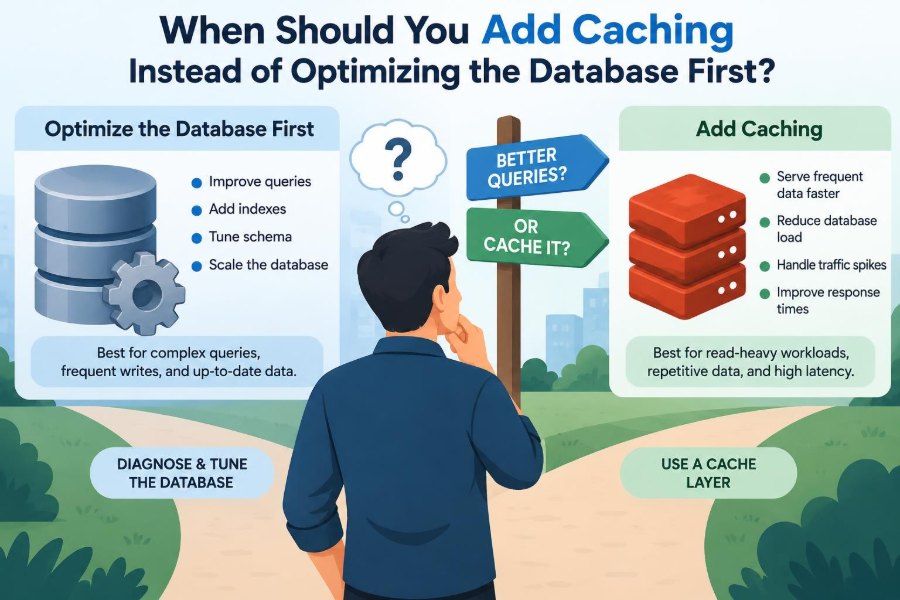

The product dashboard feels slow every Monday morning. Engineers can see database queries taking time, so the first proposal is familiar: put Redis in front of it, cache the response, and move on.
Sometimes that is exactly the right call. A popular catalog page, a configuration document read thousands of times per hour, or an expensive report with predictable refreshes can become dramatically cheaper to serve when a cache absorbs repeated reads.
But caching can also hide a missing index, preserve an inefficient query, deliver outdated data, and add a new distributed system to operate. The database was not necessarily the real problem; it was simply where the latency became visible.
The useful question is not whether caching is good. It is: what is causing the load, what correctness can the feature tolerate, and which intervention solves the underlying constraint with the least operational risk?
🧭 Start With the Decision, Not the Tool
Caching stores a previously computed result so later requests can reuse it. Database optimization makes the database retrieve, join, sort, aggregate, or write data more efficiently. These techniques address different failure modes.
If every request needs the latest account balance, a cached copy may be unacceptable. If ten thousand users request the same public product details, repeating identical database work is usually wasteful. Begin with the access pattern, not with a preferred technology.
🔍 Identify What “Slow” Actually Means
A slow endpoint can include network delay, application serialization, connection waiting, database execution, lock contention, downstream API calls, and client rendering. An average endpoint duration alone cannot identify the responsible layer.
Break the request into timings. Measure database query duration separately from time spent waiting for a connection and time spent in application code. This prevents a cache from becoming an expensive response to a problem in a completely different component.
📈 Look at Tail Latency, Not Only Averages
Average latency can look healthy while a smaller set of requests is painfully slow. Tail latency describes the slower end of the distribution, often discussed through percentile measurements such as p95 or p99.
A cache can improve tails when repeated expensive reads are the cause. It will not reliably fix tails caused by lock waits, overloaded connection pools, garbage collection pauses, or one unusually broad query shape. Inspect slow-request traces rather than assuming all requests behave alike.
🗺️ Map the Read and Write Pattern
The most promising cache candidates are usually read-heavy, repeatedly requested, and safe to reuse. The least promising are highly personalized, rapidly changing, or correctness-critical reads.
Ask concrete questions: Is the same key requested repeatedly? Are requests concentrated on a small set of records? How soon after a write must readers see the update? Does a request vary by user, role, locale, experiment, or permissions?
⚖️ Compare the Two Kinds of Work
| Situation | Usually investigate first | Why |
|---|---|---|
| Query scans far more rows than it returns | Database optimization | An index, query rewrite, or pagination may remove unnecessary work. |
| Many requests ask for the same stable result | Caching | Reuse can avoid duplicate database work. |
| Writes are slow or blocked | Database optimization | Read caches do not remove write contention. |
| Public data can be slightly stale | Caching | A bounded freshness window may be acceptable. |
| Results differ by permissions | Careful design or database work | Incorrect cache keys can expose data. |
This is a starting guide, not a rulebook. A well-designed system often uses both approaches, in a deliberate order.
🧪 Establish a Baseline Before Changing Anything
Capture a baseline under representative traffic. Record request latency, query latency, query count, database CPU, disk or memory pressure, connection-pool utilization, error rates, and relevant cache metrics if one already exists.
Also define the user-visible objective. “Make it faster” is vague; “reduce slow dashboard loads caused by this query shape” gives the team a testable target. Without a baseline, a cache hit rate can look impressive while user experience barely changes.
📝 Read the Query Plan
For a database-backed read, inspect the execution plan. A plan shows, in database-specific terms, how the engine intends to find rows, join tables, sort results, and perform aggregations.
Look for warning signs such as full scans on large tables, expensive sorts, repeated nested operations, poor row-count estimates, or joins that process much more data than the response needs. A cache may conceal these issues until an invalidation event, cold start, or new traffic pattern exposes them again.
🗂️ Fix Missing or Misaligned Indexes
An index is a data structure that helps the database locate rows without examining every row. It is often the first durable improvement for selective filters, common join keys, and ordered retrieval.
Indexes are not free. They consume storage and can make writes slower because inserts, updates, and deletes must maintain them. Add an index because it serves a measured query pattern, not because every column that appears in a query seems like a candidate.
✂️ Reduce the Work the Query Requests
Many slow queries ask for too much: every column, every historical record, an unbounded result set, or several related collections joined at once. Returning fewer rows and narrower fields can matter as much as adding an index.
Use pagination or cursor-based retrieval where appropriate. Move heavy export generation out of an interactive request. Avoid selecting large text or binary fields when a list view only needs identifiers, titles, and timestamps.
🔗 Watch for Application-Level Query Multiplication
A single page can issue one query for a list and then another query for each item in that list. This is commonly called an N+1 query pattern. Each query may be fast alone, but their combined latency and connection demand can be substantial.
Batch loading, appropriate joins, prefetching, or a purpose-built read model may fix the issue more cleanly than caching the final page. Caching an N+1 response can reduce symptoms, yet leaves a fragile and costly miss path behind.
🚦 Treat Connection Exhaustion as Its Own Problem
If requests spend time waiting to borrow a database connection, the issue may be pool sizing, long transactions, too many application instances, or slow queries holding connections too long. A cache can reduce demand, but it should not be the only diagnosis.
Increasing pool limits without considering database capacity can shift waiting from the application into an overloaded database. Find why connections remain occupied and keep transaction scopes as short as the operation allows.
🔒 Separate Read Performance From Write Correctness
Caching is usually strongest on reads. It does little for a slow write path involving validation, constraints, transaction conflicts, or multiple coordinated updates.
When a page performs a write and immediately reads the new value, decide whether it requires read-your-writes consistency. A cache that has not been invalidated can violate that expectation. The correct design may bypass the cache briefly, update it synchronously, or read from the authoritative store.
🏪 Know What a Cache Is Buying You
A cache trades computation or database access for memory, extra logic, and controlled staleness. Its value comes from reuse: a cache hit avoids work that would otherwise recur.
That trade is compelling when the avoided work is expensive and frequently repeated. It is weak when keys are requested only once, results are tiny and already cheap, or the application spends most of its time elsewhere.
🎯 Favor High-Reuse, Low-Variability Data
Good candidates include public product metadata, reference tables, feature configuration, exchange-rate snapshots where a defined delay is acceptable, rendered documentation, and aggregate counters that do not need to be exact on every view.
A hypothetical event platform might cache the public details for a popular conference. Thousands of visitors see identical title, venue, and schedule information, while edits are relatively rare. That is a far better fit than caching each attendee’s private registration state.
🧊 Use a Time-to-Live With Intent
A time-to-live, or TTL, tells a cache entry when it expires. It is a practical way to limit how long stale data can survive, but it is not proof that data will always be fresh.
Choose TTL from product requirements. A news feed may tolerate a short delay; inventory availability at checkout may tolerate none. Avoid choosing a value merely because it is conventional. The question is: what user harm occurs if this value is old for that long?
🔔 Choose an Invalidation Strategy
Invalidation removes or refreshes cached data after the underlying data changes. It is often the difficult part of caching because one write can affect several derived views, lists, counts, and user-specific results.
Common approaches
- TTL-only: simple and bounded, but changes remain stale until expiry.
- Delete on write: removes a related key after a successful update so the next read repopulates it.
- Write-through: updates the cache as part of the write flow, useful when the new value is known and safe to publish.
- Versioned keys: changes a version token so readers naturally move to new entries without deleting every old key immediately.
There is no universally correct choice. The dependencies between writes and cached views determine the complexity.
🧬 Design Cache Keys Like an Authorization Boundary
A cache key must include every input that changes the response. That can include resource ID, locale, tenant, user role, selected fields, feature flags, and pagination cursor.
Leaving out one dimension can serve the wrong representation. The most serious version is a security bug: a privileged response stored under a key later used by an unprivileged request. Treat key design and cache placement as part of access-control design, not merely performance work.
👤 Be Careful With Personalized Responses
Personalized data tends to have low reuse because each person creates a different key. Caching it may still help for a single user repeatedly refreshing a dashboard, but shared caches need strict isolation.
Often, the better approach is to cache shared fragments—such as product details or reference data—while fetching the user-specific state separately. This preserves reuse without turning every full-page response into a complicated permission-sensitive cache entry.
🌐 Pick the Right Cache Layer
Not all caches sit in the same place. Browser caches can reuse static resources for one user. Content delivery networks can serve public content near users. Application memory caches are fast but local to one process. Distributed caches let multiple application instances share entries.
Select the smallest layer that solves the actual problem. Caching immutable public assets at the edge is very different from maintaining a distributed cache of authorization-aware API responses. More shared layers increase coordination and observability requirements.
💥 Plan for Cache Misses and Cold Starts
A cache provides little help when entries are absent, expired, evicted, or never reused. The database must remain capable of serving the miss path at a reasonable level, especially after deployments or cache restarts.
Do not accept a database query that is catastrophically slow simply because production normally hits the cache. Cold caches happen. New keys happen. A functional fallback is part of a correct cache design.
🐘 Prevent Cache Stampedes
A cache stampede occurs when many requests discover the same missing or expired key and all recompute it simultaneously. Instead of protecting the database, the cache can concentrate a burst of identical work.
Common mitigations include request coalescing, where one request refreshes while others wait or receive a previous value; TTL jitter, which spreads expiration times; and stale-while-revalidate behavior, which temporarily serves an older value while a refresh happens in the background.
📉 Understand Eviction and Memory Pressure
Caches have finite memory. Under pressure, entries may be evicted according to a configured policy, such as removing less recently used entries or entries with expiration rules. A key that was available a moment ago may disappear.
Monitor memory use, eviction rate, hit rate, item size, and key cardinality. A low hit rate with many large, unique entries indicates that the cache may be adding overhead without enough reuse to justify it.
📊 Measure Hits, Misses, and Saved Work
Hit rate alone is incomplete. A high hit rate for trivial reads may save little, while a moderate hit rate on an expensive aggregate could be extremely valuable.
Connect cache metrics to outcomes: database query volume, database saturation, endpoint latency, and error behavior during load. Instrument cache operations by feature or key family so a global number does not hide one harmful cache pattern.
🧯 Avoid Caching Errors by Accident
An application can inadvertently cache an error response, an empty result caused by a transient outage, or a permission-denied page generated under unusual conditions. Readers may then receive the bad result long after the original cause has disappeared.
Define which status codes and response states are cacheable. Be particularly deliberate around authentication failures, partial responses, timeouts, and “not found” results, because some of them may be temporary in your domain.
🧱 Consider Precomputation Before Request-Time Caching
Some expensive reads are not repeated often enough for ordinary caching, but they are predictable. A nightly report, search index, dashboard aggregate, or recommendation set can sometimes be computed asynchronously and stored as a read model.
This moves expensive work away from the user request rather than hoping a previous request has already warmed a cache. It also makes freshness explicit: the read model represents data as of a known processing point.
🧰 Recognize When the Data Model Is the Constraint
If a core feature repeatedly needs difficult joins and aggregates across large operational tables, the underlying model may not serve the read workload well. Query tuning helps, but it may not be enough as the product evolves.
Options include denormalized read tables, materialized views where supported, event-driven projections, or a separate search system for search-oriented queries. These add maintenance complexity, so adopt them when the measured workload justifies a dedicated read path.
🧑💻 Make the Cache Observable and Operable
A cache needs dashboards, alerts appropriate to its role, capacity planning, backup or rebuild expectations where relevant, and runbooks for failures. Engineers should know what happens if it is slow, unavailable, flushed, or inconsistently populated.
Prefer designs that degrade safely. For noncritical data, the application may fall back to the database with rate limits or load shedding. For critical data, it may be safer to fail clearly than to present a stale value as authoritative.
🧭 Use a Practical Order of Operations
A disciplined sequence avoids premature caching while leaving room for it when it is justified:
- Measure the slow path and establish the user-facing objective.
- Inspect queries, plans, row counts, indexes, payload size, and query count.
- Fix clear database and application inefficiencies.
- Classify remaining reads by reuse, freshness needs, and authorization scope.
- Add caching to the eligible paths with explicit keys, TTLs, invalidation, and miss behavior.
- Test cold-cache, eviction, write-after-read, and outage scenarios.
- Measure whether the change improved the intended outcome.
This order is not ideology. It keeps a simple cache from masking an inexpensive fix while recognizing that optimized databases still benefit from avoiding repeated work.
🚫 Notice the Common “Cache First” Mistakes
- Caching a slow query without checking whether an index or predicate change would make misses cheap.
- Using one generic TTL for data with very different freshness requirements.
- Creating keys that omit tenant, role, locale, or query parameters.
- Assuming cached data is always present and failing badly during a cold start.
- Ignoring write paths, then discovering that users see outdated values after edits.
- Judging success by hit rate instead of reduced latency or database pressure.
Each mistake comes from treating caching as a transparent switch. It is an application behavior with correctness and operational consequences.
✅ Know When Adding a Cache Is the Right First Move
Caching can reasonably come first when investigation already shows that the database query is sound, the same result is requested frequently, and the feature has a clear tolerance for bounded staleness.
It can also be the fastest risk-reduction measure during a predictable read surge, provided the team documents it as such and still understands the miss path. For example, caching a stable public configuration document is usually simpler and safer than redesigning a database query that is already efficient.
🏁 The Core Principle: Optimize Truth, Cache Reuse
The database is generally the source of truth. Make its essential reads and writes correct, bounded, and reasonably efficient. A cache then becomes a targeted reuse layer for work that does not need to be repeated on every request.
That framing avoids a false choice. Database optimization protects correctness and resilience on misses; caching protects capacity and latency when access patterns make reuse possible. Good engineering comes from making both layers explicit.
Add caching when repeated reads, acceptable freshness, and safe keying make reused results valuable; optimize the database first when unnecessary data work, weak query plans, or write-path constraints are the real bottleneck. The best solution is the one that improves the measured problem without creating a larger correctness problem later. ⚙️🗃️📈