
A product team has a promising idea: an online booking tool, a learning platform, or a marketplace. The first version needs to reach users quickly, but the team also expects growth, new features, and unpredictable traffic.
Then an architectural question appears earlier than anyone expected. Should everything live in one application? Should the team split work into independent services? Or should they write functions that run only when an event occurs?
The wrong framing is to ask which architecture is “best.” Each model moves complexity to a different place: inside a codebase, across a network, or into managed cloud services and operational constraints.
Choosing well means matching the architecture to the application’s domain, team, delivery pace, reliability needs, and likely path of change.
🧭 Start With the Problem, Not the Pattern
Architecture is a means of managing change, not a badge of technical sophistication. Before selecting a pattern, identify what the software must do, who owns it, how often it will change, and what failure would mean.
A small internal reporting tool and a global payment platform can both expose HTTP APIs, yet they have radically different availability, security, audit, and scaling requirements.
🏗️ What “Architecture” Means in Practice
Software architecture describes the major building blocks of a system and how they communicate. It includes deployment units, data ownership, runtime dependencies, security boundaries, and operational responsibilities.
It does not replace good design inside the code. Clear modules, tests, validation, and sensible domain models matter whether an application is one deployable unit or hundreds.
🧱 Understanding the Monolith
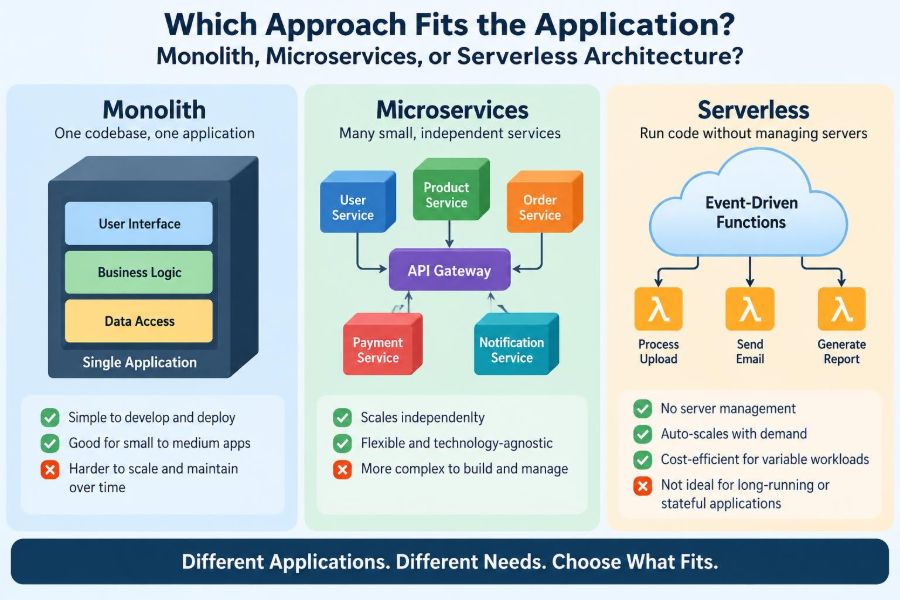
A monolith is an application deployed as a single unit. Its user interface, business rules, background jobs, and data access may all run in one process or one coordinated application package.
“Single unit” does not mean “messy.” A monolith can contain well-separated modules for accounts, orders, inventory, and reporting while sharing one deployment pipeline and often one database.
🔩 The Modular Monolith Distinction
A modular monolith deliberately creates boundaries inside one application. Modules expose limited interfaces, avoid reaching into each other’s internal data, and keep domain rules close to their own concepts.
This approach preserves straightforward deployment while making future extraction possible if a boundary becomes genuinely independent. It is often more disciplined than a rapidly assembled monolith and less costly than premature microservices.
🚀 Why Monoliths Help Early Products
Early teams benefit from short feedback loops. One repository, one local development environment, and one deployment make it easier to trace a user request from screen to database.
When product requirements are still moving, developers can change related behavior in one coordinated pull request. They do not need to negotiate API versions or deploy multiple services in a precise order.
📦 A Monolith’s Operational Simplicity
A monolith generally has fewer moving parts: fewer repositories, network calls, deployment artifacts, dashboards, permissions, and failure modes. A request can often be debugged with one set of logs and one stack trace.
This does not make operations effortless. Database performance, release safety, backups, and monitoring still require attention. But the system has fewer distributed-system problems by default.
⚠️ Where a Monolith Starts to Strain
A monolith becomes difficult when unrelated changes repeatedly collide, when one component’s workload forces the entire application to scale, or when the codebase has no meaningful internal boundaries.
Large teams can also create deployment coordination costs. If every team must test and release together, a low-risk change may wait behind unrelated work.
🧹 Monolith Problems Are Often Design Problems
Slow builds, tangled dependencies, and fragile releases do not automatically prove that microservices are needed. They may reveal weak module ownership, insufficient automated tests, or a database model that lets every feature modify every table.
Splitting such a system without fixing those habits can produce a distributed version of the same confusion.
🕸️ Understanding Microservices
Microservices organize an application as multiple independently deployable services. Each service focuses on a business capability, such as billing, catalog management, or identity, and communicates through APIs or asynchronous messages.
The goal is not to make services tiny. The useful boundary is one that allows a team to understand, test, deploy, and evolve a capability with limited coordination.
🎯 Service Boundaries Follow Business Capabilities
A good service boundary usually reflects a stable domain concept and clear ownership. For a commerce system, pricing and fulfillment may evolve differently and have different rules, making separation plausible.
Splitting by technical layers—one service for “database work” and another for “business logic”—often creates excessive chatty communication. A single user action may then require many remote calls.
🔄 The Network Changes Everything
A method call inside a monolith is fast and usually either succeeds or throws an immediate error. A network call can be slow, time out, duplicate, arrive late, or succeed after the caller has given up.
Microservices therefore require timeouts, retries, idempotency, circuit-breaking behavior, and careful error handling. Idempotency means repeating an operation produces the same intended result rather than, for example, charging a customer twice.
🗃️ Data Ownership Is the Hard Boundary
Services gain autonomy when each owns its data and exposes changes through contracts rather than direct database access. If every service reads and writes the same tables, schema changes remain tightly coupled.
Separate data introduces trade-offs. Cross-service reports and transactions become harder, and some views may be temporarily inconsistent while updates propagate.
⏳ Eventual Consistency Requires Product Thinking
Eventual consistency means related parts of a system may not show the same result at the exact same moment, but should converge after processing completes. For instance, an order screen may confirm a purchase before an analytics dashboard reflects it.
This is acceptable only when the user experience explains the state honestly. A system should not promise “payment complete” when payment is merely queued for later processing.
👥 When Microservices Fit the Team
Microservices are most persuasive when multiple teams need to release independently and own distinct capabilities for a sustained period. Clear team ownership supports clear technical ownership.
A small team can run microservices, but it also becomes responsible for deployment automation, observability, platform configuration, on-call practices, and secure service-to-service communication.
📈 Independent Scaling Is a Real but Specific Benefit
Microservices let a workload scale separately. A video-transcoding service, search indexer, or notification sender may need many more workers than account settings.
Yet independent scaling only matters when workloads actually differ. If every service scales because a shared database or gateway is overloaded, splitting compute units has not removed the true bottleneck.
🔍 Observability Becomes Essential
In distributed systems, a failed request may pass through a gateway, several services, a queue, and a database. Logs from one machine rarely tell the full story.
Teams need correlated logs, metrics, traces, meaningful alerts, and dashboards that show both technical health and business outcomes. This capability is not a luxury; it is part of operating microservices safely.
☁️ Understanding Serverless Architecture
Serverless does not mean servers disappear. It means a cloud provider manages much of the server provisioning, runtime capacity, and infrastructure operation.
Serverless systems commonly use event-driven functions, managed databases, queues, storage, and API gateways. Code runs in response to an HTTP request, file upload, scheduled trigger, or message.
⚡ Where Serverless Shines
Serverless is well suited to irregular or event-based work: processing uploaded files, sending notifications, generating reports, integrating third-party systems, or handling scheduled maintenance tasks.
It can reduce operational setup because teams deploy a function and configuration rather than maintaining an always-running server. For modest, variable workloads, this can support fast experimentation.
🧊 Cold Starts and Execution Limits
A function that has not recently run may need time to initialize before processing a request. This is commonly called a cold start, and its impact depends on language, runtime, package size, provider behavior, and workload.
Functions also have execution-time, memory, networking, and concurrency constraints. Long-running data jobs or low-latency interactive workflows may need another compute model.
💸 Cost Depends on Workload Shape
Serverless pricing often follows invocations, execution duration, resource allocation, and connected managed services. It can be economical for infrequent work, but costs may become harder to predict under sustained high traffic or inefficient function design.
Evaluate the whole system: API gateways, databases, logging, data transfer, queues, and vendor-specific services can matter as much as the function itself.
🔒 Managed Services Shift Responsibility
Serverless reduces responsibility for host patching and capacity provisioning, but it does not remove responsibility for access control, secrets, input validation, data retention, and secure configuration.
Permissions deserve special care. A function should receive only the access it needs, following the principle of least privilege. Broad permissions can turn one vulnerable component into a much larger security incident.
🪢 Vendor Coupling Needs Deliberate Choices
Serverless applications often rely on provider-specific triggers, identity systems, event formats, and managed data services. Those integrations can be highly productive, but moving later may require redesign rather than a simple deployment change.
Vendor coupling is not automatically harmful. It is a trade-off: accept it deliberately when the managed capability saves meaningful effort, and isolate business rules from provider adapters where practical.
🧩 Serverless Is Not the Opposite of Microservices
These labels describe different dimensions. Microservices describe decomposition into independently owned capabilities; serverless describes a way to run and integrate software.
A microservice can run on containers, virtual machines, or serverless functions. A monolith can also use serverless functions for isolated tasks such as image processing or scheduled imports.
📊 A Practical Comparison
| Concern | Monolith | Microservices | Serverless |
|---|---|---|---|
| Deployment unit | One application | Multiple services | Functions and managed resources |
| Early delivery | Usually straightforward | Requires platform discipline | Fast for focused event-driven work |
| Operational burden | Lower distributed complexity | High coordination and observability needs | Less server management, more configuration |
| Scaling model | Often application-wide | Per service | Often per invocation or event consumer |
| Primary risk | Tight internal coupling | Distributed-system complexity | Limits, cost surprises, provider coupling |
🧪 Example: A New Appointment Platform
Consider a hypothetical appointment platform for local clinics. Its first release manages staff calendars, bookings, reminders, and basic billing. A modular monolith is often a sensible start because booking rules and customer flows will likely change together.
A queue-backed serverless function could send reminder messages after an appointment is created. Later, if billing becomes a complex, regulated capability owned by a dedicated team, it may justify a carefully designed service boundary.
🛑 Avoid Premature Decomposition
Teams sometimes create microservices because they expect future scale. But scale is not only traffic volume; it is also organizational and domain complexity. Many applications can serve substantial demand with a well-built monolith and appropriate database design.
Extracting services before boundaries are understood creates repeated integration work while the product is still discovering its basic concepts.
🧭 Use Change Patterns as Evidence
Watch what changes together. If account rules, invoices, and subscription status are modified in the same releases, they may belong together for now. If a capability has its own roadmap, workflows, data, and team, separation becomes more credible.
Architecture should respond to observed pressure, not only imagined future diagrams.
📝 Questions to Ask Before Committing
- Can one team understand and operate the proposed design?
- Which capabilities need independent releases or scaling, and why?
- What data must be strongly consistent, and what can be asynchronous?
- How will failures be detected, investigated, and recovered?
- What cloud limits, costs, and compliance obligations apply?
- Can the team test the most important user journeys end to end?
🛠️ Build the Foundations First
Regardless of style, invest early in automated tests, repeatable deployments, backups, monitoring, structured logs, and clear ownership. These practices create more reliability than an architectural label.
Also document major decisions briefly: the context, alternatives, chosen approach, and consequences. A lightweight decision record helps future developers understand why a boundary exists.
🔀 Plan Evolution Instead of a One-Time Choice
Architecture is reversible only to a degree, so favor options that preserve learning. A modular monolith can become a source of well-understood boundaries. A separate worker can become a service when its workload and ownership justify it.
Migration should be incremental. Move one capability, measure behavior, protect contracts with tests, and keep a rollback plan rather than attempting a high-risk rewrite.
✅ The Core Principle: Optimize for the Current Constraints
Choose a monolith when speed, cohesion, and operational simplicity matter most. Choose microservices when stable business boundaries and independent team ownership outweigh distributed complexity. Choose serverless when event-driven work and managed operations fit the workload and constraints.
The strongest systems often combine these ideas thoughtfully rather than treating them as rival camps. A clear modular core, a few independently operated services, and managed event handlers can coexist.
There is no architecture that eliminates complexity; it only decides where that complexity will live. The best fit is the design your team can understand, operate, and evolve while delivering the application’s real value. ⚙️☁️🧱