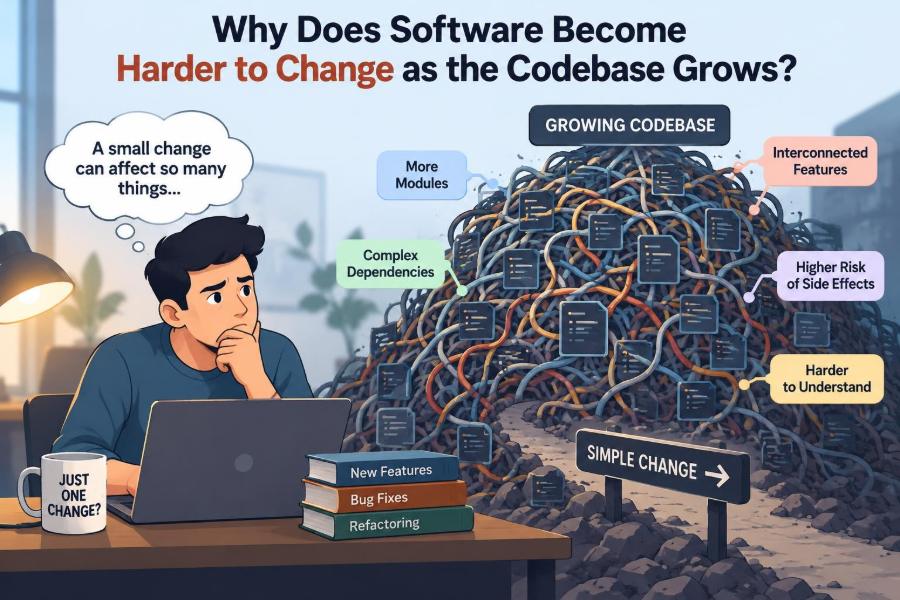

A small feature request can sound harmless: add one field, change a pricing rule, send a new notification. In a young application, the work may take an afternoon. In an older one, the same request can trigger meetings, cautious estimates, failing tests, and a long list of systems that might be affected.
This is not necessarily a sign that the engineers have become slower. It is often a sign that the software now carries more responsibilities, more users, more data, and more assumptions than it did when it was small.
As a codebase grows, changing it becomes less like rearranging a desk and more like renovating an occupied building. The walls may support other rooms. The pipes may serve people you cannot see. A change can be correct in one place and still cause trouble somewhere else.
Understanding why this happens helps teams avoid a destructive conclusion: that old code is simply bad code. Some complexity is the cost of solving real business problems. The goal is not to eliminate complexity, but to make it visible, contained, and safe to work with.
🧩 A Codebase Is More Than Its Files
People often measure software size by lines of code, repository size, or the number of services. Those measures matter, but the harder problem is the network of relationships among code, data, infrastructure, users, and operational processes.
A checkout function, for example, may connect to tax calculation, inventory, fraud checks, customer emails, accounting exports, and support workflows. Editing ten lines in that function can affect far more than ten lines.
📈 Growth Creates More Possible Interactions
Each new feature adds behavior, but it may also create new combinations with existing behavior. A discount can interact with subscriptions, refunds, currencies, regional tax rules, and promotional limits.
That is why complexity does not rise in a simple one-feature-at-a-time pattern. The difficult work is often discovering which combinations are meaningful and deciding which ones the system must support.
🕸️ Dependencies Turn Local Changes Into System Changes
A dependency exists whenever one part of a system relies on another part’s behavior, data shape, timing, or availability. Dependencies are not inherently harmful; useful software needs collaboration between parts.
Difficulty grows when dependencies are hidden or overly broad. If a reporting module reaches directly into a billing database, a billing schema change is no longer only a billing concern.
🔗 Coupling Determines the Blast Radius
Coupling describes how tightly components depend on one another. High coupling means a component knows too much about another component’s internal details.
Imagine a user interface that directly constructs database queries, calculates permissions, and formats invoices. A change to any one concern can force changes across the others. Lower coupling gives each responsibility a clearer boundary, reducing the likely blast radius.
🧱 Interfaces Can Protect—or Leak—Details
An interface is a promise about how one component can be used. A good interface exposes the capability a caller needs without exposing internal storage choices or implementation steps.
For example, reserveItem(productId, quantity) is usually safer than giving every caller direct access to inventory tables. The first allows the inventory system to change its internals; the second spreads its details throughout the codebase.
🧠 The Real Scarcity Is Shared Understanding
Computers can search millions of files quickly. Engineers cannot instantly reconstruct why a decision was made, which exception is deliberate, or whether a strange branch protects an important customer case.
This is often called cognitive load: the amount a person must hold in mind to reason correctly. Growth raises cognitive load when a task requires understanding too many concepts before a safe decision is possible.
🗺️ Architecture Is a Map for Reasoning
Architecture is not merely a diagram of boxes and arrows. It is the set of structural decisions that tells people where behavior belongs, how parts communicate, and which dependencies are allowed.
Without that map, engineers navigate by searching for familiar names and copying nearby patterns. That can work temporarily, but it gradually produces inconsistent designs and makes every future change more investigative.
🏷️ Names and Boundaries Preserve Meaning
Code communicates through names. A method called process hides purpose; one called approveRefund gives a reader a starting point for understanding its rules and consequences.
Boundaries do the same at a larger scale. Grouping code around meaningful domains—orders, identity, scheduling, payments—helps engineers ask the right question: “Who owns this rule?” rather than “Which file happens to contain it?”
📚 Business Rules Accumulate Exceptions
Many systems become difficult because the business they represent becomes more detailed. “Calculate the price” can eventually include contracts, regions, loyalty tiers, cancellation dates, legacy plans, credits, and negotiated exceptions.
These rules are not automatically technical debt. They may represent commitments the organization has made. The engineering challenge is to model them clearly instead of burying them in scattered conditionals.
🕰️ Historical Decisions Stay in the System
Code is a record of past constraints: a rushed launch, a vendor integration, an old database limitation, or a customer migration. The original choice may have been sensible at the time.
Years later, the context may be gone while the code remains. Treating prior work as foolish is rarely useful. A better question is: which assumptions no longer hold, and what would it cost to replace them safely?
🧳 Backward Compatibility Limits Freedom
Mature systems often have users, clients, scripts, or partner integrations that rely on existing behavior. Removing a field, changing an API response, or altering a report can break work outside the engineering team.
Backward compatibility means preserving what existing consumers reasonably expect while introducing change. It can slow a design, but it protects users from unexpected disruption and gives teams a path for gradual migration.
🗃️ Data Is Usually Harder to Change Than Code
Code can be deployed again if a defect is found. Production data may be long-lived, incomplete, duplicated, legally sensitive, or already used in downstream systems.
Changing a database schema therefore needs more than an edit to a table definition. Teams may need a migration, validation, a transition period where old and new formats coexist, and a rollback plan that respects data already written.
🚦 State Makes Behavior Context-Dependent
A stateless calculation gives the same output for the same input. Many business systems are not like that: an order can be pending, paid, shipped, cancelled, disputed, or partially refunded.
As states and transitions grow, a change must consider where it is valid. Allowing a refund action is easy in isolation; deciding whether it applies after shipment, after a chargeback, or across split payments is where complexity appears.
⏱️ Time and Concurrency Add Hidden Cases
Two requests can arrive at nearly the same time. A message can be delivered late. A job can run twice after a retry. Clocks can disagree across machines.
These are ordinary operating conditions in distributed software, not exotic edge cases. A stock reservation feature, for instance, must consider two customers attempting to buy the last item rather than assuming requests arrive one at a time.
📨 Asynchronous Work Is Useful but Less Visible
Queues, scheduled jobs, and event-driven processing help systems scale and keep user-facing actions fast. They also separate cause from effect: a button click now may produce a result seconds or minutes later.
That separation requires explicit handling for failures, retries, duplicate messages, ordering, and observability. Otherwise, a system appears to work while silently leaving some work unfinished.
🌐 External Services Introduce Uncontrolled Change
Payment providers, identity platforms, cloud services, and third-party APIs save teams from building everything themselves. But their availability, limits, response formats, and policies are not fully under the team’s control.
Good integration design isolates vendor-specific details and plans for timeouts and degraded behavior. Spreading a provider’s API types through the application makes a future replacement or upgrade much more expensive.
🧪 Tests Reduce Fear, Not the Need to Think
Tests provide evidence that known behavior still works. Unit tests check small pieces; integration tests check collaboration; end-to-end tests exercise realistic user flows. Together, they make change less dependent on hope.
But a passing suite is not proof that every important scenario is covered. Tests can encode the wrong behavior, miss production configuration, or become so slow and fragile that people stop trusting them.
🔍 Observability Reveals What Code Alone Cannot
Observability is the ability to understand a running system through signals such as logs, metrics, traces, and meaningful alerts. It answers questions source code cannot: what happened for this request, where did it slow down, and which version produced the error?
When a system grows, debugging without these signals becomes guesswork. Useful observability connects technical events to business actions without exposing private customer data unnecessarily.
🧯 Production Risk Changes the Economics of Editing
A defect in an internal prototype may inconvenience a few people. A defect in a mature service can affect customers, revenue, operations, security, or data integrity. The same code change therefore deserves different levels of review and rollout care.
This is not bureaucracy for its own sake. Review, automated checks, feature flags, and staged releases are ways to learn about a change while limiting how many people are exposed to a mistake.
🚩 Feature Flags Trade Deployment Risk for Cleanup Work
A feature flag lets a team deploy code while keeping new behavior disabled or limited to a selected audience. It can support gradual rollout and rapid disabling when problems appear.
However, flags create alternate execution paths. A neglected flag becomes another permanent condition future engineers must understand. Every flag should have an owner, a purpose, and a planned removal point.
🧰 Tooling Helps Navigation at Scale
Fast search, reliable builds, static analysis, dependency graphs, code ownership information, and effective test commands all shorten the time between a question and a trustworthy answer.
Tooling does not repair unclear design, but poor tooling amplifies every design problem. If developers wait a long time for feedback or cannot reproduce a production-like scenario locally, safe change becomes slower and more costly.
👥 More Contributors Require Coordination
More engineers can increase delivery capacity, but they also increase the number of decisions that must align. Two teams may independently modify the same contract, interpret a requirement differently, or optimize different local goals.
Clear ownership and lightweight decision records help. The aim is not to centralize every choice, but to make cross-boundary changes visible before incompatible work reaches production.
🧾 Documentation Captures Decisions, Not Every Detail
Documentation is most valuable when it explains information that is expensive to rediscover: system boundaries, data flows, operational procedures, non-obvious constraints, and the reasoning behind major decisions.
It does not need to narrate every line of code. Documentation that duplicates obvious implementation tends to drift. Documentation that records a surprising constraint—such as why a message must be idempotent—can prevent costly mistakes.
🏚️ Technical Debt Is a Trade-Off With Interest
Technical debt is often described as the future cost created by a shortcut taken today. The metaphor is useful when it includes context: a shortcut can be a rational response to uncertainty, urgency, or limited resources.
The problem begins when the debt is neither tracked nor repaid while the surrounding system expands. A temporary workaround becomes a foundation, and later changes must accommodate it repeatedly.
🧹 Refactoring Changes Structure While Preserving Behavior
Refactoring improves internal design without intentionally changing external behavior. Examples include extracting a cohesive module, replacing duplicated logic with a well-named rule, or narrowing an overly broad interface.
Small, continuous refactoring is often safer than waiting for a dramatic rewrite. It keeps the design close to current needs and gives teams opportunities to improve understanding while delivering product work.
🏗️ Rewrites Are Not a Universal Escape Hatch
A rewrite can be justified when fundamental constraints make incremental improvement impractical. It may simplify an obsolete platform or enable capabilities the existing architecture cannot reasonably support.
Yet rewrites also risk losing undocumented behavior, delaying user value, and recreating old problems in new technology. Before choosing one, identify which specific constraints cannot be addressed incrementally and how critical behavior will be verified.
🎯 Prefer Incremental, Reversible Change
Safer changes are usually small enough to review, test, observe, and reverse. For a database transition, that might mean first adding a new column, then writing both formats, then migrating readers, and only later removing the old path.
This approach can feel slower than one large change, but it reduces uncertainty at each step. It also makes failures easier to diagnose because fewer variables changed at once.
🧭 Design for Change, Not for Imagined Futures
Overengineering is not the cure for rigidity. Building elaborate abstractions for every possible future can make a small system harder to understand before those futures arrive.
A better standard is to design around likely areas of variation and real boundaries. Keep today’s simple behavior simple, but avoid embedding a volatile policy in ten unrelated places where changing it later will require a scavenger hunt.
✅ A Practical Checklist Before Editing
Before implementing a meaningful change, pause long enough to map the actual problem. The following questions turn vague caution into repeatable practice:
- What user or business behavior is changing, and what must remain unchanged?
- Which components own the relevant rules and data?
- Who consumes the affected API, event, database field, or report?
- What failure modes, retries, permissions, and state transitions apply?
- Which tests provide useful evidence, and what production signals will confirm the rollout?
- Can the change be introduced gradually and reversed if necessary?
The answers need not become a large document. Their value is in exposing assumptions before those assumptions become incidents.
🌱 Complexity Can Be Managed, Not Wished Away
A growing codebase becomes harder to change because it represents more reality: more rules, more history, more users, more dependencies, and more consequences. Some of that complexity is essential and should be treated with respect.
The avoidable part comes from unclear ownership, leaky boundaries, hidden assumptions, weak feedback loops, and deferred cleanup. Teams make change safer by improving their models, interfaces, tests, operational visibility, and habits of incremental delivery.
Software does not stay easy merely because its code is neatly formatted. It stays changeable when teams continuously make dependencies, decisions, and risks easier to see and manage. ⚙️🧭🌱