
You open a shopping site during a flash sale, refresh a transit app before your train arrives, or send a message that appears on another person’s screen almost immediately. From the outside, each interaction feels like one simple action: tap, wait briefly, get a result.
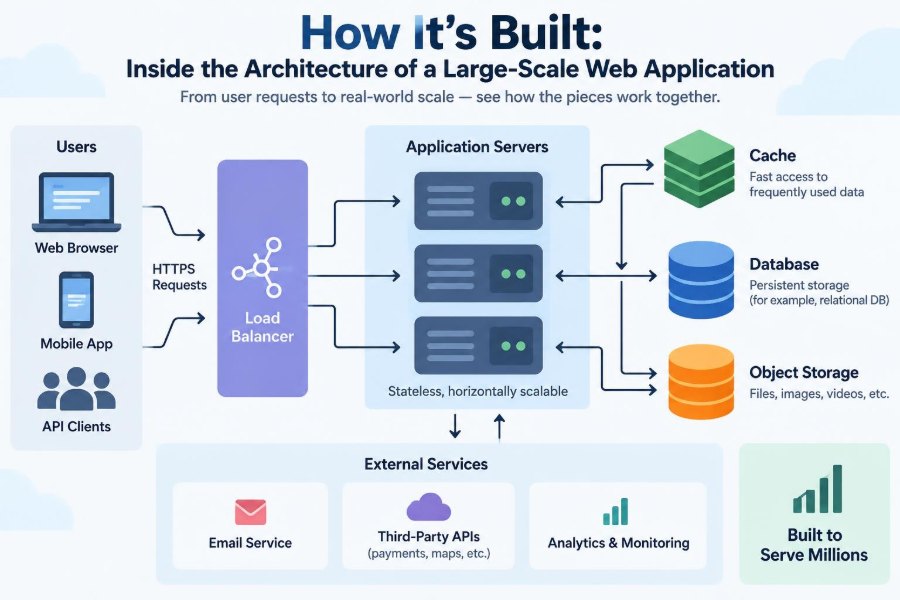
Behind that result, a large web application may coordinate browsers, mobile clients, APIs, databases, caches, background workers, search systems, and monitoring tools. It must do this while people sign in, networks fail, traffic changes suddenly, and teams release new code.
Architecture is the set of decisions that lets those moving parts work together. It is not a diagram chosen once at the beginning of a project; it is a practical response to real constraints: speed, correctness, cost, security, and the ability to change safely.
Understanding the layers beneath a familiar web page helps engineers make better technical decisions—and helps everyone else see why seemingly small product requests can have surprisingly broad consequences.
🏗️ Architecture Is a Set of Trade-offs
A large-scale application is not defined by a particular programming language or by the number of servers it uses. It is defined by the pressure it faces: many requests, valuable data, multiple teams, and features that must keep evolving.
Every design choice trades one benefit for another. A cache can make reads fast but may briefly show older data. Splitting a system into services can give teams independence but adds network failures and operational work. Good architecture makes trade-offs visible and manageable rather than pretending they do not exist.
🧭 Start With User Journeys
Architecture becomes clearer when it begins with what users actually do. Consider a hypothetical marketplace: a visitor browses products, searches for an item, adds it to a cart, pays, and tracks an order. Each journey has different correctness and speed requirements.
A product page can often tolerate a slightly stale stock indicator for a short time. A payment confirmation cannot safely be duplicated or silently lost. Defining those differences early prevents the mistake of applying one reliability rule to every part of the application.
🌐 The Client Is Part of the System
The browser or mobile app is more than a display surface. It renders screens, stores temporary state, validates basic input, makes network requests, and decides how to recover from slow or failed responses.
Modern web clients commonly load a small initial document, then fetch data from backend APIs. They may cache images and static files locally, retry selected requests, and update only part of a page after an action. But client-side checks are about usability; the server must still enforce permissions and business rules.
🚪 DNS, CDN, and the First Request
Before an application server sees a request, the user’s device needs to find the site. DNS translates a domain name into a network destination. A content delivery network, or CDN, can then serve cached static assets from locations closer to the visitor.
CDNs are especially useful for files that change infrequently, such as JavaScript bundles, style sheets, fonts, and images. This reduces work at the origin system and lowers delay for distant users. Dynamic or personalized data usually still travels to the application backend.
🔒 Transport Security Protects the Conversation
HTTPS encrypts traffic between the client and the service, helping prevent intermediaries from reading or altering it. It also lets the client verify that it is speaking to the intended domain through certificates.
Encryption does not solve every security problem. A legitimate user can still have excessive permissions, and an application can still mishandle sensitive data after receiving it. Still, secure transport is a foundational boundary, not an optional finishing step.
🚦 Load Balancers Distribute the Work
One machine eventually becomes a bottleneck or a single point of failure. A load balancer accepts incoming traffic and routes requests among multiple healthy application instances.
Health checks matter here. If an instance cannot respond correctly, the load balancer should stop sending it new work. Routing can consider simple availability, geographic location, or specialized needs, but it should avoid turning one overloaded dependency into a hidden bottleneck.
🧱 The Edge Layer Filters Early
Many systems place an edge layer before application code. It may terminate encrypted connections, enforce request-size limits, rate-limit abusive patterns, and block known malicious traffic.
This is valuable because rejecting bad traffic early is cheaper than letting every request consume application and database resources. Edge controls need careful tuning, though: a strict limit can also block legitimate users behind a shared network or a busy integration.
🧩 APIs Create a Useful Boundary
An API is a contract for communication. A client might request /products/42, and the server returns a structured representation of that product. The contract covers more than fields: it includes authentication, error behavior, pagination, and compatibility expectations.
Stable APIs allow web, mobile, and partner clients to evolve at different speeds. Versioning is sometimes necessary, but additive changes—such as adding an optional field—are often less disruptive than repeatedly creating entirely new versions.
🪪 Authentication Establishes Identity
Authentication answers, “Who is making this request?” A user might sign in with a password, a passkey, an enterprise identity provider, or another approved method. Afterward, the application commonly uses a session identifier or a signed token to recognize later requests.
Credentials and session material deserve special protection. They should not be casually logged, exposed in URLs, or treated as harmless strings. Expiration, secure storage, revocation strategies, and recovery flows are all part of the design.
🛂 Authorization Decides What Is Allowed
Authentication alone is insufficient. Authorization answers, “May this identity perform this action on this resource?” A signed-in customer may view their own order but not another customer’s order; a support agent may have limited access for a defined task.
Authorization should be checked on the server for every sensitive operation. Hiding a button in the user interface is useful guidance, not a security control. The API must reject a request that lacks permission even if someone constructs it manually.
🧠 Application Services Hold Business Rules
The application layer turns requests into meaningful operations. It may calculate taxes, apply discount rules, reserve inventory, verify account status, and choose which downstream systems to call.
Keeping business rules explicit makes them testable. If a rule is buried across a browser component, a database trigger, and a one-off script, future changes become risky. A service does not need to be a separate deployed microservice; it can be a well-defined module inside a larger application.
🧾 Stateless Requests Enable Scaling
A server is stateless when it can handle a request without relying on memory left behind by a previous request. User-specific state is instead kept in a shared session store, token, database, or client-side mechanism.
Statelessness makes it easier to add or replace application instances because any healthy instance can serve the next request. Some state still exists somewhere; the architectural question is whether it lives in a durable, shared place that can be managed deliberately.
🗃️ Databases Preserve the Source of Truth
For orders, accounts, payments, and similar records, a database provides durable storage and controlled updates. Relational databases organize data into tables and often offer transactions: groups of changes that either succeed together or fail together.
That property is useful for a checkout flow. If an order is created but the inventory update fails, leaving the system half-finished can cause expensive confusion. The exact transaction boundary depends on which data lives in the same database and what failure behavior the product can accept.
🔍 Indexes Make Queries Practical
A database index is similar to an index in a book: it helps find relevant rows without reading every row. Indexes can dramatically improve common lookups, such as finding orders for a customer or locating a product by identifier.
They are not free. Each additional index consumes storage and can slow writes because it must be updated. Engineers should examine real query patterns and query plans rather than adding indexes as a reflex.
⚖️ Consistency Depends on the Operation
When several copies of data exist, they may not update at exactly the same moment. A system may accept eventual consistency for a product recommendation, while requiring stronger coordination for an account balance.
This is not simply a database preference. It is a product decision expressed technically. The interface should handle the chosen behavior honestly: for example, showing that an update is processing rather than claiming that a distributed change is complete before it is.
⚡ Caches Reduce Repeated Work
A cache stores a reusable result closer to where it is needed. It can hold a product page, a database query result, a computed permission lookup, or a rendered response. Caches reduce latency and protect expensive dependencies from repeated reads.
The difficult part is invalidation: deciding when cached data is no longer trustworthy. Common approaches include a short expiration time, explicit removal after a change, and versioned keys. A cache should improve performance without becoming the only place important data exists.
📨 Queues Separate Urgent Work From Slow Work
Not every task belongs in the request-response path. Sending email, generating a report, resizing an uploaded image, or notifying an external service can often happen after the user receives a response.
A message queue records work for a background worker. This smooths sudden spikes and allows retries, but it also introduces delay and new failure modes. A task may run more than once, so workers should be designed to be idempotent: repeating the task should not create an incorrect second effect.
🔄 Events Connect Parts Without Tight Coupling
An event describes something that happened, such as “order placed” or “profile updated.” Other components can react by updating analytics, sending a notification, or preparing a shipment workflow.
Events reduce direct dependencies, but they should not become vague messages with unclear ownership. Define the event’s meaning, schema, producer, consumers, and retention expectations. Consumers must also tolerate delayed, duplicated, or out-of-order delivery when the platform cannot guarantee otherwise.
🔎 Search Is Usually Its Own Concern
Database queries are excellent for structured records and transactions. Full-text search, typo tolerance, ranking, and faceted filtering often require a dedicated search index designed for those jobs.
In a marketplace, the product database remains authoritative while a search index is a derived view optimized for discovery. New or edited products may take time to appear in search, so product and support teams should understand that search freshness can differ from record freshness.
📁 Object Storage Handles Large Files
Images, videos, documents, backups, and exports are usually poor fits for ordinary database rows. Object storage is designed to hold large files durably, while the database stores metadata such as ownership, file type, and location.
A common pattern lets the client upload directly using a short-lived, narrowly scoped permission issued by the application. The server still validates the completed upload and controls who may retrieve it. File names and claimed content types should not be trusted by themselves.
🧯 Failure Is a Normal Operating Condition
Networks time out, third-party APIs slow down, deployments introduce bugs, and individual machines disappear. Reliable systems assume these events will occur and choose how to limit their reach.
Useful techniques include timeouts, bounded retries, circuit breakers that pause calls to an unhealthy dependency, and bulkheads that isolate resource pools. Retrying every failure immediately can amplify an outage, so retry policies need limits, delays, and awareness of whether an operation is safe to repeat.
🩺 Observability Explains What Happened
When users report that “the site is slow,” engineers need evidence. Observability combines metrics, logs, and traces. Metrics show aggregate signals such as request rate and error rate; logs record discrete events; traces follow one request across services.
Good telemetry includes meaningful context without leaking secrets or personal information. Correlation IDs are especially useful: one identifier can connect a browser request, API log entries, queue message, and worker action during an investigation.
📈 Capacity Planning Watches the Bottlenecks
Scaling is not just adding servers. A system can have many application instances and still fail because its database connections are exhausted, its queue consumers cannot keep up, or one external provider is rate-limiting calls.
Teams should identify critical resource limits, observe trends, and test realistic load before major events when possible. Autoscaling can help with variable traffic, but it needs sensible limits and enough underlying capacity. It cannot repair a slow query or an unbounded memory leak.
🚀 Deployment Should Be Boring
A deployment changes a live system, so it should be repeatable and reversible. Automated pipelines can run tests, build artifacts, apply checks, and promote a known version through environments.
Progressive techniques such as canary releases send a small share of traffic to a new version first. Feature flags can separate code deployment from feature exposure. Both reduce blast radius, but both require cleanup; old flags and abandoned code paths eventually become maintenance debt.
🧪 Testing Works at Several Levels
Unit tests check small pieces of logic quickly. Integration tests check whether real components cooperate correctly, such as an application service and a test database. End-to-end tests exercise important user flows through a more complete stack.
No single test type is enough. A healthy strategy puts most routine coverage where feedback is fast, then adds targeted integration and end-to-end tests for high-risk boundaries. Production monitoring remains necessary because no test environment perfectly reproduces real traffic and dependencies.
🗺️ Data Migrations Need Their Own Plan
Changing a schema in a running application is more than editing a table. Older and newer application versions may run at the same time during a rollout, and a large backfill can strain the database.
A safer approach often expands first: add a new nullable field or table, deploy code that can handle both forms, migrate data gradually, switch reads, and only later remove the old structure. This takes longer than a one-step change, but it makes rollback and recovery more realistic.
👥 Team Boundaries Shape System Boundaries
Software architecture reflects how people communicate. If a tiny team splits every feature into independent services, coordination and operational overhead can overwhelm the benefit. If a large organization keeps everything in one tangled codebase, changes may require too many people to coordinate.
Start with clear ownership, documented interfaces, and a structure the team can operate confidently. A modular monolith—one deployable application with strong internal boundaries—is often a sensible starting point. Services become valuable when independent scaling, deployment, or ownership solves a demonstrated problem.
💸 Cost Is an Architectural Constraint
Every layer has a cost: storage, compute time, data transfer, managed services, engineering attention, and incident response. The cheapest design on day one may be costly to maintain; the most elaborate design may pay for capacity and complexity that are never needed.
Cost-aware engineering asks concrete questions. Which query is generating most load? Is a cache reducing expensive reads? Are logs retained longer than their diagnostic value? Financial visibility helps teams prioritize improvements based on actual usage rather than intuition.
🧰 A Practical Design Walkthrough
Imagine a user placing an order. The client sends an authenticated request through the edge and load balancer to an API. The order service validates items and permissions, then writes the order in a transaction with the data it owns.
After the durable order record exists, it publishes an event or records work for asynchronous processing. Workers can send confirmation email, update search or analytics, and begin fulfillment steps. The user receives a clear result quickly, while slower work proceeds with retry and monitoring.
This flow is not a universal template. A real payment or inventory system may require stronger coordination, provider-specific safeguards, and compensating actions when a later step fails. The lesson is to place work on the critical path only when the user’s immediate result truly depends on it.
⚠️ Common Architecture Mistakes
- Premature microservices: distributing a system before the team needs independent operations creates debugging and deployment complexity.
- Sync calls everywhere: a request that depends on many downstream responses becomes fragile and slow.
- Unbounded retries: repeated calls during an outage can overload an already failing service.
- Cache as truth: relying on volatile cached data for irreversible decisions risks inconsistency.
- Security added later: retrofitting identity, permissions, and auditability is harder than designing them into workflows.
- Metrics without action: dashboards are not useful if no one knows which signals indicate user harm or what to do next.
🧱 Build for Change, Not for a Perfect Diagram
Large-scale web applications succeed when their components have clear responsibilities, their data has appropriate guarantees, and their failure behavior is understood. A browser, API, cache, database, queue, and worker are not a checklist; each earns its place by solving a specific problem.
The core principle is simple: make the common path fast, make critical changes correct, make slow work asynchronous where possible, and make failures visible and contained. That principle supports both a modest application and a system serving far more users than its first version anticipated.
Strong web architecture is less about choosing fashionable components and more about creating understandable boundaries that let people, software, and data change safely together. Build the simplest system that meets today’s needs, then evolve it with evidence, care, and clear ownership. ⚙️🔍🚀