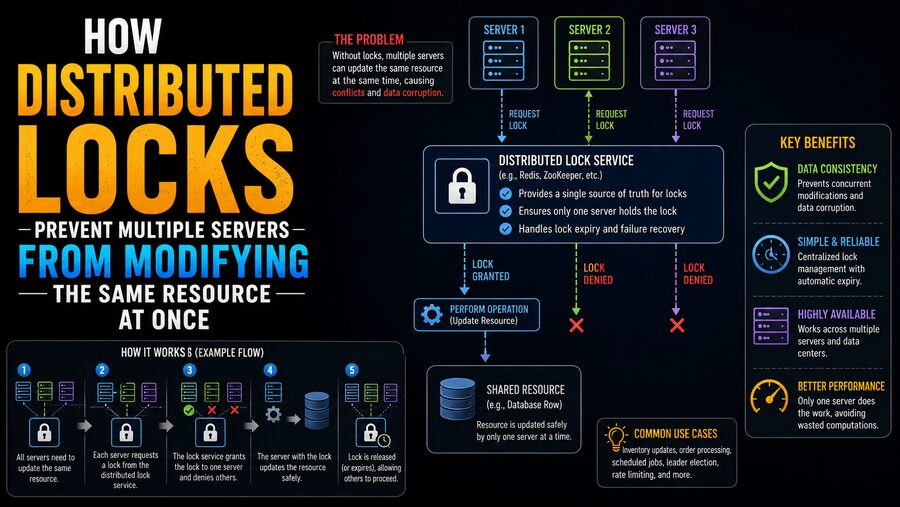

Modern applications rarely run on just one computer. A popular website, payment platform, cloud service, or online marketplace may operate across dozens, hundreds, or thousands of servers at the same time. 🌐🖥️
Distributing work across many machines improves scalability and reliability, but it creates an important coordination problem.
What happens when two servers try to modify the same resource simultaneously?
Imagine two workers processing the same customer order. Both read its status as “unprocessed,” both charge the customer, and both mark the order complete. The system may accidentally create a duplicate payment.
Or imagine several servers trying to update the same inventory count. Each reads that 10 units remain, and each independently sells the final units. The database could end up promising products that do not actually exist. 📦⚠️
One tool engineers use to prevent these conflicts is a distributed lock.
A distributed lock allows one server to temporarily claim exclusive permission to perform a protected operation. Other servers must wait, retry, or abandon their attempts until the lock becomes available.
The idea resembles locking a physical room—but implementing it reliably across unreliable networks and independent computers is far more complicated than it first appears. 🔑
🔍 What Is a Distributed Lock?
A lock is a synchronization mechanism that prevents conflicting operations from running at the same time.
Inside a single program, threads may use an ordinary mutex:
Thread A acquires lock → performs work → releases lock → Thread B proceeds
A distributed system has a harder problem because its workers run on different machines and do not share the same memory.
Server A cannot simply set a local variable saying:
locked = true
Server B has its own memory and would never see that variable.
Instead, all participating servers must coordinate through a shared external system capable of recording who currently owns the lock.
That shared system might be:
- A database 🗄️
- A distributed key-value store
- A coordination service
- A strongly consistent storage system
The lock effectively becomes a shared piece of state saying:
Resource X is currently owned by Server A.
🏦 A Simple Banking Example
Suppose a distributed banking application needs to process a withdrawal from an account.
The account currently contains:
$1,000
Two servers receive withdrawal requests for:
$700
at nearly the same time.
Without coordination, this could happen:
Server A reads:
Balance = $1,000
Server B also reads:
Balance = $1,000
Server A calculates:
$1,000 - $700 = $300
Server B independently calculates:
$1,000 - $700 = $300
Both requests may appear individually valid even though together they require $1,400.
This is a race condition. 🏁
A distributed lock can force the operations to occur one at a time.
Server A acquires:
lock:account:123
Server B attempts to acquire the same lock but fails or waits.
Server A checks the balance, completes the withdrawal, commits the new state, and releases the lock.
Server B can then acquire the lock and sees the updated balance of $300.
Its $700 withdrawal is rejected.
The lock turns overlapping operations into serialized operations.
🔑 How Lock Acquisition Works
A basic distributed locking process usually follows this pattern:
- A server requests a lock for a specific resource.
- The coordination system checks whether the lock already exists.
- If it is free, the server becomes the owner.
- If another server owns it, the new requester waits or fails.
- The owner performs the protected operation.
- The owner releases the lock when finished.
The critical requirement is that lock acquisition must be atomic.
Atomic means the operation behaves as one indivisible action.
If Server A and Server B request the same free lock at exactly the same moment, the locking system must guarantee that only one succeeds.
Otherwise, the lock itself would have a race condition. 😵
⚛️ Why Atomic Operations Matter
Imagine implementing a lock with two separate steps:
1. Check whether lock exists
2. Create lock if it does not exist
That appears reasonable—but it is unsafe.
Server A could check and find no lock.
Before it creates the lock, Server B could also check and find no lock.
Now both servers believe they are allowed to proceed.
Correct distributed locking therefore relies on an atomic operation conceptually similar to:
Create this lock only if it does not already exist.
Only one competing server can succeed.
Databases and distributed storage systems provide different mechanisms for implementing this atomicity.
🏷️ Locks Usually Identify Specific Resources
A distributed application rarely wants one giant lock protecting everything.
That would severely limit concurrency.
Instead, locks are usually associated with individual resources.
For example:
lock:order:581293
might protect one order.
lock:user:89217
could protect one user.
lock:inventory:product-543
might protect one product’s inventory.
This is known as lock granularity.
Fine-grained locks allow unrelated operations to continue simultaneously.
Server A might lock Product 543 while Server B safely works on Product 812.
Only operations targeting the same protected resource conflict. ⚙️
⏳ Why Distributed Locks Need Expiration
Suppose Server A acquires a lock and then crashes before releasing it.
If the lock lasts forever, every other server could remain blocked permanently. 🚫
Distributed locks therefore commonly have an expiration period known as a:
- Lease
- Time-to-live
- TTL
For example, a server might acquire a lock for 30 seconds.
If it finishes in five seconds, it releases the lock early.
If it crashes, the coordination service automatically considers the lock expired after 30 seconds.
Another server can then acquire it.
Expiration prevents abandoned locks from permanently freezing a resource.
💓 Lock Renewal and Leases
Some operations take longer than the original lock duration.
A server might therefore periodically renew its lease.
Suppose the lock lasts 30 seconds.
While the operation continues, the owner may renew it every 10 seconds.
Conceptually:
Acquire → work → renew → work → renew → finish → release
If the server crashes, renewals stop.
Eventually, the lease expires and another server becomes eligible to acquire the resource.
This model is commonly used in distributed coordination because it combines exclusive ownership with automatic failure recovery. 🔄
⚠️ The Dangerous Expired-Lock Problem
Expiration introduces another subtle problem.
Imagine Server A acquires a 30-second lock.
It begins processing but then experiences a long pause caused by:
- Network problems
- CPU overload
- Runtime pause
- Machine suspension
- Storage delays
The 30-second lease expires.
Server B acquires the newly available lock.
But Server A eventually resumes.
Now both A and B could believe they are entitled to modify the resource. 😬
Simply having a timeout is therefore not enough for every safety-critical distributed operation.
This is where fencing tokens become extremely useful.
🎟️ What Is a Fencing Token?
A fencing token is a monotonically increasing number issued whenever a lock is acquired.
For example:
Server A acquires the lock:
Token = 41
Its lease expires.
Server B acquires the lock:
Token = 42
If Server A later wakes up and tries to write using token 41, the protected storage system can compare the tokens.
Because:
41 < 42
Server A’s operation is rejected as stale.
Only operations carrying the newest valid token are accepted.
This protects the resource even when an old lock holder mistakenly continues working after losing ownership. 🛡️
🧠 Why Lock Ownership Must Be Verified
A safe distributed lock usually records an ownership identifier.
Suppose Server A creates a lock containing:
owner = 8f32...
When releasing the lock, Server A should only remove it if that same ownership value is still present.
Why?
Imagine this sequence:
- Server A gets the lock.
- A becomes delayed.
- A’s lock expires.
- Server B acquires a new lock.
- Server A resumes and blindly sends “delete lock.”
If the release operation does not verify ownership, A could accidentally delete B’s valid lock.
Therefore, unlocking generally needs an atomic check:
Delete the lock only if I am still its owner. 🔐
🌐 Network Partitions Make Everything Harder
Distributed systems communicate over networks, and networks can fail in inconvenient ways.
A server may send a lock request but never receive the response.
Did it acquire the lock?
Maybe.
Or perhaps the request never arrived.
Similarly, a server might lose connectivity to the lock service while continuing to communicate with the database.
This uncertainty is one reason distributed coordination is fundamentally more difficult than synchronization inside one process.
Engineers must design around conditions such as:
- Lost messages
- Delayed messages
- Duplicate requests
- Server crashes
- Network partitions
- Clock differences
A correct distributed lock must clearly define how these failure scenarios are handled. 🌐⚠️
🕰️ Why Clocks Can Be Dangerous
It may be tempting to let servers decide for themselves when locks expire using their local clocks.
But clocks on different computers are not perfectly synchronized.
Server A may think it is 10:00:00.
Server B may think it is 10:00:03.
Clock adjustments can also occur.
Distributed lock systems therefore avoid relying unnecessarily on clients’ wall clocks for critical ownership decisions.
Where possible, lease management is handled by the centralized or consensus-backed coordination mechanism rather than by independent clients making assumptions about absolute time. ⏱️
🗄️ Distributed Locks Using a Database
A relational database itself can sometimes coordinate distributed work.
For example, applications might use:
- Row-level locks
- Advisory locks
- Transactions
- Unique constraints
- Conditional updates
Suppose several servers want to process the same job.
Instead of building an external lock, they might atomically update:
status = "pending"
to:
status = "processing"
only if the current status is still "pending".
Exactly one server succeeds.
In many cases, using the database’s native concurrency mechanisms is simpler and safer than adding a separate distributed lock service.
⚡ Locking With Key-Value Stores
High-speed key-value stores are also commonly used for coordination.
A lock may be represented as a key:
lock:report-generation
with an ownership value and expiration time.
The server performs an atomic conditional creation.
If the key does not exist, acquisition succeeds.
If it already exists, another server owns the lock.
This approach can be fast and convenient, but the correctness guarantees depend heavily on the storage system’s consistency model, replication behavior, failure handling, and exact lock algorithm.
Simply placing a key in a cache does not automatically create a safe distributed lock. 🔑
🏛️ Consensus-Based Coordination
Systems that require strong coordination may use a service built around a consensus algorithm.
Consensus allows several machines to agree on a single ordered state despite certain machine or network failures.
Coordination services can provide primitives for:
- Locks
- Leader election
- Configuration
- Membership
- Leases
These systems are useful when applications need a highly consistent view of who owns a resource.
The tradeoff is additional infrastructure and communication overhead.
Stronger coordination generally costs more than purely local operations because machines must communicate before agreement is reached. 🔄
👑 Distributed Locks and Leader Election
A related use of distributed locking is leader election.
Suppose five servers can perform a scheduled cleanup operation, but only one should execute it.
All five attempt to acquire:
lock:daily-cleanup
Whichever server succeeds becomes the temporary leader.
The others remain standby workers.
If the leader crashes and its lease expires, another server can acquire the lock and continue.
This pattern appears in:
- Scheduled jobs
- Queue consumers
- Maintenance processes
- Background workers
- Cluster management
👑🖥️
📦 Preventing Duplicate Order Processing
Consider an e-commerce system where messages may occasionally be delivered more than once.
Two workers receive:
Process order #71824
Both try to start fulfillment.
A lock on:
order:71824
can ensure only one worker enters the protected processing section.
The winner performs the operation.
The other worker sees the resource is locked and may retry later.
This can reduce duplicate work, but robust systems usually combine locking with another powerful concept: idempotency.
🔁 Locks vs. Idempotency
An idempotent operation is designed so that repeating it does not create additional unwanted effects.
For example, a payment operation might carry a unique request ID.
If the same request arrives twice, the payment system recognizes that the transaction was already processed and returns the original result rather than charging again.
This can often provide stronger protection against duplicates than relying only on temporary locks.
Distributed systems frequently combine:
locks + transactions + idempotency + constraints
rather than expecting a lock to solve every concurrency problem.
🔄 Locks vs. Optimistic Concurrency Control
Another alternative is optimistic concurrency control.
Instead of locking a resource before updating it, the system reads the current version number.
Suppose a record contains:
version = 7
A server modifies the record using the condition:
Update only if version is still 7
and changes it to:
version = 8
If another server already updated the record, the condition fails.
The server knows its copy was stale and can retry.
This works especially well when conflicts are relatively rare.
Distributed locks are more pessimistic: they prevent competing operations in advance.
Optimistic concurrency allows competition but detects conflicting updates before committing them. ⚖️
🔒 Distributed Locks vs. Database Transactions
Locks and transactions solve related but different problems.
A transaction ensures that a group of database operations follows certain atomicity and consistency rules within the database.
A distributed lock coordinates ownership between processes that may perform actions across multiple components.
If all critical state exists inside one transactional database, a database transaction may be preferable.
If an operation spans:
- A database
- An external API
- A file store
- Several services
then coordination becomes more complicated.
Even then, a distributed lock does not magically make those external operations transactional.
Engineers still need failure-recovery strategies.
💥 What Is a Deadlock?
Locks create another risk: deadlock.
Suppose Server A holds Lock 1 and wants Lock 2.
At the same time, Server B holds Lock 2 and wants Lock 1.
Neither can continue.
The system becomes stuck:
A waits for B
B waits for A
🔄🚫
Engineers reduce deadlock risk using techniques such as:
- Acquiring locks in a consistent order
- Keeping lock durations short
- Using timeouts
- Avoiding unnecessary nested locks
- Detecting and recovering from deadlocks
Distributed deadlocks can be especially difficult to diagnose because the waiting processes may live on separate machines.
⏱️ Keep Critical Sections Short
The code executed while holding a lock is called the critical section.
Ideally, it should be as short as practical.
Suppose one server holds a popular resource lock for 10 minutes.
Every competing server may spend those 10 minutes waiting.
That reduces concurrency and can create a bottleneck.
A better design might perform expensive preparation first, then acquire the lock only for the final protected update.
Shorter critical sections generally mean:
- Better throughput
- Lower contention
- Lower timeout risk
- Faster failure recovery
⚡
🚦 What Happens When a Lock Is Busy?
A server that fails to acquire a lock needs a policy.
It might:
- Fail immediately
- Wait
- Retry after a delay
- Add randomized backoff
- Return an error
- Place work back on a queue
Repeatedly retrying as fast as possible is usually undesirable.
If hundreds of servers hammer the same lock service, they can create a thundering herd.
Randomized or exponential backoff helps spread retries over time.
📈 The Cost of Lock Contention
Distributed locks preserve correctness by limiting concurrency.
That means highly contested locks can reduce system performance.
Imagine 1,000 workers, all requiring the same global lock.
Although the infrastructure is massively distributed, only one worker can enter the critical section at a time.
The lock has effectively turned that part of the application into a single-file line. 🚶🚶🚶
This is why engineers prefer fine-grained locking where practical.
Instead of:
global-inventory-lock
they may use:
inventory:product-123
inventory:product-124
inventory:product-125
Different products can then be updated concurrently.
🛡️ Locks Do Not Replace Data Integrity Rules
A crucial principle is that distributed locks should not be the only defense protecting critical data.
Applications can contain bugs.
Services can be misconfigured.
A new code path may forget to acquire the lock.
Therefore, important invariants should also be enforced as close to the data as possible.
Examples include:
- Unique constraints
- Foreign-key constraints
- Conditional updates
- Transactional checks
- Version numbers
For example, if usernames must be unique, a database uniqueness constraint is generally stronger than merely trusting every application server to correctly obtain a username lock.
🧩 A Simple Real-World Analogy
Imagine several maintenance teams need access to one electrical control cabinet.
The cabinet has one physical key. 🔑
Team A takes the key and begins maintenance.
Team B arrives but cannot open the cabinet because A holds the key.
When A finishes, it returns the key.
B can then begin.
A distributed lock works similarly, except the “key” is a record in a shared coordination system.
Now imagine Team A disappears while holding the physical key.
That is similar to a crashed server.
A lease solves this by making the key automatically invalid after a certain period.
A fencing token goes further by assigning each new holder an increasing authorization number, ensuring an old holder cannot return later and perform stale work.
🌍 Common Uses of Distributed Locks
Distributed locks may appear in systems handling:
- Payment processing 💳
- Inventory updates 📦
- Scheduled jobs ⏰
- Report generation
- File processing
- Leader election 👑
- Infrastructure provisioning
- Account operations
- Cache rebuilding
- Resource allocation
- Background workers
- Migration tasks
They are especially useful when several independent machines could otherwise perform the same mutually exclusive operation simultaneously.
⚠️ When Distributed Locks Are the Wrong Tool
Distributed locks add complexity, latency, and failure modes.
They should not automatically be the first solution to every concurrency problem.
Other approaches may be better, including:
- Database transactions
- Atomic conditional updates
- Unique constraints
- Message partitioning
- Single-owner queues
- Idempotency keys
- Optimistic concurrency control
- Event-driven architecture
For example, if all commands concerning one customer can be routed to the same ordered queue partition, the system may naturally process those commands sequentially without acquiring a separate lock for each operation.
Good distributed architecture often tries to reduce the need for shared mutable state rather than adding locks everywhere. 🧠
🔬 What Makes a Distributed Lock Correct?
A robust locking design needs to answer several questions clearly.
Who owns the lock?
How is ownership acquired atomically?
How long does ownership last?
What happens if the owner crashes?
Can a lease be renewed?
How does the system prevent a stale owner from continuing after expiration?
What happens during a network partition?
How are retries handled?
Can the underlying storage provide sufficiently strong consistency?
These questions matter far more than the surface API called lock() and unlock().
The hardest part of distributed locking is not creating a lock—it is preserving correct behavior when computers and networks fail in unexpected ways. 🌐
✅ Conclusion
Distributed locks help prevent several servers from modifying the same protected resource simultaneously by creating a shared concept of temporary exclusive ownership. 🔐
Before entering a critical operation, a server atomically attempts to acquire a lock associated with the resource. If another server already owns it, the requester must wait, retry, or stop. Once the owner finishes its protected work, it releases the lock so another server can proceed.
In real distributed systems, however, this simple concept requires careful engineering.
Locks commonly use leases or expiration times so a crashed server cannot block a resource forever. Ownership tokens prevent one server from accidentally releasing another server’s newer lock. For stronger protection, fencing tokens can ensure that a delayed former owner cannot modify the protected resource after its lease has expired.
Engineers must also account for network partitions, retry storms, deadlocks, clock behavior, contention, and failures of the coordination service itself.
Most importantly, distributed locks are only one concurrency-control technique. Database transactions, conditional writes, version checks, idempotency, queues, and data constraints may provide simpler or stronger solutions in many situations.
When a distributed lock is appropriate, its purpose is straightforward: turn dangerous simultaneous access into controlled, serialized access.
That small piece of coordination can prevent duplicate payments, conflicting updates, repeated jobs, oversold inventory, and many other failures that emerge when thousands of servers act at the same time. 🌐🔑⚙️