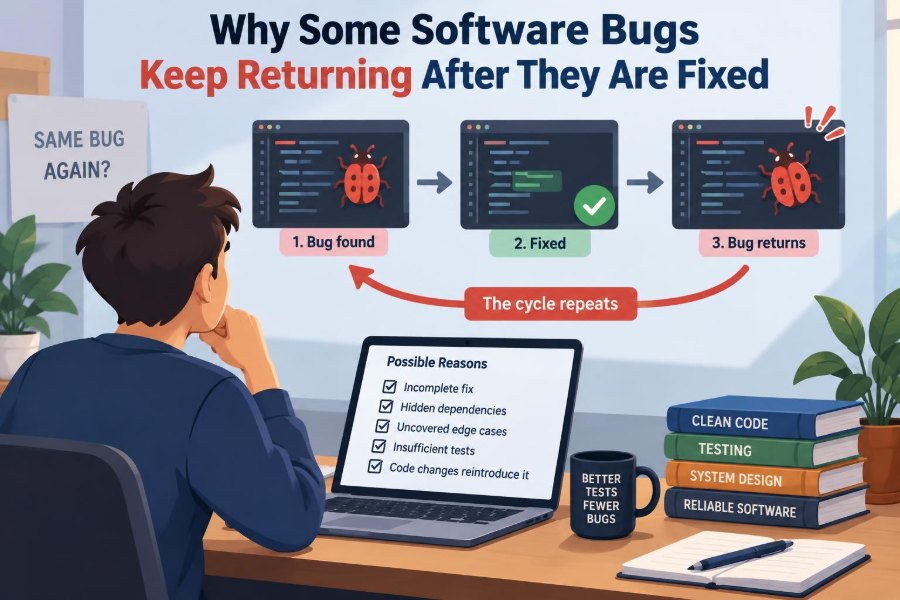

A customer reports that the checkout page occasionally charges a card twice. A developer finds a retry loop, adds a guard, writes a test, and ships the patch. For several weeks, everything looks quiet.
Then the same complaint returns—not always on the same browser, not always with the same log message, and not necessarily after the same deployment. The team may call it “the old bug,” but the code they fixed is gone. What returned was the behavior.
This is one of the most frustrating patterns in software work. Recurring defects consume time, weaken trust in releases, and make teams feel as though they are endlessly repairing the same system.
The reason is usually not that someone failed to try hard enough. Bugs return when the fix removes a visible symptom while the conditions, assumptions, or system interactions that produced it remain in place.
🔁 A returning bug is not always the same defect
A recurring bug can mean several different things. It may be the identical code path reintroduced during a merge, a different path that produces the same user-visible failure, or an intermittent condition that was never fully controlled.
That distinction matters. “Users cannot save a profile” describes an outcome, while “a stale authorization token is accepted by the client but rejected by the server” describes a mechanism. Fixing one mechanism does not guarantee that every route to the outcome has disappeared.
Teams should track both the symptom and the failure mechanism. This prevents false confidence when a familiar-looking issue is closed.
🩹 Symptom patches versus root-cause fixes
A symptom patch stops what is immediately visible. For example, an application may catch a null-value exception and show a fallback screen. That can be a responsible short-term protection, especially when users are blocked.
A root-cause fix asks why the value was null. Was required data never created? Did an asynchronous request finish after the component had been removed? Did a migration leave old records in an invalid state?
Both forms of work have a place. The danger comes when a containment measure is recorded as a permanent resolution. Label temporary safeguards clearly, create follow-up work, and decide who will verify the deeper correction.
🧭 The causal chain is usually longer than one line of code
Software failures often have a chain: an input enters the system, a state changes, a dependency responds unexpectedly, an error is handled poorly, and a user sees a broken result. The line that throws an exception may be the final link rather than the origin.
Consider an order with a missing shipping method. The crash might occur in a price formatter, but the actual defect could be an import job that accepted incomplete records days earlier.
Investigating only at the crash site makes recurring bugs likely. Trace backward through data creation, transformations, state transitions, and external boundaries until the team can explain why the invalid condition became possible.
🔍 Reproduction is evidence, not a ritual
A reliable reproduction turns an anecdote into an observable engineering problem. It specifies the relevant application version, data state, user actions, timing, environment, and expected versus actual result.
But “cannot reproduce” does not prove a report is wrong. It may mean the team has not captured an essential variable: account history, device clock, network interruption, feature flag, queue delay, or concurrent activity.
Good bug reports preserve raw clues before they disappear. Request IDs, timestamps, relevant configuration, sanitized payload shapes, and screenshots can narrow a huge search space without exposing sensitive information.
🎲 Intermittent failures hide their triggering conditions
Some defects occur only when events happen in a narrow order. A request may time out just as the server completes it, or two workers may select the same job before either marks it claimed.
Intermittency is often mistaken for randomness. In practice, it commonly reflects hidden inputs: timing, load, cache state, network behavior, or scheduling. The event is hard to reproduce because the team is not yet observing the right conditions.
Instrument the boundary where uncertainty enters. Record attempt counts, durations, state transitions, and correlation IDs. Then use controlled delay, repeated runs, or a test environment with injected faults to make the condition more visible.
⏱️ Race conditions can survive ordinary testing
A race condition occurs when correctness depends on the relative timing of operations that may overlap. A familiar example is two requests both reading “one item left,” then both completing a purchase before either update becomes visible to the other.
Manual tests usually follow one orderly path, so they miss races. Even automated tests can miss them when every run schedules work in the same convenient sequence.
Possible controls include transactions, locks, atomic database operations, idempotency keys, and carefully designed state ownership. The right choice depends on latency, consistency needs, and the infrastructure involved; adding a lock everywhere can introduce contention or deadlocks.
🧵 Concurrency bugs are often state-ownership bugs
Many concurrency failures become easier to reason about when teams ask a basic question: who is allowed to change this state? If several browser tabs, services, or background jobs can update the same record without a coordination rule, contradictory outcomes are predictable.
Define ownership and transitions explicitly. For example, an invoice might move from draft to issued once, while payment processing records separate attempts rather than repeatedly mutating one ambiguous status.
Clear state models reduce the number of legal-but-confusing combinations. They also make tests more precise because engineers can assert which transitions are permitted and which must be rejected.
📦 Bad data outlives a code deployment
Production data has memory. A code fix may prevent new invalid records while old records, cached values, queued messages, exports, or replicas still carry the bad state.
Imagine a validation bug that allowed blank country codes. Adding validation fixes future submissions, but existing accounts may still fail whenever an address is displayed, billed, or synchronized with another service.
A complete correction includes a data plan: identify affected records, decide whether they can be repaired automatically, quarantine unsafe cases, and monitor the repair. Database migrations need the same review discipline as application code.
🗃️ Schema assumptions drift over time
Applications often assume the database contains values that are non-null, unique, current, or formatted consistently. Those assumptions can become false after manual edits, older releases, imports, partial migrations, or integrations.
Constraints at the data layer are useful because they protect every writer, not just the current web form. Examples include foreign keys, unique constraints, checks, and appropriate nullability rules.
Constraints are not a substitute for useful application errors. They are a final boundary. A durable design validates data where users can act on feedback and also protects persistent data from bypasses and future code paths.
🧊 Caches can replay yesterday’s mistake
Caching improves performance by serving previously computed data, but it also introduces another copy of application state. A corrected record may coexist with an old cached response, derived value, or authorization decision.
Cache-related bugs return when invalidation is incomplete, keys omit a meaningful dimension, or different services use different freshness assumptions. For instance, a key that ignores a user’s locale can make a language bug appear and disappear unpredictably.
Make cache ownership and expiry rules explicit. When correctness is sensitive, consider versioned keys, targeted invalidation, and a safe fallback to the source of truth. Cache hits should be observable, not mysterious.
📬 Queues and retries can duplicate work
Distributed systems often retry because networks and processes fail. A worker may complete an action but crash before acknowledging the message, causing the queue to deliver it again. This behavior is frequently intentional.
Problems arise when consumers assume a message arrives exactly once. Sending an email twice may be inconvenient; charging a card twice can be serious. A retry-safe operation is called idempotent: repeating it has the same meaningful result as performing it once.
Use durable idempotency keys, unique business identifiers, and recorded outcomes where appropriate. Do not rely only on an in-memory “already processed” flag, because a restart erases it.
🌐 External dependencies change independently
Your code may be stable while a payment provider, identity service, browser, operating system, DNS route, or third-party API behaves differently. A dependency can also return a valid response that violates an undocumented assumption in your code.
Defensive integration design validates responses, handles timeouts, distinguishes retryable from permanent errors, and avoids treating every unexpected response as a generic failure.
Still, resilience has limits. A fallback that silently accepts uncertain payment status may be worse than temporarily asking a user to wait. The appropriate behavior depends on the cost of delay versus the cost of an incorrect action.
🧩 API contracts fail at the edges
An API contract is the shared agreement about fields, meanings, formats, errors, and lifecycle behavior. A contract can break without a dramatic version change: a field may become optional, an enum may gain a new value, or pagination may begin returning more data.
Returning bugs often appear after one service “fixes” its own behavior but another consumer still depends on the previous quirk. The consumer then recreates the original failure through a different route.
Contract tests and compatibility checks help reveal these mismatches. They work best when they cover meaningful behavior, such as how absent fields or duplicate requests are handled, rather than merely checking that JSON parses.
🚩 Feature flags create multiple versions of reality
Feature flags let teams release gradually, experiment, and disable risky functionality quickly. They also multiply the number of active code paths. A defect may be fixed for new users but remain enabled for a legacy segment, region, tenant, or staff role.
A flag can also interact with another flag in a combination nobody tested. This is especially common when flags live longer than their original rollout plan.
Maintain an inventory that states each flag’s owner, purpose, audience, default, and removal date. Test the enabled and disabled paths that remain supported, then delete obsolete flags instead of treating them as permanent configuration.
🧪 Tests may prove the wrong thing
A regression test is valuable only if it fails before the fix and passes afterward for the relevant reason. A test that mocks away the faulty dependency, uses unrealistic data, or asserts an implementation detail may give reassuring green results without protecting users.
For example, a unit test may verify that a function rejects an empty email address, while the recurring production issue is a CSV import that turns missing values into the literal string "null". Both concern email data, but they are not the same behavior.
Match the test level to the failure. Unit tests are fast and focused; integration, contract, end-to-end, and load tests expose different classes of risk. None covers every boundary alone.
🧫 Production-like test data reveals assumptions
Small, tidy fixtures make tests easy to read, but production contains older accounts, unusual Unicode characters, partial onboarding states, large collections, and records created by previous versions.
Teams do not need to copy sensitive production data into every environment. They can create sanitized representative datasets and deliberately include difficult cases: missing optional values, old formats, duplicate attempts, time zones, permission changes, and failed prior jobs.
The goal is not to simulate every possible user. It is to expose assumptions that ordinary fixtures hide, particularly at system boundaries and upgrade paths.
🪵 Logs without context cannot explain recurrence
A log line saying “request failed” is rarely enough to diagnose a returning defect. Engineers need context that connects events across components: a request or trace ID, operation name, safe account or entity reference, version, timing, and error category.
Logging every payload indiscriminately is not the answer. It can expose personal data, credentials, or proprietary information and can make important signals harder to find.
Design observability deliberately. Structured logs, metrics for error rates and retries, and traces across service boundaries help teams answer whether the same mechanism returned or merely the same symptom.
📈 Monitoring should detect behavior, not just crashes
A crash alert catches obvious failure, but many bugs degrade behavior quietly. A confirmation email may be missing, a search result may be stale, or a payment may remain pending too long without generating an exception.
Useful monitoring includes business-level signals that reflect intended outcomes: completed workflows, reconciliation mismatches, backlog age, duplicate operation attempts, or unusual transition rates between states.
Metrics need interpretation. A change in traffic or a planned campaign can alter normal levels. Alerts should point engineers toward a meaningful investigation, not create noise that trains people to ignore them.
🧱 Deployment and rollback can restore old behavior
Sometimes a bug truly returns because an old artifact, configuration, database schema, or container image is deployed again. A rollback may restore application code while leaving a newer schema, exposing incompatibilities that did not exist before.
Build provenance helps answer what actually ran: identify releases, configuration versions, migration status, and dependency versions. Immutable artifacts reduce the chance that “version 42” means different code in two environments.
Plan rollbacks before an incident. Some changes require a forward fix rather than a simple reversal, especially after data has been transformed or a public API behavior has changed.
🔀 Merge conflicts can silently resurrect logic
Long-lived branches and hurried conflict resolution can reintroduce code that a previous fix removed. The result may not look like a literal revert; an older validation rule or helper function can be copied into a new feature.
Code review should compare the change against the current behavior, not only against the author’s branch. Reviewers can ask: did this feature duplicate an existing rule, bypass a newer abstraction, or restore an assumption that was deliberately retired?
Small, frequently integrated changes reduce this risk. So does preserving a regression test close to the behavior that once failed.
🧠 Tribal knowledge disappears from the codebase
A team may know that “this field is sometimes absent for migrated customers” or “this endpoint must not be retried after the provider responds ambiguously.” If that knowledge stays in a chat thread or one person’s memory, later changes can undo it.
Encode important constraints in several places where useful: names, types, validation, tests, runbooks, API documentation, and architecture decisions. Not every detail needs a document, but critical exceptions need a durable home.
Good documentation explains the reason behind a strange rule. “Do not remove this check” is weaker than explaining the failure scenario it prevents.
🧑💻 Ownership gaps leave fixes unfinished
Returning defects frequently cross team boundaries. One team owns the UI, another owns an API, a platform group owns the queue, and a vendor owns part of the workflow. Each group may implement a reasonable local fix while no one owns the end-to-end outcome.
Assign a coordinator for significant recurring issues, even when many teams contribute. That person need not perform all the work; they ensure evidence, decisions, remediation, validation, and communication connect.
Clear ownership is not about blame. It makes it less likely that data cleanup, flag removal, monitoring, or customer recovery becomes an unowned final step.
🕵️ Ask “why” without turning it into blame
A blameless investigation examines conditions and decisions, not personal fault. The question is not “who wrote the bad line?” but “what made this outcome possible, and what allowed it to reach users?”
A useful review may consider detection, containment, technical causes, process gaps, and recovery. It should also identify what worked, such as an alert that limited impact or a support report that exposed an unseen scenario.
Blame makes people hide uncertainty and avoid reporting near misses. Learning-oriented reviews make earlier warning signs more likely to surface in the future.
🧾 Classify recurrence before choosing a remedy
Not all recurring bugs deserve the same response. A useful classification prevents teams from applying a familiar tool to the wrong problem.
| Recurrence pattern | Likely focus | Typical durable control |
|---|---|---|
| Same code restored | Change management | Regression test, review, smaller integrations |
| Same symptom, new route | Shared invariant | Central validation or state model |
| Only old records fail | Historical data | Migration, repair, compatibility handling |
| Occurs under overlap or delay | Timing and coordination | Atomic operations, idempotency, concurrency tests |
| Appears by audience or region | Configuration variation | Flag inventory and targeted observability |
The table is a starting point, not a diagnosis. One incident can involve several patterns at once.
🛠️ Build a recurrence-resistant fix plan
After identifying a likely cause, write down the complete scope of the fix. This keeps the team from stopping after the most visible code change.
- Describe the user-visible symptom and the technical mechanism separately.
- State the invariant that should always hold, such as “an order is charged at most once per payment intent.”
- Patch the immediate risk and decide whether user or data recovery is needed.
- Add tests that reproduce the relevant path, including timing or historical data where necessary.
- Add instrumentation that would reveal recurrence early.
- Identify flags, caches, jobs, migrations, documentation, and dependent services affected by the change.
- Define a verification period and the signal that indicates the fix is holding.
This approach is slower than editing one line, but it is often faster than reopening the same incident repeatedly.
✅ Verify the fix across time, not just at merge time
A passing pull request is a checkpoint, not proof that production behavior is permanently correct. Some failures need time to reveal themselves because queues drain slowly, caches expire later, rare users return, or a scheduled job runs weekly.
Choose verification that matches the risk. That may include checking a dashboard after release, reconciling records, replaying a safe sample, observing a canary deployment, or reviewing support contacts for a defined period.
Verification should have an owner and a stopping condition. Otherwise “we will keep an eye on it” becomes an intention that disappears after the next urgent task.
⚖️ Avoid overengineering every defect
Not every small defect needs a redesign, distributed trace overhaul, or extensive postmortem. Engineering effort should be proportional to impact, likelihood of recurrence, uncertainty, and the cost of a wrong outcome.
A typo caused by a local constant has a different risk profile from duplicated financial operations. The first may need a focused test and review; the second may justify stronger invariants, reconciliation, and careful failure handling.
Pragmatism is not superficiality. It means understanding which layer failed and selecting the smallest change that credibly protects the system and its users.
🌱 Design for invariants, not happy paths
An invariant is a condition that must remain true despite retries, retries from clients, stale messages, partial failures, or unusual input. Examples include “a user cannot access another tenant’s data” and “a completed refund cannot be refunded again without a new authorization.”
Happy-path code asks what normally happens. Invariant-driven design asks what must never happen and where that rule can be enforced most reliably. Often, the answer is at a shared boundary rather than in each individual screen.
This mindset does not eliminate bugs. It reduces the number of paths through which the same harmful state can be created.
🤝 Recurring bugs are feedback about the system
A returning defect is frustrating, but it is also information. It may reveal fragmented ownership, weak observability, an unclear domain model, unsafe retries, unsupported data history, or a testing gap at a boundary.
The most productive response is neither resignation nor a search for someone to blame. It is a better question: what assumption did our previous fix leave untouched?
The core principle is simple: a bug stops returning when the system no longer permits the underlying failure conditions—not merely when one visible occurrence has been patched.
Teams that investigate mechanisms, protect invariants, repair historical state, and verify behavior after release turn recurring bugs from a cycle of emergency fixes into concrete opportunities to build more dependable software. 🐞🔧🌱