
A product team launches a small booking feature with one payment option, a handful of screens, and a straightforward workflow. The code feels clear because every rule has an obvious place to live.
Then the requests arrive: add another payment provider, support cancellations, send notifications through more than one channel, and expose the same workflow through an API. A quick change in one file begins to require edits in five others.
This is where maintainability becomes concrete. The problem is not that the team wrote “bad code”; it is that decisions that used to be simple have become change points with many consequences.
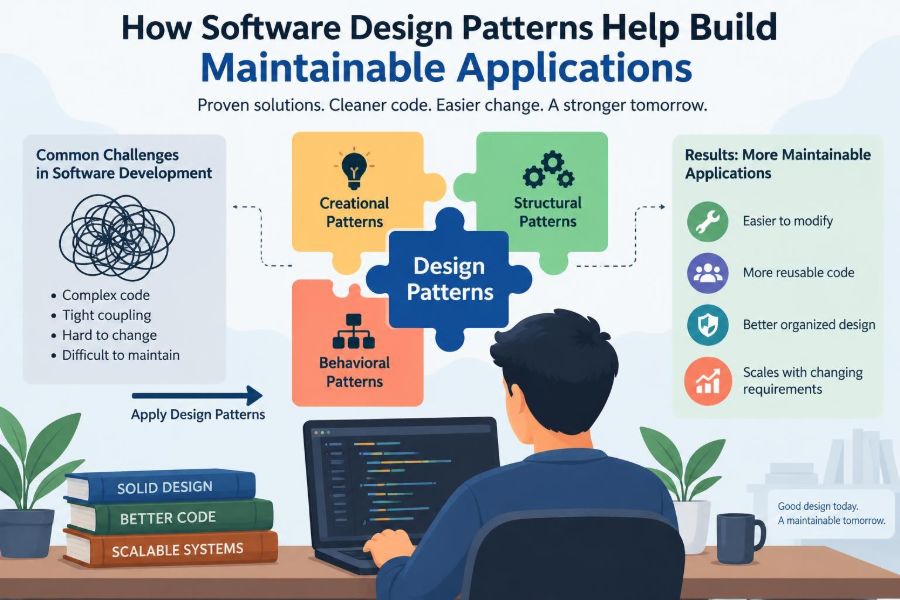
Software design patterns help developers organize those recurring change points. They provide shared names and proven shapes for responsibilities, dependencies, and collaboration between objects. Used thoughtfully, they make applications easier to extend, test, explain, and repair. 🧩
🧭 1. Maintainability Is the Real Long-Term Requirement
Maintainable software can be understood, changed, tested, and operated without creating unnecessary risk. It is not the same as code that merely works today.
Most applications spend far more of their lifetime being modified than being initially written. New business rules, bug fixes, performance work, security changes, and integrations all place pressure on the original design.
- Understandability: a developer can find the relevant behavior.
- Changeability: a new requirement has a limited blast radius.
- Testability: behavior can be checked without elaborate setup.
- Reliability: a local change is less likely to break distant features.
🧩 2. What a Design Pattern Actually Is
A design pattern is a reusable description of a solution to a recurring design problem in a particular context. It is not a library, a copy-and-paste class hierarchy, or a rule that every program must follow.
Patterns describe relationships and responsibilities. For example, a Strategy pattern describes how a caller can use interchangeable algorithms through a stable interface.
The pattern name gives a team useful shorthand. Saying “this adapter translates the vendor API” communicates intent more clearly than discussing a collection of conversion methods from scratch.
🧱 3. Patterns Address Forces, Not Just Shapes
Every useful pattern balances competing forces. A system may need flexibility, but it also needs readability. It may need isolation from a third-party service, but it should avoid layers that obscure ordinary work.
Before selecting a pattern, identify the pressure in the design. Is behavior varying? Is object construction becoming complicated? Are observers tightly coupled to a publisher? Is legacy code incompatible with a newer interface?
If there is no meaningful force to resolve, a pattern may be ceremony rather than design.
🔍 4. Start With the Change You Expect
The most practical question is not “Which pattern should we use?” It is “What is likely to change, and what should remain stable when it does?”
A delivery system might change its carrier-selection rules. A report might gain formats. An authentication module might support new identity providers. These are signs that variation deserves a deliberate boundary.
Design for credible changes, not every imaginable future. Predicting too much produces abstraction that no current requirement can justify.
🗺️ 5. Separate Stable Policies From Variable Details
Maintainable designs keep the core policy readable while moving volatile details behind an interface or boundary. The policy answers what the application is trying to accomplish; details answer how a particular mechanism accomplishes it.
For example, an order workflow may have a stable policy: authorize payment before confirming an order. The payment gateway implementation is a variable detail.
This separation lets teams replace or add details without rewriting the central workflow. It also makes the policy easier to test in isolation.
🧠 6. Use the Single Responsibility Principle as a Compass
A class should have one coherent reason to change. This does not mean every class must contain only a few lines; it means its responsibilities should belong together.
A class that validates invoices, formats PDF output, stores records, and emails customers has several independent reasons to change. Such a class becomes a conflict point where unrelated modifications collide.
Patterns often support this principle by making responsibilities explicit: factories construct, adapters translate, commands represent actions, and observers react to events.
🚪 7. Program to Interfaces, Not Concrete Dependencies
Depending on an abstraction allows high-level code to express what it needs without committing to a particular implementation. A notification service can depend on a MessageSender contract rather than directly creating an email client.
interface MessageSender {
  send(message)
}

class NotificationService {
  constructor(sender) {
    this.sender = sender
  }
}
The concrete sender can be email, SMS, a test double, or a future provider. This is a practical expression of dependency inversion: policy should not be trapped by low-level details.
🔁 8. Strategy Makes Changing Behavior Explicit
The Strategy pattern packages an algorithm behind a common interface so clients can select among alternatives. It is especially useful when a growing conditional statement chooses behavior based on a type, region, plan, or workflow.
A pricing service might delegate discount calculation to a standard-price strategy, a member-price strategy, or a seasonal-price strategy. The service coordinates the work while each strategy owns its calculation.
Good signals for Strategy
- Multiple algorithms perform the same conceptual task.
- New variants are expected to be added independently.
- Large conditional branches are becoming difficult to read or test.
- Callers should not need to know each algorithm’s internal rules.
Strategy does not eliminate decisions; it moves the decision about which algorithm to use into a clear, controlled place.
🏭 9. Factory Patterns Clarify Object Creation
Object construction becomes a design concern when creating an object requires choices, validation, configuration, or dependencies. The Factory pattern centralizes that knowledge.
Instead of allowing many callers to instantiate a storage client with environment-specific settings, a factory can select and configure the appropriate client. Callers receive an object ready for its intended role.
Factories reduce duplicated setup and prevent application code from learning details that belong to composition and configuration. They are most valuable when construction is genuinely variable or complex.
🧰 10. Builder Helps With Complex Valid Objects
The Builder pattern is helpful when an object has many optional fields, nested parts, or rules about valid combinations. It lets construction happen in deliberate steps before producing a finished object.
An export request might have filters, columns, a date range, sorting, and output settings. A builder can make those choices readable while validating required combinations at the boundary.
Do not introduce a builder merely because a constructor has several arguments. First consider simpler options such as a well-named parameter object or a smaller domain model.
🔌 11. Adapter Protects Your Code From External APIs
The Adapter pattern converts one interface into another that the client expects. It is invaluable at system boundaries, where vendor SDKs, legacy services, file formats, and transport protocols often use awkward or unstable models.
For example, an application can define its own PaymentGateway interface and create an adapter around a provider’s SDK. The rest of the application works in its own vocabulary.
When the provider changes its API, the adaptation work is localized. This boundary also prevents vendor-specific data types from spreading through business logic. 🔌
🛡️ 12. Facade Reduces the Cost of Understanding a Subsystem
A Facade offers a simple entry point to a complex collection of services. It does not need to expose every capability; its purpose is to support common use cases with a smaller, clearer API.
A document-processing subsystem may involve parsing, validation, conversion, storage, and audit logging. A facade such as DocumentImportService can coordinate the ordinary workflow for its callers.
Facades reduce coupling to internal structure. They are particularly useful when a subsystem is evolving and callers should not depend on its moving parts.
🎭 13. Decorator Adds Features Without Changing the Core
The Decorator pattern wraps an object with another object that has the same interface and adds behavior before or after delegation. It supports composition instead of building a large inheritance tree.
A data reader can be decorated with caching, logging, authorization checks, or retries. Each wrapper has a focused responsibility, and combinations can be assembled where needed.
This flexibility has a cost: too many wrappers can make execution hard to trace. Use descriptive names and make the composition visible in configuration or startup code.
📬 14. Observer Supports Event-Driven Collaboration
In the Observer pattern, a subject announces that something happened and interested observers react. The publisher does not need to know all the downstream actions.
After an account is created, one observer might send a welcome message, another might create an audit record, and another might update analytics. The account service remains focused on account creation.
Observers create looser coupling, but they can also hide important work. Teams should document event contracts, define failure behavior, and avoid turning every ordinary method call into an event.
📜 15. Command Turns an Action Into an Object
The Command pattern represents a request as an object. That object can carry the action’s parameters, identity, validation state, and metadata.
Commands are useful for queued jobs, undoable operations, workflows, audit trails, and request handling. A command such as ApproveExpense states an intent more clearly than passing a collection of unrelated arguments.
Separating the command from its handler lets the application route, validate, authorize, and test actions consistently.
🚦 16. State Models Workflows That Have Real Modes
The State pattern helps when an object’s valid behavior depends on its current state. Rather than scattering checks such as if status == ... across the application, state-specific behavior is grouped together.
An order might be drafted, submitted, paid, shipped, cancelled, or returned. Each state can define which transitions are allowed and what actions are valid.
Not every status field needs State objects. Use the pattern when transitions and state-dependent rules are substantial enough that conditional logic obscures the domain.
🌳 17. Composite Treats Parts and Groups Consistently
The Composite pattern lets clients work with individual objects and collections of objects through a common interface. It fits naturally where the domain has a tree structure.
A file can be a leaf, while a folder contains files and other folders. A UI layout can contain components and nested containers. A pricing package can contain individual products and bundles.
The common interface simplifies traversal and operations, while the composite object handles delegation to its children.
🧮 18. Template Method Shares a Workflow Skeleton Carefully
Template Method defines the overall steps of an algorithm in a base type while allowing subclasses to fill in selected steps. It can reduce duplication across closely related workflows.
For example, several imports may share the sequence of load, validate, transform, persist, and report, while differing in parsing or transformation. The stable sequence remains in one place.
However, inheritance creates a strong relationship between parent and child. If variation must be selected at runtime or combined freely, Strategy and composition are often easier to maintain.
🧪 19. Patterns Improve Tests by Creating Seams
A seam is a place where a program’s behavior can be altered for testing or configuration without rewriting production code. Interfaces, injected dependencies, and focused collaborators create useful seams.
A service that receives a clock can be tested against a fixed time. A service that receives a repository can be tested without a live database. A payment adapter can be replaced with a controlled fake.
The goal is not to mock every class. Tests are strongest when they verify meaningful behavior and use fakes only at boundaries that would otherwise be slow, nondeterministic, or expensive.
🧷 20. Dependency Injection Keeps Wiring Out of Business Logic
Dependency injection means supplying an object’s collaborators from outside rather than having the object construct them internally. It makes dependencies visible in constructors, functions, or configuration.
This practice works naturally with patterns such as Strategy, Adapter, and Decorator. A composition root can choose implementations and assemble them, while domain services focus on their actual behavior.
A dependency injection framework may automate wiring, but the framework is not the principle. Manual construction is often clearer in smaller applications.
🏛️ 21. Patterns Strengthen Architectural Boundaries
At an application scale, patterns help protect boundaries between user interfaces, use cases, domain rules, infrastructure, and external systems. The exact architecture may vary, but the direction of dependencies matters.
Business rules should not need to import web framework controllers or database clients to express their meaning. Ports and adapters, repositories, facades, and application services can keep those concerns separated.
This separation makes it easier to change delivery mechanisms or infrastructure without rewriting the core rules of the application.
📊 22. Choose Patterns by Trade-Off, Not Popularity
No pattern is automatically superior. Each introduces names, interfaces, indirection, and places to navigate. Those costs are worthwhile only when they buy clarity or reduce likely change risk.
| Situation | Often useful pattern | Main benefit |
|---|---|---|
| Several interchangeable rules | Strategy | Isolates changing algorithms |
| Third-party interface mismatch | Adapter | Protects internal code |
| Complicated construction | Factory or Builder | Centralizes creation rules |
| Optional cross-cutting behavior | Decorator | Composes features |
| One event, several reactions | Observer | Reduces direct coupling |
| Lifecycle-dependent behavior | State | Clarifies transitions |
Use this as a conversation starter, not a lookup table that replaces design thinking.
⚠️ 23. Avoid Pattern Fever and Premature Abstraction
Pattern fever occurs when developers add factories, interfaces, base classes, or event systems before the code has a demonstrated variation point. The result can be a maze of tiny types with no clearer business story.
Premature abstraction is especially harmful when it guesses incorrectly. A generic solution may lock the team into concepts that do not match the way the domain eventually evolves.
- Start with direct, readable code.
- Notice duplication that changes for the same reason.
- Extract an abstraction when a real pattern of variation appears.
- Keep the new boundary as small as possible.
Simple code is not unsophisticated. It is often the best starting point for a maintainable design.
🧯 24. Watch for Common Pattern Misuses
A Singleton can hide global mutable state and complicate tests. A deep inheritance hierarchy can make behavior difficult to predict. An Observer chain can obscure failures and ordering. A generic factory can become a second language developers must learn.
The remedy is not banning patterns. It is making ownership, lifecycle, error handling, and dependency direction explicit.
Ask whether a newcomer can answer: who creates this object, who calls it, what can fail, and where should a change be made? If those answers are difficult, the abstraction may need revision.
🧑💻 25. Refactor Toward a Pattern in Small Steps
Patterns are often most useful as refactoring destinations rather than initial blueprints. Begin with a concrete pain: duplicated algorithms, a switch statement that keeps growing, or framework types leaking into domain code.
- Write or strengthen tests around existing behavior.
- Identify the varying responsibility and the stable caller.
- Introduce a narrow interface or collaborator.
- Move one implementation behind it.
- Repeat for the remaining variants while keeping tests green.
Small steps preserve behavior and expose whether the new structure truly improves comprehension. Refactoring is successful when the next change becomes easier, not merely when more files exist.
🤝 26. Pattern Names Improve Team Communication
Shared vocabulary is one of the understated benefits of design patterns. During a review, a teammate can ask whether an adapter is leaking provider types, whether a decorator’s order matters, or whether a strategy should be selected elsewhere.
These names focus discussion on intent and trade-offs. They should never end discussion: calling something a Factory does not prove that it is well designed.
Document the reason for an important boundary in code comments, architecture notes, or review discussions. Future maintainers need the “why,” not just the pattern label.
🌱 27. Learn Patterns Through Small, Real Examples
Reading definitions is useful, but implementation teaches the important details: where dependencies are created, how errors move through the system, and whether the abstraction makes a common task clearer.
Try applying one pattern to a small problem. Replace a format-selection conditional with Strategy, wrap a mock external API with an Adapter, or model a simple approval lifecycle with State.
Then remove the pattern and compare both versions. The lesson is not that patterned code always wins; it is learning to recognize when its trade-off is worthwhile.
🧭 28. The Core Principle: Design for Clear Change
Software design patterns help build maintainable applications because they separate responsibilities and create stable boundaries around likely variation. They turn tangled dependencies into collaborations with recognizable roles.
The best pattern is the one that makes today’s code understandable while leaving tomorrow’s plausible change contained. It should clarify the domain, improve tests, and reduce accidental coupling without burying simple behavior beneath ceremony.
Use patterns as tools for making change safer and intent clearer, not as decorations for making code look advanced. With that principle in mind, a small set of well-chosen patterns can help an application remain adaptable long after its first release. 🧩🌱🚀