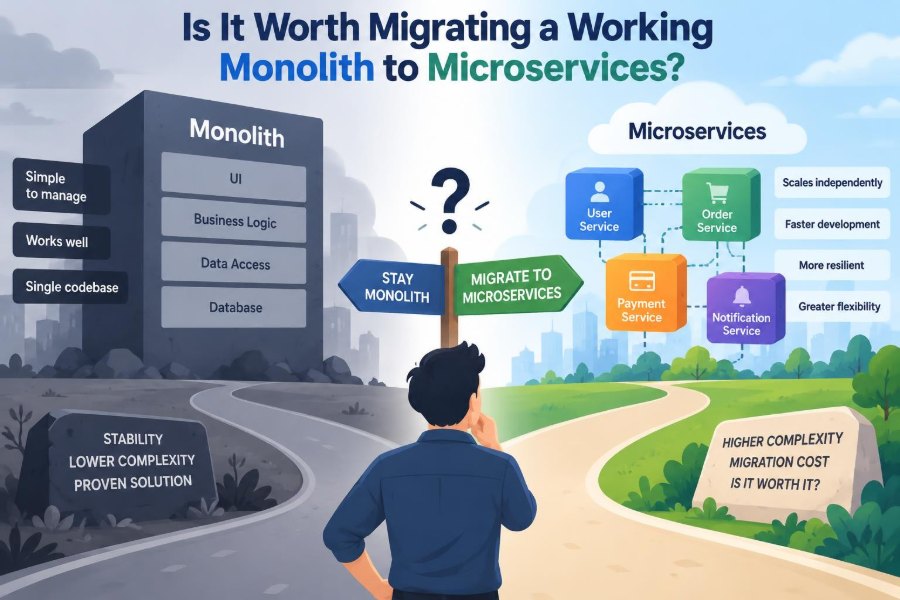

A product has grown beyond its first release. Deployments now make the whole team nervous, a small checkout change can touch three unrelated modules, and the codebase feels increasingly difficult to navigate. Someone eventually asks the familiar question: should we break the monolith into microservices?
The question is tempting because microservices promise independent deployment, targeted scaling, and smaller codebases. They also have an impressive reputation in engineering conversations, especially when a successful company is described as “moving to microservices.”
But a working monolith is not automatically a problem. It may be a valuable asset: one deployable unit, one place to debug, and one transaction boundary for many business operations. Replacing that simplicity with distributed systems has a real cost.
The useful question is not whether microservices are modern. It is whether the constraints of your current system and organization justify accepting a different, more demanding set of constraints.
🧱 Start with What a Monolith Actually Is
A monolith is an application deployed as a single unit. Its modules may cover accounts, orders, billing, notifications, and reporting, but they run and are released together.
A monolith does not have to be poorly structured. A modular monolith keeps related code behind clear internal boundaries, even though it is packaged and deployed as one application. Many successful systems remain in this form for a long time.
The real concern is usually not “one deployment artifact.” It is uncontrolled coupling: unrelated areas sharing tables, reaching into each other’s internals, or requiring broad changes for a simple feature.
🔌 Understand What Microservices Change
Microservices split an application into independently deployable services, each ideally responsible for a specific business capability. An order service might own order creation, while a catalog service owns product information.
This is not merely code moved into separate repositories. Services communicate across a network, own their operational behavior, and often own their data. A function call becomes an HTTP request, message, or remote procedure call.
That change introduces new failure modes. Networks time out, messages arrive late or twice, a service may be healthy while its dependency is not, and observing one user action can require tracing activity across several systems.
🎯 Define the Problem Before Choosing the Architecture
“The monolith is hard to work with” is an honest observation, but it is too broad to guide a migration. Turn frustration into observable problems: release lead time, production incidents, build duration, team interference, or a component that cannot scale economically.
For example, a nightly report that overloads the application has a different solution from a team blocked because every deployment requires coordinated testing. Neither issue automatically requires dozens of services.
Write down the current pain, who experiences it, how often it occurs, and what improvement would count as success. Without this baseline, a migration can become a long technical project whose value is impossible to judge.
📈 Recognize Legitimate Reasons to Split
Some conditions genuinely favor service boundaries. A workload may need to scale independently, such as video processing consuming far more compute than the customer-facing application. A separate deployment may also reduce the blast radius of frequent, isolated changes.
Microservices can help when business domains have stable boundaries and different teams need meaningful autonomy. They can also support different reliability requirements: a recommendation feature may degrade gracefully, while payment authorization needs stricter handling.
The key word is specific. “We need scalability” should become “image conversion needs separate worker capacity.” “We need faster delivery” should become “two teams repeatedly block each other in the same release path.”
🛑 Know When a Working Monolith Is the Better Choice
A monolith is often preferable when the product changes rapidly and its domain model is still being discovered. Early boundaries are guesses, and services make incorrect guesses harder to revise because they create APIs, data ownership rules, deployment pipelines, and operational obligations.
Small teams also benefit from a single system. One process can be inspected locally, tested end to end, and deployed without maintaining service discovery, cross-service authentication, distributed tracing, or multiple alert configurations.
If the main issue is messy code, extract modules before extracting services. A service boundary cannot compensate for an unclear domain boundary.
🧭 Separate Technical Pain from Organizational Pain
Architecture is frequently asked to solve problems that originate elsewhere. Slow approvals, unclear product ownership, weak test practices, or an overloaded review process can make delivery feel slow regardless of how many deployables exist.
Likewise, creating separate services will not make teams autonomous if they share priorities, databases, deployment ownership, or decision-making authority. The technical boundary and the human boundary need to support each other.
Before migrating, ask whether the desired improvement is actually blocked by the application structure. If not, process or team changes may produce more value with much less risk.
🧩 Find Bounded Contexts, Not Technical Layers
A useful service boundary typically represents a bounded context: an area where a particular business model and vocabulary apply consistently. “Fulfillment” and “billing” may be separate contexts because they have different rules, responsibilities, and rates of change.
By contrast, splitting into a database service, API service, and validation service usually preserves technical layering while increasing network dependency. Such services often need to change together, which defeats independent delivery.
Listen for language differences. If “customer” means an account holder to support, a payer to billing, and a recipient to shipping, those distinctions can reveal boundaries worth investigating.
🗺️ Map Dependencies Before Cutting Anything
Use code reading, production telemetry, database queries, and conversations with domain experts to map how the system behaves. Trace important workflows such as signup, purchase, refund, and cancellation from entry point to stored data.
Pay particular attention to hidden dependencies: shared tables, scheduled jobs, database triggers, file exchanges, configuration flags, and reporting queries. These are often more consequential than visible imports in application code.
A dependency map does not need to be perfect. Its purpose is to prevent a team from extracting a component only to discover that every important action still requires synchronous calls back into the monolith.
🧠 Treat the Database as a Major Boundary Decision
In a monolith, several modules may query the same database and join data freely. This is convenient, but it can hide ownership. Once services are separated, shared tables become a source of tight coupling and risky releases.
A robust direction is for each service to own its data and expose information through an API or events. Other services should not write directly to that data store, even if direct access seems faster in the moment.
Data ownership is difficult because it changes reporting, reconciliation, and transaction design. It deserves early design work rather than being postponed until “after the services are split.”
🔄 Accept That Distributed Transactions Are Different
A monolith can often update an order, reserve inventory, and record payment inside one database transaction. In a distributed design, those records may live in separate services, where a single all-or-nothing transaction is impractical or undesirable.
Instead, workflows may use eventual consistency: one change is recorded, an event is published, and other services react shortly afterward. The system may temporarily show a state that is incomplete but valid.
That requires explicit business decisions. What happens if inventory reservation fails after an order is accepted? Can the customer see “processing”? Who compensates for a completed payment when fulfillment cannot proceed?
📬 Design Events for Reliability, Not Optimism
Event-driven communication can reduce direct dependency, but it is not magic. Producers can fail after writing data but before publishing an event; consumers can receive a message more than once; messages can arrive out of order.
A common reliability pattern is an outbox: write the business change and an event record in the same local transaction, then publish the recorded event asynchronously. Consumers should be idempotent, meaning repeated delivery does not produce repeated side effects.
Events are contracts. Include stable identifiers, meaningful event names, and enough context for consumers without turning events into a duplicate of every internal database row.
🌐 Count the Cost of Network Calls
A local method call usually completes quickly or fails visibly. A remote call can be slow, temporarily unavailable, or ambiguous: the caller may time out without knowing whether the remote side completed the request.
Services need timeouts, retries, circuit breakers, and fallback behavior. Retries must be cautious because retrying a non-idempotent payment request, for example, may create duplicate charges unless the receiving system supports a request key.
Every synchronous dependency also affects availability. If a page requires five services to respond, the user experience depends on the weakest link in that request path.
🧪 Rebuild the Testing Strategy
Service extraction changes what testing can prove. Unit tests remain useful, but they cannot verify that an API contract, event schema, authentication rule, and deployment configuration work together in production-like conditions.
Use a layered approach: unit tests for rules, integration tests for databases and adapters, contract tests for service interfaces, and a limited set of end-to-end tests for critical customer journeys. Contract tests are particularly valuable when teams release services independently.
Do not respond by making every test end to end. Large end-to-end suites tend to become slow and fragile, making them poor feedback tools for everyday development.
🔎 Plan for Observability from Day One
In a monolith, a stack trace may show a complete request path. With services, a checkout failure could involve an API gateway, order service, inventory service, message broker, and payment provider.
Observability means being able to infer system behavior from signals such as logs, metrics, and traces. Use correlation IDs so events associated with one request can be followed across boundaries, and structure logs so they can be searched reliably.
Monitoring should answer operational questions: which dependency is failing, how long a workflow takes, whether a queue is growing, and whether error rates changed after a release. Collecting dashboards without actionable questions creates noise, not insight.
🚨 Expand Your Operational Readiness
Each new service needs a build pipeline, deployment process, secrets management, health checks, alerts, runbooks, ownership, and a plan for rollback or safe mitigation. The number of repositories is a poor measure of this work; the number of things that can fail is more relevant.
On-call responsibility also changes. An engineer debugging a production incident may need access to traces, logs, message queues, deployment history, and domain knowledge spanning several teams.
If the organization cannot support this operational load yet, improve the platform and practices first. A reliable monolith with good monitoring is often safer than a fleet of poorly operated services.
💸 Include the Costs That Do Not Appear in a Diagram
Architecture diagrams make microservices look clean because they omit operational and coordination work. Real costs include cloud infrastructure, environments, data movement, CI capacity, security reviews, dependency upgrades, incident response, and developer onboarding.
There is also a cognitive cost. Engineers must understand versioned contracts, asynchronous workflows, partial failure, and service ownership instead of reasoning about one runtime and one database transaction.
These costs may be justified, but they are ongoing costs. The decision should compare them with the recurring cost of keeping the monolith, not only with a one-time migration estimate.
👥 Align Services with Team Ownership
Independent deployment works best when a team can own a service from feature request through production support. Ownership includes code, operational health, interfaces, and the business outcomes the service supports.
Be wary of creating many tiny services for a small group of engineers. If every change requires the same people to coordinate across six repositories, the organization has gained boundaries without gaining autonomy.
Conversely, a large monolith maintained by multiple teams can create constant merge conflicts and release negotiations. In that setting, carefully chosen extraction may reduce coordination rather than merely redistribute it.
🏗️ Improve the Monolith Before You Extract
Preparing a monolith is not wasted work. Introduce clear modules, prevent forbidden dependencies, define internal interfaces, and move domain logic out of controllers or database scripts where possible.
A useful test is whether a module can be treated as if it were remote while still running in process. Can other modules interact through a narrow interface? Does it own its rules? Can its data access be identified?
This approach exposes weak boundaries cheaply. If a module cannot be isolated inside the monolith, extracting it into a networked service will usually make the entanglement more expensive to manage.
🪜 Prefer Incremental Extraction Over a Rewrite
A full rewrite asks a team to recreate years of behavior while continuing to serve users. Hidden rules, edge cases, and operational knowledge are easily missed, and the long gap before value appears increases risk.
An incremental approach extracts one capability while the monolith remains operational. The strangler pattern routes selected requests or workflows to the new component over time, allowing behavior to be compared and rolled back.
Start with a capability that has a clear boundary and meaningful payoff, rather than the most central and tangled part of the system. Early learning is valuable only if failure is survivable.
🚪 Choose a Good First Candidate
A suitable first extraction often has a distinct responsibility, limited data dependencies, measurable load or release pressure, and a team prepared to own it. Notification delivery, document conversion, search indexing, or an integration adapter can be reasonable candidates depending on the product.
Core identity, pricing, and order workflows are often poor first choices when their rules are deeply intertwined with the rest of the application. They may eventually deserve boundaries, but they impose large consistency and security demands.
Choose work that teaches the organization how to deploy, monitor, secure, and support a service. A first service is partly a technical project and partly an operating-model experiment.
🛡️ Preserve Security at Every New Boundary
A monolith may rely on internal method calls and a shared authentication context. Services require explicit identity, authorization, transport security, secret rotation, and rules for machine-to-machine access.
Do not assume an internal network is automatically trusted. A service should authenticate callers and enforce the least privilege needed for its task. Sensitive data should be minimized in logs, messages, and tracing attributes.
Security responsibilities become more distributed, so standards and reusable platform tooling matter. Otherwise each service may implement authentication and audit behavior differently, creating gaps that are hard to see.
📊 Measure Outcomes, Not Service Count
A migration is not successful because the monolith has fewer lines of code or because a dashboard shows more deployable units. Measure the original problem: deployment frequency, recovery time, queue latency, incident scope, team waiting time, or cost of a targeted workload.
Also monitor negative indicators. Are incidents harder to diagnose? Has the number of cross-team dependencies increased? Are engineers spending more time maintaining pipelines than delivering product improvements?
Use measurements as decision inputs, not as a reason to force a predetermined answer. If a first extraction adds complexity without improving the intended outcome, pause and learn from it.
⚖️ Compare Options Honestly
| Approach | Works well when | Main trade-off |
|---|---|---|
| Keep the current monolith | Change is manageable and operations are stable | Existing coupling may continue to slow future work |
| Modularize the monolith | Boundaries are unclear but one deployment is still practical | Does not provide independent scaling or deployment |
| Extract selected services | A few capabilities have clear, costly constraints | Requires distributed-system and platform maturity |
| Rewrite broadly as services | Rarely justified without an exceptional, validated reason | Highest delivery, parity, and operational risk |
This comparison is not a maturity ladder. A modular monolith can be the strongest choice, and selected services can coexist with it for years.
🚩 Watch for Warning Signs in Migration Plans
Be cautious when the plan begins with “one service per table,” “one service per developer,” or “we will solve the boundaries during implementation.” These rules optimize superficial simplicity rather than business cohesion.
Other warning signs include no clear owner for production incidents, a shared database presented as a permanent architecture, no strategy for data consistency, and a schedule that assumes all legacy behavior is already understood.
A migration driven primarily by résumé value or technology fashion deserves extra scrutiny. New tools can be enjoyable, but they are not sufficient justification for transferring risk to customers and operators.
🧰 Build Platform Capabilities at the Right Pace
A platform need not be a massive separate program, but common capabilities reduce repeated service work. Useful building blocks include templates for deployment, centralized secrets handling, logging conventions, trace propagation, alerting defaults, and safe service-to-service authentication.
Build these in response to repeated needs. Prematurely designing an elaborate internal platform can recreate the same overengineering problem that an unnecessary service migration creates.
The goal is a paved road: teams can follow reliable defaults while retaining a justified path for exceptions. Platform work should make the safer option easier than the improvised option.
🗣️ Communicate the Trade-offs to Stakeholders
Product leaders do not need a lecture on message brokers, but they do need to understand the consequences of the decision. Explain what problem is being solved, what customer-facing work may be delayed, how risks will be limited, and what evidence will trigger a change in direction.
A sensible proposal includes a narrow first scope, success measures, operational requirements, migration stages, and a rollback plan. It should also state what will remain in the monolith.
Clear communication prevents “microservices” from becoming a vague promise of speed. It frames architecture as an investment with assumptions that can be tested.
🧾 Use a Decision Checklist
Before approving an extraction, ask questions that connect technical design to actual needs:
- What recurring problem does this solve, and how will we measure improvement?
- Is the business capability cohesive enough to own its data and interface?
- Can the team operate it, including monitoring, security, and incident response?
- What consistency model does the workflow require?
- Which calls must be synchronous, and what happens when they fail?
- Can the change be released gradually and reversed safely?
- Would stronger modularity inside the monolith solve most of the problem?
Uncomfortable answers are useful. They reveal preparation work or indicate that the migration should wait.
🌱 Let Architecture Evolve with Evidence
Architecture is not a declaration that must remain unchanged to be credible. A service can be extracted after a boundary becomes clear; a planned extraction can be canceled if modularization solves the need; in unusual cases, services can even be consolidated when coordination costs become excessive.
The best decisions preserve options. Keep contracts narrow, avoid spreading a domain’s data everywhere, document assumptions, and revisit them when product strategy, team structure, or usage patterns change.
Evolution is not indecision. It is a disciplined response to information that was unavailable when the original system was designed.
✅ The Core Principle: Earn the Complexity
Microservices are valuable when they solve concrete problems that a monolith handles poorly: genuinely independent scaling, release autonomy around stable domains, isolated reliability needs, or team boundaries that are already real and sustainable.
They are harmful when adopted as a cure for vague dissatisfaction, messy internal code, or organizational friction. In those cases, they can turn local complexity into distributed complexity while adding more infrastructure and more ways to fail.
Keep a working monolith until specific, measured constraints make the added complexity of services worth paying for—and extract only the boundaries you can truly own.
A well-structured monolith is not a temporary embarrassment; it is often the simplest system that can safely deliver value. Choose microservices when they earn their operational cost, not when their popularity makes them feel inevitable. ⚙️🧭