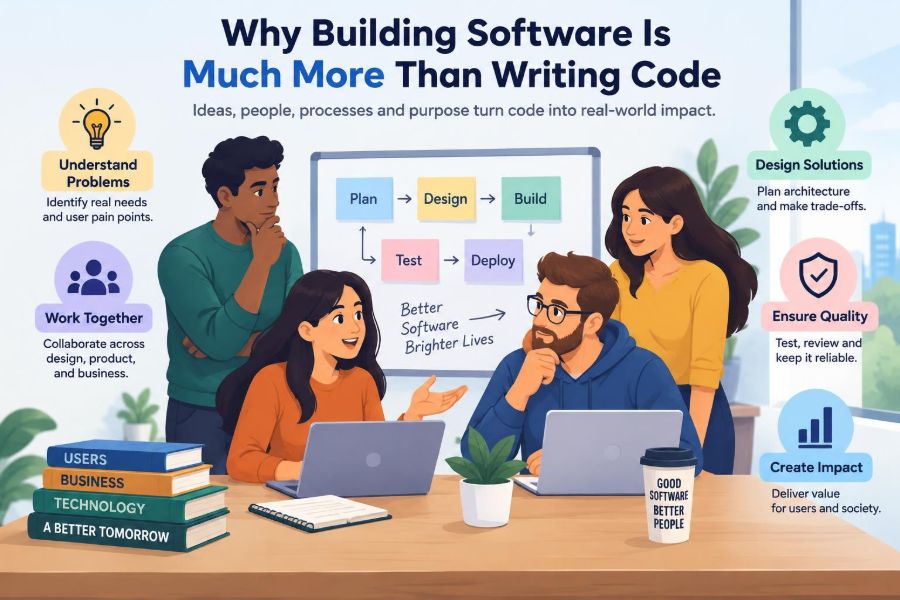

A customer reports that they cannot complete a purchase. The developer finds the faulty condition, changes three lines, and deploys a fix. That looks like software engineering at its simplest: identify a bug, write code, ship it.
But before those three lines can safely reach users, someone must understand the report, reproduce the problem, check whether it affects payments, review the change, test it, decide when to release it, monitor the result, and explain what happened. The code is real work—but it is only one part of the work.
The same pattern appears when a team builds a new feature. “Add team invitations” sounds small until it raises questions about permissions, email delivery, duplicate accounts, abuse prevention, privacy, support workflows, and what should happen when an invitation expires.
Software succeeds when it solves a real problem reliably in a changing environment. That requires technical judgment, communication, design, operations, and an understanding of people—not merely the ability to make a program run.
🧩 Code Is an Implementation, Not the Whole Product
Code expresses instructions for a computer. A product is the useful outcome created when those instructions meet a user’s need within constraints such as time, money, security, and reliability.
A beautifully written search algorithm does not help if people cannot find the search box, results are stale, or the system fails when traffic rises. Conversely, a simple implementation can be excellent when it is understandable, dependable, and appropriate for the problem.
Writing code answers “how will the system behave?” Software engineering must also answer “what should it do, for whom, and at what cost?”
🎯 The Real Work Begins With Problem Definition
Requirements are often stated as solutions: “We need a dashboard” or “add an AI assistant.” A stronger starting point is the underlying problem: which decision is difficult, which task takes too long, or which error keeps occurring?
Consider a manager asking for a dashboard showing late orders. The real need may be to contact at-risk customers sooner. A daily report, alert, or improved fulfillment workflow could solve that need more directly than a large dashboard.
Useful discovery asks what users do now, where they struggle, what a successful outcome looks like, and what must not get worse. This prevents teams from efficiently building the wrong thing.
👥 Software Has Many Stakeholders
The person requesting a feature is not always the person using it. A change to an online checkout can affect shoppers, support agents, finance teams, warehouse staff, and engineers responsible for incidents.
Different stakeholders carry different kinds of knowledge. Users know their workflow; domain specialists know rules and exceptions; operations teams know failure modes; legal or security colleagues may know obligations the interface does not reveal.
Ignoring a group does not make its needs disappear. It usually means those needs return later as confusing tickets, manual workarounds, or costly redesigns.
🔍 Requirements Are Conversations, Not Checklists
A requirement document can be valuable, but it cannot remove ambiguity by itself. Phrases such as “fast,” “secure,” “simple,” and “support multiple accounts” need interpretation.
For example, “users can delete projects” prompts necessary questions: Can anyone delete one? Is deletion immediate or reversible? What happens to invoices, shared files, audit records, and integrations?
Good engineers make assumptions visible. They use examples, sketches, acceptance criteria, and follow-up questions to turn a vague request into behavior that can be discussed and tested.
🗺️ Understanding the Domain Prevents Elegant Mistakes
A domain is the area of real-world knowledge a system represents: healthcare appointments, freight delivery, subscriptions, classrooms, or something else. Domain rules are often more complex than the screen suggests.
In a booking system, “available” may mean a room is empty, a clinician is qualified, equipment is present, insurance is accepted, and a cleaning buffer has elapsed. Treating availability as one Boolean value can create serious operational errors.
Engineers do not need to become subject-matter experts overnight. They do need to learn enough vocabulary and rules to model the important distinctions correctly.
🧱 Architecture Shapes Future Change
Architecture is the set of significant structural choices in a system: how components communicate, where data lives, which responsibilities are separated, and which dependencies are accepted. It is not just a diagram of boxes.
A quick solution can be sensible for a short-lived internal tool. A public service handling sensitive data may need stronger boundaries, logging, backups, and failure isolation. The “best” architecture depends on expected change, risk, team capacity, and operating conditions.
Architecture matters because it makes some future changes easy and others expensive. It should be deliberate, but not treated as a prediction that must never be revised.
⚖️ Engineering Is Mostly Trade-Off Management
Many technical choices improve one quality while making another harder. More caching can reduce latency but create stale data. Stronger validation can reduce bad input but add friction. A distributed design can isolate failures but increases operational complexity.
| Choice | Potential gain | Potential cost |
|---|---|---|
| Rapid delivery | Earlier learning from users | May leave cleanup or limited coverage |
| Generalized design | Can support variation later | May solve needs that never arrive |
| Strict controls | Reduces some security risks | Can slow legitimate work |
The skill is not finding a perfect option. It is making the trade-off visible, choosing it for a reason, and revisiting it when assumptions change.
📐 Design Makes Behavior Understandable
Software design includes user-interface design, but it also includes the internal shape of code and data. In both cases, the goal is to make correct behavior easier and incorrect behavior harder.
A clear interface tells a person what will happen before they act. A clear module tells a maintainer where a rule belongs. Both reduce cognitive load: the mental effort required to understand a system.
Names, boundaries, error messages, defaults, and workflows are design decisions. Small choices in these areas accumulate into either clarity or confusion.
🧪 Testing Is Evidence, Not a Ritual
Tests provide evidence that specified behavior works under particular conditions. They do not prove that a system has no defects, because real inputs, environments, and interactions are too broad to exhaust completely.
Different tests answer different questions. A unit test checks a focused piece of logic; an integration test checks components working together; an end-to-end test exercises a user-facing flow. Manual exploratory testing is still valuable for surprising behavior and usability issues.
A useful test suite focuses on consequential behavior: calculations, permissions, state changes, boundaries, and previously fixed defects. Hundreds of shallow tests can be less useful than a smaller set that protects important outcomes.
🐛 Debugging Is Investigation Under Uncertainty
A bug report is often a clue rather than a diagnosis. “It stopped working” may involve a browser extension, missing data, a timing issue, an external service, or a misunderstanding of expected behavior.
Effective debugging narrows uncertainty. Reproduce the issue, inspect relevant logs and inputs, form a hypothesis, change one meaningful variable, and verify the result. Random edits may occasionally work, but they create fragile knowledge.
The durable outcome is not only a patch. It is an explanation of why the failure occurred and, when practical, a test, alert, or guardrail that makes recurrence less likely.
🔒 Security Must Be Built Into Decisions
Security is not a final checklist item. It concerns who can do what, which data is exposed, how secrets are handled, what inputs are trusted, and how the system responds when something goes wrong.
For example, hiding an administrative button is not authorization. The server must independently verify that the requester has permission. Similarly, encrypting a database does not resolve overly broad employee access or unsafe data exports.
Threats and appropriate controls vary by system. The practical habit is to ask early: what could be abused, accidentally disclosed, altered, or made unavailable, and what protections are proportionate?
🔐 Privacy Is About Data Lifecycle, Not Just Storage
Privacy asks why a system collects personal information, who can access it, how long it remains useful, and how people understand or control its use. A field that seems harmless in isolation can become sensitive when combined with other data.
Collecting less data often reduces complexity as well as exposure. It simplifies permissions, support requests, migrations, breach impact, and deletion processes.
Requirements differ by context and location, so teams should involve appropriate specialists when obligations are unclear. Engineers still have a direct role: make data flows visible and avoid treating personal data as ordinary test material.
🗃️ Data Models Encode Business Meaning
A database schema is not merely a technical storage choice. It defines what the system considers an order, membership, refund, account, or event—and which relationships and histories can be preserved.
Suppose a subscription record has only “active” and “inactive.” That may be insufficient when billing needs to distinguish trial, overdue, canceled at period end, paused, and refunded. Collapsing meaningful states forces application code and support staff to guess later.
Good data modeling identifies stable concepts, constraints, ownership, and lifecycle. It also anticipates that data outlives many individual features.
🔄 Integrations Turn Local Assumptions Into System Risks
Most useful software depends on something else: payment providers, identity systems, maps, email services, internal APIs, or devices. An integration can fail slowly, return partial data, send duplicate events, or change its behavior.
Robust integration work considers timeouts, retries, idempotency, and observability. Idempotency means repeating a request has the same intended effect as processing it once—crucial when networks make delivery uncertain.
Teams should also plan for degraded operation. Can users save work while an external service is unavailable? Can a task be retried safely? These questions are engineering, not pessimism.
🚀 Deployment Is a Product Decision
Code is not useful until it reaches the environment where people depend on it. Deployment includes building artifacts, configuring environments, applying database changes, releasing safely, and knowing how to recover.
A risky release is not automatically bad; sometimes an urgent fix is necessary. But the risk should be managed through small changes, feature flags, staged rollout, backups, rollback plans, and clear ownership.
A feature flag separates deployment from exposure. The code can be present without being enabled for everyone, allowing teams to validate behavior gradually. Flags also need cleanup; permanent flags become hidden complexity.
📈 Observability Lets Teams See Running Software
Once software is running, developers cannot infer its state from source code. Observability is the ability to understand a system through signals such as logs, metrics, traces, dashboards, and user reports.
Logs record discrete events. Metrics summarize measurements over time, such as request duration or queue depth. Traces follow work across services. Each reveals a different part of a problem.
Useful observability begins with questions: How would we know checkout is failing? Which dependency is slow? Can we distinguish a user error from a server error? Collecting every possible signal is expensive and can obscure the important ones.
🧯 Reliability Requires Planning for Failure
Servers restart, networks drop packets, disks fill, credentials expire, and people make configuration mistakes. Reliable systems are designed with this ordinary reality in mind.
Graceful failure may mean showing a clear message, preserving unsent work, limiting a cascading overload, or directing requests to a healthy component. It does not mean pretending failure is impossible.
Backups matter only if restoration is understood. Incident procedures matter only if people can find and use them under pressure. Reliability is therefore a combination of technical safeguards and practiced operational habits.
📣 Incidents Are Also Communication Problems
During an outage, customers need honest information about impact and progress, not speculation. Internally, teams need a clear coordinator, shared timeline, and a place to record decisions.
A calm update such as “some users cannot upload files; investigation is under way; existing files are safe” is more useful than silence or an overly confident cause. It helps support teams respond consistently too.
Afterward, a blameless review can examine contributing conditions: missing alerting, unsafe defaults, unclear ownership, or an unusual dependency response. The purpose is learning and system improvement, not assigning personal shame.
🤝 Collaboration Changes the Quality of Code
Software is usually maintained by a team, often across time zones and job roles. The quality of collaboration affects the quality of technical decisions because knowledge must travel.
Design discussions expose assumptions before implementation. Pairing can spread context during complex work. Written decisions preserve why a constraint exists after memories fade. None of these practices replaces coding; they make coding more effective.
The healthiest teams make it safe to say “I do not understand,” “this seems risky,” or “the requirement conflicts with another rule.” Silence is not alignment.
📝 Code Review Is Shared Reasoning
A code review should do more than catch typos. It is an opportunity to check whether the change fulfills the intended behavior, fits local conventions, handles edge cases, and remains understandable to the next reader.
Review quality improves when changes are small and contextual information is included: what problem is being solved, what alternatives were considered, and how it was tested. Large, unexplained changes invite shallow approval because careful review becomes impractical.
Comments should focus on the work rather than the author. “What happens if the account is suspended here?” opens discussion; vague criticism rarely does.
📚 Documentation Is Part of the Interface
Documentation serves users, operators, contributors, and future maintainers. A setup guide makes a project accessible; an API contract explains expectations; a runbook guides a response during an incident.
The most valuable documentation often captures non-obvious decisions: why a retry limit exists, which system owns a field, what must happen before a deployment, or why a tempting shortcut is unsafe.
Documentation can become stale, so it should be concise, close to the work, and updated as part of meaningful change. An ignored encyclopedia is less helpful than a short, reliable guide.
⏱️ Estimation Is About Uncertainty, Not Fortune-Telling
Estimates help teams coordinate scope, sequencing, staffing, and expectations. They become harmful when treated as guarantees despite unknown requirements, unfamiliar systems, or external dependencies.
Breaking work into smaller slices reveals uncertainty. “Build invitations” becomes permission rules, email provider behavior, acceptance flow, expired links, audit records, and support cases. Each slice can be investigated or delivered independently.
A good estimate includes assumptions and risks. If discovery reveals a new constraint, changing the estimate is responsible engineering, not failure.
📦 Scope Is a Quality Lever
When time is limited, teams often try to keep every requested feature and reduce engineering care instead. That can produce a release that appears complete but is difficult to support.
A better conversation asks which outcome is essential. Perhaps the first release supports one account type, manual approval, or a narrower workflow. This is not automatically “cutting corners”; it can be a deliberate way to learn before automating exceptions.
Scope reduction is harmful only when it removes the core value or conceals material limitations from users. Clear boundaries protect trust.
♻️ Maintenance Is the Majority of a System’s Life
After launch, software needs dependency updates, security patches, performance work, data corrections, accessibility improvements, bug fixes, and adaptation to changing business rules. The first release is the beginning of a system’s life, not its finish line.
Maintainable code favors clarity over cleverness. It has understandable names, limited coupling, useful tests, and reasonable paths for common changes. These qualities reduce the cost of future work, especially for people who did not write the original code.
Technical debt is best understood as a future cost created by expedient choices. Some debt is intentional and worthwhile; unmanaged debt accumulates interest as changes become slower and riskier.
♿ Accessibility Expands Who Can Use the Product
Accessibility considers whether people with different sensory, motor, cognitive, and situational needs can use a system. Keyboard navigation, meaningful labels, sufficient contrast, clear error messages, and predictable behavior help many users, not only those who identify as disabled.
It is cheaper and more effective to consider accessibility while designing a flow than to patch it after every interface decision is fixed. Automated checks can find some issues, but human testing remains necessary for real usability.
Accessibility is a practical measure of product quality: if an essential task only works for an idealized user in ideal conditions, the design is incomplete.
🌱 Ethics Appears in Ordinary Product Choices
Engineering decisions can influence who is included, what information is exposed, which behavior is encouraged, and who bears the cost of errors. These effects do not require dramatic or futuristic technology.
For instance, a default notification setting can create interruption; an opaque ranking can disadvantage some contributors; an irreversible automated action can harm people who cannot easily appeal. Asking who may be negatively affected improves design.
Ethical judgment rarely produces a frictionless answer. It does require teams to surface consequences, seek relevant perspectives, and avoid hiding value choices behind the phrase “the system decided.”
🧠 Learning the System Is Real Engineering Work
New engineers sometimes feel unproductive when reading code, tracing a request, studying a domain rule, or asking questions. In a mature system, this learning is often the work required to make a safe change.
Speed without context can produce local fixes that violate unseen invariants—conditions the system must always preserve. Taking time to map ownership, data flow, tests, and deployment paths prevents many such mistakes.
Experienced engineers are not people who immediately know every answer. They are often people who know how to reduce uncertainty efficiently and communicate what they have learned.
🛠️ A Practical Workflow Connects the Pieces
A lightweight workflow can prevent code from becoming disconnected from value:
- Describe the user or business problem and the desired outcome.
- Identify stakeholders, constraints, risks, and unanswered questions.
- Choose the smallest useful slice and define observable acceptance criteria.
- Design the data, interfaces, and failure behavior before implementation becomes expensive.
- Build, review, test, release gradually where appropriate, and monitor the result.
- Collect feedback, fix gaps, document learning, and decide what to improve next.
The sequence is not rigid. Urgent work may compress steps, and discovery may send a team backward. Its value is ensuring that essential questions are not forgotten.
🚫 Common Mistakes Come From Narrow Definitions of “Done”
“Done” should not mean merely “my code compiles.” That definition misses behavior, review, testing, documentation, deployment readiness, and the user’s actual ability to complete a task.
- Building from assumptions: solve this with early examples and stakeholder feedback.
- Optimizing too early: measure or establish a plausible need before adding complexity.
- Shipping without a recovery plan: know how to disable, roll back, or mitigate a harmful change.
- Ignoring support signals: recurring questions often reveal product or design defects.
- Deferring all cleanup: reserve time to remove obsolete code, flags, and fragile workarounds.
🧭 The Core Principle: Build Outcomes, Not Just Features
Writing code remains a central craft. It is where intentions become executable behavior, and strong implementation skills matter deeply. But code earns its value only within a wider system of decisions, people, processes, and consequences.
Software engineering means connecting those parts: understanding the problem, making informed trade-offs, designing for change and failure, collaborating clearly, and learning from real use. A feature is successful not because it was difficult to implement, but because it reliably improves the situation it was meant to address.
The central skill is not producing the most code; it is helping create the right outcome with care, evidence, and sustainable technical choices.
When you see software as a living service rather than a pile of files, every conversation, test, deployment, and maintenance task becomes part of the engineering craft. ⚙️ 🤝 🚀