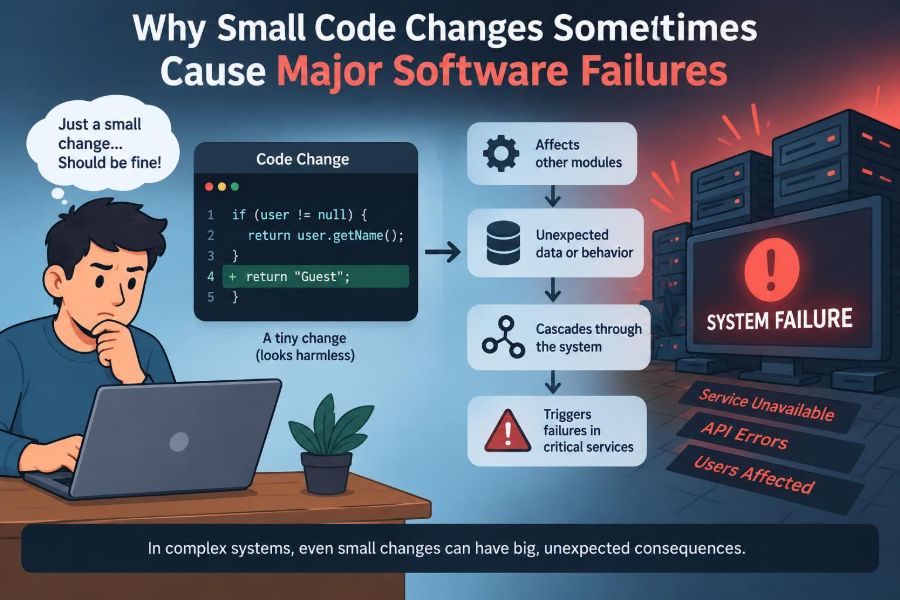

A developer changes one line to fix a display bug. The change passes local tests, receives approval, and is deployed without drama. Minutes later, customers cannot complete checkout, a background queue grows rapidly, or an internal tool starts returning confusing results.
The surprising part is not that bugs exist. It is that the visible change can be tiny while the failure is wide, expensive, and difficult to diagnose.
Software is a network of assumptions: about data, timing, dependencies, users, infrastructure, and the order in which work happens. A small edit can alter one assumption that many other parts quietly depend on.
Understanding this pattern helps engineers review changes more intelligently, design safer systems, and respond calmly when a “harmless” patch behaves very differently in production.
🧩 A Small Diff Is Not a Small Change
A code diff shows edited lines, not the full behavioral surface area of a change. Replacing a condition, renaming a field, or upgrading a library may affect every request, record, or process that passes through that point.
Consider a helper function called by ten services. Changing one default argument is visually small, but it may change the behavior of every caller that omitted that argument. Line count is therefore a poor measure of risk.
🕸️ Software Is a Dependency Network
Applications are built from connected components: modules call modules, services exchange messages, databases enforce constraints, and users create inputs developers did not predict. Each connection carries a contract, whether it is documented or merely assumed.
A failure occurs when a change breaks a contract at one connection and the resulting mismatch travels outward. The original edit may be correct in isolation while still being incompatible with its surroundings.
🔗 Hidden Coupling Makes Impact Hard to See
Coupling is the degree to which one part of a system depends on another. Some coupling is explicit, such as an imported function. Other coupling is indirect: two components may rely on the same database value, environment variable, cache key, or naming convention.
Hidden coupling is especially dangerous because ordinary code navigation may not reveal it. A change to a shared configuration value can affect a job that runs only overnight or a service owned by another team.
📜 Every Interface Carries a Contract
An interface contract includes more than a function signature. It can include accepted values, null handling, ordering, formatting, performance expectations, error behavior, and whether an operation is safe to repeat.
For example, changing an API field from an empty string to null may seem like an improvement in data meaning. A client that calls a string method without checking, however, may fail immediately.
🧱 Shared Code Amplifies Both Value and Risk
Shared utilities reduce duplication, but they concentrate influence. Authentication middleware, date parsers, feature-flag clients, serialization helpers, and logging libraries may sit on paths used by much of the application.
This does not mean shared code should never change. It means its changes deserve impact analysis that matches its reach: identify callers, verify assumptions, and deploy with a way to contain problems.
🧭 The Call Path Is Often Longer Than It Looks
A request might enter through a browser, pass a gateway, invoke several services, read a cache, write a database record, publish an event, and trigger asynchronous processing. A local modification can influence any later stage.
Tracing the expected call path before editing helps, but teams should also ask about alternate paths: retries, admin tools, batch imports, mobile clients, scheduled jobs, and older API consumers.
🌊 Edge Cases Are Where Assumptions Meet Reality
Most tests and manual checks use ordinary data: a valid account, a current browser, a small record set, and a stable network. Production includes expired sessions, duplicate messages, unusual characters, partially migrated data, and interrupted requests.
A conditional changed from > to >= may only affect a boundary value. If that value marks a billing threshold, permission level, or pagination cursor, the edge case may matter far more than its rarity suggests.
🗃️ Data Has a Longer Memory Than Code
Code can be deployed and rolled back quickly. Data persists. Old rows may contain formats created years ago, and records written by a new version may not be understandable by the old version after a rollback.
This is why schema and data migrations require special care. A code deployment can be reversible while a destructive database change is not.
🔄 Backward Compatibility Protects Existing Consumers
Backward compatibility means a new version continues to work with valid behavior or data from earlier versions. It matters whenever clients, stored data, plugins, services, or queued messages update at different times.
A safer pattern is often additive: introduce a new field, support both forms for a transition, migrate consumers, and remove the old form only when usage is understood. This adds temporary complexity but reduces coordinated-release risk.
⏱️ Time Turns Simple Logic into State
Many failures depend on timing. A token expires during a request, a cache refresh overlaps with an update, or a background job processes an event before another job has finished preparing related data.
Code that appears correct in a single, linear execution may fail when operations overlap. Time is effectively another input, and production supplies more timing combinations than a developer can manually inspect.
🏁 Concurrency Creates Race Conditions
A race condition occurs when the result depends on the order or timing of concurrent operations. Imagine two requests both see one remaining item in inventory and both reserve it before either writes its update.
A small optimization, such as moving a check outside a transaction, can reopen this risk. The right protection may be a database constraint, transaction, lock, atomic operation, or redesigned workflow; the choice depends on the system’s needs.
🔁 Retries Can Repeat Side Effects
Networks fail in ambiguous ways. A caller may time out without knowing whether the server completed its work, then retry. If the operation charges a card, sends an email, or creates an order, repeating it can cause harm.
Designing for idempotency means repeated requests produce the same intended final result. Idempotency keys, unique constraints, and careful state transitions make small retry-related changes less likely to multiply effects.
📬 Asynchronous Work Hides Delayed Failures
Queues and event streams decouple systems, which improves resilience and throughput. They also mean a deployment can look healthy while messages accumulate or a consumer starts rejecting an event shape hours later.
Producers and consumers may run different versions at the same time. Event changes should be treated as public interfaces, with compatible schemas and monitoring for failures, lag, and dead-letter queues.
🧠 Caches Can Preserve Yesterday’s Assumptions
Caches improve speed by returning previously computed values. They also introduce questions about freshness, invalidation, key construction, serialization, and isolation between users or tenants.
A hypothetical change that removes an account identifier from a cache key might pass tests with one account. In production, it could return one customer’s result to another. Cache changes require security as well as performance review.
🌐 Configuration Is Executable Behavior
Feature flags, environment variables, routing rules, permissions, timeouts, and deployment settings can change behavior as decisively as source code. They are often edited outside the usual code-review path.
Configuration failures are difficult because environments differ. A value that is harmless in development may activate a production-only integration, change a timeout under real load, or disable a necessary safety check.
📦 Dependency Updates Change More Than Versions
Updating a package can bring bug fixes and security improvements, but it can also alter defaults, validation rules, timing, transitive dependencies, and supported platform behavior. A version number changing in one file may represent a large behavior change.
Read release notes where practical, test the paths the library affects, and distinguish a patch-level update from a low-risk update. Version labels are useful signals, not guarantees of compatibility.
🔐 Security Fixes Need Functional Reasoning Too
Security-related changes may tighten validation, alter permissions, escape output, or reject previously tolerated input. Those changes can be correct and necessary while still breaking integrations that depended on unsafe or undocumented behavior.
The answer is not to weaken protection for convenience. It is to identify affected consumers, provide a migration path when possible, and make the safer contract explicit.
🧪 Tests Sample Behavior; They Do Not Prove Everything
Tests provide evidence, not a universal proof that a change is safe. Unit tests are excellent for local logic, while integration tests exercise boundaries such as databases, networks, and serialization. End-to-end tests reveal broader workflows but are slower and more selective.
| Test approach | Best at finding | Common blind spot |
|---|---|---|
| Unit test | Logic errors in a focused component | Incorrect assumptions at integrations |
| Integration test | Contract and infrastructure mismatches | Full user workflows and unusual traffic |
| End-to-end test | Critical workflow failures | Every data, timing, and scale variation |
A balanced test suite uses each layer for the uncertainty it can realistically reduce.
🧫 Test Environments Are Imperfect Models
Staging may have smaller datasets, fewer integrations, different permissions, simplified traffic, or cleaner data than production. A test database also rarely contains the historical irregularities of a long-lived production system.
Rather than assuming staging is identical, identify the differences that matter to a proposed change. Privacy-safe production-like data and realistic dependency behavior can expose risks that mock-heavy tests miss.
🔍 Code Review Should Explore Consequences
A strong review asks more than “Does this code look clean?” Reviewers should ask what contract changes, which callers are affected, what happens with absent or old data, and whether failure behavior remains sensible.
- What assumptions does this edit add or remove?
- Which paths use this shared component?
- Can retries, concurrency, or partial failure change the outcome?
- Is the rollback plan safe for data and messages already created?
These questions turn review into collaborative risk discovery rather than a search for stylistic flaws.
📏 Risk Depends on Reach, Not Just Complexity
A five-line change in authentication, money movement, authorization, migrations, or request routing can deserve more caution than a hundred-line isolated UI adjustment. Risk rises with blast radius, irreversibility, uncertainty, and difficulty of detection.
Teams benefit from explicitly classifying high-risk changes. The classification should trigger proportionate safeguards, not bureaucracy for its own sake.
🚩 Feature Flags Separate Deployment from Release
A feature flag allows code to be deployed while its behavior remains disabled or limited. This can reduce exposure by enabling a change for internal users, a small cohort, or a noncritical path before broader release.
Flags have costs: stale flags confuse future maintenance, combinations create complexity, and a flag cannot undo a destructive migration. Give each flag an owner, clear behavior, and a removal plan.
🧯 Progressive Delivery Limits the Blast Radius
Canary releases, phased rollouts, and similar techniques expose a new version gradually. Instead of asking whether a change is perfectly safe, a team asks whether it behaves acceptably under limited real traffic.
This only works with meaningful observation and a quick rollback or disable path. Releasing slowly without watching relevant signals merely delays discovery.
📈 Observability Reveals What Tests Did Not
Observability is the ability to infer a system’s internal behavior from signals such as logs, metrics, traces, and alerts. Useful signals connect to user outcomes: error rates, latency, queue depth, failed payments, or completed workflows.
Logs should include enough context to investigate without leaking sensitive information. Tracing can be especially valuable in distributed systems because it shows where a request changed direction or failed.
🛑 Rollback Is a Design Capability
A rollback plan is not merely a button in a deployment tool. Teams must consider whether old code can read new records, whether messages already emitted remain valid, and whether a third-party side effect can be reversed.
For risky work, state the rollback conditions before release: which signals trigger it, who decides, and what recovery is required if code rollback alone is insufficient.
🧰 Safer Database Change Patterns
Database changes are safer when application versions can coexist. A common sequence is expand, migrate, switch, and contract: add compatible structure, backfill data, move reads and writes, then remove obsolete structure later.
For example, do not rename a widely used column in one step if old application instances may still run. Add the replacement, keep values synchronized during transition, and retire the old column only after compatibility is no longer needed.
🧑💻 Human Factors Shape Technical Failures
Interruptions, time pressure, unclear ownership, unfamiliar code, and overly broad review requests make mistakes more likely. Many incidents are not caused by carelessness; they arise from reasonable decisions made with incomplete information.
Smaller, focused changes are easier to understand and revert. Clear ownership and documentation of critical contracts reduce the amount of system history an engineer must reconstruct during urgent work.
🗣️ Incident Reviews Should Improve the System
After a failure, the useful question is not “Who made the mistake?” but “What conditions allowed this outcome to reach users?” A blameless review can identify missing tests, unclear contracts, weak alerts, risky deployment practices, or insufficient guardrails.
The goal is concrete learning: improve a check, document a dependency, add an invariant, or redesign a fragile interface. Repeating “be more careful” rarely changes the system that produced the error.
📝 A Practical Pre-Release Checklist
Not every edit needs a formal ceremony. For changes with meaningful reach, a short deliberate check can prevent rushed assumptions.
- Describe the behavior change, not only the code change.
- List direct callers, consumers, and stored data affected.
- Check nulls, boundaries, duplicates, old formats, and failure paths.
- Choose tests that exercise the changed contract.
- Decide how to observe the release and how to stop it safely.
- Confirm compatibility with rollback, concurrent versions, and queued work.
🎯 The Core Principle: Reason About Systems, Not Lines
Small changes cause major failures when they alter an assumption with a large or poorly understood reach. The risk is not located in the number of edited lines; it lives in dependencies, interfaces, data history, timing, and operational context.
Good engineering does not require predicting every possible failure. It requires making assumptions visible, reducing exposure, testing the boundaries that matter, observing real behavior, and designing recovery before it is urgently needed.
The safest teams treat every change as a change to a living system, then match their caution to its real blast radius rather than its diff size. 🐞🔍🛠️