
A developer opens a familiar issue: add a validation rule, update an API response, write tests, and make sure an old integration still works. A few years ago, the work might have begun with documentation searches, a blank editor, and a long stretch of focused coding.
Now, the first move may be to ask an AI assistant to map the relevant files, propose a plan, draft a patch, and run the test suite. The developer is still responsible for the change, but the shape of the work has shifted.
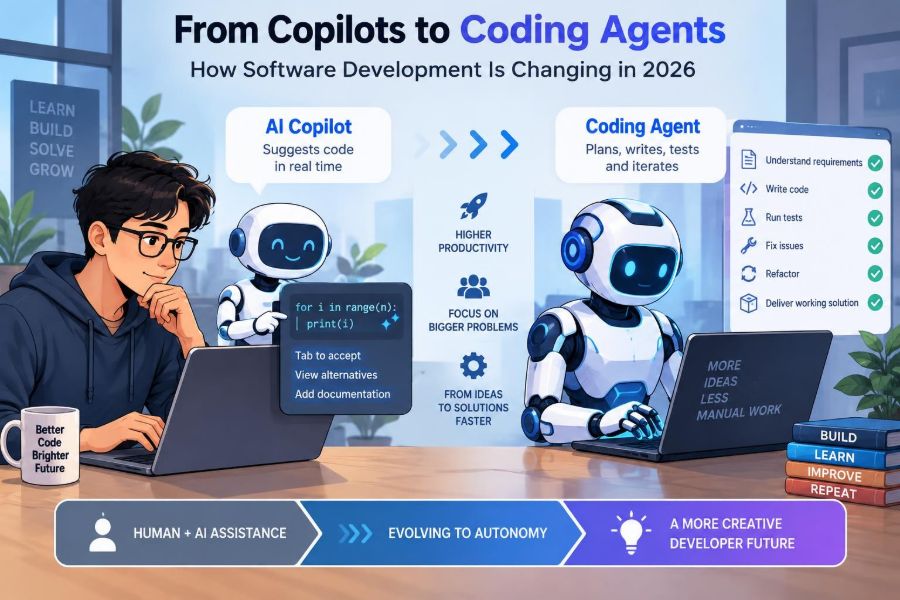
This is not simply faster autocomplete. Modern tools are increasingly able to take a goal, inspect a repository, use development tools, revise their own output, and return a proposed result. That makes them coding agents, not just coding copilots.
The distinction matters for students deciding what to learn and professionals redesigning how their teams build software. Development is becoming less centered on typing every line and more centered on specifying, verifying, integrating, and making sound engineering judgments.
🧭 The Shift From Suggestions to Delegated Work
A copilot usually responds in the immediate context of a developer’s cursor: complete this function, explain this error, or generate a test. A coding agent can work toward a broader objective across multiple steps.
For example, an agent might be asked to “add CSV export to the reporting screen.” It may inspect the user interface, find the report data source, identify authorization rules, modify several files, run tests, and summarize its changes. Each action still needs constraints and review, but the unit of assistance is now a task, not merely a line of code.
🧩 What Makes a Tool an Agent?
An agent is software that can pursue a goal through a loop of planning, acting, observing, and adjusting. In development environments, its actions may include reading files, searching code, editing branches, running commands, querying documentation, and opening a pull request.
Language models supply the reasoning-like interface: they turn natural-language goals into candidate actions. Tools supply the leverage. Memory or a working context supplies continuity. Without reliable access to repository state and feedback from tools, an assistant remains much closer to a conversational helper.
🔄 The Agent Loop in Practice
A typical agent workflow resembles a junior engineer’s first pass through a ticket, although its strengths and weaknesses are different. It gathers context, proposes an approach, changes code, checks results, then revises if checks fail.
- Interpret: translate the request into concrete requirements and unknowns.
- Investigate: inspect relevant code, configuration, tests, and documentation.
- Plan: choose files and changes, ideally exposing assumptions before editing.
- Execute: write code and invoke permitted tools.
- Verify: run tests, linters, builds, or targeted checks.
- Report: explain the patch, evidence, limitations, and remaining questions.
That loop can save substantial setup time. It can also magnify a bad assumption across many files, which is why boundaries matter.
⌨️ Why Autocomplete Still Has a Place
Copilots have not become obsolete. Inline completion is often ideal for a developer who already understands the local design and wants to avoid repetitive typing. It is quick, low-disruption, and easy to accept or ignore one suggestion at a time.
Agents fit a different shape of work: repository exploration, repetitive migrations, test scaffolding, documentation updates, and well-bounded bug investigations. Treating every request as an agent task can create unnecessary overhead, especially for a two-line edit.
| Mode | Best fit | Primary human responsibility |
|---|---|---|
| Autocomplete | Local implementation details | Directly inspect each suggestion |
| Chat assistant | Explanation, brainstorming, debugging discussion | Supply context and evaluate advice |
| Coding agent | Multi-step, bounded repository tasks | Define scope, permissions, and acceptance criteria |
🗺️ Repository Understanding Is the Real Bottleneck
Generating syntactically valid code has never been the hardest part of maintaining a mature system. The hard part is learning which conventions, dependencies, feature flags, data contracts, and historical compromises constrain a change.
Agents can search a codebase rapidly, but search results are not understanding. A similarly named service may be deprecated. A passing test may encode an outdated behavior. A missing comment may conceal a compliance requirement. The developer who knows how to build a trustworthy mental model of a system remains valuable.
🎯 Better Requests Produce Better Changes
“Fix the checkout bug” leaves an agent to invent too much. A stronger task describes the observed behavior, intended behavior, affected boundary, non-goals, and how success will be checked.
For example: “When a signed-in user’s coupon has expired, show the existing invalid-coupon message and preserve the cart. Do not change guest checkout. Add a regression test at the API boundary and run the checkout test suite.” This does not guarantee a correct patch, but it reduces ambiguity and makes review concrete.
📋 Planning Before Editing Reduces Surprise
For meaningful changes, ask the agent for an investigation and plan before granting it broad editing authority. A useful plan names likely files, explains the proposed data flow, identifies risks, and lists tests.
This is not bureaucracy. A plan catches mistaken assumptions while they are still cheap. It also lets a staff engineer review direction without reading a large generated diff line by line before understanding its purpose.
🧪 Tests Become the Agent’s Guardrails
Automated tests are not only a quality practice; they become part of the interface through which an agent learns whether its change is plausible. A failing focused test gives much more useful feedback than a vague instruction to “make it work.”
However, passing tests are evidence, not proof. Tests may miss a business rule, exercise a mock rather than production behavior, or fail to cover a concurrency path. Strong agent workflows use layered checks: focused tests, broader suites where practical, static analysis, type checks, and human review of the intended behavior.
🧱 Architecture Determines How Safely Work Can Be Delegated
Systems with clear boundaries are easier for both humans and agents to change. A well-defined module, stable interface, and focused test suite create a smaller area in which an agent can operate safely.
Conversely, a tightly coupled codebase turns a small request into a guessing exercise. If presentation logic, authorization, database access, and external calls are tangled together, neither an experienced engineer nor an agent can confidently isolate a change. AI adoption often reveals existing architectural debt rather than creating it.
🔍 Review Changes From Intent to Impact
Generated code can look polished while solving the wrong problem. Review should begin with intent: does this patch satisfy the stated acceptance criteria without changing unrelated behavior?
Then inspect impact: data handling, permissions, error paths, performance-sensitive loops, compatibility, and operational behavior. Finally, inspect implementation details such as naming, duplication, and maintainability. Starting at the business-level question prevents reviewers from spending all their attention on style while missing a flawed design.
🛡️ Security Cannot Be an Afterthought
An agent with shell access, repository credentials, package installation rights, or deployment capabilities has meaningful power. Its permissions should be designed as carefully as those of a new service account.
Use the least privilege necessary for the task. Keep secrets out of prompts and logs, isolate untrusted code execution where possible, and require approval for irreversible or externally visible actions. Treat tool output, issue descriptions, and repository files as potentially untrusted input; an agent can be misled by instructions embedded in text it reads.
🔐 Prompt Injection Is a Development Risk
Prompt injection occurs when content encountered by an AI system tries to redirect its behavior, such as a malicious issue comment telling a tool to reveal configuration values or ignore its task. The risk is especially relevant when agents browse tickets, documentation, web pages, or logs.
Practical defenses are procedural as well as technical:
- separate trusted instructions from untrusted retrieved content;
- limit access to secrets and sensitive commands;
- require confirmation before network, credential, or deployment actions;
- log tool calls and review unexpected behavior;
- avoid treating generated summaries as authoritative records.
No single control eliminates the risk. Layered limits reduce the consequences of a mistake.
📦 Dependency Changes Need Extra Scrutiny
Agents can quickly suggest libraries, version bumps, and configuration snippets. That speed is useful, but dependencies carry licenses, supply-chain exposure, maintenance obligations, and compatibility consequences.
A good review asks why a dependency is needed, whether an existing library already solves the problem, what code it runs during installation or build, and whether its version range is controlled. “The package made the error disappear” is not a sufficient engineering justification.
🧠 Context Windows Are Not Institutional Memory
An agent may appear to understand a project because it can summarize many files. Yet its active context is limited, selective, and vulnerable to outdated or incomplete information. It does not automatically inherit the team’s tacit knowledge about customers, incidents, or past trade-offs.
Teams should preserve important decisions in accessible forms: architecture decision records, concise runbooks, useful code comments, issue templates, and tests that state behavior. Clear project artifacts help human onboarding and give agents better evidence to work from.
🧰 Tool Use Changes the Definition of “Good at AI”
Skill is not mainly about finding a magical prompt. It is about decomposing work, choosing safe tools, supplying relevant context, and recognizing when the output is insufficient.
A capable engineer might ask an agent to locate all callers of a function, produce a migration plan, or generate tests for known edge cases. They would not ask it to infer a product policy that has never been written down. Good delegation begins by knowing what cannot be delegated.
👩💻 Junior Developers Need Deliberate Practice
There is a real risk in accepting large generated patches before learning how to trace control flow, read errors, design tests, and debug state. Those foundational activities develop judgment; skipping them can create developers who can produce changes but cannot validate them.
For learners, AI is most valuable when used as a tutor and sparring partner. Ask it to explain code after you attempt an explanation, generate exercises with hidden tests, compare two designs, or point out gaps in a debugging plan. Build small features manually often enough to understand what the agent is doing for you.
🧑🏫 Senior Engineers Become System Designers and Coaches
Senior work already extends beyond writing code: clarifying ambiguous requirements, designing boundaries, managing risk, and helping others make good decisions. Agents increase the leverage of these responsibilities.
The challenge is avoiding a bottleneck where one senior engineer must review an enormous volume of generated output. Teams need shared standards, constrained task types, automated checks, and review practices that distribute judgment instead of concentrating it in a single exhausted gatekeeper.
🏗️ The Pull Request Is Evolving
A traditional pull request mostly answers, “What code changed?” Agent-assisted work should also answer, “What was the task, what did the tool do, and what evidence supports the result?”
A useful description includes the acceptance criteria, design choices, commands or checks run, known limitations, and areas needing particular review. This improves collaboration regardless of whether the author is a human, an agent, or a human-agent pair.
📏 Measure Outcomes, Not Generated Volume
Lines of code, number of agent runs, and number of accepted suggestions are weak signals. They can reward busy output rather than better software.
More meaningful team questions include: Are lead times improving without more regressions? Are reviews becoming clearer or noisier? Are recurring support issues declining? Can developers explain and safely modify the changes they merge? Measurement should inform process changes, not become a quota for AI usage.
⚡ Speed Can Move Bottlenecks Downstream
If implementation becomes faster, other stages may become the constraint: unclear product decisions, limited test environments, slow code review, security approval, or manual release processes. Generating more patches does not automatically produce more customer value.
This is why teams should examine the whole delivery system. An agent that drafts code in minutes is less useful if integration takes weeks because interfaces are undocumented and environments are unreliable.
🐛 Debugging Requires Evidence, Not Plausible Narratives
Language models are good at generating explanations that sound coherent. In debugging, coherence is not enough. A useful diagnosis connects observed symptoms to reproducible evidence: logs, traces, a minimal failing case, a changed input, or a verified code path.
Ask agents to state hypotheses separately from facts and to propose discriminating experiments. For a timeout, that might mean comparing database query timing, connection pool saturation, and downstream response time rather than accepting the first likely explanation.
🧬 Legacy Systems Offer Both Opportunity and Danger
Large older systems often contain repetitive patterns, sparse documentation, and tests of uneven quality. Agents can help inventory modules, identify duplicated logic, add characterization tests, and draft modernization plans.
But legacy code also contains accidental behavior that users may depend on. Before refactoring, establish a behavioral baseline. Characterization tests do not claim what the system ought to do; they record what it currently does, making unintended changes easier to detect.
🌐 Documentation Becomes Executable Infrastructure
When documentation is precise enough to guide an agent, it is usually more useful to humans too. API examples, local setup instructions, module ownership, and runbooks reduce time spent guessing.
Some teams are moving toward repository instructions that describe build commands, conventions, testing expectations, and prohibited actions. Keep these instructions short and maintained. A detailed but stale document can confidently steer people and agents in the wrong direction.
⚖️ Accountability Does Not Transfer to the Tool
An agent can draft code, but it cannot hold a duty to users, customers, colleagues, or regulators. The organization and the people approving a release remain accountable for the system’s behavior.
This matters in ordinary work as much as regulated domains. A flawed recommendation engine, billing calculation, access-control change, or deletion workflow can harm users even if every line was generated quickly. “The agent wrote it” explains a process; it does not justify an outcome.
🚦 Choose Autonomy Levels Deliberately
Not every agent should receive the same freedom. Match autonomy to reversibility, blast radius, and the quality of available checks. A documentation formatting task can tolerate more automation than a production database migration.
| Autonomy level | Example | Appropriate controls |
|---|---|---|
| Suggest | Propose a refactor | Human makes all edits |
| Draft | Create a branch and tests | Human reviews before merge |
| Execute in sandbox | Run builds or migration rehearsal | Isolated environment and logs |
| Act with approval gates | Prepare a release change | Explicit confirmation at critical steps |
Autonomy should be earned through evidence that the workflow is observable and safe enough, not granted because a demo looked impressive.
🧩 Start With Narrow, Repeatable Workflows
The most reliable early uses are often bounded tasks with clear feedback: update tests after a known interface change, summarize a failing build, generate a changelog draft, locate likely owners, or make a mechanical rename with validation.
Start small, capture failures, and refine instructions and checks. A team that cannot consistently review a small automated patch is not ready to delegate open-ended feature work.
📝 Build an Agent-Ready Task Template
A lightweight template makes delegation more predictable without turning every issue into a specification document. It also exposes when a request is still too vague to implement.
- Goal: What user or system outcome should change?
- Scope: Which services, directories, or interfaces are in bounds?
- Constraints: What must not change? Which patterns are required?
- Acceptance checks: Which examples, tests, or observable results define success?
- Permissions: Which tools, environments, and external actions are allowed?
- Escalation: Which uncertainty requires a human decision?
🔧 Improve the System Around the Agent
Better prompts help, but the highest-value improvements are often ordinary engineering investments: reliable tests, fast local setup, type checking, reproducible builds, clear ownership, and small modules.
These practices create feedback loops that make both people and agents more effective. They also reduce dependence on a particular AI product. The durable asset is not a prompt library; it is a codebase whose behavior can be understood and verified.
🌱 A More Valuable Definition of Developer Productivity
Productivity is not the rate at which code appears in a repository. It is the rate at which a team safely turns worthwhile problems into reliable outcomes, while retaining the ability to maintain what it builds.
Agents may reduce the cost of routine implementation. That can free developers for discovery, design, accessibility, resilience, performance, and customer understanding. Or it can create a larger backlog of unclear, fragile changes. The difference comes from engineering discipline, not from the tool alone.
🔮 What Development Work May Look Like in 2026
Many developers will spend more time framing tasks, examining plans, reviewing diffs, investigating behavior, and connecting technical work to product intent. Writing code remains central, but it is increasingly one activity within a wider control loop.
Teams will likely use different modes for different risks: inline help for routine implementation, supervised agents for bounded changes, and tightly controlled automation for repeatable operational tasks. The exact tools will change quickly; the need for clear requirements and credible verification will not.
🏁 The Core Principle: Increase Leverage, Preserve Judgment
Coding agents are best understood as leverage. They can compress the distance between an idea and a working patch, especially when a project has good boundaries, tests, and documentation.
Leverage amplifies direction as well as effort. Clear goals, narrow permissions, observable actions, and rigorous review can turn it into a practical advantage. Ambiguity, weak checks, and blind trust can turn the same capability into faster delivery of defects.
The future-facing developer is not the person who avoids AI or accepts it uncritically; it is the person who can direct powerful tools while preserving evidence, accountability, and engineering judgment. 🤖🛠️🌱