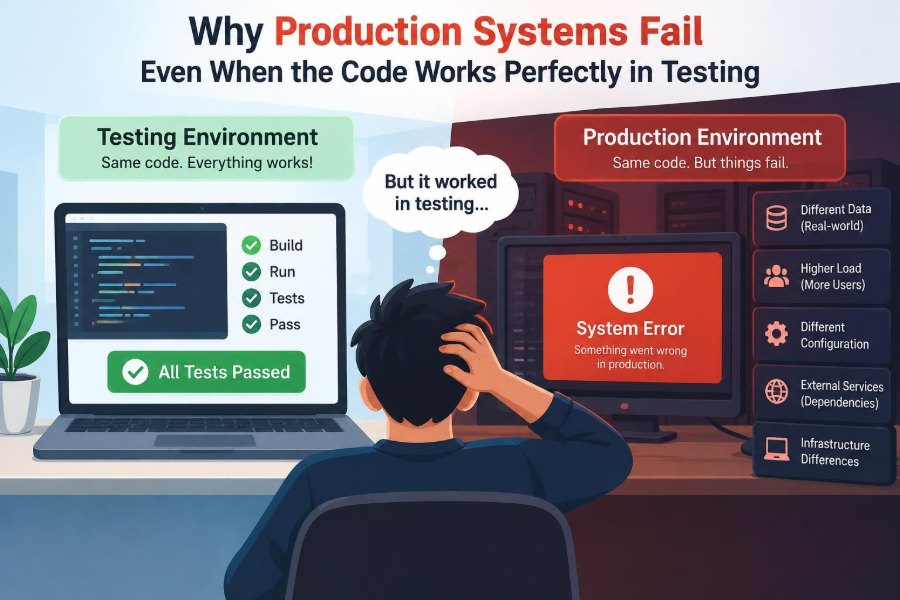

The feature passed every automated test. It worked on a developer laptop, behaved correctly in staging, and received a clean deployment approval. Then it reached production and began timing out under ordinary customer traffic.
This is one of the most frustrating experiences in software engineering because the code may not contain an obvious bug. The logic can be correct, the unit tests can be green, and the failure can still be entirely real.
Production is not simply a larger test environment. It is a live socio-technical system: real users, uneven traffic, shared infrastructure, old data, network failures, changing dependencies, and operational constraints all interact at once.
Understanding that difference changes what “done” means. Reliable software is not only code that produces the right answer under controlled conditions; it is code that continues to provide an acceptable service when its assumptions meet reality.
🧩 Correct Code Is Only One Part of Correct Behavior
A program can be logically correct and operationally unsuccessful. For example, an endpoint may calculate a customer’s invoice total accurately but take 40 seconds to do so during a busy period. From the customer’s perspective, a timeout is a failure, regardless of whether the calculation would eventually finish.
Testing often verifies functional correctness: given a known input, does the program produce the expected output? Production also demands performance, availability, security, recoverability, and understandable behavior under partial failure.
🌍 Production Has Conditions Testing Rarely Recreates
A test environment is intentionally controlled. Its data is usually smaller, traffic is predictable, access permissions are simplified, and connected services are more stable than their production counterparts.
Production contains variation that is difficult to fully copy: customers use unexpected input, background jobs overlap, caches expire together, deployment versions briefly coexist, and external providers occasionally slow down. Tests reduce uncertainty, but they cannot eliminate it.
🧪 What Tests Usually Prove—and What They Do Not
A passing test is evidence, not a guarantee. Its value depends on what it exercises, what it asserts, and how closely its environment matches the conditions where the system will run.
| Test type | Useful evidence | Common gap |
|---|---|---|
| Unit test | A small component handles specified cases | Real infrastructure and interactions |
| Integration test | Selected components communicate correctly | Production traffic and unusual data |
| End-to-end test | A representative user journey works | Scale, timing, and dependency degradation |
| Load test | Known workloads meet defined targets | Unexpected workload shapes and live contention |
The lesson is not that tests are weak. It is that each test answers a bounded question. Reliable teams know which questions remain unanswered.
📈 Real Traffic Has Shape, Not Just Volume
“The system handled 1,000 requests per second” is not enough information. Traffic arrives in patterns: morning peaks, campaign-driven surges, retries after errors, synchronized mobile clients, and a few expensive requests mixed with many cheap ones.
A hypothetical checkout service may work well at a steady load but fail when thousands of users submit payment at the same minute. Bursts exhaust connection pools, queues grow, and slow requests trigger retries that create even more load.
⏱️ Latency Compounds Across Dependencies
A request that calls several services inherits some of their delay and risk. If an API endpoint waits on a database, a payment provider, an inventory service, and a recommendation service, one slow dependency can dominate the whole user experience.
This is especially harmful when calls happen serially. A modest delay at each step becomes a noticeable delay overall, and a timeout late in the chain may waste work already completed upstream.
🌐 Networks Fail in Ambiguous Ways
Networks do not fail only by disconnecting completely. Packets can be delayed, connections can reset, name resolution can fail, and a request can reach a server while the response is lost on the way back.
That last case creates a difficult question: did the operation happen? Blindly retrying a payment, email send, or order creation can duplicate work. Production-safe designs use timeouts, retry limits, and idempotency—the ability to repeat an operation without changing the final result more than once.
🔁 Retries Can Turn a Small Incident Into an Outage
Retries are sensible when a failure is temporary, but they are not free. If every caller immediately retries a struggling service, the service receives more work precisely when it has the least capacity to recover.
Use bounded retries with backoff and jitter, meaning callers wait progressively longer and vary their retry timing. Also distinguish retryable failures, such as a transient connection error, from permanent ones, such as invalid input or missing authorization.
🗄️ Data in Production Is Older, Larger, and Messier
Test fixtures are usually tidy: a few users, valid records, straightforward relationships, and recently created data. Production databases accumulate historical imports, migrated records, blank optional fields, unusual Unicode text, duplicates, and entities with far more related rows than expected.
A query that is fast against a small fixture may become expensive when one customer has millions of events. Data-dependent behavior deserves explicit tests, realistic samples where privacy permits, and database plans reviewed against production-like scale.
🔒 Permissions and Identity Change the Execution Path
Code often runs in tests with broad credentials. In production, separate identities may be used by application instances, scheduled jobs, support tools, and deployment pipelines, each with different permissions.
Failures appear when an overlooked action needs access to a secret, storage bucket, queue, schema, or internal API. Least-privilege access remains a strong security practice, but it requires environments and deployment checks that reveal missing permissions before customer impact.
⚙️ Configuration Is Part of the Software
Feature flags, environment variables, timeout values, database URLs, memory limits, region settings, and secret references all influence behavior. A correct binary with an incorrect configuration is still an incorrect deployment.
Treat configuration as reviewed, versioned operational input. Validate it at startup where possible, provide safe defaults carefully, and avoid allowing minor spelling mistakes to silently activate dangerous fallback behavior.
🏗️ Infrastructure Has Its Own Failure Modes
Applications depend on compute capacity, disks, DNS, load balancers, certificates, clocks, and platform policies. These layers can be healthy enough to pass a simple health check while still causing request failures or elevated latency.
For instance, a container may be running but unable to accept useful work because it is out of file descriptors or waiting on a blocked downstream connection. Health checks should reflect whether an instance can safely serve traffic, not merely whether its process exists.
🧵 Concurrency Reveals Bugs Sequential Tests Miss
Many tests execute one operation at a time. Production executes many at once, exposing race conditions: failures caused by operations interleaving in an unexpected order.
Imagine two customers attempting to purchase the final item simultaneously. If both requests read “one item remaining” before either writes the new stock level, both may succeed unless the database or application enforces an atomic update.
🔐 Shared State Creates Hidden Coupling
Mutable shared state includes database rows, caches, files, message queues, and even in-memory objects within a long-running process. A change made for one request can affect another request later or elsewhere.
Clear ownership, transactional boundaries, and explicit consistency rules reduce surprises. Where strong consistency is too costly or unavailable, the product must be designed to handle temporary disagreement, such as an order status taking time to update.
💾 Caches Change Both Performance and Correctness
Caches reduce repeated work, but they introduce another copy of information that can become stale. A test that always reads fresh data may not reveal what happens when a customer sees an old permission, price, or inventory count.
Define what stale data is acceptable for each use case. Cache keys, invalidation behavior, expiration policy, and behavior during a cache outage are design decisions, not implementation details to postpone.
📬 Asynchronous Work Changes When Failures Appear
Queues and background workers make systems more resilient to spikes by moving work out of the request path. They also make outcomes delayed: a user may receive an immediate confirmation while the later email, invoice, or data export fails.
Workers need observability, retry policies, dead-letter handling for repeatedly failing messages, and safe reprocessing. A queue is not a guarantee that work happened; it is a record that work still needs reliable handling.
🔗 Third-Party Services Operate Outside Your Control
Payment processors, mapping APIs, identity providers, analytics tools, and email platforms have their own latency, quotas, deployment schedules, and incidents. A test double can verify your client code without reproducing their behavior under stress.
Design a graceful fallback where one is meaningful. A product may defer nonessential analytics or recommendations, while payment authorization may require a clear customer-facing failure path and a way to reconcile uncertain results later.
🧯 Resource Limits Arrive Before Machine Failure
Systems can fail while CPU and memory dashboards still look acceptable. Connection pools, worker threads, database locks, file handles, queue capacity, and rate limits are all finite resources.
One slow dependency can hold connections for longer, gradually exhausting a pool and preventing otherwise healthy requests from starting. Measure saturation, not only utilization: a resource near its limit often predicts trouble earlier than a final crash.
🪜 Deployments Create Mixed and Transitional States
During a rolling deployment, some instances may run old code while others run new code. Database migrations can outlive the release that introduced them, and clients may continue using an older API for a long time.
Prefer backward-compatible changes when possible. A safer sequence is often to add a new field or behavior, deploy readers that understand both forms, migrate data, and only later remove the old path.
🧱 Database Migrations Need Operational Design
A schema migration that is logically valid can still lock a busy table, consume excessive resources, or fail halfway through. Large backfills can compete with customer queries and create sudden load at the worst time.
Plan migrations as operations: assess lock behavior, make changes resumable, batch large updates, monitor progress, and retain a recovery path. “It ran quickly on staging” is not evidence that it is safe against production data volume.
🧭 Time Is More Complicated Than a Timestamp
Production systems cross time zones, daylight-saving transitions, clock drift, delayed messages, and independently deployed services. A test using one fixed clock rarely exposes these edge cases.
Store an unambiguous time representation when appropriate, define business-time rules explicitly, and inject clocks in code that makes time-sensitive decisions. Ordering based on local machine time is particularly risky in distributed systems.
📊 Monitoring Must Describe User Impact
A system cannot be operated well if its team learns about failure from social media or support tickets. Logs, metrics, traces, and alerts provide different views: individual events, numerical trends, request paths, and urgent signals.
Monitor outcomes customers notice, such as successful checkouts, completed uploads, and response latency, alongside internal indicators like queue depth or database saturation. A low error rate can conceal a serious problem if the failing requests are all high-value transactions.
🔎 Debuggability Is a Production Feature
When an incident occurs, engineers need enough context to ask what changed, which requests were affected, where time was spent, and whether a dependency was involved. Without correlation IDs and structured events, investigation becomes guesswork.
Useful observability avoids recording secrets or unnecessary personal data. The goal is not to log everything; it is to preserve the signals needed to distinguish a code defect, configuration issue, capacity problem, and external dependency failure.
🚦 Safe Releases Reduce the Blast Radius
A blast radius is the scope of harm if a change behaves badly. Releasing to a small subset of traffic, using a feature flag, or running a canary deployment limits exposure while the team observes real behavior.
These practices are not substitutes for testing. They are ways to learn under controlled production conditions, where the remaining unknowns—real data, dependencies, and workload—can finally be observed with a rapid rollback available.
↩️ Rollback Is Necessary but Not Always Simple
Rolling back application code may not undo a database migration, an emitted message, a changed cache entry, or an external side effect. A deployment plan should identify which changes are reversible and which require a forward fix or compensating action.
Teams should practice the mechanics before an incident: who can stop a rollout, how long reversal takes, what dashboards confirm recovery, and how to communicate a decision under pressure.
🧑🤝🧑 People and Processes Shape Reliability
Production reliability is not solely a property of technology. Unclear ownership, incomplete runbooks, unreviewed changes, missing handovers, and pressure to deploy without safeguards can turn a manageable defect into a long outage.
Healthy incident practice focuses first on restoring service and learning from conditions, rather than finding someone to blame. That makes it more likely that engineers will report risks early and improve the system that allowed the error to matter.
📝 Incident Reviews Should Produce Better Defenses
An effective review reconstructs what happened: triggering conditions, detection gaps, decisions, technical mechanisms, customer impact, and recovery. It asks why the system made the failure possible, not only why an individual action occurred.
Good follow-up work is concrete. Examples include adding a timeout, improving an alert, making a migration resumable, documenting a dependency limit, or changing a release gate. A vague action such as “be more careful” does not strengthen the system.
🧠 Design for Failure Instead of Assuming Success
Failure-aware design asks practical questions early: What happens if this call takes ten seconds? What if the message is delivered twice? What if the worker restarts after performing the side effect? What can the user do while a result is uncertain?
This mindset does not require building elaborate defenses for every hypothetical event. It means choosing protections in proportion to impact, likelihood, and the cost of recovery—especially around money, data integrity, safety, and customer trust.
🛠️ A Practical Pre-Release Reliability Checklist
Before release, use a short review that reaches beyond whether the feature works on a happy path. The right questions expose assumptions while there is still time to address them.
- What happens under increased traffic, slow dependencies, and partial network failure?
- Are timeouts, retries, and idempotency appropriate for each external action?
- Will old and new versions coexist safely during deployment?
- Does the change behave correctly with large, old, or malformed-but-accepted data?
- What metrics, logs, and alerts will show customer impact?
- Can the change be halted, rolled back, or repaired safely?
Not every release needs the same depth of analysis. A text-label change and a payment-flow change carry very different operational risks.
🎯 The Core Principle: Software Runs in Systems
The deepest mistake is treating production failure as proof that testing was pointless or that engineers should somehow predict every event. Neither conclusion is useful. Testing remains essential because it catches defects cheaply and clarifies intended behavior.
The broader principle is that code executes within a system of data, infrastructure, dependencies, timing, and people. Reliability improves when teams test deliberately, release gradually, observe continuously, and design recovery as carefully as success.
Production-ready software is not code that never encounters failure; it is software whose failures are bounded, visible, recoverable, and understood. That is the standard that turns a passing build into a dependable service. 🛠️🌍📈