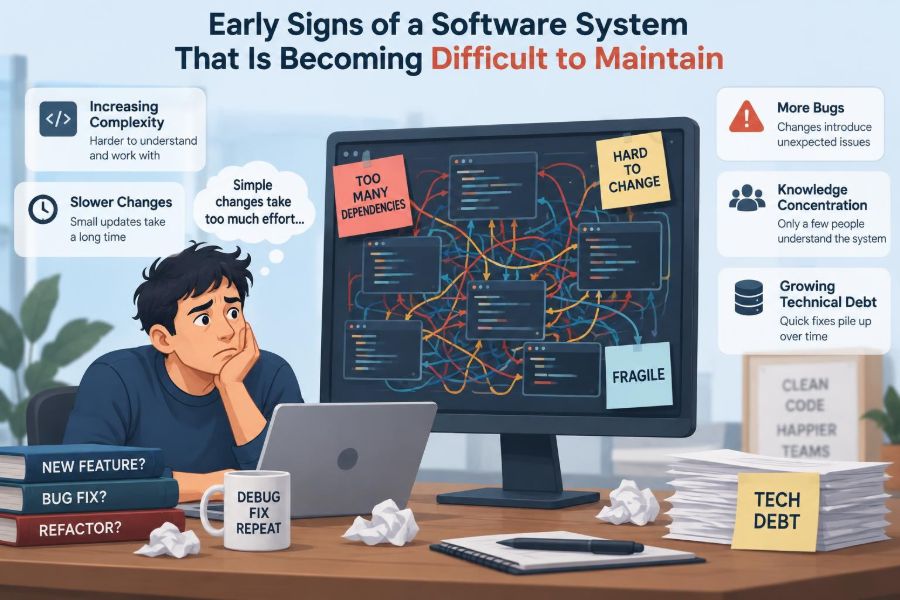

A product team adds a seemingly small feature: one more payment option, a slightly different onboarding route, a new field in an existing report. The estimate sounds modest. Then the work uncovers a chain of conditions, a fragile integration test, and a configuration file nobody feels confident changing.
Nothing may be visibly broken. Customers can still use the product, deployments may still happen, and the codebase may even be growing quickly. Yet the team starts paying a quiet tax: changes require more investigation, more coordination, and more caution than they should.
This is what declining maintainability often looks like in practice. It is rarely one dramatic failure. It is a pattern in which understanding and safely changing the system becomes steadily more expensive.
Recognizing the early signals gives a team options. It can improve the parts that slow delivery before a routine change turns into an urgent, risky rewrite.
🧭 Maintainability Is the Ability to Change Safely
Maintainability is a system’s ability to be understood, corrected, extended, tested, and operated without disproportionate effort. It includes source code, automated tests, build tooling, deployment processes, data models, documentation, and the knowledge held by people.
It does not mean a system must be elegant or perfectly abstract. A small internal tool may reasonably favor simplicity over elaborate architecture. The concern begins when ordinary changes repeatedly demand extraordinary care because the system’s behavior is unclear or tightly entangled.
⏱️ Small Changes Begin Taking Surprisingly Long
One of the clearest early signs is a widening gap between a request and the code change itself. Adding a display label might take ten minutes to implement but two days to trace through APIs, permissions, caches, templates, and tests.
Investigation is normal. Persistent investigation for routine work is not. Track where time goes in planning and delivery: reading unfamiliar code, reproducing behavior, waiting for answers, and repairing side effects are often more revealing than coding time alone.
🔍 No One Can Predict What a Change Will Affect
When developers routinely say, “I think this is safe,” rather than explaining why it is safe, the system has weak boundaries. A change in one area may quietly alter another because components share state, reuse ambiguous helpers, or depend on undocumented conventions.
Prediction does not require certainty. It requires a credible path from change to likely consequences, supported by module ownership, tests, observability, and clear interfaces.
🧶 A Single Feature Touches Too Many Layers
Cross-cutting features sometimes genuinely span layers. Authentication, auditing, and accessibility can reasonably affect many parts of an application. The warning sign is when ordinary domain work must modify a controller, several services, database queries, front-end state, background jobs, and deployment settings for no principled reason.
That pattern usually means business rules are scattered. The system has no obvious home for a concept, so each new feature is stitched through existing paths.
🧩 Names Stop Explaining Intent
Names such as processData, handleThing, utils, and manager often signal code that has accumulated responsibilities. They force readers to inspect implementation details before learning what a function or module is meant to do.
Good names cannot rescue poor design, but they preserve important decisions. Prefer names that reveal a domain action or policy, such as calculateRenewalPrice or rejectExpiredInvitation, over names that merely describe mechanics.
📦 “Utility” Modules Become a Shared Junk Drawer
A utility module is convenient at first: a place for genuinely general formatting, validation, or conversion routines. Over time, it can become the easiest destination for unrelated business logic, database shortcuts, and application-wide state.
As its imports spread, every change becomes harder to assess. Split such modules by responsibility and dependency direction. A pricing rule belongs near pricing, not beside date formatting simply because both were useful once.
🕸️ Dependencies Point in Every Direction
Maintainable systems tend to have understandable dependency flow. A user interface can call an application service; an application service can depend on a domain policy or repository interface. Problems arise when low-level modules import high-level features, or when neighboring components reach into each other’s internals.
Circular dependencies are especially revealing. They may work in a particular runtime, but they indicate that concepts are coupled in ways the structure does not express clearly.
🧱 Modules Know Too Much About One Another
A module should collaborate through a small, meaningful contract. If callers must know internal field names, lifecycle order, caching details, or which exceptions happen to leak out, they are coupled to implementation rather than capability.
For example, a checkout feature should ask an inventory service to reserve stock. It should not update inventory tables directly and then manually invalidate the inventory cache. Encapsulation gives teams room to change internals without coordinating every consumer.
🔁 Copy-and-Paste Fixes Keep Multiplying
Duplicated code is not automatically harmful. Two similar lines can be clearer than a premature abstraction. The concern is repeated logic that represents the same rule and must remain synchronized, such as eligibility checks copied into an API, a batch job, and an admin screen.
When a policy changes, teams must remember every copy. Consolidate behavior when variations move together; leave coincidental similarity alone until a shared concept is genuinely visible.
🎛️ Conditionals Grow Into Hidden Rule Engines
Long chains of conditionals often begin as sensible exceptions. After enough additions, they encode pricing tiers, account states, regional restrictions, and legacy behavior in one opaque sequence. Order matters, overlap is hard to spot, and no one can state the rules without reading code.
Extract named policies, decision tables, or strategy objects where they make the rules easier to inspect. The goal is not fashionable patterns; it is making business decisions explicit and testable.
🧨 One Class or Service Does Everything
A class that validates requests, applies domain rules, reads the database, sends emails, and formats responses has multiple reasons to change. Its tests become broad and setup-heavy, while a small adjustment risks behavior in unrelated responsibilities.
Separate responsibilities around meaningful boundaries. A coordinator may still orchestrate a workflow, but validation, persistence, notification, and policy decisions should be independently understandable where possible.
🧪 Tests Exist but Do Not Create Confidence
A large test suite can coexist with low confidence. Teams notice this when harmless refactors fail many brittle tests, while production defects slip through untested paths. The issue is not necessarily test quantity; it is whether tests check useful behavior at useful boundaries.
Reliable tests make a developer more willing to improve code. Tests that fail for irrelevant markup, timestamps, random ordering, or private implementation details make change feel dangerous.
🧱 Test Setup Is More Complicated Than the Behavior
If testing a small rule requires booting a database, configuring a message broker, creating dozens of unrelated objects, and mocking half the system, the design is telling you something. Dependencies may be too concrete, or the unit’s responsibility may be too broad.
Use integration tests where integrations matter. But isolate pure decisions and focused application behavior so their tests can express intent with small, readable setup.
🚨 Flaky Tests Become Background Noise
A flaky test sometimes passes and sometimes fails without a relevant code change. Common causes include timing assumptions, shared test data, real network calls, uncontrolled clocks, random input, and cleanup failures.
Once teams accept rerunning failures as normal, the suite loses its role as a warning system. Treat flakiness as a defect: identify the uncontrolled dependency, make it deterministic, or remove the unreliable test until it can be repaired.
📝 Comments Explain Surprising Behavior, Not Decisions
Comments that describe obvious syntax add little value. More useful comments preserve context that code cannot easily show: why a compatibility path remains, why an unusual limit exists, or what external behavior must not change.
A growing collection of comments such as “do not touch,” “magic,” or “temporary workaround” is an early maintenance signal. Record the reason, owner, and removal condition for a workaround—or turn it into a tracked decision rather than permanent folklore.
🗺️ Documentation Drifts Away From Reality
Outdated setup instructions, diagrams, and API descriptions create a second system that developers must distrust. New contributors then learn by trial, tribal knowledge, or production incidents instead of reliable guidance.
Documentation need not describe every implementation detail. Keep the high-value material current: local setup, architecture boundaries, operational runbooks, key data flows, and decisions that would otherwise be rediscovered.
👤 Critical Knowledge Lives With One Person
Every experienced engineer carries useful context. Risk appears when only one person knows how to deploy, diagnose a failure, interpret an integration, or safely modify a critical subsystem. Holidays, role changes, and incidents then become operational hazards.
Reduce this risk through pairing, reviews that explain context, rotation of on-call and maintenance work, concise runbooks, and deliberate ownership sharing. This is resilience, not a criticism of expertise.
🔀 Merge Conflicts Are Constant in the Same Files
Frequent conflicts in a few central files often mean too many features pass through a bottleneck. Examples include giant routing files, shared configuration, a monolithic database schema migration area, or a single “core” service.
Some contention is unavoidable in a small team. Repeated contention should prompt a structural question: can ownership be divided, registrations generated, configuration localized, or the central abstraction made smaller?
🏗️ Builds and Local Setup Feel Fragile
If developers cannot reliably build, test, or run the system from a documented path, maintenance cost rises before anyone changes application code. Hidden environment variables, unpinned tool versions, manual database steps, and machine-specific assumptions make defects difficult to reproduce.
A repeatable development environment is part of the product’s engineering system. Automate setup where practical, validate configuration early, and make required dependencies visible.
🚚 Deployments Require Heroics
A release that depends on a particular person, a late-night checklist remembered from experience, or manual changes in several consoles is difficult to maintain operationally. It also makes recovery uncertain when something goes wrong.
Improve deployment in increments: version configuration, automate repeatable steps, add pre-release checks, use reversible migrations where possible, and document rollback decisions. Full continuous delivery is not required before meaningful risk can be removed.
📊 Production Behavior Is Hard to See
Logs, metrics, traces, dashboards, and alerts are forms of observability: evidence that helps a team understand a running system. Without them, a bug report becomes guesswork, and engineers may change code simply to discover what it did.
Start with questions users and operators actually need answered: Did a request fail? Which dependency was slow? Did a background job complete? Avoid collecting data indiscriminately; useful signals should support investigation and respect privacy.
🗃️ Database Changes Feel Especially Dangerous
Fear around schema changes often reflects hidden coupling between data, application versions, reports, jobs, and external consumers. A column that appears unused may feed an export, an old worker, or an undocumented query.
Use migration practices that support transition: add new structures before removing old ones, backfill deliberately, maintain compatibility during rollout, and verify real usage before deletion. Data usually outlives individual releases.
🔌 Third-Party Integrations Leak Everywhere
When payment-provider types, cloud SDK calls, or vendor-specific error codes appear throughout the application, replacing or even upgrading that dependency becomes expensive. The provider’s model has become the system’s model.
Place an adapter around meaningful external capabilities. This does not eliminate vendor complexity, but it confines translations and lets core business code speak in its own terms.
📉 Defects Reappear in Familiar Areas
Repeated defects around the same workflow are often a design signal, not merely carelessness. The area may have unclear invariants—conditions that must always remain true—weak tests, confusing state transitions, or competing implementations of the same rule.
After fixing a recurring bug, ask what allowed its category to recur. Add a targeted regression test, clarify the invariant, and simplify the boundary that made the mistake easy.
🧯 Every Incident Produces Another Patch
During an incident, restoring service comes first. A local guard clause, retry, or feature flag may be exactly the right immediate response. The long-term problem is when emergency patches become the only form of learning.
Follow urgent repairs with proportionate review. Identify contributing technical conditions, improve detection, and decide whether a structural fix is worth scheduling. Not every incident justifies a redesign, but every recurring pattern deserves examination.
📅 Backlog Items Stay Vague and Perpetual
“Clean up technical debt” is too broad to guide action. A maintenance backlog becomes useful when items describe a concrete friction: split a shared billing service, remove an obsolete integration path, stabilize a test, or document a recovery procedure.
Connect work to outcomes the team can observe, such as shorter lead time for a common change, fewer failed deployments, or clearer ownership. This makes maintenance a delivery concern rather than an abstract aspiration.
⚖️ Not All Complexity Is a Design Failure
Some systems are difficult because their domain is difficult. Tax rules, healthcare workflows, financial reconciliation, and distributed coordination contain real complexity that cannot be refactored away. A maintainable design makes that complexity visible, localized, and testable.
Do not mistake unfamiliarity for poor design, or rewrite stable code merely because it looks old. Assess whether the complexity corresponds to a real requirement and whether engineers can safely reason about it.
🩺 Diagnose Before Choosing a Remedy
Different symptoms need different responses. A flaky suite needs determinism; unclear ownership needs organizational clarity; duplicated policy may need consolidation; slow builds may need tooling work. A broad rewrite is rarely the first or safest answer.
| Observed signal | Likely question to investigate | Possible first move |
|---|---|---|
| Slow routine changes | Where is investigation time spent? | Map dependencies around one common workflow. |
| Brittle tests | What irrelevant detail is being asserted? | Test behavior at a more stable boundary. |
| Repeated incidents | Which invariant is unclear or unenforced? | Add a focused check and regression test. |
| Deployment anxiety | Which steps are manual or irreversible? | Automate one repeatable, high-risk step. |
🎯 Improve the Most Expensive Path First
Trying to “clean up the codebase” all at once creates uncertain scope and interrupts useful delivery. Instead, choose a high-frequency or high-risk path: the onboarding flow changed every sprint, a service that causes on-call pages, or the module that blocks multiple teams.
Make a small improvement alongside feature work. This is often called the boy-scout approach: leave a part of the system clearer than you found it, while respecting release pressure and avoiding unrelated churn.
🧭 Create Guardrails That Preserve Improvements
Improvements fade if the same pressures recreate the problem. Lightweight guardrails can help: clear code review expectations, ownership boundaries, automated formatting and static analysis, dependency checks, test reliability expectations, and architectural decision records for consequential choices.
Guardrails should reduce cognitive load, not become bureaucracy. If a rule produces constant exceptions, revise it or understand why the architecture makes compliance impractical.
🤝 Treat Maintainability as Shared Product Work
Product managers, designers, engineers, support staff, and operators all encounter maintenance signals. Support sees recurring user confusion; operations sees fragile recovery; engineers see coupling; product sees delayed options. Combining those views produces better priorities.
Discuss maintenance in concrete trade-offs: “This refactor lets us change eligibility rules in one place,” not “We need to improve code quality.” Clear consequences make capacity decisions more grounded.
🌱 The Core Principle: Keep Change Understandable
Early maintainability problems are usually signals of lost understanding: behavior is scattered, dependencies are hidden, tests are untrustworthy, and knowledge is concentrated. The system becomes hard to change long before it becomes impossible to run.
The practical response is steady rather than dramatic. Make boundaries clearer, preserve decisions, automate repeatable work, observe production behavior, and use real delivery friction to choose improvements. A healthy system is not one that never changes; it is one that can change without relying on luck.
Maintainability is built by repeatedly making the next safe change easier to understand than the last. That habit protects delivery speed, operational confidence, and the people responsible for the system. ⚙️🧭🌱