
A product team is halfway through a promising quarter when a familiar request arrives: add a new customer workflow, support another payment option, or expose an API that sales has already discussed with a prospect. The team can probably build it. The harder question is what the change will disturb.
A few files have become risky to touch. Tests take too long or fail intermittently. A simple request requires three approvals, a database workaround, and someone who remembers why an old integration behaves strangely. Meanwhile, pausing feature work to “clean everything up” is rarely realistic.
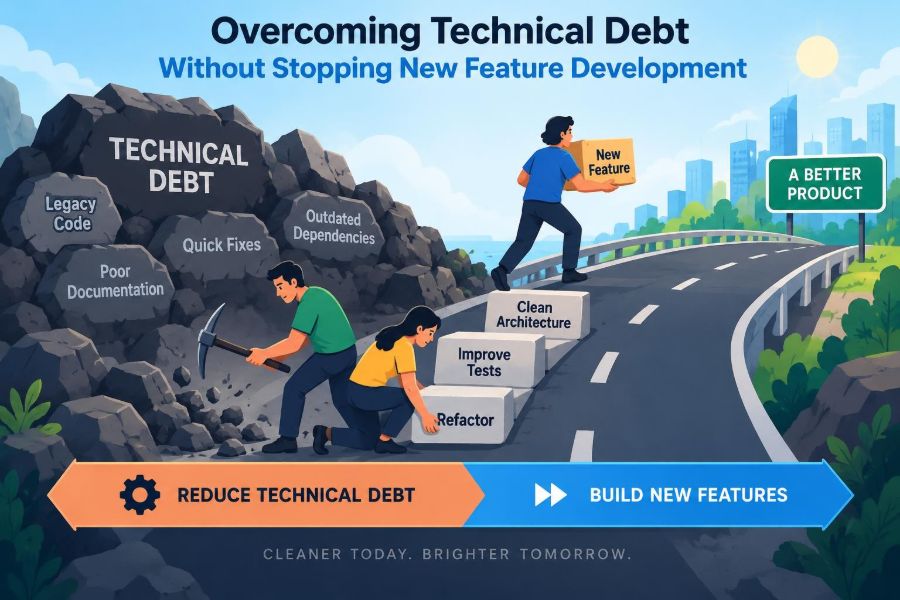
This is the practical tension of technical debt. Teams must deliver value now while preserving their ability to deliver value later. The goal is not a perfectly pristine codebase; it is a system whose risks, costs, and compromises are understood and deliberately managed.
That requires treating debt reduction as part of product delivery rather than as a competing activity that happens only when the roadmap is quiet.
🧾 Technical Debt Is a Delivery Cost, Not Just Messy Code
Technical debt is the future cost created when a team chooses a quicker or narrower solution today. The metaphor is useful because a shortcut can be sensible, but it carries interest: future changes become slower, less predictable, or more error-prone.
Debt is not synonymous with poor code. A small prototype, a temporary manual process, or a deliberately limited architecture can be responsible choices when uncertainty is high. It becomes harmful when the temporary decision outlives its context and nobody records its limits.
🔍 Separate Intentional Debt from Accidental Debt
Intentional debt is a conscious trade-off. For example, a team may launch with one identity provider because supporting several would delay validation of a new product. The decision has an owner, a reason, and a condition for revisiting it.
Accidental debt emerges from incomplete understanding, hurried changes, weak tests, outdated dependencies, or unclear ownership. Both forms deserve attention, but they need different responses: intentional debt needs a review point; accidental debt needs better engineering practices and discovery.
💸 Recognize the Interest Before It Becomes an Outage
The interest on debt appears in ordinary work: longer estimates, repeated defects, difficult onboarding, fragile releases, and engineers avoiding certain areas of the repository. These signals often matter more than an abstract code-quality score.
A nightly job that fails once a month may look minor until every failure consumes an afternoon of investigation. A copied validation rule may seem harmless until policy changes require editing it in six places. The cost is cumulative because it interrupts planned work.
🧭 Start with Product Outcomes, Not a Refactoring Wish List
“Modernize the backend” is too broad to prioritize well. Connect debt to an outcome such as faster checkout changes, safer releases, reduced support work, or the ability to serve a new region.
This framing changes the conversation. Instead of asking stakeholders to fund code cleanliness, a team can explain that extracting pricing rules will make upcoming discount features cheaper and reduce the chance of inconsistent customer totals.
🗺️ Build a Lightweight Debt Inventory
A debt inventory should be useful, not bureaucratic. Record the affected component, the observable problem, likely consequence, relevant upcoming work, a possible remedy, and an owner who can keep the entry current.
- Problem: order status logic is duplicated across the web app and worker.
- Impact: status changes can disagree and require two coordinated releases.
- Trigger: planned returns workflow needs new statuses.
- Next step: introduce one shared transition module while building returns.
This makes hidden constraints visible without pretending that every issue deserves immediate repair.
📊 Prioritize by Cost, Risk, and Opportunity
Not all debt is urgent. A useful prioritization discussion weighs the pain paid today, the risk of failure, the likelihood of touching the area soon, and the effort needed to improve it.
| Signal | What it suggests | Typical response |
|---|---|---|
| Frequent defects | Customer or operational risk is already present | Stabilize before adding complexity |
| Upcoming feature touches it | Repair can be combined with delivery | Use a scoped incremental refactor |
| Rarely changed legacy area | Immediate value may be low | Document boundaries and monitor |
| Security or data integrity concern | Failure impact may be unacceptable | Escalate and address promptly |
Prioritization is judgment, not arithmetic. A low-frequency flaw can still outrank everything else if it threatens sensitive data or financial correctness.
🎯 Give Every Debt Item a Specific Trigger
A vague promise to fix something “later” usually means it will compete forever with visible feature requests. Attach a trigger: before the next partner integration, when the current library reaches an unsupported state, or whenever a related module is changed.
Triggers turn cleanup into a planned decision. They also prevent premature rewrites of code that may never need to evolve.
🧱 Reserve Capacity Without Creating a Separate World
Many teams reserve a modest, adjustable share of iteration capacity for reliability, maintenance, and debt reduction. The exact amount depends on system condition, team size, and commitments; a fixed percentage is less useful than reviewing whether the allocation reduces recurring pain.
The essential point is visibility. If maintenance work has no place in planning, it still happens—through interruptions, rushed patches, and invisible overtime.
🔗 Repair Debt Along the Feature Path
The most sustainable approach is often opportunistic refactoring: improve a component when a feature already requires changing it. A new notification preference may be the right moment to separate notification rules from delivery channels.
Keep the repair proportional. Replacing a tangled method with a tested boundary that supports the new behavior is different from redesigning the entire messaging platform. The first lowers immediate delivery risk; the second needs its own business case.
✂️ Slice Work Vertically, Not by Technical Layer
A vertical slice delivers a small end-to-end capability: interface, business rule, data handling, and observability. It exposes integration problems early and leaves the system working after each increment.
For example, support one new account type through the complete signup flow before building a generalized account framework. The slice can reveal which abstractions are actually needed, avoiding architecture built for imagined requirements.
🧪 Use Tests as a Safety Harness
Tests do not guarantee correctness, but they make change safer when they verify meaningful behavior. Before altering fragile code, add characterization tests: tests that describe what the software currently does, including awkward edge cases.
Then refactor in small steps. If testing is difficult because dependencies are tangled, that difficulty is useful information. Introduce seams—clear boundaries around time, storage, network calls, or external services—rather than attempting a broad rewrite first.
🚦 Keep the Main Branch Releasable
Long-lived branches allow a large refactor to drift away from ongoing feature work. When finally merged, they create conflicts, uncertain behavior, and a stressful release event.
Prefer small, integrated changes guarded by tests, configuration, or feature flags. A releasable main branch does not mean every unfinished capability is visible to users; it means deployment remains a routine option rather than a high-stakes event.
🏳️ Use Feature Flags Carefully
A feature flag separates deployment from release. It can let a team merge structural work, test behavior internally, and enable a feature gradually. This is particularly valuable when a database migration or risky integration must precede customer access.
Flags also create debt if they remain forever. Name them clearly, define who will remove them, and schedule cleanup after rollout. Nested flags and unknown combinations can make behavior harder to reason about than the original code.
🗄️ Plan Database Changes for Compatibility
Database changes often constrain delivery because old and new application versions may run at the same time. A safer pattern is expand, migrate, contract: add compatible structures, move reads and writes gradually, verify data, then remove obsolete paths.
Suppose a single full_name field must become separate fields. Add the new columns first, write both values during a transition, migrate existing records, switch readers, and only later remove the old field. The details vary, but backward compatibility reduces deployment risk.
📦 Make Dependency Work Part of Normal Maintenance
Outdated libraries and runtimes accumulate compatibility and security risk. Leaving all updates until a crisis combines many unknown changes into one difficult event.
Small, regular updates are easier to review and revert. Pin or constrain versions appropriately, read upgrade notes for behavior changes, and use automated checks as assistance—not as a substitute for understanding how a dependency is used.
🧰 Improve the Developer Experience Where Friction Repeats
Slow builds, confusing local setup, unreliable test environments, and cumbersome code review affect every feature. These are engineering-system debts: the product may work, but the team’s delivery system is inefficient.
Measure practical signals such as time to run a focused test suite, steps required for a new developer to run the application, or how often a deployment needs manual intervention. Fixing repeated friction can have broader value than a local code cleanup.
📐 Define Architecture Boundaries That Serve Change
Architecture is most useful when it makes likely changes local. Clear boundaries around domains—such as billing, inventory, and identity—help teams avoid accidental coupling, where a small policy change requires edits across unrelated areas.
A boundary does not require many services. A well-organized modular application can provide strong separation with much less operational overhead. Choose structure based on coordination needs, reliability requirements, and the team’s ability to operate it.
🧹 Refactor in Small, Reversible Steps
Safe refactoring preserves externally observable behavior while improving internal structure. Rename a misleading concept, extract a pure calculation, replace duplicated logic, or introduce an interface around an external provider.
Each step should be reviewable and testable. Separate behavior changes from structural changes when possible; mixing both makes it harder to identify whether a defect came from a new requirement or an altered implementation.
🛑 Know When a Rewrite Is Actually Justified
Rewrites are tempting because old systems make every flaw visible. Yet a rewrite can discard undocumented business rules, delay customer value, and create a long period in which two systems must be understood.
A larger replacement may be justified when the current platform cannot meet essential reliability, security, regulatory, or scalability constraints and incremental change is no longer credible. Even then, migrate capability by capability where possible, validate results, and retain a rollback path.
🧑🤝🧑 Make Ownership Explicit
Shared code with no clear steward tends to accumulate deferred decisions. Ownership does not mean one person must approve every line; it means a team or role is accountable for health, documentation, operational response, and prioritization of a component.
Good ownership includes inviting contributions. The owners provide context, maintain standards, and ensure that improvements are not lost when immediate feature pressure returns.
🗣️ Translate Engineering Risk for Stakeholders
Stakeholders do not need a lecture on internal patterns. They need a clear explanation of choices and consequences: “We can ship the basic export this week, but supporting large files reliably needs a streaming change that adds time,” is more useful than “the code is messy.”
Bring options, not only alarms. State the fast path, the safer path, what each enables, and what risk remains. This supports informed trade-offs instead of positioning engineering and product as opposing sides.
📅 Put Debt Work Into Planning Conversations
Include maintenance items when refining work, estimating initiatives, and setting objectives. If a feature crosses a fragile boundary, the estimate should include the stabilization required to deliver it responsibly.
Do not hide this effort inside inflated feature estimates. Naming it helps leaders see where product ambition depends on technical investment and lets the team decide what to defer consciously.
📈 Track Trends, Not Vanity Metrics
A single “technical debt score” can create false confidence because tools cannot fully assess domain complexity, operational fragility, or the value of a workaround. Automated analysis is useful for finding certain patterns, but it is not a complete prioritization system.
Track trends that relate to delivery: recurring incidents, change failure patterns, lead time for common work, flaky tests, aging dependencies, and the backlog of known high-risk areas. Discuss causes before treating a metric as a target.
🔎 Learn from Incidents and Near Misses
When a release fails or an incident occurs, ask how the system and process allowed it—not who made an isolated mistake. A blameless review can uncover missing checks, unclear ownership, insufficient monitoring, or a shortcut that no longer fits.
Turn findings into small changes with owners and follow-up dates. An incident review that produces only a document is less valuable than one that improves a test, dashboard, runbook, or deployment guardrail.
📚 Preserve Decisions in Lightweight Records
Short architecture decision records can prevent teams from rediscovering old debates. Capture the context, decision, alternatives considered, consequences, and date. The goal is not formal paperwork; it is preserving why a compromise was reasonable at the time.
These records are especially helpful when someone sees an apparently odd design. They distinguish deliberate constraints from forgotten accidents and make revisiting a decision more efficient.
🚫 Avoid the “Cleanup Sprint” Trap
A dedicated cleanup sprint can help after an emergency or before a major migration, but it often fails as a permanent strategy. The backlog refills if daily feature work continues to create shortcuts and if no one changes the conditions that caused them.
Likewise, “no new features until everything is fixed” is usually neither feasible nor well defined. Use focused investment for urgent risks, then embed quality practices into ordinary delivery.
⚖️ Balance Local Optimization with System Health
A team can optimize its own velocity by adding a shortcut that shifts complexity onto support, operations, security, or another engineering team. This is still debt, even if the originating team’s board looks healthy.
Consider the full lifecycle: development, testing, deployment, monitoring, support, and eventual removal. The best choice is sometimes a slightly slower implementation that avoids handing hidden manual work to someone else.
🌱 Build Habits That Prevent New Debt
Prevention is not a ban on shortcuts. It is a habit of making shortcuts visible and bounded. During design and review, ask what assumption is being made, how it could fail, who will own it, and what event should trigger revisiting it.
- Keep changes small enough to understand and reverse.
- Automate repeatable checks and deployments.
- Review operational behavior, not only code style.
- Remove obsolete code, flags, and migration paths deliberately.
- Leave concise notes where a non-obvious compromise remains.
🧭 Create a Practical Operating Rhythm
A sustainable cadence might include a brief weekly review of newly discovered risks, debt items attached to relevant roadmap work, regular dependency maintenance, and a periodic look at delivery friction. The rhythm should fit the team rather than become a ritual with no decisions.
For a hypothetical team building a reporting feature, this could mean first adding tests around existing report rules, extracting the slow query behind a stable interface, releasing the new report behind a flag, and scheduling removal of the old path after usage is verified. Feature delivery and debt reduction happen in the same sequence.
🏁 The Core Principle: Keep Future Change Affordable
Technical debt cannot be eliminated once and for all because software, markets, and understanding keep changing. The aim is to prevent unknown, high-interest obligations from quietly consuming the team’s capacity.
Make trade-offs explicit, prioritize debt by real consequences, improve the areas you must touch, and use incremental delivery practices that keep options open. When engineering health is connected to customer outcomes, debt work becomes a normal part of building software rather than a request to stop building it.
The strongest teams do not choose between features and technical debt; they deliver features in ways that steadily reduce the cost and risk of the next change. ⚙️🛠️📈