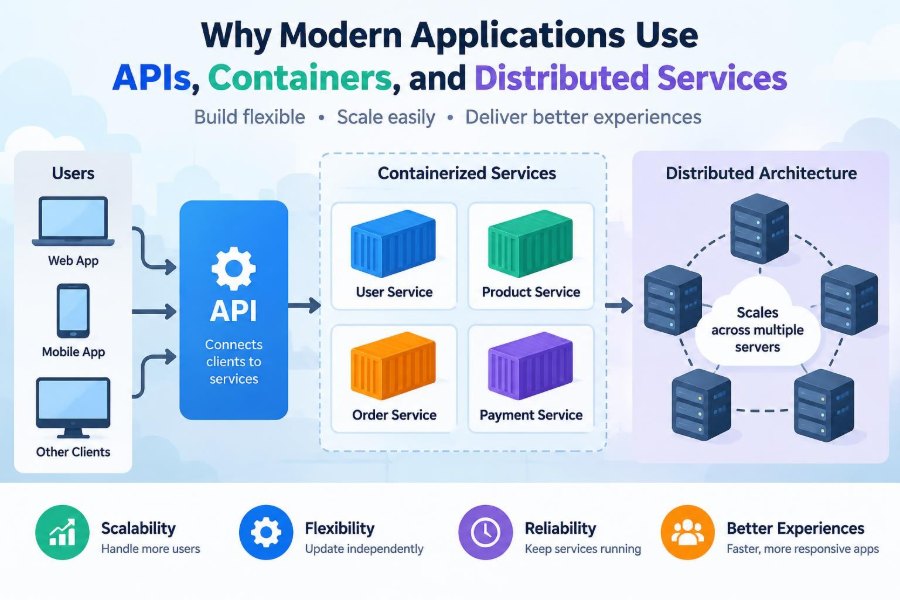

You order dinner through an app, watch a film on a television, then receive a delivery update on your phone. The experience feels like one product, even though several systems may be involved: identity, payment, inventory, mapping, notifications, and customer support.
For users, software should feel immediate and dependable. For engineering teams, that simple experience creates difficult questions: how should parts communicate, how can a change be released safely, and what happens when one part fails while the rest of the product still needs to work?
Modern applications increasingly answer those questions with APIs, containers, and distributed services. These are not fashionable replacements for all older designs. They are practical tools for building software that must evolve, integrate with other systems, and operate across changing infrastructure.
Understanding the reasons behind them matters whether you write code, test systems, manage projects, or simply want to make better technical decisions.
🏗️ One Application, Many Responsibilities
An application usually performs more than one job. An online shop displays products, manages carts, charges payments, tracks stock, sends receipts, and handles returns. Putting all logic into one program can work at first, but the codebase becomes harder to change as responsibilities multiply.
Modern architecture tries to make those responsibilities explicit. APIs define communication boundaries, containers package software consistently, and distributed services let selected responsibilities run independently.
🧩 The Monolith Is a Starting Point, Not a Failure
A monolith is an application deployed as one unit. Its components may still be well organized internally, and many successful systems remain monoliths for a long time.
A monolith is often easier to develop, test, and debug because a single process can make local function calls and share one deployment pipeline. Teams usually consider other approaches when independent release schedules, scaling needs, ownership boundaries, or integration demands create real friction.
🔌 APIs Create Useful Boundaries
An application programming interface, or API, is a defined way for software components to request work or exchange data. A weather app might ask a weather API for a forecast rather than maintain its own network of sensors.
The key idea is a contract. A caller needs to know what request to send, what response to expect, and how errors are represented. It does not need to know the provider’s internal database design or implementation language.
📨 Requests and Responses in Practice
Many web APIs use HTTP, the protocol browsers use, with methods such as GET for reading and POST for creating or submitting data. A request to GET /products/42 might return a structured representation of one product.
HTTP is common, not mandatory. Internal systems may use remote procedure calls, message queues, or streaming protocols. The architectural value comes from the stable agreement between producer and consumer, not from one particular data format.
🤝 APIs Let Systems Integrate Without Merging
Organizations rarely build every capability themselves. Payment processors, email providers, maps, tax services, and company identity systems can each be connected through APIs.
This avoids copying a specialist capability into every application. It also creates dependency risk: an external API can change, slow down, or become unavailable. Good integration design includes timeouts, clear failure messages, monitoring, and a plan for what the user sees when the dependency cannot respond.
🧱 Contracts Protect Independent Change
An API contract lets a provider improve its internals while preserving the behavior its clients depend on. A search service can change indexes or algorithms without requiring every client application to be rebuilt.
That freedom has limits. Removing a field or changing its meaning can break consumers. Teams commonly add optional fields, support versions when necessary, document behavior precisely, and retire old interfaces gradually rather than making abrupt incompatible changes.
🗺️ APIs Are More Than Endpoints
A useful API includes semantics, not just URLs. Clients need to understand authentication, authorization, pagination, rate limits, validation rules, error codes, and whether repeating a request is safe.
For example, retrying a network call that creates an order may accidentally create two orders unless the API supports an idempotency key. Idempotent means that repeating the same intended operation has the same effect as performing it once.
🔐 Boundaries Improve Security, but Do Not Guarantee It
APIs create places to verify identity and permissions. A service can confirm that a caller is authenticated and allowed to view a particular account before returning sensitive data.
However, an API boundary is not automatically secure. Common failures include overly broad permissions, leaked credentials, insufficient input validation, and exposing internal details in errors. Security requires careful authorization rules, secret handling, auditability, and regular review.
📦 Containers Package the Running Environment
A container packages an application with the runtime, libraries, and configuration it needs to run. Instead of saying “install the correct version of everything,” a team can build an image that specifies the environment.
This addresses the classic mismatch between a developer laptop, a test server, and production. It does not eliminate all differences—operating systems, network policies, and external services still matter—but it reduces avoidable variation.
🧪 Why “Works on My Machine” Happens
Software may depend on a particular language version, native library, system utility, environment variable, or default configuration. If another machine lacks one of these details, behavior changes unexpectedly.
A container image makes dependencies visible and repeatable. The same image can move through development, testing, and deployment stages, while environment-specific values such as database credentials are supplied securely at runtime rather than baked into the image.
⚖️ Containers Are Not Virtual Machines
Virtual machines emulate complete computers, including a guest operating system. Containers generally share the host operating system kernel while isolating processes, filesystems, and resources to varying degrees.
| Approach | Usually packages | Typical trade-off |
|---|---|---|
| Virtual machine | Application plus a full guest operating system | Strong separation, with more overhead |
| Container | Application and its user-space dependencies | Fast, portable deployment, with shared-kernel considerations |
Neither is universally better. The choice depends on isolation requirements, operating system needs, operational tooling, and workload characteristics.
🛡️ Container Images Need Maintenance
Containers make packaging reproducible; they do not make packaged software harmless. An image can contain outdated libraries, unnecessary tools, weak default permissions, or embedded secrets.
Teams reduce exposure by starting from maintained base images, installing only needed components, running as a non-root user where practical, scanning dependencies, and rebuilding regularly. An image should be treated as a deployable artifact with a lifecycle, not as a permanent snapshot.
🚚 Immutable Deployments Reduce Configuration Drift
An immutable deployment replaces a running artifact rather than manually altering it in place. If a new release is needed, a new image is built, tested, and deployed.
This makes deployments easier to trace and roll back because the artifact is identifiable. It also discourages emergency server edits that cannot be reproduced later. Configuration still changes, but it should be managed through controlled, reviewable mechanisms.
🧭 Orchestration Coordinates Many Containers
Running one container is straightforward. Running hundreds introduces placement, service discovery, networking, updates, health checks, resource limits, and recovery after machine failures.
Container orchestration platforms automate much of this coordination. They can restart failed instances and distribute workloads across available machines. Automation helps, but it adds operational complexity; a small application may not need a large orchestration system.
🌐 Distributed Services Divide Work Across Processes
A distributed system has components that communicate over a network and may run on different machines. A distributed-service architecture might separate catalog search, checkout, account management, and recommendation features.
The purpose is not to maximize the number of services. It is to create independently deployable units where independent operation produces a clear advantage.
📈 Independent Scaling Matches Real Demand
Different parts of an application receive different workloads. During a product launch, catalog browsing may surge while account settings remain quiet. A separate catalog service can receive more computing capacity without scaling every feature.
This can reduce waste, but only when measurements support the decision. Splitting a system before understanding its traffic patterns often replaces a simple scaling problem with several harder operational problems.
👥 Service Boundaries Can Support Team Ownership
When one team owns checkout and another owns product search, separate services can align code ownership with business responsibility. Each team can release changes on its own schedule within agreed interface contracts.
Ownership is not just permission to deploy. It includes on-call responsibility, documentation, quality standards, security obligations, and the ability to diagnose production behavior. A service with no clear owner becomes a long-term risk.
📡 Networks Make Remote Calls Different
A call inside one program is fast and usually either succeeds or throws an immediate error. A network call can be delayed, dropped, duplicated, or completed after the caller has stopped waiting.
This is the central cost of distributed services. Engineers must design for timeouts, retries, connection limits, partial responses, and uncertainty about whether an operation actually completed.
⏱️ Latency Accumulates Across Dependencies
If a page request waits for several services in sequence, each delay contributes to the user’s wait. One slow dependency can affect an otherwise healthy page.
Useful responses include parallelizing independent work, caching data that can safely be slightly old, setting deadlines, and avoiding unnecessary chains of calls. The goal is not merely faster code; it is fewer avoidable waits across the whole request path.
🔁 Retries Require Discipline
Retries can handle temporary network failures, but indiscriminate retries can amplify an outage. If many clients repeatedly call an overloaded service, the extra traffic can prevent recovery.
Use bounded retries, backoff delays, jitter to avoid synchronized retry bursts, and strict timeouts. Pair retries with idempotent operations or deduplication so that a request whose response was lost does not repeat a charge, booking, or shipment.
🧯 Graceful Degradation Preserves the Essential Journey
Not every feature must fail in the same way. If personalized recommendations are unavailable, a retail site may still show popular products. If a delivery estimate is delayed, an order may still be accepted with a clear notice.
This is graceful degradation: preserving the most valuable function while making limits visible. It requires product decisions as well as technical design, because teams must decide which features are essential and which can temporarily disappear.
🗃️ Data Ownership Becomes More Deliberate
In a service-based system, giving every service unrestricted access to one shared database creates hidden coupling. A schema change by one team can unexpectedly break another team’s code.
A stronger pattern is for a service to own its data and expose needed information through an API or published event. This can duplicate selected data, but it makes ownership and change responsibilities clearer.
🔄 Eventual Consistency Is a Product Decision Too
When services keep their own data, an update may take time to propagate. A newly placed order might appear in customer history before an analytics dashboard reflects it. This is often called eventual consistency.
It is acceptable only when the business process can tolerate temporary disagreement. Payment authorization, inventory reservations, and legal records may require stronger coordination than a recommendation count. The correct choice depends on the consequence of stale or conflicting data.
📬 Events Reduce Direct Coupling
An event announces that something happened: for example, “order placed.” Other services can react by sending a receipt, reserving stock, or updating reporting data without the order service needing to call each one directly.
Events improve extensibility, but they introduce delivery and ordering questions. Consumers must handle duplicates, late messages, and malformed payloads. Event schemas deserve the same care as request-response API contracts.
🔎 Observability Replaces Guesswork
With many running components, a single log file is not enough. Observability means gathering evidence that helps teams understand system behavior: logs record events, metrics show measured trends, and traces follow work across services.
For a failed checkout, a trace can reveal whether the delay occurred in authentication, inventory, payment, or a database query. Correlation IDs and consistent structured logs make that investigation substantially easier.
🚨 Reliability Depends on Failure Planning
Distributed applications should assume that dependencies will occasionally fail. Health checks, resource limits, backups, capacity planning, alert thresholds, and incident procedures turn that assumption into operational practice.
Reliability also means avoiding noisy alerts and testing recovery paths. A backup that has never been restored, or a failover that has never been rehearsed, is an unverified assumption rather than a dependable plan.
💸 More Services Create More Operational Cost
Each service adds code, deployments, dashboards, access controls, dependencies, and possible failure paths. Network communication and duplicated data can also increase infrastructure and engineering costs.
Microservices are therefore not an automatic maturity upgrade. A well-structured monolith with a clear API can be safer and cheaper than a poorly understood set of tiny services.
🧰 Choose the Simplest Architecture That Fits
Start with the problems you actually have. Do teams need independent deployment? Does one capability require very different scaling? Is an external integration best isolated? Are boundaries in the business domain already clear?
- Use APIs whenever software needs a clear, controlled interface.
- Use containers when repeatable packaging and deployment solve real environment problems.
- Use distributed services when independence outweighs network and operational complexity.
- Keep a modular monolith when simpler deployment and shared transactions remain valuable.
Architecture should be reversible where possible. Extracting one service around a proven boundary is usually easier to learn from than redesigning an entire system at once.
🧑💻 A Practical Learning Path
Students and early-career engineers can learn these ideas by building a small application with a deliberately narrow scope. First create one modular application, then expose one API with validation and clear errors.
Next, package it in a container, configure it through environment variables, and add logs that identify each request. Only then split one component—perhaps notifications—if you can explain why it benefits from being separate. The learning comes from observing the trade-offs, not from collecting tools.
✅ The Core Principle: Manage Change and Failure
APIs manage change by creating contracts between consumers and providers. Containers manage change by making runtime environments repeatable. Distributed services manage change by allowing selected parts of a system to evolve and operate independently.
All three also expose new responsibilities: versioning, security, image maintenance, network resilience, data coordination, and monitoring. Their value is highest when teams treat them as design commitments rather than shortcuts.
Modern applications use APIs, containers, and distributed services to make complex software easier to change and operate—provided the added boundaries are designed, owned, and observed with care. The best architecture is the one whose complexity your team can understand and sustain. ⚙️🔌🌐