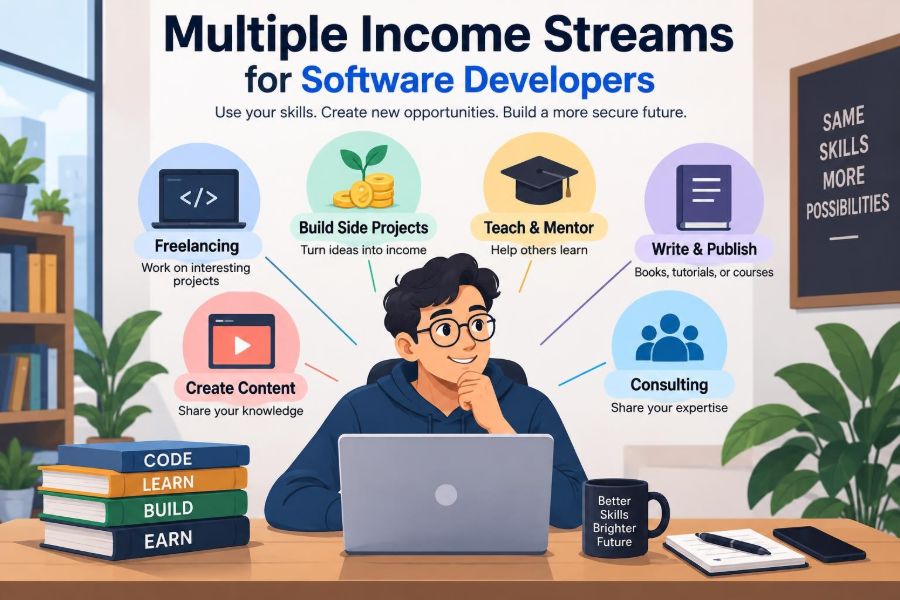

A full-time software job can feel financially stable—until a layoff, hiring freeze, family expense, or career change makes that single paycheck look less certain. Even when work is going well, many developers want more control over how their skills create value.
The obvious response is to “start a side hustle.” But that phrase hides the hard part: deciding what to build, where to find customers, and how to protect the energy needed for a demanding engineering role.
Multiple income streams do not require becoming an influencer, shipping a viral app, or working every evening. They require choosing opportunities that fit your skills, constraints, and appetite for uncertainty.
For developers, the strongest options often begin with a practical advantage: you can turn technical knowledge, repeatable workflows, and software into things other people will pay to use or learn.
🧭 Start With the Real Purpose of Extra Income
“More money” is a valid goal, but it is too broad to guide decisions. Define what the income is for: building an emergency buffer, reducing debt, funding a sabbatical, testing self-employment, or creating more career resilience.
Your purpose affects the right model. A developer seeking predictable monthly cash may prefer part-time consulting, while someone seeking long-term flexibility may accept years of slow progress on a product or educational asset.
🧱 Understand the Main Types of Income
Income streams differ mainly in how closely earnings depend on your time. None is truly effortless; even software products need support, updates, and distribution.
| Type | How it works | Typical trade-off |
|---|---|---|
| Service income | You are paid for expertise or delivery. | Fastest to start, limited by available time. |
| Product income | Customers pay for software, templates, or tools. | More scalable, uncertain demand and maintenance. |
| Audience-based income | Learning resources or content earn through sales or sponsorships. | Requires trust and consistent distribution. |
| Investment income | Capital produces returns over time. | Requires savings and carries market risk. |
A balanced portfolio can include more than one category, but a beginner usually benefits from validating one before adding another.
⚖️ Protect Your Primary Job First
Your employment contract may contain rules about outside work, conflicts of interest, intellectual property, confidentiality, or use of company equipment. Read it before accepting a client or building a related tool.
Do not reuse private code, customer information, internal documents, or employer time. Even an innocent overlap can create legal and professional problems. Keep separate devices, repositories, accounts, calendars, and working hours where practical.
🔍 Inventory Skills People Actually Buy
Developers often focus only on programming languages. Buyers usually pay for outcomes: a faster workflow, a reliable integration, fewer production incidents, a clearer technical decision, or a team that can ship.
List your capabilities across technical and business contexts:
- Backend systems, APIs, databases, and cloud infrastructure
- Frontend implementation, accessibility, and performance
- Automation, data pipelines, testing, and developer tooling
- Technical writing, teaching, interviewing, and mentoring
- Experience in a domain such as retail, logistics, education, or finance
The overlap between a technical skill and a painful customer problem is usually more valuable than a generic claim to “build websites.”
🎯 Pick a Narrow Problem Before Picking a Platform
A marketplace, newsletter, online course platform, or app store is only a delivery channel. Start with a specific person and a recurring inconvenience.
For example, “a deployment dashboard” is broad. “A lightweight release checklist and status dashboard for small agencies managing several client sites” is narrower and easier to discuss with potential users.
Narrowing does not permanently limit growth. It gives you a clear first group to serve, clear language for marketing, and feedback that is less ambiguous.
💼 Offer Freelance Development Strategically
Freelancing is often the most direct route from skill to revenue because a client already has a problem and a budget. It also teaches useful lessons about scope, communication, sales, and delivery.
Avoid presenting yourself as available for every technology and project. A focused offer, such as API integrations for a particular type of business or performance audits for ecommerce stores, makes referrals easier and discovery calls more productive.
📦 Turn Services Into Defined Packages
Hourly work is sometimes appropriate, especially when requirements are uncertain. But a defined package can reduce ambiguity for both sides. It describes the outcome, boundaries, timeline, client responsibilities, and price structure.
A package might include a codebase review, a written risk report, a prioritised improvement plan, and one follow-up call. It is not simply “eight hours of engineering.” The buyer understands what they will receive.
- State what is included and excluded.
- Define how many revisions or meetings are covered.
- Use a written agreement and an approval process for changes.
- Request a deposit or staged payments when appropriate.
🧑🏫 Sell Technical Mentoring and Coaching
Many developers need guidance more than they need another tutorial. They may want help preparing for interviews, moving into a new specialty, reviewing a portfolio, or navigating their first production system.
Mentoring works best when expectations are explicit. Clarify whether you are offering career advice, pair programming, code review, accountability, or curriculum guidance. Never imply that coaching guarantees a job, promotion, or particular salary.
🏢 Teach Teams and Organizations
Companies sometimes need short, practical training on subjects such as testing practices, secure coding habits, Git workflows, cloud fundamentals, or effective code review. This can pay better than individual tutoring because it solves a team-level need.
Training delivery includes preparation, examples, exercises, and follow-up materials. A good workshop is more than a slide deck: participants should leave able to perform a useful task in their own environment.
🛠️ Build a Micro-SaaS Around Repetition
A micro-SaaS is a small software-as-a-service product aimed at a narrow workflow. It is not defined by a tiny codebase; it is defined by a focused customer problem and manageable operating scope.
Look for repetitive tasks that involve copying data between systems, checking status manually, generating routine documents, or chasing approvals. A product that saves a small business a few frustrating steps each week can be more viable than a broad platform with dozens of unfinished features.
🧪 Validate Demand Before Building Deeply
The most common product mistake is confusing the ability to build with evidence that people will buy. A prototype is useful, but conversation often comes first.
Talk to people who experience the problem. Ask how they solve it now, what it costs in time or errors, who owns the budget, and what would make a new approach difficult to adopt. Specific past behavior is more informative than compliments about your idea.
A simple landing page, manual pilot, or paid pre-order can test interest without months of development. Be transparent about what exists today.
🧰 Create Developer Tools and Extensions
Developers understand developer friction unusually well. Command-line utilities, IDE extensions, API clients, boilerplates, testing helpers, observability add-ons, and workflow integrations can become useful products.
However, developers are often price-sensitive and have strong opinions about tooling. A tool needs a sharp advantage: meaningful time savings, fewer errors, a smoother integration, or support for a neglected workflow. Good documentation and dependable updates matter as much as clever implementation.
📄 Sell Templates, Starters, and Reusable Assets
Digital assets can be a practical middle ground between services and a full application. Examples include deployment checklists, architecture decision record templates, component libraries, starter repositories, CI configurations, and technical documentation kits.
Assets sell when they remove setup work and embody trusted judgment. A folder of generic files is rarely enough; explain the intended use, assumptions, setup steps, and customization points.
✍️ Write for a Specific Technical Reader
Technical writing can lead to paid articles, documentation contracts, newsletters, books, or consulting inquiries. It also makes your thinking visible to people who may never see your résumé.
Write from genuine experience. A clear explanation of how you diagnosed a difficult bug, migrated a system safely, or chose between architectural options is usually more useful than a broad article that restates documentation.
🎥 Build Educational Content Carefully
Courses, workshops, videos, and guides can earn over time, but they are not passive. Curriculum design, recording, editing, learner support, and updates all take work.
Choose a teachable outcome rather than an enormous topic. “Build and deploy a small API with monitoring” is easier to complete and evaluate than “learn backend engineering.” Use your own examples, respect software licenses, and update claims as tools change.
🧩 Consider Open Source as a Trust Builder
Open source software can create reputation, demonstrate skill, and attract support, sponsorship, consulting, or hosted-product customers. It should not be treated as an automatic income stream.
Maintainers can face substantial unpaid support and security responsibilities. Before publishing, decide what contribution and support level you can sustain. A clear license, contribution guide, issue policy, and maintenance boundaries protect both users and maintainers.
🔄 Create a Productized Retainer
A retainer is an ongoing agreement for continuing access to a service. For developers, it might cover a monthly reliability review, security patch coordination, analytics checks, or a limited amount of maintenance.
Retainers work when the recurring work is genuinely useful and clearly bounded. “Unlimited development support” is a dangerous promise. Define response times, communication channels, included tasks, and how larger projects are quoted separately.
🤝 Use Your Network Without Treating People as Leads
Early opportunities often come through former colleagues, local communities, meetups, and professional groups. The most durable approach is to be helpful, reliable, and clear about what you do.
Share a concise description of your offer and examples of work you can publicly discuss. Ask for introductions only when there is a plausible fit. Aggressive mass messages can damage trust faster than they create business.
📣 Learn Distribution, Not Just Development
Distribution means how the right people discover, understand, and decide to use what you offer. It may involve referrals, communities, search, partnerships, demonstrations, useful writing, or direct outreach.
Engineers sometimes postpone this work until launch. That creates a painful surprise: a polished product with no defined path to customers. Build an audience of conversations and relationships while the product is still small.
💰 Price for Value, Scope, and Risk
Pricing is not a measure of personal worth. It is a business decision shaped by the result delivered, alternatives available, time required, operating costs, risk, and the customer’s ability to pay.
For services, estimate the hidden work: sales calls, planning, project management, testing, invoicing, and support. For products, account for payment fees, hosting, customer service, taxes, refunds, and future maintenance. Low prices can attract demand that is expensive to serve.
🧾 Handle Money and Records Responsibly
Income earned outside employment can have tax, registration, invoicing, and reporting implications that vary by location and business structure. Keep accurate records of revenue, expenses, invoices, contracts, and relevant receipts from the beginning.
Use a separate account or clear bookkeeping process so personal and business transactions are distinguishable. A qualified local accountant or legal professional can help with decisions specific to your jurisdiction; general online advice cannot replace tailored guidance.
🔐 Treat Security and Privacy as Product Features
The moment a side project stores customer data, accepts payments, or connects to other systems, security becomes part of the work. Collect only data you genuinely need, restrict access, protect secrets, back up important information, and apply updates promptly.
Be honest about limitations. A one-person product may not offer enterprise-grade guarantees, but it can still implement sensible safeguards and explain its data practices clearly. A preventable breach can erase trust built over months.
⏱️ Design a Sustainable Weekly Schedule
Side income should not quietly become a second full-time job. Choose fixed, realistic blocks of time and protect rest, relationships, exercise, and primary-job performance.
A useful pattern is to separate work by energy level: use a focused weekend block for building or client delivery, and reserve low-energy evenings for admin, learning, or scheduling. If every spare hour is committed, unexpected work or life events will break the plan.
🚧 Watch for Burnout and Opportunity Cost
Extra work has a cost even when it earns money. Fatigue can reduce judgment, creativity, and patience—qualities that matter in engineering and relationships.
Regularly ask whether the stream is still worth its time. A modest project that teaches a valuable skill may justify itself early on, but not forever. Pausing or closing an unpromising venture is often disciplined decision-making, not failure.
🧯 Avoid Common Side-Project Traps
Several mistakes repeatedly slow down capable developers:
- Building for months without speaking to likely users
- Taking vague client work without written scope
- Trying to serve everyone instead of one reachable group
- Underestimating support, maintenance, and sales work
- Copying a business model without understanding its audience
- Using employer resources or creating a conflict of interest
The practical antidote is small commitments, early feedback, documented boundaries, and regular review.
📈 Measure Signals That Inform Decisions
Revenue matters, but it is a lagging indicator. For a service, track qualified conversations, proposals sent, close rate, delivery time, and repeat work. For a product, observe activation, recurring use, support volume, cancellations, and which acquisition channels bring engaged customers.
Do not drown in dashboards. Pick a few measures tied to the current bottleneck. If people visit but do not try the product, the issue may be positioning or onboarding; if they try but do not return, the product may not solve a continuing problem.
🌱 Reinvest Before You Expand
Early earnings can improve the system that produced them. Reinvest in better tooling, legal or accounting advice, accessibility improvements, customer research, documentation, or help with repetitive work.
Expansion should follow evidence. Adding a second product, contractor, or marketing channel before the first offer is understood can multiply complexity rather than income.
🪜 Build a Low-Risk First 90 Days
A simple first phase is more useful than an elaborate master plan. Choose one route, one audience, and one small offer.
- Review your employment agreement and available weekly capacity.
- Write down three problems you understand from direct experience.
- Speak with several people who have one of those problems.
- Create a small offer or manual pilot with explicit boundaries.
- Ask for payment or a concrete commitment before building extensively.
- Deliver carefully, gather feedback, and decide what to repeat.
This approach creates evidence quickly while keeping financial and personal risk contained.
🌟 Focus on Durable Value, Not Endless Hustle
Multiple income streams are strongest when they are built around useful outcomes, ethical practices, and a pace you can sustain. A freelancer’s reliability, a teacher’s clarity, and a product builder’s attention to customer pain all create value beyond writing code.
There is no requirement to pursue every option. One well-run consulting package, a small tool with loyal users, or periodic mentoring may be enough to meet your goal. The right mix is personal, and it can change as your career and responsibilities change.
The core principle is simple: begin with a real problem you can responsibly solve, validate it with people, and grow only at a pace that protects your work and life. Small, deliberate steps can turn software skills into useful options over time. 💻🌱🚀