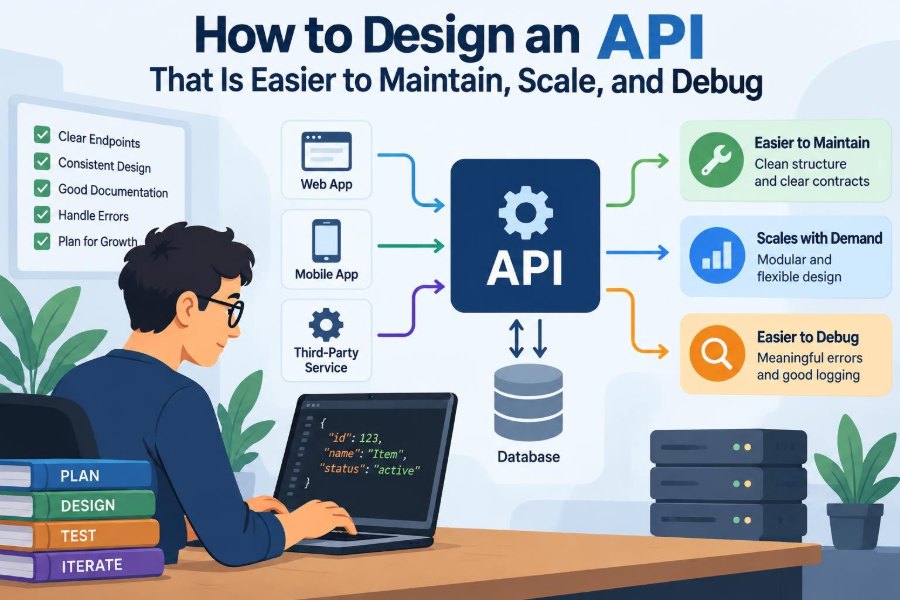

A small API can feel wonderfully simple: a few endpoints, a database table, and a frontend that sends JSON. Then the product grows. A mobile app needs the same data in a different shape, a partner asks for access, and an old client cannot upgrade as quickly as the backend team would like.
At that point, API design stops being mainly about making a request return a response. It becomes a question of how safely a system can change while other systems depend on it.
Teams often discover maintainability problems during an urgent incident. An ambiguous error gives no clue about the failing layer, an endpoint performs five hidden database queries, or a “minor” field rename breaks a customer integration.
A well-designed API cannot eliminate complexity. It can make complexity visible, bounded, and easier to reason about—so that maintenance, scaling, and debugging become routine engineering work rather than repeated emergencies.
🧭 Treat the API as a Long-Lived Contract
An API is a contract between a provider and its consumers. Consumers may be a web application, another internal service, a public partner, or a script someone wrote months ago. Once they rely on request fields, response shapes, error codes, or timing behavior, those details have consequences.
Think beyond the URL and JSON schema. The contract also includes pagination rules, authorization behavior, ordering, rate limits, and what happens when an operation is retried. Documented or not, clients will form expectations from observed behavior.
Design for change by being explicit about what clients may depend on. That boundary is the foundation of a maintainable API.
🎯 Start With User Tasks, Not Database Tables
A common early mistake is to expose database tables directly: /users, /orders, /order_items. Resource-oriented URLs can be useful, but a table is a storage detail, not necessarily a useful business boundary.
Begin with the task a caller needs to complete. A shopper may need to “place an order,” while an administrator needs to “approve a refund.” These actions can involve several tables and business rules, yet should remain coherent operations from the client’s perspective.
This approach prevents clients from coordinating sensitive workflows themselves. If the server owns the rules for an order, the server should validate stock, calculate totals, and record the order atomically rather than asking the client to assemble the process through many low-level calls.
🧱 Choose Resource Boundaries Deliberately
A resource is a meaningful thing the API exposes, such as a project, invoice, account, or ticket. Good resource boundaries make ownership and permissions easier to understand.
Nested routes can communicate a real relationship: /projects/{projectId}/tasks clearly scopes tasks to a project. But deep nesting often becomes brittle when resources have multiple relationships. A task may belong to a project but also be assigned to a user; neither hierarchy needs to dominate every endpoint.
Use nesting when the parent scope changes authorization, identity, or query meaning. Otherwise, a top-level collection with filters, such as /tasks?project_id=..., can be less restrictive.
📝 Make Naming Predictable, Not Clever
Consistency reduces the amount of API documentation people must keep in their heads. Pick conventions for plural resource names, casing, identifiers, timestamps, and query parameters, then apply them broadly.
For example, an API might consistently use plural nouns in paths, snake_case properties, ISO 8601 timestamps, and created_at/updated_at fields. The particular convention matters less than avoiding a mixture like userId, user_id, and uid for the same concept.
Avoid abbreviations unless they are truly universal to your audience. Saving a few characters is rarely worth forcing every integrator to consult a glossary.
🔄 Use HTTP Semantics as Useful Signals
For HTTP APIs, methods carry meaning. GET reads data, POST commonly creates a resource or initiates an action, PATCH applies a partial update, and DELETE requests removal.
Following these conventions helps tools, caches, proxies, and developers make reasonable assumptions. A GET endpoint that changes state can create surprising production behavior when a browser prefetches it or an intermediary caches it.
Do not force every operation into a pure CRUD shape. A domain action such as POST /invoices/{id}/send may be clearer than pretending that “send” is a field update. The goal is honest, predictable semantics.
🧩 Design Request and Response Shapes for Stability
Response objects should be purposeful rather than accidental serializations of internal models. Returning every database column leaks implementation details and makes future refactoring harder.
Expose fields that callers need, with clear types and meanings. Keep sensitive or internal values out by default. For instance, a response can include an order’s status and total while excluding internal fraud-review notes.
Use a stable envelope only when it solves a repeated need, such as pagination metadata or request tracing. Wrapping every response in several layers of generic objects can obscure the actual resource.
🧠 Separate External Models From Internal Code
Your API schema should not be identical to your persistence schema or in-memory domain objects. They may overlap, but they evolve for different reasons.
An internal model can optimize storage, join data, or represent an intermediate workflow state. An external model should prioritize clarity, security, and compatibility. A mapping layer between them costs some code, but it prevents database migrations from automatically becoming breaking public changes.
This separation is particularly valuable when one endpoint combines data from several services. Clients receive one coherent representation while the implementation remains free to evolve behind the boundary.
✅ Validate at the Boundary
Validate incoming data as soon as it enters the system. Check required fields, types, ranges, formats, allowed values, and relationships that can be verified safely at that point.
Boundary validation is not the same as business validation. “Quantity must be a positive integer” is a request-shape rule. “This customer may not purchase a restricted item” is a business rule that may require database state and authorization context.
Return field-level guidance when appropriate, but do not reveal internal details. Clear validation prevents invalid data from drifting into deeper layers where failures are harder to diagnose.
🚦 Make State Transitions Explicit
Many difficult APIs manage entities that change state: drafts become submitted, payments become captured, tickets become resolved. A generic update endpoint can accidentally allow impossible transitions.
Model permitted transitions intentionally. A request to cancel a shipped order should either be rejected with a clear domain error or start a defined return process; it should not quietly overwrite status with cancelled.
Explicit actions can be better than exposing status as a freely editable field. They make business intent visible in logs, authorization rules, and documentation.
🔁 Build Safe Retries With Idempotency
Networks fail in inconvenient ways. A client can time out after the server creates a payment, leaving it uncertain whether retrying will create another charge. This is not an edge case; distributed systems regularly produce ambiguous outcomes.
For operations with costly side effects, support an idempotency key: a client-generated value representing one intended operation. The server stores the outcome associated with that key and returns the original result when the same request is repeated.
Idempotency requires careful scope and retention decisions. The server must detect when one key is reused with a materially different request, and teams should document how long prior results remain available.
📄 Paginate Every Growing Collection
An endpoint that returns “all records” works until it does not. Large responses consume memory, increase latency, overload databases, and make client behavior unpredictable.
Pagination gives callers bounded work. Offset-based pagination is familiar but can skip or duplicate records when data changes during traversal. Cursor-based pagination, often based on a stable sort key, usually behaves better for frequently changing datasets.
Include enough metadata for clients to continue safely, such as a next cursor. Set a sensible default and maximum page size so one client cannot request an unbounded response.
🔎 Filter, Sort, and Search With Constraints
Collection endpoints become more useful when callers can filter and sort them, but unrestricted querying can create expensive, hard-to-secure database access patterns.
Offer a defined set of filters and sort fields. Specify whether filters are exact matches, prefixes, ranges, or full-text search. Also document the default ordering, because pagination without stable ordering produces confusing results.
For complex reporting needs, a dedicated reporting endpoint or asynchronous export may be safer than adding unlimited query expressions to a general resource endpoint.
⚖️ Keep Payloads Efficient Without Making Them Fragile
Overly large payloads waste bandwidth and server work. Underpowered payloads create chatty clients that must call many endpoints to render one screen. The right design depends on the task.
Allow selective field inclusion only when it addresses a real use case, and keep the default representation useful. For example, an order list can return summary details while GET /orders/{id} returns line items and shipment history.
Do not optimize prematurely by making every client construct a query language. Measure expensive endpoints, then improve the relevant response shape, query plan, cache strategy, or read model.
🔐 Put Authorization Near the Resource
Authentication answers “who is calling?” Authorization answers “what may this caller do?” They are related but should not be conflated.
Authorize each operation against the actual resource and tenant context. Checking that a user is logged in is not enough if the request can access another organization’s invoice by guessing an identifier.
Centralized policy code can improve consistency, but authorization decisions still need the context of the requested action. Test both allowed and denied paths, including indirect references embedded in request bodies.
🛡️ Avoid Leaking Sensitive Information
Error messages, identifiers, metadata, and timing can disclose more than intended. A detailed database exception may help an engineer, but it can expose table names or query structure to an external caller.
Return safe, actionable public errors and keep diagnostic detail in protected logs. Consider whether sequential identifiers expose business volume or make enumeration easier; opaque identifiers can reduce that risk, though they do not replace authorization.
Apply data minimization to responses. If a client only needs a display name, it should not automatically receive a full profile, permissions, and audit history.
❗ Use a Consistent Error Vocabulary
Errors are part of the API contract. A client needs to distinguish invalid input from missing authorization, a nonexistent resource, a conflict with current state, and a temporary server failure.
| Situation | Useful response pattern | Client implication |
|---|---|---|
| Malformed or invalid request | 4xx status with stable validation code and field details | Fix input before retrying |
| Permission denied | Authentication or authorization status without internal policy details | Authenticate or request access |
| State conflict | Conflict status with a domain-specific code | Refresh state or resolve the conflict |
| Temporary service problem | 5xx status, request ID, and retry guidance where safe | Retry with backoff when appropriate |
Use machine-readable codes such as insufficient_stock or version_conflict alongside human-readable messages. Messages may improve over time; stable codes let software respond reliably.
🧵 Attach Request IDs for Debugging
A request ID connects what a caller saw with what the server recorded. Generate or accept a correlation ID at the edge, return it in the response, and include it in logs across downstream calls.
When a customer reports a failed checkout, a support engineer should be able to ask for one identifier and trace the request through the gateway, application, queue, and payment adapter. Without correlation, debugging turns into searching broad time windows.
Do not put secrets or personal data in these identifiers. They should be opaque handles for investigation, not compact summaries of a request.
📊 Add Observability Before You Need It
Logs answer detailed questions, metrics reveal trends, and traces show the path through distributed components. Together, they make an API observable: engineers can infer what is happening from its emitted signals.
Record useful dimensions such as endpoint, response class, latency, dependency outcome, and deployment version. Be cautious with high-cardinality labels, such as raw user IDs, because they can make monitoring systems costly or difficult to query.
Measure service-level behavior, not just server exceptions. A request that returns HTTP success after a ten-second wait can still be a serious user experience problem.
⏱️ Define Timeouts, Limits, and Backpressure
Scaling fails less often from one slow request than from cascading waits. If each service waits indefinitely for another service, exhausted worker pools spread the outage outward.
Set timeouts for inbound requests and outbound dependencies. Limit request body sizes, page sizes, concurrency, and expensive operations. When capacity is constrained, return a clear overload response rather than allowing queues to grow until the whole system becomes unresponsive.
Timeout values are context-specific. A report generation endpoint can reasonably have a different expectation from an interactive search endpoint, so document and test the chosen behavior.
🧯 Use Rate Limits as Product and Reliability Controls
Rate limits protect shared infrastructure from accidental loops, abusive traffic, and one integration consuming disproportionate capacity. They also create a predictable fairness boundary.
Limits should reflect the operation’s cost where possible. A cheap read and a computationally expensive export need not share the same allowance. Return enough information for respectful clients to slow down, and ensure legitimate traffic has an escalation path.
Rate limiting is not a substitute for efficient code or capacity planning. It is one layer of protection in a broader resilience design.
🧮 Handle Concurrency Instead of Hoping It Behaves
Two users can edit the same record at nearly the same time. Without a concurrency strategy, the last write may silently erase the first user’s change.
Optimistic concurrency uses a version number or entity tag. The client updates only if the version it read is still current. If it is not, the server returns a conflict and the client can refresh, merge, or ask the user to decide.
This is especially valuable for high-value data such as inventory, permissions, and financial records. The correct conflict experience depends on the domain; automatic retries are not safe for every write.
📬 Move Long Work Out of the Request Path
Some tasks take too long for a normal request: generating a large export, processing media, importing files, or coordinating several slow dependencies. Holding an HTTP connection open makes timeouts and retries harder to manage.
Accept the work, return an operation identifier, and let the client check a status resource or receive a callback where appropriate. The operation should expose states such as queued, running, succeeded, and failed, plus a safe error summary.
Asynchronous design adds complexity: status retention, duplicate submissions, and cancellation semantics need clear rules. Use it for genuinely long or variable work, not as a reflex.
🗃️ Cache With Clear Ownership and Invalidation Rules
Caching can reduce latency and protect downstream dependencies, but stale data is still incorrect data in some workflows. Before adding a cache, decide what may be stale, for how long, and who invalidates it.
Public, mostly static reference data may be cacheable at clients or intermediaries. Per-user account balances usually require more caution. Cache headers and entity validators can help clients avoid downloading unchanged representations.
Never let caching bypass authorization checks. A fast response is not useful if it belongs to another user or tenant.
🧪 Test the Contract, Not Only the Implementation
Unit tests can prove that a function behaves correctly, but they may not catch a changed field name, altered nullability, or unexpected error representation. Contract tests exercise the API boundary that consumers actually use.
Maintain examples for successful responses, validation failures, authorization failures, empty collections, pagination, and conflicts. Test compatibility intentionally when a schema changes.
Consumer-driven contract testing can be useful in organizations with many services, but it also creates maintenance work. The essential practice is simpler: treat externally visible behavior as something that must be tested before release.
📚 Keep Documentation Close to Reality
Documentation is most valuable when it answers operational questions: what to send, what comes back, which fields are required, which errors are possible, and how retries or pagination work.
Provide concise examples that are valid for the current version. Explain domain rules that cannot be inferred from a schema, such as whether a cancellation is reversible or when an asynchronous operation can be retried.
Generate reference material from schemas when that fits the team’s workflow, but review it for clarity. A technically complete list of fields is not the same as guidance for using an API safely.
🧬 Evolve Without Breaking Existing Clients
Additive changes are usually safer than destructive ones. Adding an optional response field is often compatible; renaming a field, changing a type, or changing default behavior may not be.
Deprecation needs a plan: identify consumers where possible, announce the change through appropriate channels, provide a migration path, and observe whether old usage declines. Versioning can help with fundamentally incompatible contracts, but maintaining multiple versions has a real operational cost.
Do not version every small adjustment. Prefer stable, extensible representations and reserve major version changes for changes that clients cannot reasonably absorb.
🏗️ Design for Failure Across Dependencies
An API often depends on databases, identity providers, queues, and other services. A successful design acknowledges that any dependency can become slow, unavailable, or inconsistent.
Classify dependencies by what the endpoint can do without them. Perhaps a product page can show cached catalog data when recommendations fail, while a payment confirmation must fail safely if the payment provider cannot be reached.
Use fallback behavior only when it preserves meaning. Returning outdated shipment status may be acceptable with a timestamp; claiming that an order shipped when its status is unknown is not.
🧰 Create an API Design Review Checklist
A lightweight review before implementation catches expensive problems early. It should be practical enough that teams use it during ordinary delivery work.
- What task does this endpoint help a caller complete?
- What is the stable resource or action boundary?
- How are validation, authorization, and state conflicts represented?
- Can a client safely retry this operation?
- What are the pagination, sorting, timeout, and rate-limit rules?
- Which logs, metrics, and request IDs will help diagnose failure?
- What future changes might break a client?
Not every endpoint needs every feature. A simple internal read endpoint may not need cursor pagination or idempotency keys. The checklist prompts deliberate trade-offs instead of copied boilerplate.
🚀 Build for Operability, Not Just Correctness
An API is maintainable when engineers can understand it, change it safely, and investigate its failures. It is scalable when its resource use stays bounded as traffic and data grow. It is debuggable when callers and operators can connect a symptom to useful evidence.
These qualities reinforce one another. Stable contracts make deployments safer; bounded pagination and timeouts protect capacity; structured errors and tracing shorten incident response. None requires a perfect architecture at the start, but each requires intentional boundaries.
The core principle is simple: design every API behavior as a promise that clients, operators, and future maintainers must be able to understand and rely on.
Start with a clear task, make the contract explicit, prepare for retries and partial failure, and leave a trail that humans can follow when something goes wrong. That is how an API remains useful long after its first endpoint ships. ⚙️🔍📈