
Picture a ticket sale opening at noon. Within seconds, a familiar app receives a flood of people refreshing pages, searching seats, and trying to pay at the same time. Most users never see the machinery behind it—unless the page freezes or the checkout fails.
The same pressure appears when a popular creator posts a link, a breaking-news alert goes out, or commuters all open a transit app at 8:30 a.m. A large application is not successful because it never receives surprises. It succeeds because it is designed to absorb them.
Handling millions of users is not one magic cloud setting or a single “fast server.” It is a set of engineering decisions about where work happens, how failures are contained, and what the system should do when demand exceeds capacity.
Those decisions matter whether you are building a student project with a growing audience or maintaining a service used around the world. The scale may differ, but the core questions are remarkably similar.
🏙️ Scale Is About Concurrent Work, Not Just User Counts
“Millions of users” can be misleading. An app may have millions of registered accounts but only a modest number of people active at once. What stresses a system is usually concurrency: many requests needing attention during the same short period.
A request is one interaction with the backend, such as loading a profile, searching products, sending a message, or submitting payment. One person can create many requests while a page loads, especially if it fetches images, recommendations, notifications, and account data separately.
Engineers therefore ask practical questions: how many requests arrive per second, how long do they take, and what resources do they consume? These are more useful than a headline account count.
📈 Demand Comes in Uneven Waves
Traffic is rarely steady. Daily peaks, product launches, scheduled events, marketing campaigns, and bugs that trigger repeated retries can create sharp bursts. A system sized only for an average afternoon may fail during a five-minute surge.
Capacity planning considers normal demand, expected peaks, and a safety margin. It also distinguishes predictable events from sudden ones. A planned concert sale allows teams to prepare; an unexpected viral post demands systems that can adapt automatically.
The goal is not to reserve infinite capacity. That would be expensive and often wasteful. The goal is to identify the parts that must remain available and decide what can be slowed, delayed, or temporarily disabled.
🚪 Load Balancers Share the Front Door
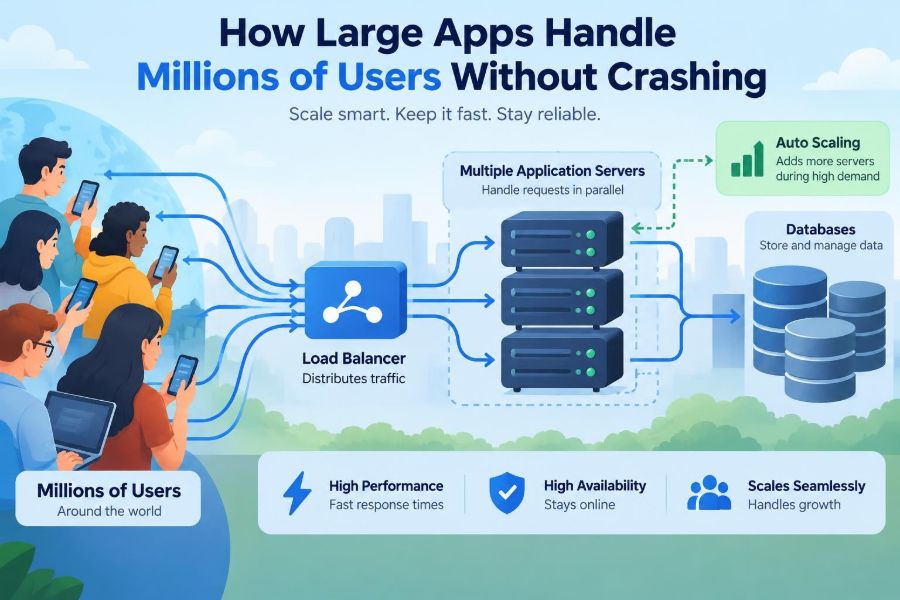
A load balancer sits in front of application servers and directs incoming requests among healthy instances. Instead of every visitor reaching one machine, requests are spread across a fleet.
Distribution can be simple, such as rotating through servers, or more informed, such as sending work away from machines already handling many long-running requests. Load balancers also perform health checks, removing an instance that no longer responds correctly.
This is like having several checkout lanes and a staff member guiding customers away from a closed lane. It improves both throughput and resilience: losing one server does not need to take down the whole app.
🧩 Stateless Services Make Replication Easier
Application servers are easiest to scale when they are stateless. A stateless server does not keep a user’s essential session information only in its own memory between requests.
If a user’s cart, login session, or workflow exists only on one server, later requests must return to that same machine. That creates “sticky” routing and makes failure more disruptive. A replacement server does not know what happened before.
Instead, shared state can live in a database, a cache, or a purpose-built session store. Any healthy application instance can then serve the next request. Statelessness does not remove state; it puts state where multiple servers can access it safely.
➕ Horizontal Scaling Adds More Workers
There are two broad ways to increase capacity. Vertical scaling means making one machine larger by adding CPU, memory, or faster storage. Horizontal scaling means adding more machines that can do similar work.
Vertical scaling is often simple at first, and some workloads genuinely need a powerful machine. But every individual machine has limits, and maintenance or failure can create a single point of failure.
Horizontal scaling is the common foundation for high-traffic web services. It requires coordination—shared data, service discovery, deployments, and observability—but it lets capacity grow in increments and makes redundancy practical.
🤖 Autoscaling Responds to Real Pressure
Autoscaling starts or removes application instances based on signals such as request rate, CPU usage, memory pressure, queue depth, or latency. It is especially useful when demand has regular but changing patterns.
A poor autoscaling rule can react too late. CPU may remain low while requests wait on a database, for example, so CPU alone is not a reliable measure of health. Queue length and user-visible response time often reveal trouble earlier.
New instances also need time to start, load code, and pass health checks. Teams account for that delay by maintaining baseline capacity and by testing a scaling policy before an important event.
🗺️ Content Delivery Networks Shorten the Journey
Many things users download do not need to come from the application servers every time: images, videos, style sheets, JavaScript bundles, fonts, and downloadable files. A content delivery network, or CDN, stores copies closer to users in multiple locations.
When a browser requests a popular image, a nearby CDN location may serve it directly. This reduces latency—the time before a response arrives—and prevents origin servers from spending valuable resources on identical static files.
CDNs are not only for huge companies. Even a small app can benefit when it has global users or media-heavy pages. Dynamic, personalized responses still usually travel to the application backend.
🧠 Caches Avoid Repeating Expensive Work
A cache stores the result of work that is likely to be needed again. For example, a product catalog, public profile, feature configuration, or computed leaderboard may be read many times but updated relatively rarely.
If every request recomputes the result or asks the primary database, the system wastes work. A cache can return a recent value much faster. Caching may happen in a browser, CDN, application process, or shared in-memory service.
The trade-off is freshness. A cached value can be briefly outdated, and cache rules must state how long data may remain valid. For a public photo count, slight delay may be fine; for available concert seats, it may be unacceptable.
🧊 Cache Misses Can Become Their Own Outage
A cache helps only when it is warm and available. If a popular cache expires all at once, thousands of requests may simultaneously fall through to the database. This is sometimes called a cache stampede.
Systems reduce that risk by spreading expiration times, refreshing popular entries before they expire, and allowing one request to rebuild an entry while others receive the previous value or wait briefly. These choices depend on how stale data may safely be.
It is also wise to treat cache failures as expected conditions. An app should know whether it can fall back safely, reduce features, or reject nonessential work rather than overwhelming its source of truth.
🗄️ Databases Are Often the Tightest Bottleneck
Application servers can often be copied easily. Databases are harder because they hold shared, changing data and must preserve correctness. A slow query, missing index, overloaded connection pool, or lock conflict can affect every request path that depends on it.
An index is a data structure that helps the database locate rows without scanning an entire table. It can dramatically improve common lookups, but indexes also cost storage and make writes more expensive because they must be updated.
Database performance begins with understanding access patterns. Engineers inspect the actual queries an app sends, measure their execution plans, and avoid loading much more data than the screen needs.
📚 Read Replicas Separate Reading from Writing
Many applications read data far more often than they change it. A read replica is a copy of a database that can serve read queries while a primary database accepts writes.
This can increase read capacity, but replicas may lag behind the primary. Immediately after changing an address or publishing a post, a user might briefly see the older version if the next read reaches a lagging replica.
That makes routing a product decision as well as a technical one. Critical “read your own write” flows may need the primary or another consistency strategy, while less sensitive browsing can use replicas.
🧱 Partitioning Splits Data Deliberately
When one database can no longer comfortably hold or process all data, teams may partition it. Also called sharding, partitioning assigns different subsets of data to different database servers, perhaps by customer, region, or a calculated key.
Partitioning can spread load, but it complicates queries that need data from many partitions. Choosing a poor key can create hot spots—for instance, if one especially popular account receives most of the traffic.
It is a powerful tool, not an automatic first step. Good schema design, indexes, caching, archival policies, and query improvements should usually be understood before a team introduces distributed data complexity.
🔒 Transactions Protect Critical Changes
Some operations must behave as one unit. Moving money between accounts, reserving inventory, or recording a booking should not leave only half the change completed. A transaction groups related database operations so they either commit together or are rolled back.
Transactions protect correctness, but long transactions can hold locks and reduce concurrency. A request that makes a slow external network call while holding a database transaction open can block unrelated work.
The practical rule is to keep transactions focused and short. Protect the smallest set of data needed to enforce the business rule, then perform slower follow-up work outside the transaction when possible.
📬 Queues Turn Spikes into Manageable Backlogs
Not every task has to finish while a user waits. Sending an email, resizing an uploaded image, generating a report, indexing search content, or notifying followers can be placed on a message queue.
The request stores a job, quickly tells the user it was accepted, and worker processes handle jobs later. During a burst, the queue grows temporarily instead of forcing every task through the web request path immediately.
A queue does not create unlimited capacity. If workers stay slower than incoming jobs, delay keeps growing. Teams monitor queue age and depth, set priorities, and decide which jobs can be postponed during pressure.
🔁 Idempotency Makes Retries Safer
Networks fail in ambiguous ways. A client may time out after the server has already processed a payment request, or a worker may crash after sending an email but before recording that it did.
An operation is idempotent when repeating it has the same intended effect as doing it once. A payment endpoint might accept an idempotency key, storing the first result and returning it again if the client retries.
This is essential for distributed systems because “exactly once” processing is difficult to guarantee across independent machines. Safer designs assume messages and requests may arrive more than once.
⏱️ Timeouts Prevent Requests from Waiting Forever
Without timeouts, a slow dependency can cause requests to pile up. Each waiting request consumes connections, memory, threads, or event-loop attention; eventually the app may become unable to serve even simple requests.
Every network boundary needs a sensible deadline: browser to API, API to database, service to service, and worker to third-party provider. The exact value depends on the user experience and the operation’s normal behavior.
Timeouts should be paired with a clear outcome. A search request might return partial results; a payment request may report that its status is being confirmed rather than guessing whether it succeeded.
🛑 Rate Limits Protect Shared Capacity
Rate limiting restricts how often a user, device, account, or IP address can perform an action in a period. It helps protect APIs from accidental loops, abusive automation, credential attacks, and one client consuming a disproportionate share of resources.
Limits should reflect the operation. Reading public content might allow more requests than generating a costly export or trying a password. Fair systems communicate limits clearly and return a response that tells clients when to try again.
Rate limits are not merely a security feature. They are a capacity-management tool that keeps a few noisy callers from harming everyone else.
🚦 Backpressure Says “Slow Down” Before Collapse
Backpressure is a system’s ability to signal that it cannot safely accept more work at the current rate. It may reject a request, delay a response, reduce a stream’s intake, or ask a client to retry later.
This sounds unfriendly, but controlled refusal is often better than accepting work the system cannot finish. A ticket site may place visitors in a waiting room instead of allowing unlimited checkout attempts to overload inventory and payment systems.
Good backpressure is selective. Protect essential actions first, and shed optional work such as recommendation refreshes, background analytics, or high-resolution previews.
🔌 Circuit Breakers Isolate Failing Dependencies
Large apps depend on many components: payment providers, search systems, identity services, maps, internal APIs, and databases. If one dependency is failing, repeatedly calling it can exhaust resources and spread the failure.
A circuit breaker temporarily stops calls after enough failures. For a short period, the application uses a fallback or returns a controlled error; it later tests whether the dependency has recovered.
For example, an online store may still show products if its recommendation service is unavailable. It should not make every product page fail because a nonessential widget is unhealthy.
🪂 Graceful Degradation Preserves the Core Journey
Graceful degradation means intentionally offering a smaller but useful experience during trouble. It is different from pretending nothing is wrong. The app identifies its core journey and protects that journey first.
For a messaging service, sending and receiving messages may outrank typing indicators or animated reactions. For an e-commerce service, browsing and checkout may outrank personalized recommendations and live sales analytics.
This priority list should be decided before an incident. Under pressure, teams need an understood switch, feature flag, or fallback—not a debate about what may safely be turned off.
🧯 Fault Isolation Limits the Blast Radius
Failure isolation prevents one overloaded customer, feature, or service from consuming every shared resource. Common techniques include separate worker pools, per-tenant quotas, isolated databases for high-risk workloads, and limits on concurrent calls.
Imagine a report-generation feature that creates huge queries. If it shares the same database connections as checkout, a handful of reports might make purchases fail. Separate pools and strict resource budgets reduce that risk.
Microservices can help isolate components, but they are not automatically safer. Splitting one application into many networked services adds operational overhead and more possible failure paths. The boundaries must solve a real problem.
🌍 Multiple Regions Improve Resilience, With Costs
Serving users from multiple geographic regions can reduce latency and provide resilience when one location has a serious outage. Traffic can be routed to another region, and data can be replicated between them.
However, multi-region systems make data consistency harder. Two regions may briefly disagree about an update, and coordinating strongly consistent writes across distance adds delay and complexity.
The right design depends on consequences. A globally visible feed may tolerate brief replication delay. A system preventing duplicate bookings needs more careful coordination. Geographic redundancy is valuable, but it should match the risk.
🔍 Observability Makes Invisible Problems Visible
Engineers need more than a dashboard saying “servers are up.” Observability combines metrics, logs, and traces to explain how a system behaves from the inside.
- Metrics track numerical trends such as request rate, error rate, latency, queue depth, and database connections.
- Logs record notable events with useful context, while avoiding sensitive user data.
- Traces follow one request across services, revealing where time was spent.
A slow page may be caused by database contention, a remote API, a cache miss, or overloaded workers. Observability helps teams identify the bottleneck instead of scaling everything blindly.
📏 Latency Percentiles Reveal the User Experience
An average response time can hide painful outliers. If most requests are quick but a minority are extremely slow, the average might look acceptable while many users experience a poor app.
Percentiles describe the distribution. For example, teams often examine median behavior alongside higher percentiles to understand the slower end of requests. The specific target varies by product and operation.
Monitoring also needs business signals. A technically healthy API is not enough if successful checkouts, completed uploads, or message deliveries suddenly drop. Reliability is ultimately about user outcomes.
🧪 Load Testing Finds Limits Before Users Do
Load testing simulates realistic traffic to learn how a system behaves as demand rises. Useful tests include a mix of common reads, writes, logins, searches, and background jobs rather than one artificial endpoint.
A test should measure where latency increases, when errors begin, and which dependency saturates first. It is also useful to test recovery: does the system return to normal after traffic falls, or do exhausted queues and connections keep it unstable?
A test environment is never a perfect copy of production, so results are estimates rather than guarantees. Still, rehearsing exposes assumptions and gives teams a baseline for capacity decisions.
🎭 Failure Drills Test the Recovery Plan
Reliable teams practice failures on purpose, carefully and within safe boundaries. They may disable a noncritical dependency in a test environment, simulate a slow database response, or verify that an instance can be replaced automatically.
The point is not to create chaos. It is to validate alarms, runbooks, fallback paths, permissions, and communication. A plan that only exists in a document may fail when people are tired and an incident is moving quickly.
After a real incident or drill, teams review what happened without focusing only on individual blame. They improve safeguards, documentation, tests, and system design.
🚨 Incident Response Needs Calm, Clear Priorities
When a system is failing, the immediate objective is to reduce harm: stop a bad rollout, shed nonessential load, increase safe capacity, or route around a broken dependency. Diagnosis matters, but restoring the core service often comes first.
Clear roles help. One person can coordinate, others investigate, another communicates status, and someone records decisions. This reduces duplicated effort and prevents every engineer from changing production independently.
Temporary fixes should be followed by deeper work. Restarting a service may restore it, but it does not explain why memory grew, why retries amplified traffic, or why an alert arrived too late.
🧰 Common Scaling Mistakes
Many outages come from reasonable ideas applied without their trade-offs. The following patterns deserve special caution:
- Adding servers when the real bottleneck is one slow database query.
- Retrying every failed request immediately, creating a retry storm.
- Caching sensitive or rapidly changing data without an invalidation plan.
- Making synchronous calls to many services on a user-facing request path.
- Assuming a third-party API has the same capacity and reliability as your own system.
- Deploying a major architectural change immediately before a predictable traffic spike.
The corrective habit is measurement. Identify the constrained resource, understand the failure mode, and make the smallest safe change that addresses it.
🧭 Design From User Journeys, Not Infrastructure Fashion
A social feed, a banking transfer, a live classroom, and a file-processing platform do not need identical architectures. The right choices begin with what users must be able to do, what correctness means, and what delay is acceptable.
Write down key journeys and their dependencies. For each one, ask what happens if traffic increases tenfold, a cache disappears, a database becomes slow, or an external provider fails. Those answers guide practical investments better than copying a famous company’s stack.
Start simple enough to operate confidently, then evolve when evidence shows a limit. Premature distribution can be as harmful as ignoring growth.
🧑💻 Practical Habits for Engineers
Students and working engineers can apply large-scale thinking without running a huge platform. Build services with timeouts, pagination, indexes for known queries, bounded queues, and meaningful error handling. Make slow paths visible in logs and metrics.
When reviewing code, ask where state lives, what happens on a retry, which dependency can fail, and whether an operation needs to happen synchronously. These questions catch many scale and reliability problems early.
Most importantly, treat capacity as a whole-system property. Fast code in one service cannot compensate for an overloaded database, a blocked worker queue, or a fragile dependency chain.
🏁 The Core Principle: Control Work and Contain Failure
Large applications stay available by controlling the flow of work. They distribute requests, reuse results, move deferrable tasks into queues, protect scarce resources, and refuse excess load in deliberate ways.
They also assume components will be slow or unavailable. Redundancy, timeouts, circuit breakers, observability, and graceful degradation prevent a local problem from becoming a complete outage.
Scale is therefore not a finish line reached by buying bigger machines. It is an ongoing discipline of measuring demand, preserving correctness, and making sensible trade-offs when the system is under pressure.
The strongest large-scale systems are not those that never struggle; they are the ones designed to stay useful, recover quickly, and fail in contained, understandable ways. ⚙️📈🛡️