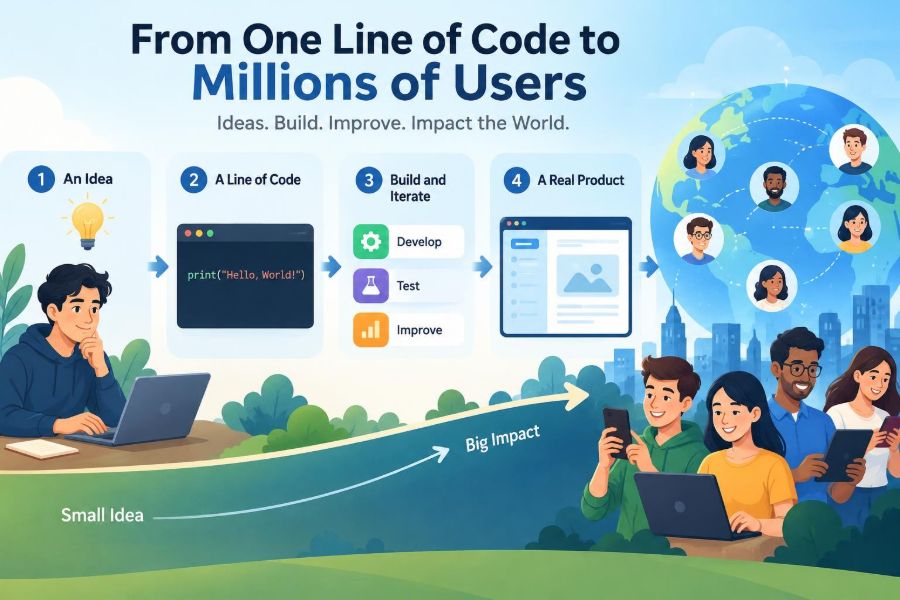

A developer writes a small script to stop copying data between two spreadsheets. A student builds a simple study planner because existing apps feel cluttered. A team adds a button to an internal tool that solves one frustrating daily task.
At first, the code may fit in one file and serve one person. Then a colleague asks to use it. More people arrive with different devices, expectations, data, and ways of breaking assumptions the original author did not know they had made.
This is how many software products begin: not as a polished platform, but as a useful answer to a specific problem. The difficult part is not merely writing more code. It is learning how to turn a working idea into a reliable system that people can discover, trust, and keep using.
Understanding that journey helps students make better project decisions and helps working engineers see why product growth changes architecture, process, and responsibility.
💡 A Product Begins With a Problem, Not a Feature
A feature is a capability: “send reminders,” “share a document,” or “filter results.” A problem describes the user’s unwanted situation: forgetting deadlines, losing track of feedback, or searching through too much irrelevant information.
Starting with the problem prevents a common trap: building a technically impressive feature that nobody needs. The strongest early question is usually, who experiences this problem, when does it happen, and what do they do instead?
For example, “people need an AI dashboard” is too broad to guide design. “Support agents cannot quickly find the prior conversation that explains a customer’s issue” gives a team something observable to investigate.
🔍 Find the Smallest Useful Starting Point
An early product needs a narrow first use case. This is often called a minimum viable product, or MVP: the smallest version that can test whether a proposed solution creates real value.
“Minimum” does not mean careless. It means removing optional scope while preserving the core experience. A meal-planning app might initially let users save recipes and generate one weekly shopping list, rather than attempting nutrition tracking, social sharing, delivery integration, and family accounts.
A narrow scope makes learning faster. If users do not return, the team can examine one clear promise instead of guessing which of twenty partially built features failed.
🧭 Turn Assumptions Into Questions
Every software idea contains assumptions: users have a certain workflow, are willing to enter information, understand a label, or care enough to change their habits. Code cannot validate those assumptions by itself.
Write them down as testable questions. Instead of assuming “freelancers want automatic invoices,” ask whether they already use a satisfactory tool, what causes errors in their current process, and whether automation solves the part they actually dislike.
- Who has the problem most often?
- What is their current workaround?
- What cost does the problem create: time, money, confusion, risk, or frustration?
- What would make them abandon a new solution?
These questions are product discovery, not a substitute for engineering. They give engineering a target worth building.
🗺️ Describe the User Journey Before the System
A user journey is the sequence of actions and decisions a person takes to achieve an outcome. Mapping it exposes steps that a feature list hides: sign-up, permissions, empty states, errors, confirmation, and support.
Consider a hypothetical appointment-booking service. The main action is not simply “book appointment.” A person must find a provider, compare availability, select a time, supply details, receive confirmation, and know what happens if plans change.
Sketching this path early avoids building isolated screens that technically work but leave the user stranded between them.
✏️ Make the First Version Understandable
Early interfaces should reduce uncertainty. A person opening a new product should quickly understand what it does, what action to take next, and what result to expect.
That often means choosing plain language over internal jargon. “Create your first project” is clearer than “Initialize workspace entity.” It also means giving useful empty states rather than displaying an empty table with no explanation.
Good usability is not decoration added after development. It determines whether people can access the value the code is meant to provide.
🏗️ Build for Change, Not for an Imaginary Empire
New engineers sometimes hear that successful products need elaborate architecture from day one. Overdesign can slow a small team just as surely as poor design can slow a large one.
A practical early goal is changeability: code that can be understood, tested, and modified without causing surprising damage. Clear module boundaries, meaningful names, version control, and a modest test suite are often more valuable than a complex distributed design.
Choose complexity in response to demonstrated needs. A single application and database can serve many early products well; splitting services too soon creates deployment, monitoring, and coordination work before it solves a real bottleneck.
🧱 Choose Boundaries That Match the Domain
Software becomes easier to evolve when responsibilities are separated. User authentication, payment processing, search, and notification delivery may interact, but they should not all be tangled inside the same functions.
These boundaries should reflect the product’s domain rather than fashionable patterns. For a learning platform, concepts such as courses, enrollment, submissions, and feedback are useful organizing ideas because the business and users understand them too.
Good boundaries make change local. Updating reminder rules should not require rewriting the grading system.
🗃️ Treat Data as Product Infrastructure
Features come and go, but user data often outlives them. A careless database decision can make future changes difficult, especially when records have unclear ownership or duplicate meanings.
Define what each important piece of data represents, who may read or change it, and how long it should exist. A “deleted” account may require different handling from a removed comment; the correct answer depends on the product, obligations, and user expectations.
Database migrations—the controlled changes to a database schema—deserve the same review discipline as application code. Data changes are harder to undo once real records exist.
🔐 Build Trust Into the First Release
Security is not a final checklist item. Even a small product may hold email addresses, passwords, personal notes, business records, or payment-related information.
Use established authentication and cryptographic tools rather than inventing custom security mechanisms. Limit access to only what a person or service needs, validate input on the server, protect secrets, and keep dependencies updated.
Privacy matters alongside security. Collecting less data can reduce risk and simplify the product. Ask whether each field is truly needed to deliver the promised value.
✅ Test the Behaviors That Must Not Break
Testing is a way to turn expectations into repeatable checks. Unit tests examine a small component; integration tests check that components work together; end-to-end tests simulate important user flows through a running system.
The most valuable tests protect critical behavior: calculating a price correctly, preventing unauthorized access, saving a submission, or delivering a confirmation after a successful action.
Do not pursue a cosmetic test count. Tests that are slow, vague, or coupled to trivial implementation details become expensive to maintain. Aim for confidence in the changes the team makes most often.
🚀 Make Deployment a Routine, Not a Ceremony
A deployment is the process of making a new software version available. When deployments are risky, teams postpone them; then many unrelated changes accumulate, making each release harder to diagnose and reverse.
Automated build and deployment pipelines help make releases repeatable. At a basic level, a pipeline can run tests, package the application, deploy it to an environment, and report whether a step failed.
Small, reversible releases reduce uncertainty. A feature flag can keep a completed capability hidden or limit it to a selected group while the team watches how it behaves.
🌱 Early Users Are Partners in Discovery
The first users are not merely a marketing audience. They reveal whether the team’s model of the problem matches reality.
Listen for behavior as well as opinions. A user may say a feature is useful but never return to it. Another may complain about an inconvenient workaround while using the product every day because it solves a costly problem.
Feedback is most useful when connected to context: what the person was trying to do, where they hesitated, and what outcome they expected. “I did not like it” is a starting point for questions, not a specification.
📊 Measure Outcomes Instead of Collecting Vanity Metrics
A metric is useful when it helps a team make a decision. Total registrations can look encouraging while hiding the fact that few people reach the product’s central outcome.
Define an activation event that represents initial value. For a collaborative writing tool, it might be creating a document and receiving a response from a teammate, not simply opening an account.
| Question | More useful signal | Potentially misleading signal |
|---|---|---|
| Do new users find value? | Completion of a meaningful first task | Page views alone |
| Do people return? | Repeat use over an appropriate period | Total account count |
| Does a change help? | Behavior before and after with context | A single favorable comment |
Metrics need interpretation. Numbers show patterns, but user research and operational knowledge help explain why those patterns exist.
🔄 Learn Through Deliberate Product Loops
Healthy product development follows a loop: identify a problem, form a hypothesis, build a focused change, observe results, and decide what to do next. This is not an excuse for random experimentation; each loop should answer a meaningful question.
Suppose a team believes a shorter onboarding flow will help new users reach their first successful task. They can release the change carefully, monitor completion and errors, then talk with users who still stop midway.
The lesson may be that the issue was not form length at all, but unclear instructions. Learning quickly is valuable because it prevents confident investment in the wrong solution.
⚖️ Prioritize With Explicit Trade-Offs
There will always be more requests than capacity. Prioritization means choosing what not to build yet, not arranging every request in a hopeful queue.
A simple decision can consider expected user value, reach, confidence in the evidence, engineering effort, operational cost, and risk. No formula makes the decision objective, but writing down the reasoning exposes disagreements that would otherwise remain hidden.
Urgent requests deserve scrutiny too. A loud customer request may represent a broad need, or it may be a one-off customization that makes the product harder for everyone else.
👥 Design for More Than the Original User
Growth introduces variation. Users may have slower connections, smaller screens, assistive technologies, different languages, different permission levels, or workflows unfamiliar to the creators.
Accessibility is a practical example. Keyboard navigation, sufficient contrast, descriptive labels, and sensible focus behavior help people using screen readers or alternate input methods. They also often improve the experience for everyone.
Inclusive design does not require predicting every circumstance perfectly. It requires treating variation as normal rather than as an inconvenient exception.
📈 Scale the Bottleneck You Actually Have
Scaling means maintaining acceptable behavior as demand grows. Demand can involve more requests, larger datasets, more concurrent users, more teams, or more complicated operations.
Before adding infrastructure, identify the constraint. A slow product may be limited by an inefficient database query, a third-party API, a large image, a blocked background job, or an overloaded team process. Adding servers will not repair every one of these problems.
Measure first, change one meaningful thing, then measure again. This approach is less glamorous than guessing, but it produces systems based on evidence.
⚡ Design for Performance People Can Feel
Performance is part of usability. A response that arrives too late can feel like a broken response, especially during searches, payments, saves, or time-sensitive work.
Start with the user’s waiting experience. Can the page show useful content before secondary details? Can expensive work happen asynchronously? Can repeated data be cached safely, meaning stored temporarily so it need not be recomputed every time?
Optimization has costs: caching can serve stale information, background jobs need retries and monitoring, and compression can increase processing work. The right choice depends on what users need to see immediately and what can wait.
🛡️ Plan for Failures, Not Just Success Paths
Networks time out, services become unavailable, users submit the same action twice, and infrastructure fails in ordinary ways. Reliable systems expect this rather than treating it as an unlikely surprise.
Idempotency is one useful concept: repeating the same request should not create repeated unintended effects. For example, retrying a payment request should not charge a customer twice merely because the first response was lost.
Graceful failure also includes honest messages. “We could not save your changes; please retry” is better than silently losing work or presenting a generic error with no next step.
🔎 Observe the Product in Production
Once software reaches users, production becomes the real environment of evidence. Observability is the ability to understand a system’s internal state from its outputs, such as logs, metrics, and traces.
Logs record events, metrics summarize measurable behavior, and traces can show the path of a request across components. Together, they help engineers answer questions like: Is the failure isolated? Which release changed behavior? Where is the delay occurring?
Collecting every possible signal is not the goal. Useful observability connects technical events to user impact while avoiding exposure of sensitive information.
🚨 Treat Incidents as Learning Opportunities
An incident is a disruption that affects users or important operations. During an incident, priorities are restoring service, communicating clearly, and protecting data—not assigning blame.
Afterward, a review can examine what happened, what made detection or recovery difficult, and which safeguards would reduce recurrence. A blameless review does not mean avoiding accountability; it means looking beyond an individual mistake to the conditions and system design that allowed it to matter.
Runbooks, rollback plans, backups, and practiced response procedures turn stressful surprises into manageable operational work.
🤝 Product, Design, and Engineering Need Shared Language
Software products are built by people with different expertise. Product roles may focus on user value and priorities; designers on interaction and clarity; engineers on feasible, maintainable implementation; operations and security specialists on safe delivery.
Conflict is not evidence of dysfunction. It can reveal a genuine trade-off, such as speed versus review depth or simplicity versus flexibility. The problem appears when decisions are made through assumptions about another discipline’s work.
Shared artifacts—user journeys, acceptance criteria, prototypes, architecture notes, and incident reviews—give teams a common object to discuss.
📚 Documentation Is a Scaling Tool
When a product has one author, knowledge can live largely in memory. As people join, leave, or work across time zones, undocumented decisions become a source of delay and risk.
Useful documentation is short enough to stay current and specific enough to guide action. It may explain how to run a service locally, why a trade-off was made, how to deploy safely, or what a business term means.
Documentation should not duplicate every line of code. It should preserve context that code alone cannot communicate.
💳 Make Business Constraints Visible
A product must operate within constraints: hosting costs, support capacity, contractual commitments, regulation, pricing, and the organization’s ability to maintain what it sells. Technical decisions affect these realities.
For example, a feature that sends immediate notifications for every event may create infrastructure costs and notification fatigue. A deeply customized enterprise workflow may help one account while creating long-term support obligations.
Engineers do not need to become finance or legal specialists, but understanding the constraint behind a decision leads to more realistic options.
🧹 Pay Down Technical Debt Deliberately
Technical debt is the future cost created by a quick or imperfect technical decision. It is not automatically bad. A shortcut may be sensible when a team is testing an uncertain idea and can later replace it safely.
Debt becomes dangerous when its cost is invisible: deployments slow down, defects cluster in one area, onboarding becomes painful, or small changes require disproportionate effort. The team should describe these effects in product terms, not only as “the code is messy.”
Address debt through planned work, opportunistic improvements during related changes, and clear ownership. A vague promise to “clean everything up later” rarely survives competing priorities.
🧪 Avoid Confusing Activity With Progress
Busy teams can produce tickets, meetings, commits, and releases without improving the user’s situation. Output measures work performed; outcomes describe the change that work creates.
Shipping a new search filter is output. Helping users locate relevant records with less effort may be the desired outcome. The distinction encourages teams to revisit whether a delivered feature actually solved its intended problem.
This does not mean every result is immediately measurable or that teams should ignore necessary maintenance. It means connecting effort to a reason whenever possible.
🪜 Grow Teams and Processes Gradually
Processes that help a fifty-person organization may burden a three-person team. Conversely, an informal approach that works in a small room can fail when multiple teams deploy interconnected services.
Add structure when a recurring failure reveals a need: code review for quality and shared learning, release checks for safety, ownership boundaries for faster decisions, or planning rituals for coordination.
The principle is similar to architecture: use enough structure to solve the present coordination problem, then revisit it as circumstances change.
🌍 Keep Ethics and Impact in the Engineering Conversation
Software influences people through the data it requests, the choices it makes easy, and the errors it permits. Recommendation systems, automated decisions, data sharing, and persuasive notifications can have effects beyond a narrow feature specification.
Teams should ask who might be harmed by a failure or misuse, whose needs were omitted from testing, and whether the product makes its limitations understandable. Some high-impact domains require specialized legal, safety, or domain review; general engineering judgment is not a replacement for that expertise.
Responsible product development is not a separate phase. It is part of defining requirements and acceptable risk.
🎯 The Core Principle: Preserve Value While Complexity Grows
Millions of users do not transform a product through code volume alone. Growth introduces more expectations, edge cases, dependencies, and consequences. The task is to preserve the original value while deliberately managing that new complexity.
Start with a specific problem. Build the smallest trustworthy solution. Learn from real behavior. Strengthen architecture, operations, security, and collaboration when evidence shows they are needed.
The products that endure are rarely those that predicted every future detail. They are the ones that kept learning, made trade-offs visible, and retained the ability to change without losing sight of the people they serve.
A software idea becomes a real-world product when useful code is paired with continuous learning, responsible operation, and a clear commitment to the user’s problem. That is how one line can grow into something dependable without losing its purpose. ⚙️🌱🚀