
Modern applications depend heavily on APIs, or Application Programming Interfaces. Mobile apps use APIs to load user profiles, websites use them to retrieve products and process payments, cloud services use them to communicate with one another, and developers use public APIs to access everything from maps and weather data to artificial intelligence services. 🌐⚙️
Because APIs sit directly between software systems, they can receive enormous numbers of requests. Most of those requests may be legitimate—but some can be accidental, excessive, automated, or malicious.
If an API accepts unlimited traffic, a single badly written script could send thousands of requests per second and consume enough CPU, memory, database capacity, or network bandwidth to slow the entire service.
A deliberate attacker could do the same thing intentionally.
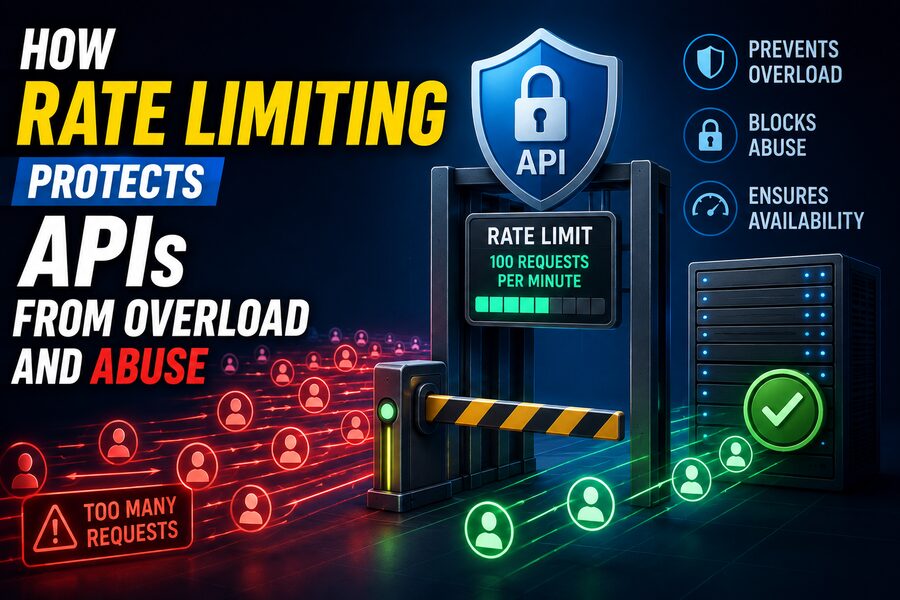
One of the most important defenses against this problem is rate limiting. 🚦
Rate limiting controls how frequently a user, application, IP address, API key, or other client is allowed to make requests within a given period.
It helps keep services responsive, reduces abuse, protects expensive backend systems, and ensures that one client cannot unfairly consume resources intended for everyone.
🌐 What Is an API Rate Limit?
A rate limit is a rule that places a boundary on request volume.
For example, an API might allow:
100 requests per minute per user
or:
1,000 requests per hour per API key
or:
10 login attempts every 5 minutes per IP address
Once the allowed rate is exceeded, the server can temporarily reject additional requests.
A typical response uses the HTTP status code:
429 Too Many Requests
The server may also tell the client how long it should wait before trying again.
Rate limits can be extremely simple or highly sophisticated depending on the size and security requirements of the system.
🛡️ Why APIs Need Rate Limiting
Without limits, every client effectively competes for the same backend resources.
Imagine an online store whose API normally handles 5,000 requests per second.
Now suppose one malfunctioning program accidentally begins making 30,000 requests per second.
Even though the traffic is not malicious, the consequences might include:
- Slow page loads 🐢
- Database overload 🗄️
- Increased cloud costs 💰
- Request failures ❌
- Server crashes 💥
- Poor service for legitimate customers
Rate limiting prevents that one client from consuming unlimited capacity.
Instead of allowing 30,000 requests per second, the system might restrict that client to a reasonable amount while continuing to serve everyone else.
⚠️ Accidental Overload Is Surprisingly Common
Not every traffic spike is an attack.
Software bugs can create excessive API calls.
For example, a developer might accidentally write a loop like:
while true:
    request_api()
A mobile application could repeatedly retry a failed request without any delay.
Thousands of devices running that software might suddenly begin hammering the same endpoint.
Rate limiting acts as a safety boundary.
Even when the client behaves incorrectly, the server prevents the mistake from becoming a system-wide outage. 🔧
🤖 Protecting Against Automated Abuse
APIs are also attractive targets for automated bots.
Attackers may send large numbers of requests to:
- Scrape data
- Guess passwords
- Create fake accounts
- Test stolen credentials
- Search for valid usernames
- Reserve scarce inventory
- Spam forms
- Abuse promotional offers
Because computers can generate requests far faster than humans, automation can overwhelm an unprotected endpoint.
Rate limiting does not eliminate every bot, but it can dramatically increase the cost and difficulty of automated abuse.
🔐 Example: Blocking Brute-Force Login Attempts
Consider a login API.
Without rate limiting, an attacker could attempt thousands of passwords against one account every minute.
Suppose the API instead allows:
5 failed login attempts per account within 10 minutes
After that threshold, additional attempts are slowed or temporarily blocked.
This makes brute-force password guessing much less practical.
Security systems may combine several limits, such as:
- Attempts per account
- Attempts per IP address
- Attempts per device
- Attempts across many accounts from one source
This matters because sophisticated attackers often distribute requests across multiple accounts or IP addresses. 🛡️
⚖️ Rate Limiting Creates Fairness
Rate limiting is not only about security.
It also ensures fair access.
Imagine an API used by 10,000 customers.
Without limits, one customer could send millions of requests and consume most of the available infrastructure.
Everyone else would experience slower performance.
A rate limit ensures that resources are shared more predictably.
Paid API services often use multiple tiers:
Free plan: 100 requests per hour
Standard plan: 10,000 requests per hour
Enterprise plan: Custom capacity
In this case, rate limits are both a technical protection mechanism and a product-management tool. 💳
🧮 The Simplest Method: Fixed Window Limiting
One common rate-limiting algorithm is the fixed window counter.
Suppose the rule is:
100 requests per minute
The system divides time into one-minute windows:
12:00:00–12:00:59
12:01:00–12:01:59
12:02:00–12:02:59
Each client’s requests are counted within the current window.
When the counter reaches 100, additional requests are denied until the next minute begins.
This technique is simple and efficient.
However, it has an important weakness.
🪟 The Fixed-Window Boundary Problem
Imagine a client sends:
100 requests at 12:00:59
Then, when the next window begins, it sends:
100 more requests at 12:01:00
Technically, neither one-minute window exceeds the limit.
But the server has received:
200 requests within roughly two seconds
This burst can defeat the intent of the rule.
To solve this problem, engineers use more flexible algorithms.
🕒 Sliding Window Rate Limiting
A sliding window looks at activity over a continuously moving period rather than fixed clock boundaries.
Suppose the rate limit is:
100 requests in any 60-second period
If a client sends 100 requests at 12:00:59, those requests remain part of the calculation until they become more than 60 seconds old.
The client cannot immediately send another full batch simply because the minute changed.
Sliding windows provide smoother enforcement, although they can require more state and computation.
🪣 Token Bucket Algorithm
The token bucket is one of the most widely used rate-limiting models.
Imagine a bucket that contains tokens.
Each API request costs one token.
Tokens are replenished at a fixed rate.
For example:
- Bucket capacity: 100 tokens
- Refill rate: 10 tokens per second
- Request cost: 1 token
If the bucket contains tokens, the request is accepted and a token is removed.
If the bucket is empty, the request must be rejected or delayed.
This algorithm allows controlled bursts.
A client that has been inactive for a while can accumulate tokens and briefly send requests faster than the long-term refill rate.
That makes token buckets useful for real applications where occasional bursts are normal. 🪣⚡
💧 Leaky Bucket Algorithm
Another common concept is the leaky bucket.
Imagine incoming requests being poured into a bucket.
The bucket drains at a fixed rate.
As long as requests enter slowly enough, everything works normally.
If requests arrive faster than the bucket can drain, they accumulate.
If the bucket becomes full, new requests are rejected.
The leaky bucket is useful when engineers want to smooth bursty traffic into a predictable outgoing rate.
Token bucket and leaky bucket algorithms are related, but they emphasize different behaviors:
Token bucket → permits bursts within limits
Leaky bucket → smooths traffic toward a fixed rate
🎯 What Exactly Can Be Rate Limited?
A system must decide who or what is being limited.
Possible identifiers include:
- IP address 🌐
- User account 👤
- API key 🔑
- Device ID 📱
- Authentication token
- Customer organization 🏢
- Geographic region 🌍
- Specific endpoint
- Combination of several attributes
For a public unauthenticated endpoint, the IP address may be the only obvious identifier.
For an authenticated API, limiting by API key or account is usually more accurate.
Sophisticated systems often apply multiple limits at once.
🧩 Layered Rate Limits
A large API might enforce all of these simultaneously:
5 requests per second per user
1,000 requests per hour per API key
20,000 requests per minute per organization
500,000 requests per minute globally
This creates multiple layers of protection.
A single user cannot overwhelm the API.
An entire customer organization cannot consume excessive resources.
And if overall traffic reaches the service’s physical capacity, a global limit provides a final safety boundary.
📍 Different Endpoints Need Different Limits
Not all API requests cost the same amount to process.
Consider these endpoints:
GET /status
This may simply return a tiny cached response.
Now consider:
POST /generate-report
This might query millions of database rows, create a PDF, and consume substantial CPU time.
Allowing both endpoints 1,000 requests per minute would not make sense.
Engineers often assign different limits based on endpoint cost.
An expensive operation may have a much stricter limit.
⚙️ Weighted Rate Limiting
Some systems go even further and assign cost weights to requests.
For example:
- Simple lookup = 1 unit
- Complex database search = 5 units
- Large export = 20 units
- AI inference request = 50 units
Instead of counting requests, the rate limiter counts consumed capacity.
A user might receive:
1,000 processing units per minute
This approach better reflects actual resource consumption.
Ten extremely expensive calls may be more dangerous than hundreds of lightweight requests.
🧠 Where Is Rate Limiting Implemented?
Rate limiting can appear at several layers of architecture.
🌐 API Gateway
An API gateway sits in front of backend services and can reject excessive traffic before it reaches them.
This is a common place to enforce limits.
🔄 Reverse Proxy
Web servers and reverse proxies can apply limits based on IP addresses, routes, or headers.
☁️ Cloud Infrastructure
Cloud platforms often provide managed rate-limiting features.
💻 Application Code
The API itself may track user-specific quotas and business rules.
🛡️ Web Application Firewall
A WAF may limit suspicious request patterns as part of security protection.
Large systems often use several layers at once.
🚪 Why Early Rejection Matters
Imagine a request requires:
- Authenticating the user
- Querying a database
- Calling three internal services
- Running a large computation
- Formatting the response
If the client has already exceeded its rate limit, performing all those steps wastes resources.
A well-positioned rate limiter rejects the request as early as possible.
This protects downstream systems before expensive work begins.
That is why API gateways and edge infrastructure are such effective enforcement points. 🚦
🌍 Rate Limiting in Distributed Systems
Rate limiting becomes more complicated when an API runs across many servers.
Suppose ten servers each independently allow:
100 requests per minute
A client could potentially send requests across all ten servers and receive:
1,000 requests per minute
even though the intended limit was only 100.
To enforce a global limit, the servers need shared coordination.
Systems may use:
- Centralized counters
- Distributed databases
- In-memory data stores
- Consistent hashing
- Approximate distributed algorithms
The challenge is enforcing limits quickly without turning the rate limiter itself into a bottleneck.
⚡ Why In-Memory Stores Are Popular
Rate limiting often requires incrementing counters on every request.
That operation must be extremely fast.
For this reason, systems frequently use high-speed in-memory storage rather than traditional disk-based databases.
A counter may store information such as:
user_482_requests = 73
with an expiration time corresponding to the current rate-limit window.
When a new request arrives, the counter increments atomically.
If the value exceeds the configured threshold, the request is rejected.
Atomic updates are important because many servers may update the same counter simultaneously.
🧱 Protecting Databases With Rate Limits
An API server may be capable of accepting enormous traffic while its database cannot.
Suppose the web layer can handle:
50,000 requests per second
but the database becomes unstable above:
8,000 expensive queries per second
Without protective controls, incoming traffic can push the database beyond its capacity.
Once the database slows down, requests remain active longer, connection pools fill, and failures spread through the application.
Rate limits help keep incoming work within sustainable bounds.
🌊 Preventing Cascading Failures
Overload can spread through distributed systems.
Imagine:
API traffic increases
⬇️
Database slows down
⬇️
Requests take longer
⬇️
Application threads remain busy
⬇️
Queues become full
⬇️
Clients retry failed requests
⬇️
Traffic increases even more
This feedback loop can cause a cascading failure. 💥
Rate limiting interrupts the cycle by rejecting excess work before every component becomes saturated.
🔁 Rate Limiting and Retries
Clients should not immediately retry a rate-limited request over and over.
If thousands of clients do this simultaneously, they can make overload worse.
A server may include a header such as:
Retry-After
This tells the client how long to wait.
Good clients also use exponential backoff.
Instead of retrying every millisecond, they wait progressively longer:
1 second
2 seconds
4 seconds
8 seconds
Often a small random delay called jitter is added so that thousands of clients do not all retry at exactly the same moment. 🎲
📡 Useful Rate-Limit Response Headers
APIs may provide information about the client’s remaining quota.
Depending on the system, response headers can indicate values such as:
- Maximum requests allowed
- Requests remaining
- Time until reset
- Retry delay
For example, conceptually:
RateLimit-Limit: 100
RateLimit-Remaining: 12
RateLimit-Reset: 30
These values allow well-designed clients to slow themselves down before receiving a rejection.
Exact header formats vary between APIs and standards.
🤝 Rate Limiting vs Throttling
The terms rate limiting and throttling are often used interchangeably, but they can describe slightly different behavior.
Rate limiting often means:
Too many requests → reject additional requests
Throttling can also mean:
Too many requests → intentionally slow or queue them
For example, instead of rejecting request 101, a server might delay it until capacity becomes available.
Whether rejection or delay is preferable depends on the application.
Interactive APIs often prefer fast rejection because long unpredictable delays produce poor user experiences.
🛑 Rate Limiting Is Not the Same as DDoS Protection
Rate limiting can help mitigate some forms of denial-of-service traffic, but it is not a complete DDoS defense.
A distributed denial-of-service attack may involve enormous numbers of devices spread across thousands or millions of IP addresses.
If each source remains below its individual limit, the combined traffic can still be massive.
Large-scale DDoS protection may also require:
- Traffic filtering
- Anycast networks
- Edge scrubbing
- Network-level mitigation
- Bot detection
- Connection controls
- Content delivery networks
Rate limiting is one layer within a broader defense strategy. 🛡️🌐
🕵️ Preventing Data Scraping
Suppose a competitor writes a bot that attempts to download an entire product database through a public API.
If the endpoint has no limits, the bot may retrieve millions of records rapidly.
Rate limiting slows this extraction.
A normal user might make only a handful of requests per minute.
A scraper making hundreds per second can be identified and restricted.
Other defenses may include:
- Authentication
- Pagination restrictions
- Bot detection
- Behavioral analysis
- CAPTCHA for human-facing applications
Rate limits increase the time and infrastructure required for large-scale scraping.
💳 Protecting Expensive Third-Party Services
An API endpoint may call another service that charges money per request.
For example:
Your API → external SMS service
If an attacker repeatedly triggers the endpoint, the system could generate a huge bill even if its own servers remain stable. 💸
Rate limits can protect economic resources as well as technical ones.
This is especially important for:
- SMS messages
- Email delivery
- AI model inference
- Mapping services
- Payment-processing operations
- Cloud storage operations
📨 Example: Password Reset Abuse
A password-reset endpoint may send an email or SMS.
Without limits, an attacker could repeatedly request password resets for the same user.
This might:
- Spam the victim
- Increase provider costs
- Create annoyance
- Hide legitimate security messages
A sensible system might restrict password-reset requests per account and per IP address.
Rate limiting therefore protects both infrastructure and users.
🏷️ Quotas vs Rate Limits
A rate limit controls how quickly requests are made.
A quota typically controls how much usage is allowed over a longer period.
For example:
Rate limit: 20 requests per second
Daily quota: 100,000 requests per day
The two mechanisms solve different problems.
The per-second limit protects the service from sudden bursts.
The daily quota controls total resource usage.
Many commercial APIs use both.
🧠 Adaptive Rate Limiting
Static limits work well in many cases, but modern infrastructure can also adjust limits dynamically.
Suppose servers are operating at only 30% capacity.
The system might temporarily allow higher traffic.
If CPU utilization climbs above 90%, the allowed request rate can be reduced.
Adaptive systems may consider:
- CPU utilization
- Memory pressure
- Database latency
- Queue depth
- Error rate
- Backend health
This turns the rate limiter into part of the service’s real-time overload-management system. 🤖
👤 Personalized Rate Limits
Different users may deserve different limits.
For example:
- Anonymous visitor → 20 requests/minute
- Registered user → 100 requests/minute
- Premium customer → 1,000 requests/minute
- Internal service → 10,000 requests/minute
A system may also temporarily tighten limits for suspicious clients.
A user exhibiting normal behavior receives generous capacity.
A user suddenly attempting thousands of login requests might receive much stricter enforcement.
This type of context-aware rate limiting can improve both usability and security.
🧪 Rate Limiting and API Testing
Developers should test what happens when limits are exceeded.
Important questions include:
- Does the API return the correct status code?
- Are retry instructions clear?
- Are counters accurate under high concurrency?
- Can limits be bypassed through alternate endpoints?
- Do authenticated and unauthenticated users receive appropriate limits?
- Does the system remain responsive during overload?
Rate limiting that works during ordinary traffic but fails under true concurrency is not sufficient.
Load testing helps expose these weaknesses before production traffic does.
📊 Monitoring Rate-Limit Events
Rate limiting also generates valuable operational data.
Engineers can monitor:
- Number of blocked requests
- Most frequently limited clients
- Endpoints receiving excessive traffic
- Sudden changes in request patterns
- Geographic origins
- Error rates after enforcement
A sudden spike in rate-limit violations may indicate:
- A software bug
- A scraping campaign
- Credential abuse
- A bot attack
- An unexpectedly popular feature
Thus, rate limiting can double as an early-warning system. 🚨
⚠️ Limits That Are Too Strict Can Hurt Users
Rate limiting must be carefully tuned.
If limits are too generous, they fail to protect the service.
If limits are too restrictive, legitimate applications break.
Imagine a dashboard that legitimately loads 50 pieces of data when it opens.
If the API allows only 20 requests per minute, users may constantly encounter errors.
Developers therefore study realistic usage patterns before deciding thresholds.
A good rate limit protects the system while staying mostly invisible to normal users.
🔐 Avoiding Common Rate-Limit Bypasses
Simple rate limiting based only on IP address can be bypassed.
Attackers may use:
- Proxy servers
- VPNs
- Botnets
- Cloud instances
- Rotating IP addresses
That is why sensitive APIs may combine several signals.
For example:
IP + account + device + API key + behavior
The goal is to make abuse difficult without unnecessarily blocking legitimate users who happen to share an IP address, such as people on a corporate or university network.
🌐 Edge Rate Limiting
Large Internet services increasingly enforce limits close to the network edge.
The “edge” refers to infrastructure geographically closer to users.
Blocking abusive traffic there has important benefits.
Unwanted requests never need to travel deep into the company’s network.
This reduces:
- Bandwidth consumption
- Backend load
- Internal network traffic
- Application processing
For massive global systems, early edge rejection can save considerable resources.
🔗 Rate Limiting and Other Resilience Patterns
Rate limiting works best alongside other protective techniques.
One important companion is the circuit breaker pattern.
If a downstream service begins failing, a circuit breaker can temporarily stop sending it requests.
Another is load shedding, where lower-priority requests are dropped when the system approaches capacity.
Queues, timeouts, caching, and concurrency limits also play important roles.
Together, these mechanisms allow systems to degrade gracefully instead of collapsing completely under pressure. 🧱
🚦 An Everyday Analogy
A useful analogy for rate limiting is a highway entrance ramp.
If every car entered the highway at once, traffic could become dangerously congested.
A ramp meter uses traffic lights to control how quickly vehicles enter.
The road still carries traffic, but the inflow stays within a manageable range.
An API rate limiter performs a similar task.
Requests are the cars.
Backend servers are the highway.
The rate limiter prevents too many requests from entering simultaneously. 🚗🚦
🏁 Final Thoughts
Rate limiting is one of the simplest ideas in API architecture, yet it solves several major problems at once.
By controlling how frequently a client can make requests, it helps protect APIs from:
- Accidental traffic floods
- Automated scraping
- Brute-force attacks
- Spam
- Expensive resource abuse
- Backend overload
- Unfair resource consumption
- Cascading failures
Different algorithms offer different behaviors.
Fixed windows provide simplicity.
Sliding windows provide smoother enforcement.
Token buckets allow controlled bursts.
Leaky buckets help regulate traffic into a steady flow.
Large systems often combine these algorithms with API gateways, shared counters, edge infrastructure, adaptive policies, and user-specific quotas.
The most important principle is straightforward:
An API should never allow one client—or one sudden traffic burst—to consume unlimited shared resources. 🚦
Rate limiting creates a controlled boundary between unpredictable incoming demand and finite computing capacity.
When designed well, legitimate users barely notice it. But during a software bug, scraping attempt, login attack, or sudden traffic surge, that invisible boundary may be exactly what prevents a slow API from becoming a complete outage. 🌐🛡️⚡