
Modern applications can generate and store staggering amounts of information. Social networks may track billions of posts and interactions, online stores may process millions of orders, financial platforms may record enormous streams of transactions, and software services may manage data for users spread across the world. 🌍💻
At some point, one database server may no longer be enough.
A single machine has limits on:
- Storage capacity
- CPU power
- Memory
- Disk throughput
- Network bandwidth
- Number of simultaneous queries
One way to grow is to buy a larger server. This is called vertical scaling. But vertical scaling eventually becomes expensive or physically impractical.
Database sharding offers another approach.
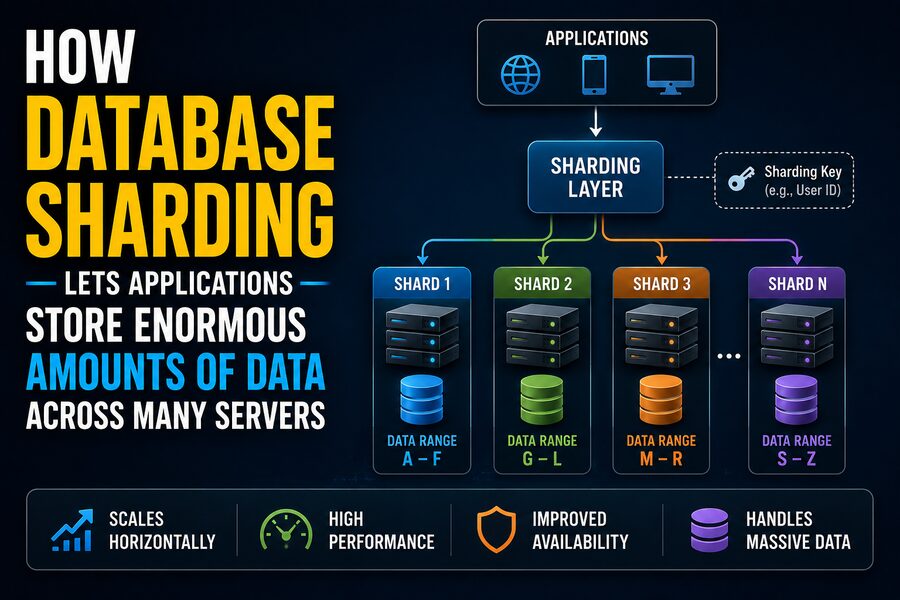
Sharding divides a large database into smaller pieces called shards and distributes those pieces across multiple servers. Each server stores and handles only part of the total dataset.
Instead of asking one giant database server to store everything, the system spreads the workload across many machines.
This technique is a major reason large-scale applications can continue operating even as their data grows from millions to billions of records. 🚀
🧩 1. What Is a Database Shard?
A shard is an independent portion of a larger database.
Imagine a database containing 100 million customer accounts.
Instead of storing all 100 million rows on one server, the application might divide them across four database servers:
- Shard 1 → Customers 1–25 million
- Shard 2 → Customers 25–50 million
- Shard 3 → Customers 50–75 million
- Shard 4 → Customers 75–100 million
Each shard contains the same general table structure, but it stores only a subset of the rows.
Together, all shards form the complete logical database.
From the user’s perspective, the application may still appear to have one unified database.
Behind the scenes, however, the information is spread across many separate machines. 🖥️🖥️🖥️
📏 2. Sharding Is a Form of Horizontal Partitioning
Database sharding is often described as horizontal partitioning.
Why horizontal?
Imagine a table with millions of rows.
Horizontal partitioning splits the table by rows.
For example:
| User ID | Name | Country |
|---|---|---|
| 1001 | Maya | India |
| 1002 | Daniel | Canada |
| 1003 | Akira | Japan |
One shard might contain the first group of users, another shard the second group, and so on.
This differs from vertical partitioning, where different columns might be stored separately.
Sharding usually means splitting rows across independent database instances.
🔑 3. The Shard Key Determines Where Data Goes
A sharded database needs a rule for deciding which shard should store each record.
That rule usually depends on a shard key.
A shard key might be:
- User ID
- Customer ID
- Account number
- Geographic region
- Organization ID
- Order ID
- Device ID
Suppose an application uses customer ID as the shard key.
When customer 84321 creates an order, the system calculates which shard is responsible for customer 84321.
The order is then sent directly to that server.
Choosing the shard key is one of the most important design decisions in a sharded database. 🎯
A good shard key distributes data and workload evenly.
A poor shard key can create overloaded servers known as hot shards.
🧮 4. Hash-Based Sharding Distributes Data Mathematically
One common approach is hash-based sharding.
The system applies a hash function to the shard key.
Conceptually, it might perform something like:
shard = hash(user_id) mod number_of_shards
Suppose there are four shards.
A user ID is transformed into a hash value, and the result determines which of the four servers stores that user’s data.
The major advantage is relatively even distribution.
Sequential user IDs do not all accumulate on one server.
Instead, the hash function spreads them across the available shards. ⚖️
However, simple modulo-based sharding creates difficulties when the number of shards changes because many records may need to move.
More advanced systems may use consistent hashing or other placement algorithms to reduce unnecessary redistribution.
📚 5. Range-Based Sharding Groups Similar Keys Together
Another strategy is range-based sharding.
Instead of hashing values, the system assigns specific key ranges to different servers.
For example:
- Shard A → IDs 1–1,000,000
- Shard B → IDs 1,000,001–2,000,000
- Shard C → IDs 2,000,001–3,000,000
This approach makes range queries easier.
If an application asks for records between IDs 1.2 million and 1.4 million, the system knows that all of them should exist on the same shard.
But range sharding can create imbalance.
If all new records use increasing IDs, the newest shard may receive most write traffic while older shards remain relatively idle. 🔥
Engineers therefore need to consider access patterns carefully.
🌍 6. Geographic Sharding Keeps Data Near Users
Some systems shard data by geography.
For example:
- Europe → European database cluster
- North America → North American cluster
- Asia → Asian cluster
Geographic sharding can reduce network latency because users access servers closer to them.
It can also help organizations satisfy data residency or regulatory requirements.
A global service may want European customer data to remain in European data centers while Asian customer data stays in Asia. 🌐
However, global systems become more complicated when users in one region need access to data stored in another.
🏢 7. Tenant-Based Sharding Works Well for SaaS Applications
Software-as-a-Service platforms often serve thousands of independent businesses or organizations.
In this case, the tenant ID can make a natural shard key.
For example:
- Companies A–F → Shard 1
- Companies G–M → Shard 2
- Companies N–S → Shard 3
- Companies T–Z → Shard 4
All data belonging to one customer organization can remain on the same shard.
This simplifies many queries because information for a single tenant does not need to be collected from multiple servers.
However, one extremely large tenant can still become a problem if it grows much larger than everyone else.
⚡ 8. Sharding Improves Write Capacity
Suppose a single database server can safely handle 20,000 write operations per second.
If an application grows beyond that limit, simply optimizing queries may no longer be enough.
With four shards, write traffic can be divided across four machines.
Instead of one server processing all writes, each server handles only part of the workload.
The total system may therefore support far more operations per second.
This is one of the biggest benefits of sharding:
it allows write capacity to scale horizontally.
Adding more machines can increase the overall ability of the system to process new data. 🚀
💾 9. Sharding Increases Total Storage Capacity
Storage is another major advantage.
Suppose each database server can comfortably hold 10 terabytes.
One server gives the system approximately 10 TB of capacity.
Ten similar shards could provide roughly 100 TB of raw storage capacity before considering replication and operational overhead.
This makes sharding useful for databases that simply cannot fit on one machine.
Large-scale systems may use dozens, hundreds, or even thousands of partitions depending on workload and architecture.
🔍 10. Queries Become More Complicated
Sharding solves capacity problems, but it introduces new challenges.
If a query concerns one shard key, routing is straightforward.
For example:
Find all orders for customer 28741.
If customer 28741 belongs to Shard 3, the application sends the query directly there.
But consider:
Find the 100 largest orders across all customers today.
Now the answer may be spread across every shard.
The system may need to:
- Send the query to all relevant shards.
- Retrieve partial results.
- Merge those results.
- Sort them again.
- Return the final answer.
This is often called a scatter-gather query.
Scatter-gather operations can be expensive because they involve multiple machines. 📡
🗺️ 11. A Router Must Know Where Each Record Lives
Applications need a way to determine which shard should receive a query.
This logic may live in:
- Application code
- A database proxy
- A routing service
- A distributed database engine
The router examines the shard key and determines the correct destination.
For example:
user_id = 5008 → Shard 7
Without correct routing, the application would have to ask every shard where the record exists.
Efficient shard routing is therefore central to system performance.
🔄 12. Replication and Sharding Solve Different Problems
Sharding and replication are related but not the same.
Sharding divides different data across machines.
Replication copies the same data onto multiple machines.
For example, Shard A may contain customers 1–1 million.
That shard may itself have:
- One primary server
- Two replicas
Shard B may contain customers 1–2 million with its own replicas.
This means a large distributed database often uses both techniques simultaneously.
Sharding provides scalability.
Replication provides redundancy and can improve read capacity. 🛡️
📖 13. Read Traffic Can Also Be Distributed
Sharding can improve read performance when queries naturally target specific shards.
If four shards each receive a quarter of the traffic, no single server needs to handle every query.
Read replicas can further increase capacity.
A typical architecture might look like:
Application → Shard Router → Primary/Replica Sets
Reads may go to replicas while writes go to the primary.
This creates several layers of distribution.
However, maintaining consistency between replicas adds additional complexity.
⚠️ 14. Hot Shards Can Defeat the Benefits
Sharding only works well when load is distributed reasonably evenly.
Suppose an application shards data by country.
If 80% of its users are in one country, the corresponding shard could receive most of the traffic.
That server becomes overloaded while others remain underused.
This is known as a hot shard or hot partition.
Hot shards may result from:
- Uneven user distribution
- Viral content
- Large enterprise tenants
- Time-based keys
- Sequential IDs
- Poor shard-key selection
A strong sharding strategy attempts to avoid predictable hotspots.
🔧 15. Resharding Becomes Necessary as Systems Grow
A system that begins with four shards may eventually need eight, sixteen, or more.
Moving data from the old arrangement to the new one is called resharding.
Resharding can be difficult because databases may remain active while data is moving.
The system must ensure that:
- No records are lost
- Writes go to the correct location
- Queries remain consistent
- Duplicate records are avoided
- Downtime is minimized
Advanced distributed databases may automate this process by moving partitions gradually in the background while routing requests appropriately.
Manual sharding systems require much more operational work. 🛠️
🧠 16. Consistent Hashing Makes Expansion Easier
Traditional modulo hashing can cause large amounts of data movement.
Suppose records are assigned using:
hash(key) mod 4
If the system expands to five shards, the formula becomes:
hash(key) mod 5
A huge percentage of keys may now map to different servers.
Consistent hashing reduces this disruption.
Instead of remapping nearly everything, it tries to move only a fraction of the data when servers are added or removed.
This technique became especially important in distributed storage systems and large-scale key-value databases.
🔗 17. Cross-Shard Joins Are Difficult
Relational databases are excellent at joining tables.
For example:
Customers JOIN Orders JOIN Payments
On one server, the database engine can efficiently coordinate these operations.
In a sharded system, related rows may live on different machines.
A cross-shard join may require network communication, partial query execution, and result merging.
This can become much slower than a local join.
For this reason, sharded database schemas are often designed so frequently joined data shares the same shard key.
This is called data co-location.
Keeping related records together can dramatically simplify queries.
💸 18. Cross-Shard Transactions Are More Expensive
Transactions also become more complicated.
Suppose money must be transferred from an account on Shard A to another account on Shard B.
The system must ensure that both sides of the transaction succeed or both fail.
Coordinating such an operation across multiple servers may require distributed transaction protocols.
These protocols can increase latency and reduce availability during failures.
Many large systems therefore design workflows to minimize cross-shard transactions whenever possible.
This is another reason shard-key selection matters so much.
🛡️ 19. Failure Isolation Can Be an Advantage
Sharding can sometimes reduce the impact of failures.
If one shard becomes unavailable, only the users or records assigned to that shard may be affected.
Other shards may continue operating normally.
For example, if Shard 4 fails, customers on Shards 1, 2, and 3 may still access the service.
This property is called failure isolation.
Replication can further improve resilience by allowing a replica to take over if a primary shard server fails.
However, poorly designed routing or shared infrastructure can still cause a local problem to become system-wide.
📊 20. Monitoring Shards Is Essential
A sharded database requires more operational monitoring than a single database.
Engineers need to track:
- Storage utilization
- CPU usage
- Memory consumption
- Query latency
- Read/write throughput
- Replication lag
- Error rates
- Data distribution
- Hot partitions
If one shard approaches its storage limit much faster than the others, the system may require rebalancing.
Monitoring makes it possible to detect those problems before users experience severe performance issues. 📈
🧰 21. Some Databases Automate Sharding
Traditional relational databases often require applications to implement sharding logic manually.
Modern distributed databases may provide automatic sharding.
The database itself can:
- Divide data into partitions
- Move partitions between servers
- Route queries
- Detect failed nodes
- Rebalance storage
- Replicate data
This greatly simplifies application development, although the distributed database engine itself becomes much more sophisticated.
Examples of modern systems may use terms such as:
- Partitions
- Tablets
- Buckets
- Regions
- Vnodes
The terminology varies, but the underlying principle is similar: divide a large dataset across multiple machines.
📦 22. Sharding Is Different From Simple Partitioning on One Server
Some databases partition a large table into smaller sections while keeping all partitions on one physical server.
This can improve query management and maintenance.
However, it does not provide the same horizontal scalability as true sharding.
With database sharding, separate partitions live on separate database servers or nodes.
That allows CPU, memory, storage, and network load to be spread across multiple machines.
The distinction is important because both techniques may use similar partitioning concepts.
🌐 23. Large Applications Often Hide Sharding From Users
A user opening a social-media profile does not know which database shard contains that account.
An online shopper does not know which server stores their purchase history.
The application layer hides this complexity.
To the user, the system behaves like one service.
Behind the scenes, requests may travel through:
- Load balancers
- API servers
- Cache layers
- Shard routers
- Database nodes
- Replicas
This abstraction allows enormous distributed systems to appear simple from the outside. 🌐
🎯 24. Choosing a Good Shard Key
The best shard key depends on the application.
A strong shard key typically has several characteristics:
High cardinality: There are many possible values.
Even distribution: Records are spread reasonably uniformly.
Query alignment: Common queries include the shard key.
Low hotspot risk: A small number of values do not receive most traffic.
Stable identity: The key does not change frequently.
For a multi-tenant application, tenant ID may work well.
For a consumer application, user ID may be appropriate.
For a time-series workload, engineers may need a composite key to prevent all current writes from landing on one shard.
There is no universally correct choice.
🧩 25. Composite Shard Keys Can Improve Distribution
Sometimes one field is not enough.
A system may use multiple values together.
For example:
tenant_id + user_id
or:
region + hashed_customer_id
This creates a composite shard key.
Composite keys can balance competing goals such as locality and distribution.
For example, keeping users in the same region while hashing within that region can reduce latency without creating one enormous regional hotspot.
🚀 26. Why Sharding Enables Massive Scale
The greatest strength of sharding is that it changes the scaling model.
Without sharding, application growth is limited by the maximum capacity of one database machine.
With sharding, new servers can be added as data and traffic increase.
A system might grow from:
4 shards → 8 shards → 32 shards → 100+ shards
Theoretically, capacity can keep increasing as long as the architecture can manage routing, balancing, replication, and distributed operations efficiently.
This is why sharding is so important in systems expected to operate at internet scale.
⚖️ 27. Sharding Is Powerful but Not Free
Sharding introduces substantial engineering complexity.
Benefits include:
- Greater storage capacity
- Higher write throughput
- Distributed read load
- Better horizontal scalability
- Potential failure isolation
But the costs include:
- More complicated queries
- Harder transactions
- Difficult resharding
- Additional monitoring
- Cross-shard coordination
- More complex backups
- Operational overhead
For smaller applications, sharding may be unnecessary.
A well-designed single database with indexes, caching, replicas, and adequate hardware may support a very large workload.
Sharding becomes attractive when the limits of simpler approaches are approaching.
🏁 Conclusion
Database sharding allows applications to store enormous amounts of data by dividing one logical database into many smaller physical pieces.
Each shard stores only part of the overall dataset.
A shard key determines where records belong, while routing logic ensures queries reach the appropriate server.
Different strategies—including hash-based, range-based, geographic, and tenant-based sharding—offer different tradeoffs.
When implemented well, sharding distributes storage, writes, reads, and computation across many machines. 🖥️⚡
Instead of continually replacing one database server with a larger and more expensive machine, applications can scale horizontally by adding additional nodes.
However, that scalability comes with new challenges. Cross-shard joins become harder, distributed transactions become more expensive, hot shards can form, and moving data during resharding requires careful coordination.
The core idea remains remarkably simple:
Do not make one database server store and process everything. Divide the data into manageable pieces and let many servers share the work.
That principle enables modern applications to grow far beyond the physical limits of a single machine, making database sharding one of the foundational techniques behind large-scale distributed systems. 🗄️🌍🚀