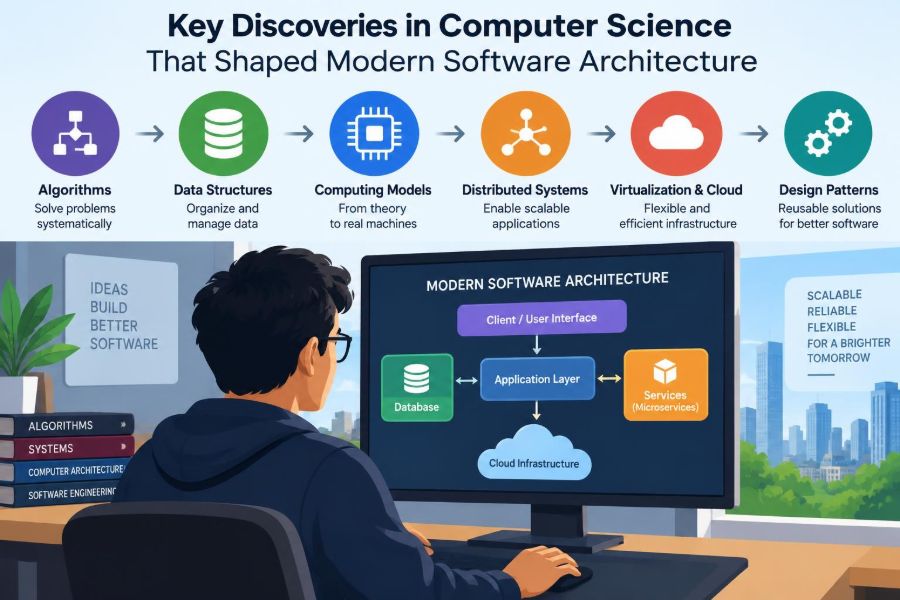

A payment succeeds on a phone in seconds. A music service recommends a song, a delivery app updates a driver’s location, and a team deploys a small change without taking down an entire website. These experiences look simple because layers of architectural decisions hide beneath them.
When software behaves well under load, recovers from failure, protects data, and changes without collapsing into confusion, it is rarely the result of one framework choice. It reflects ideas discovered over decades of computer science: ways to organize computation, manage shared state, communicate across unreliable networks, and reason about complexity.
Those discoveries did not arrive as a ready-made recipe for microservices, cloud platforms, or mobile apps. Many began as theoretical models, hardware constraints, or research questions. Engineers later translated them into practical architectural patterns.
Understanding that lineage gives architectural decisions more depth. Rather than adopting a fashionable pattern because another company uses it, you can ask what underlying problem it solves, what assumptions it makes, and when a simpler design is the better answer.
🧭 Architecture Is Applied Computer Science
Software architecture is the set of high-impact structural choices that shape a system over time: boundaries between components, ownership of data, communication methods, failure handling, and deployment topology. It is not merely a diagram of boxes and arrows.
Computer science provides the models behind those choices. An architectural boundary often reflects information hiding; a queue reflects asynchronous computation; replication reflects distributed-systems trade-offs. The vocabulary may change, but the underlying constraints remain.
🧩 Abstraction Made Large Systems Thinkable
Abstraction is the practice of exposing the behavior someone needs while hiding unnecessary implementation detail. A programmer can call a database query interface without knowing how disk pages, indexes, or network packets are handled internally.
This is not just a convenience. Without abstraction, every change forces people to understand every lower layer. Modern architecture uses layers, modules, APIs, and platform services to limit what each team must hold in its head at once.
The risk is leaky abstraction: details such as latency, failures, or transaction limits can still matter. Good architecture hides accidental complexity without pretending that physical limits do not exist.
🔒 Information Hiding Created Stronger Boundaries
Information hiding sharpened abstraction into a design rule: a module should conceal decisions likely to change. A pricing component might expose “calculate quote” while keeping discount rules, tax providers, and rounding policies private.
This idea shaped encapsulation in object-oriented programming, package design, service interfaces, and bounded contexts in domain-driven design. A useful boundary is not defined by folder structure alone; it protects a decision from unrelated code.
When a supposedly private database table becomes the unofficial integration point for several teams, information hiding has failed. Changes then become coordination projects rather than local improvements.
🧱 Modularity Turned Complexity into Manageable Parts
Modularity divides a system into parts that can be understood, tested, and changed with limited impact on one another. The goal is high cohesion inside a module and low coupling between modules.
A coherent “orders” module owns order rules and data. A module called “utils,” by contrast, often becomes a home for unrelated dependencies. Its convenience can create hidden coupling across the codebase.
- Prefer boundaries based on business responsibility or stable technical responsibility.
- Make dependencies explicit through interfaces, events, or well-defined calls.
- Watch for circular dependencies; they usually signal an unclear ownership split.
🧠 Algorithms Made Performance an Architectural Concern
Algorithmic analysis taught engineers to reason about growth, not merely whether a program works on a small sample. A lookup that scans every record may feel fine in development and become unacceptable as usage grows.
Architecture inherits this lesson. Choosing an index, cache, search engine, batch job, or stream processor changes the cost model of the whole system. A fast endpoint may depend more on avoiding unnecessary work than on using a faster programming language.
Big-O notation does not predict every real-world delay; constants, storage behavior, contention, and network travel also matter. Still, it identifies designs that will age badly as data or traffic increases.
🗂️ Data Structures Shaped Data-Centered Design
Arrays, hash tables, trees, graphs, and queues are not just interview topics. They express different access patterns. A queue preserves work ordering, a graph represents relationships, and an index accelerates a particular form of lookup.
At architectural scale, databases, caches, message brokers, and search systems embody these data-structure choices. Selecting storage begins with questions such as: Which queries dominate? Is order meaningful? Do relationships require traversal? Is immediate consistency required?
Designing the data model after every API is already fixed often produces awkward compromises. Data access patterns deserve early attention because they constrain latency, correctness, and operational cost.
🧵 Concurrency Explained Why Shared State Is Difficult
Concurrent programs make progress through more than one active task. That may mean threads on one machine, asynchronous handlers, or many workers processing jobs. The central danger is that independently timed operations can observe or modify shared state in surprising orders.
Consider two requests both trying to reserve the final seat. If each reads “one seat available” before either writes an update, both may report success. This is a race condition, and it exists whether the code runs in a monolith or a distributed service.
Locks, transactions, atomic operations, and carefully designed ownership rules help. None is free: stronger coordination can reduce throughput or introduce waiting.
🔐 Mutual Exclusion Led to Critical Sections
A critical section is code that accesses shared mutable state and must not run unsafely alongside conflicting work. Mutual exclusion ensures only one eligible actor enters at a time, commonly through locks or database isolation mechanisms.
It is tempting to add a lock whenever behavior looks inconsistent. But broad locks can create bottlenecks, deadlocks, and long tail latency. The better question is: what exact invariant must remain true, and where should it be enforced?
For an account balance, a database transaction may be the natural coordination point. For independent image-processing jobs, no shared lock may be needed at all.
📬 Message Passing Offered an Alternative to Shared Memory
Message passing moves work or facts between independent actors rather than letting every component modify the same state directly. Queues, actor systems, event streams, and background job systems all build on this approach.
A checkout service might publish an “order placed” event. Inventory, notifications, and analytics can react independently. This can reduce direct coupling and absorb temporary spikes because work waits in a durable queue.
However, messaging replaces some immediate coordination with delayed processing. Consumers may receive duplicates, arrive late, or fail midway through handling a message. Architecture must therefore include idempotency: processing the same message more than once should not create harmful duplicate effects.
⏱️ Time Became a First-Class Distributed Problem
Inside one process, an instruction order can often be controlled. Across machines, clocks drift, messages are delayed, and a missing response might mean a failed server, a congested network, or simply a slow operation.
This is why “the latest value” can be ambiguous in a distributed system. Two updates can occur close together without a universally reliable shared timestamp. Systems use version numbers, logical ordering, conflict rules, and carefully chosen leaders to manage this uncertainty.
Timestamps remain useful for observability and user-facing records, but treating wall-clock time as unquestionable ordering evidence can create subtle bugs.
🌐 Packet Networks Made Failure Normal
Networked systems changed the assumptions of software design. A local function call either returns or throws under conditions mostly visible to the program. A remote call can time out after the remote side already completed the action.
That ambiguity matters. Retrying a request to create a payment could create two charges unless the receiving system recognizes the retry as the same intended operation. Idempotency keys, request identifiers, and durable operation records are architectural responses to an unreliable network.
Remote calls should also have timeouts, bounded retries, and fallbacks where appropriate. An unlimited retry loop can turn a temporary outage into an overload event.
🗳️ Consensus Clarified Coordination Limits
Consensus concerns how separate machines agree on a value or ordered sequence of decisions despite failures. It underlies systems that elect leaders, coordinate replicated logs, or maintain strongly consistent configuration data.
The key lesson for application architects is not that every service needs a consensus protocol. It is that agreement costs communication and can be interrupted by partitions or failures. A single globally coordinated write path may become slower or less available than expected.
Use strong coordination where correctness truly demands it, such as preventing conflicting ownership of a scarce resource. Avoid imposing it on independent actions that can safely be reconciled later.
⚖️ Consistency and Availability Require Trade-offs
Distributed-systems theory made a difficult reality explicit: during certain network partitions, a system cannot simultaneously guarantee every request receives a response and that every response reflects one single, up-to-date state. Architecture must choose behavior deliberately.
For a bank transfer, rejecting or delaying an uncertain operation can be preferable to presenting an incorrect balance. For a social feed, temporarily showing an older post list may be acceptable if the service remains responsive.
This does not reduce design to a slogan or a two-option checkbox. Real systems make trade-offs per workflow, data type, and failure mode. The useful question is what inconsistency users can tolerate, for how long, and how it will be corrected.
🔄 Eventual Consistency Made Scale More Practical
Eventual consistency means replicas or derived views may differ for a period but are expected to converge if updates stop and delivery succeeds. Search indexes, analytics dashboards, caches, and read replicas often operate this way.
The architectural work is in designing the user experience around the delay. After a customer changes an address, an order screen may need to read from the authoritative source rather than a lagging replica. A clear “processing” state is often more honest than claiming immediate completion.
Eventual consistency is not an excuse to ignore errors. It needs reconciliation processes, monitoring for stuck messages, and defined rules for conflicts.
🧾 Transactions Protected Business Invariants
A transaction groups operations so they appear to succeed together or fail together, subject to the guarantees offered by the storage system. This is valuable when partial progress would violate a business rule.
Transferring funds illustrates the idea: debiting one account without recording the corresponding credit is unacceptable. Within one database, transactional support can make this operation far safer than hand-built recovery code.
Across separate services and databases, one all-encompassing transaction is often impractical or costly. Teams then use compensating actions, durable workflows, and explicit states. A compensation is not a magical rollback; shipping a package, for example, may require a new business action rather than simply undoing a record.
📜 Append-Only Logs Changed Data Flow
An append-only log records facts in sequence rather than repeatedly overwriting a single current value. Event streams, database write-ahead logs, and audit trails use this concept for durability, replication, or replay.
Logs enable consumers to build their own views from the same series of events. One consumer might update inventory, while another calculates metrics. If a consumer is fixed later, it may replay past events to reconstruct its state.
This power comes with obligations: schemas evolve, retention is finite, and sensitive information in immutable records is difficult to remove. Event design needs governance, not just a broker.
🏛️ Layering Separated Policy from Mechanism
Layered architecture separates concerns so high-level business policy does not depend directly on low-level mechanisms. A domain rule about whether a subscription can be renewed should not need to know whether persistence uses SQL, a cloud API, or an in-memory test double.
Common variations include presentation, application, domain, and infrastructure layers. The names matter less than dependency direction: volatile external details should sit behind interfaces, while core rules remain independently testable.
Over-layering is a real failure mode. If every simple operation passes through five nearly empty wrappers, the system gains ceremony without isolation. Layers should defend meaningful boundaries.
🧪 Separation of Concerns Improved Testability
Testability is a practical signal of architectural quality. When a pricing rule can be exercised with plain inputs and outputs, tests are fast and focused. When it requires starting a web server, connecting to a production-like database, and calling a third party, feedback becomes slow and fragile.
Separating pure decisions from side effects helps. A function can decide which email should be sent; another component performs the actual delivery. This distinction makes failures easier to locate and enables controlled tests for unhappy paths.
Not every code path needs elaborate indirection. The goal is to isolate volatile, slow, or failure-prone dependencies where doing so pays for itself.
🧬 Object-Oriented Design Promoted Polymorphism
Object-oriented design popularized encapsulation and polymorphism: code can depend on a common behavior rather than on one concrete implementation. A shipping calculation can work with a carrier interface while different carriers implement their own rules.
At architectural scale, this becomes ports-and-adapters or hexagonal architecture. The core application defines a port it needs, and adapters connect that port to HTTP, a database, a payment provider, or a command-line tool.
The benefit is substitutability. The limitation is that an interface created before real variation exists can obscure simple code. Introduce abstractions around credible points of change, not every class.
🧱 Functional Ideas Reduced Accidental State
Functional programming emphasized immutable data, pure functions, and composition. A pure function returns the same result for the same input and does not alter external state. These properties reduce the number of invisible interactions developers must reason about.
Immutability is especially useful in concurrent code because a value that cannot change cannot be half-updated by another task. It also makes event handling and state transitions easier to inspect.
Real applications still require state: orders change status, counters increase, records are stored. Functional ideas encourage making those changes explicit rather than scattering mutation through unrelated parts of the system.
🕸️ Graph Theory Illuminated Dependencies
Software systems are dependency graphs. Services call services, packages import packages, and deployment units rely on databases, credentials, queues, and networks. Graph thinking reveals why a small shared component can have an outsized blast radius.
Cycles are particularly costly. If service A cannot start without B, and B cannot start without A, independent deployment and recovery become difficult. Similar cycles in code prevent clean build order and make ownership unclear.
Dependency maps, architecture tests, and observability traces help make the graph visible. You cannot eliminate all dependencies, but you can minimize surprising central nodes and unnecessary cycles.
🛡️ Security Principles Shaped Trust Boundaries
Security architecture draws heavily on principles such as least privilege, complete mediation, and defense in depth. Least privilege means a component receives only the permissions it needs, rather than broad access “just in case.”
A reporting job that only reads summarized sales data should not have authority to modify customer accounts. Authentication establishes who or what is requesting access; authorization decides what that identity may do.
Trust boundaries matter as much as encryption. Data arriving from a browser, partner API, queue, or internal service should be validated according to its risk. “Internal” does not automatically mean safe, especially after a credential compromise or configuration mistake.
📈 Observability Made Invisible Behavior Explainable
As systems became distributed, logs alone stopped being enough. Observability uses signals such as structured logs, metrics, and traces to infer internal behavior from what a system emits.
A trace can follow one request across a gateway, application service, database, and message consumer. Metrics reveal rates, errors, and latency distributions. Structured logs add contextual details for investigation.
Instrument the questions operations will need answered: Which dependency is slow? Which release changed error behavior? Are queued jobs aging? Collecting every possible detail can be expensive and noisy, so meaningful identifiers and consistent event fields matter more than volume.
🚦 Queueing Theory Explained Why Saturation Hurts
Queueing theory studies work arriving faster or slower than it can be served. A system can look healthy at average load yet suffer sharply rising wait times as utilization approaches its capacity limit. Small bursts then have nowhere to go.
This explains architectural practices such as backpressure, rate limits, bounded queues, and load shedding. Backpressure tells an upstream producer to slow down rather than endlessly accumulating work in memory or storage.
Adding servers can help, but not when all requests contend for one database lock or external dependency. Find the constrained resource before scaling blindly.
☁️ Virtualization Changed Deployment Boundaries
Virtual machines and later containers made it easier to package software with its runtime dependencies and run isolated workloads on shared infrastructure. This encouraged smaller, independently deployable units and repeatable environments.
Containerization does not automatically make an application a good microservice. A tightly coupled distributed application can be harder to operate than a well-structured modular monolith, even if every process runs in its own container.
Deployment boundaries should follow operational and team needs: independent scaling, fault isolation, distinct release cadence, or clear ownership. Splitting solely to match a trend often increases network, security, and monitoring complexity.
🧭 Microservices Applied Old Ideas with New Costs
Microservices combine modularity, message passing, networked communication, and independent deployment. They can help large organizations align services with business domains and allow separate scaling or release decisions.
They also turn in-process calls into remote calls, multiply deployment artifacts, and require mature monitoring and incident response. Distributed transactions, testing, and schema evolution become more complicated.
A modular monolith is frequently a strong starting point. It keeps boundaries in code while avoiding unnecessary network failure modes. Extract a service when there is evidence of a durable operational or organizational boundary, not merely because the code has more than a few modules.
🧰 Architecture Decision Records Preserve Reasoning
Discoveries from computer science are useful only when teams connect them to actual decisions. An Architecture Decision Record, often called an ADR, is a short document recording a context, decision, alternatives, and consequences.
For example, a team may choose asynchronous processing for report generation because requests can take minutes, users can tolerate a notification, and synchronous workers would tie up web capacity. The record should also note costs: job monitoring, retry behavior, and eventual completion.
ADRs prevent a common problem: future maintainers see a pattern but cannot tell whether it is deliberate, obsolete, or accidental.
🧑💻 Choosing Principles Before Patterns
Patterns are compressed experience, not universal laws. A cache trades freshness for speed. A queue trades immediate completion for resilience and throughput. A transaction trades flexibility or concurrency for stronger correctness guarantees.
Before choosing a pattern, state the invariant, workload, failure behavior, and acceptable user experience. Then choose the smallest mechanism that handles those realities. This approach resists both premature optimization and wishful simplicity.
- What must never happen, even during failures?
- Which data must be current, and which can be delayed?
- What resource is likely to become constrained first?
- Which dependencies and decisions are expected to change?
🌟 The Core Lesson: Make Trade-offs Explicit
Modern software architecture is not a collection of isolated inventions. It is the ongoing application of deep ideas about computation, state, communication, uncertainty, and limits. Abstraction manages knowledge; modularity manages change; concurrency and distribution demand careful coordination.
The strongest designs do not promise impossible simplicity. They make assumptions visible, place critical invariants in enforceable locations, and acknowledge the cost of reliability, consistency, security, and scale. That is the practical value of computer science in everyday engineering.
Good architecture is the disciplined practice of choosing which complexities to contain, which trade-offs to accept, and which guarantees users genuinely need.
Learning these discoveries turns architectural vocabulary into judgment: not “use a queue” or “split into services,” but “what problem are we solving, and what new obligations will this solution create?” That question remains useful in every language, platform, and deployment model. ⚙️🧠🌐