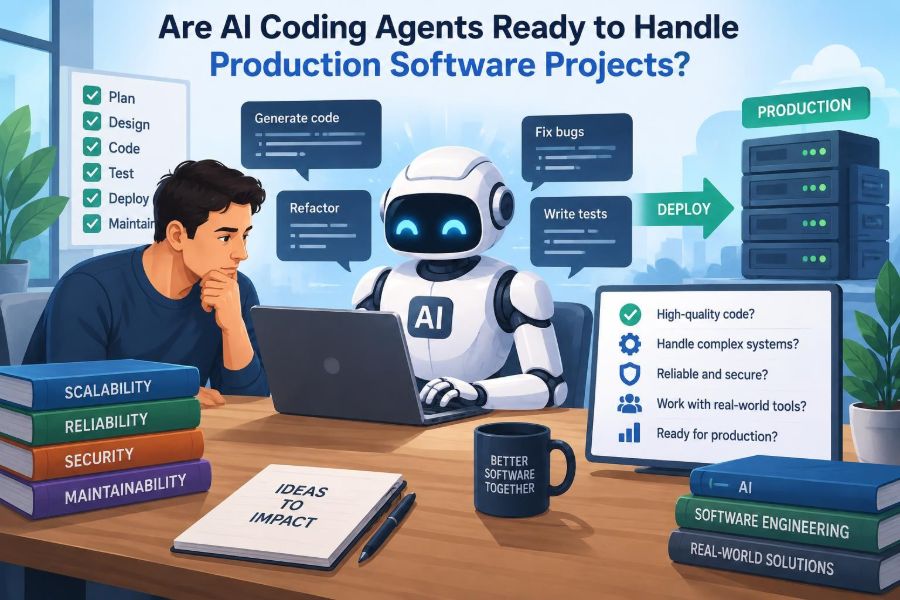

It is Friday afternoon, a release is approaching, and a small but awkward bug appears in the billing flow. An AI coding agent can search the repository, suggest a patch, update a test, and open a pull request before the team has finished discussing the issue.
That speed is compelling. It can also conceal the hard part: production software is not simply code that compiles. It is a living system of users, data, permissions, deployment pipelines, operational constraints, and decisions made years ago.
For students, the question shapes what engineering skills remain essential. For working developers, it affects how to use agents without turning code review into an expensive recovery process.
AI coding agents are already useful contributors in many workflows. Whether they are ready to handle a production project depends less on a dramatic yes-or-no verdict and more on the scope, controls, and accountability surrounding their work.
🧭 What Counts as an AI Coding Agent?
An AI coding agent is more than autocomplete. It can take a goal, inspect files and documentation, decide on intermediate steps, call tools such as a terminal or test runner, modify code, and report what it did.
Its apparent autonomy varies. One agent may only prepare a proposed diff inside an editor; another may create a branch, run a build, and submit a pull request. Those permissions make a major difference to its risk profile.
🏭 Why Production Work Is a Different Test
A classroom exercise usually has a stated problem, a narrow codebase, and a known answer. Production work often starts with incomplete information: a vague ticket, an old incident report, conflicting stakeholder expectations, or behavior that customers rely on despite being undocumented.
The desired change must fit existing architecture and preserve non-obvious promises. A service can be technically correct in isolation while breaking a downstream consumer, exposing private data, or making an on-call alert noisier.
🧩 Code Is Only One Part of the System
An agent may write a clean function yet still make a poor engineering change. Production behavior also depends on configuration, feature flags, databases, queues, cloud permissions, build tooling, deployment settings, and runtime traffic.
Consider a request to add a new API field. The implementation may require a schema migration, versioning guidance, authorization checks, analytics updates, contract tests, and a rollback plan. The code file is only the visible portion of the work.
⚡ Where Agents Deliver Real Value Now
Agents are particularly strong at bounded, repetitive, and well-specified tasks. They can reduce the friction that keeps experienced engineers occupied with mechanical work instead of design and investigation.
- Generating boilerplate around an established project pattern
- Writing focused unit tests for a clearly understood function
- Tracing references during a refactor
- Explaining unfamiliar code paths in plain language
- Updating repetitive call sites after an interface change
- Drafting documentation, release notes, or migration checklists
These are meaningful gains, not trivial conveniences. The team still needs to verify the result, but the agent can shorten the path to a reviewable starting point.
🎯 The Quality of the Task Definition Matters
An agent performs better when success can be stated precisely. “Add validation that rejects expired tokens, preserve the existing error format, and add tests for boundary cases” is far safer than “make authentication more secure.”
Ambiguous prompts invite plausible guesses. In software, plausible is not the same as compatible. A good task includes constraints, affected interfaces, expected behavior, and ways to verify completion.
🗺️ Repository Context Is Necessary but Incomplete
Modern agents can search a repository and build a local picture of relationships among files. That is valuable for navigation, especially in large codebases with inconsistent naming.
But repositories do not contain every fact. The reasoning behind a compromise may live in a design decision record, a ticket, an incident review, or the memory of a teammate. Agents can summarize available context; they cannot reliably infer missing organizational knowledge.
🧠 Understanding Intent Is Harder Than Editing Syntax
A request such as “support enterprise customers” may imply tenant isolation, audit logging, retention policies, procurement obligations, or a new support workflow. None of those requirements necessarily appear in the first file an agent opens.
Experienced engineers ask questions before changing code: Who is affected? What must remain true? What failure is acceptable? An agent can be prompted to ask these questions, but a person must decide when the answers are sufficient.
🔍 Plausible Output Can Still Be Wrong
Language models generate likely continuations, which makes them effective at familiar programming patterns. It also means they can confidently produce an API call that looks right but does not exist, an outdated configuration option, or a subtly incorrect explanation.
This is not limited to obvious hallucinations. More dangerous errors are nearly correct: a retry loop that duplicates payments, a cache key missing a tenant identifier, or an authorization check applied after data retrieval.
🧪 Tests Are Evidence, Not a Certificate
Agents can create tests quickly, but generated tests may mirror the implementation rather than challenge it. If both the code and test misunderstand the requirement in the same way, a green test suite offers false comfort.
Useful test review asks what behavior was exercised, which failure paths were excluded, and whether the assertions reflect user-visible or contract-level outcomes. Integration, contract, and end-to-end tests often reveal issues that unit tests cannot.
🧱 Existing Test Coverage Sets the Safety Ceiling
An agent operating in a well-tested module can make a small change and receive meaningful feedback quickly. In a legacy area with sparse tests, it has little protection from regressions—just as a human developer does.
Before delegating a change, assess the local safety net. If the code lacks characterization tests, the first useful task may be to document current behavior and add tests around it rather than attempt a broad rewrite.
🔐 Security Requires Adversarial Thinking
Production security depends on identifying how a feature can be misused, not only how it should work. Authentication, authorization, input handling, secret management, and dependency choices all carry consequences beyond a passing test.
An agent can flag common patterns and help implement established controls. It should not be treated as the final security reviewer, particularly for payment flows, access control, cryptography, regulated data, or internet-facing endpoints.
🕵️ Sensitive Context Creates Its Own Risk
Giving an external service access to source code, internal documentation, logs, or database snapshots may expose secrets and customer information. Even a read-only agent needs carefully defined data access.
Teams should understand where prompts and tool outputs go, what retention rules apply, and which repositories are appropriate for a given tool. Redacting credentials is necessary but insufficient when logs or code reveal business-sensitive behavior.
🗃️ Database Changes Need Extra Caution
Database migrations change persistent state, often across large tables and live traffic. A syntactically valid migration can lock a table, backfill data incorrectly, or make an older application version unable to run during a rolling deployment.
For meaningful schema changes, require a human review of compatibility, data volume, execution time, backup assumptions, and rollback or forward-fix strategy. An agent can draft the migration and test fixtures; it should not decide operational safety alone.
🚦 Deployment Is Not Just Pressing a Button
A production release may pass continuous integration and still fail under real traffic, unusual configuration, slow dependencies, or a partial rollout. Continuous delivery pipelines automate checks, but their coverage is never identical to live conditions.
Safer releases use layered controls: feature flags, canary deployments, monitoring, rate limits, and an explicit rollback path. Agents can help prepare these artifacts, while release ownership remains a human responsibility.
📈 Observability Turns Changes into Operable Systems
Observability means being able to understand a system from its outputs: logs, metrics, traces, dashboards, and alerts. A feature without useful signals is harder to diagnose when it behaves unexpectedly at 2 a.m.
Ask an agent to include structured logs, meaningful error context, and metrics consistent with local conventions. Then have an engineer check that the signals answer an operational question rather than merely adding noise.
🧯 Incident Response Cannot Be Fully Prewritten
During an incident, the visible symptom may be far from the cause. A surge in errors could come from a dependency, a data edge case, a deployment, a quota, or a change in customer behavior.
An agent can summarize logs, search recent changes, and propose hypotheses. It cannot own the judgment calls: whether to disable a feature, notify customers, accept data loss to restore service, or escalate a security event.
👩⚖️ Accountability Must Stay Clear
Software teams need an accountable owner for changes that affect customers. “The agent wrote it” does not answer who confirmed the requirements, approved the risk, or decided the release was safe.
Clear ownership also improves agent use. A responsible engineer gives better constraints, reviews more carefully, and treats generated output as a contribution requiring evidence rather than an authority requiring trust.
🔄 Code Review Changes, Not Disappears
When agents produce larger diffs faster, review can become the bottleneck. A reviewer facing hundreds of generated lines may approve based on surface plausibility, especially if the change looks conventional.
Keep agent-generated changes small and cohesive. Reviewers should inspect the problem statement, behavioral changes, tests, error paths, and operational impact—not merely style and syntax.
📏 A Practical Autonomy Ladder
Autonomy should be earned by the task and environment, not granted because a tool appears capable. The following model helps match permissions to consequences.
| Level | Agent role | Appropriate examples | Human control |
|---|---|---|---|
| 1 | Suggest | Explain code, draft snippets, identify references | Human applies every change |
| 2 | Prepare | Create a branch, patch, and tests | Human reviews and runs normal checks |
| 3 | Execute bounded workflow | Routine internal refactor with strong tests | Predefined guardrails and pull-request approval |
| 4 | Operate under supervision | Limited maintenance automation | Monitoring, least privilege, rapid stop mechanism |
For most production teams, Levels 1 and 2 are broadly useful today. Higher levels can work in carefully engineered environments, but they demand stronger controls and narrower scopes.
🧰 Start With Low-Blast-Radius Work
Blast radius is the extent of harm a mistake can cause. A typo in an internal document has a small blast radius; a change to identity permissions or invoice calculation has a large one.
Choose early agent tasks that are reversible, isolated, and easy to validate. This lets a team learn the tool’s behavior without turning its first experiment into a customer-impacting incident.
🪜 Break Large Requests into Checkpoints
“Implement the new subscription system” is too broad for reliable delegation. It mixes discovery, architecture, data design, compliance, user experience, implementation, testing, and rollout.
Split it into checkpoints: map current flows, write an interface proposal, identify migration risks, implement one bounded component, then validate it. Each checkpoint creates a place for humans to correct assumptions before they spread.
📝 Give the Agent a Working Contract
A useful prompt is a small engineering brief, not a casual instruction. State the goal, scope, non-goals, relevant directories, conventions, commands to run, and conditions that require the agent to stop and ask.
- Do not alter public API behavior without explicit approval.
- Do not add dependencies unless they are named or justified.
- Do not access production credentials or customer data.
- Prefer the project’s established error and logging patterns.
- Report assumptions, files changed, tests run, and unresolved risks.
Such rules make output more reviewable and reveal when the task itself is underspecified.
🧹 Keep Diffs Small and Reversible
Large changes hide causality. If an agent reformats unrelated files, renames components, changes dependencies, and alters behavior in one commit, reviewers cannot efficiently determine which part introduced risk.
Request minimal diffs, separate refactoring from behavior changes, and use commits that can be reverted cleanly. Reversibility is a practical design property, not an admission that a change will fail.
📚 Treat Project Knowledge as Engineering Infrastructure
Agents benefit from concise repository guidance: local setup instructions, architecture notes, coding conventions, test commands, dependency policies, and examples of good changes. So do new human teammates.
A maintained guide cannot replace judgment, but it reduces avoidable guessing. If an agent repeatedly violates an unstated convention, that is often a documentation problem before it is a model problem.
🧑🤝🧑 Junior Developers Need Deliberate Practice
Agents can accelerate learning when used as a tutor: ask for alternative implementations, request explanations of trade-offs, or compare a proposed patch against project conventions. They can also make it easy to skip the productive struggle that builds debugging skill.
Students and junior engineers should practice reading stack traces, writing tests from requirements, tracing data flow, and explaining every line they submit. The goal is not to avoid assistance; it is to remain capable of detecting when assistance is wrong.
🏛️ Senior Engineers Shift Toward System Stewardship
As routine implementation becomes faster, design quality and coordination become more visible bottlenecks. Senior engineers still need deep technical skill, but they increasingly spend it on boundaries, constraints, reviews, failure modes, and shared standards.
This is not a reduction in engineering rigor. It is a reminder that production software succeeds because someone connects local code changes to system-wide consequences.
🚫 Common Failure Modes to Avoid
The most damaging mistakes usually come from misplaced trust or poorly designed workflows, not from using an agent at all.
- Accepting generated code because it is polished or verbose
- Giving broad repository and deployment permissions by default
- Using tests as the only release criterion
- Letting an agent mix a requested fix with opportunistic cleanup
- Assuming internal tools are safe from privacy or access-control concerns
- Measuring success only by lines changed or tickets closed
Each failure reduces the feedback that would have caught an incorrect assumption early.
🧭 Measure Outcomes, Not the Demo
A compelling demonstration shows an agent completing a task quickly. A production evaluation should ask different questions: Did review time decrease? Did defects rise or fall? Were rollbacks needed? Did developers understand the changes? Were sensitive-data rules followed?
Track these signals over representative work, including maintenance and edge cases. A workflow that saves minutes on implementation but adds hours of investigation is not yet an improvement.
⚖️ So, Are They Ready?
AI coding agents are ready to assist with production software projects when teams give them bounded work, controlled access, strong verification, and human ownership. In mature environments, they can also automate selected repetitive workflows with careful guardrails.
They are not ready to replace the engineering function that discovers requirements, weighs trade-offs, understands organizational context, accepts accountability, and responds to unexpected failure. The more consequential and ambiguous the work, the more direct human judgment it needs.
🌱 The Core Principle: Amplify Judgment, Do Not Outsource It
The best use of an agent is not to make software development unattended. It is to remove repetitive effort so people can spend more attention on the decisions machines cannot reliably validate: what to build, what must not break, and what risk is acceptable.
Build workflows in which the agent produces evidence—small diffs, test results, explicit assumptions, and clear summaries—and engineers evaluate that evidence in context. That combination is far more durable than either blind automation or reflexive rejection.
AI coding agents are becoming practical production tools, but safe production engineering still depends on clear constraints, independent verification, and people who remain accountable for the outcome. Used that way, they can make teams faster without making their systems careless. ⚙️🧪🚀