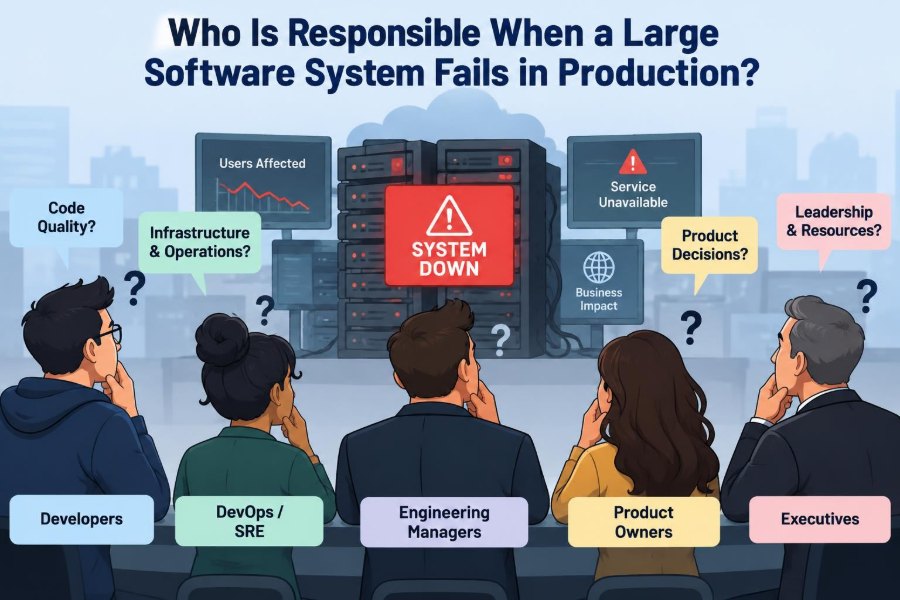

A customer presses “Pay,” sees a spinner for too long, and receives an error. Within minutes, support tickets arrive, dashboards turn red, and a company’s most important workflow has stopped working.
Someone will inevitably ask a direct question: “Who caused this?” It sounds reasonable. Production outages can cost money, interrupt essential services, and damage trust. People want a name, a team, or a single change to reverse.
But large software systems rarely fail for one simple reason. A visible incident may result from a code change, an unclear requirement, a missing alert, an overloaded dependency, a risky deployment process, or decisions made months earlier.
Understanding responsibility is not about avoiding accountability. It is about assigning it accurately enough to restore service, learn from failure, and make the next incident less likely.
🚨 Production Failure Is a System Event
A production failure occurs when software behaves in a way that prevents users or dependent systems from receiving the expected service. It may be a complete outage, severe slowdown, incorrect result, data inconsistency, or security-relevant malfunction.
The word system matters. Production behavior emerges from application code, infrastructure, data, external services, traffic patterns, deployment tooling, operational practices, and people making decisions under pressure.
A failed checkout page might begin with one configuration change, yet become an outage because retries amplify traffic, database connections run out, and no automatic safeguard stops the rollout.
🧭 Responsibility Is Not the Same as Blame
Blame seeks a person to punish. Responsibility asks who owned which decisions, controls, and recovery actions. The distinction changes the quality of an incident response.
If a developer made a defect, that fact belongs in the investigation. It does not automatically mean the developer alone is responsible for the impact. A mature organization also examines review practices, testing scope, release controls, and whether the team had enough information to make a safe decision.
Accountability without learning produces silence. Learning without accountability produces vague promises. Effective engineering needs both.
🧩 Large Systems Have Many Owners
A large system is usually divided across teams and technical boundaries. One team may own a customer-facing service, another the shared authentication platform, another the deployment pipeline, and another a cloud account or database platform.
These boundaries are useful, but they create dependencies. A service owner can maintain excellent code and still be unavailable because a shared DNS configuration, identity provider, or message queue fails.
The relevant question is often not “Who owns the outage?” but “Which parts of the failure path were owned by whom?”
👤 Individual Responsibility Still Exists
Systems thinking should not erase individual agency. Engineers are responsible for following agreed practices, raising concerns, reviewing changes carefully, and reporting mistakes quickly rather than concealing them.
Leads and managers are responsible for creating conditions in which those practices are realistic. Requiring every change to ship immediately while also demanding perfect reliability is not a meaningful safety strategy.
Individual responsibility is strongest when expectations, authority, time, and information are clear. Holding someone responsible for a decision they could not influence is neither fair nor useful.
🏗️ Team Ownership Connects Design and Operations
Teams that build a service should normally share responsibility for its behavior in production. This does not mean every developer must be awake at all hours or personally operate every infrastructure component.
It means the team participates in operational readiness: dashboards, alerts, runbooks, capacity assumptions, safe release plans, and post-incident improvements. This is often described as “you build it, you run it,” though the model needs adequate staffing and support to work safely.
When builders never see production consequences, reliability lessons remain abstract. When operators have no influence over design, they repeatedly inherit preventable risks.
🔗 Dependencies Change the Picture
Modern applications depend on services that may be owned elsewhere: payment providers, cloud regions, identity systems, package registries, analytics tools, and internal APIs. A dependency outage can break a perfectly healthy application.
The consuming team is not responsible for repairing a vendor’s platform. It is responsible for deciding what happens when that platform becomes slow or unavailable. Can users retry later? Can nonessential features degrade? Are timeouts and fallback behavior sensible?
Dependency ownership and dependency risk are different responsibilities.
🧠 The Trigger Is Rarely the Whole Cause
An incident report should distinguish the trigger from the contributing conditions. The trigger is the event that immediately started the failure. Contributing conditions made the system vulnerable or let the damage spread.
Consider a hypothetical release that contains an unbounded database query. The query is the trigger. Missing load tests, no query timeout, insufficient database capacity, and an all-at-once deployment may all be contributing conditions.
Fixing only the query restores functionality. Fixing the conditions improves resilience.
🕳️ Latent Conditions Wait Quietly
Many dangerous conditions remain invisible until the right combination of traffic, timing, and change exposes them. A stale cache rule, undocumented manual step, or single overloaded administrator account may work for months.
These are sometimes called latent conditions: weaknesses already present in the system before the visible failure. They are especially common where knowledge is concentrated in one person or a process has grown through exceptions.
A fair review asks why a latent condition was allowed to persist, not merely who happened to encounter it first.
🧪 Testing Reduces Risk, Not Uncertainty
Tests are essential, but they do not recreate all of production. Test environments commonly have smaller data sets, simpler traffic, different permissions, fewer integrations, and less contention for shared resources.
A change can pass unit tests, integration tests, and manual validation yet fail under real concurrency or unusual customer data. This is a limitation of testing, not evidence that testing is pointless.
Responsibility includes choosing test strategies that match the risk: contract tests for service interfaces, load tests for capacity-sensitive paths, and production canaries for uncertain changes.
🚀 Deployment Design Can Turn Bugs Into Outages
Every nontrivial system contains defects. The deployment process determines how broadly a defect can spread before it is detected. Releasing to all users at once turns a small uncertainty into a large exposure.
Safer approaches include staged rollouts, canary releases, feature flags, and automated rollback criteria. Each has trade-offs: flags add complexity, and rollbacks may be unsafe when a release changes data formats.
The person who wrote a bug is not the only relevant owner when the release process has no practical way to limit its blast radius.
🛡️ Guardrails Are Shared Safety Mechanisms
Guardrails are controls that prevent ordinary mistakes from becoming severe failures. Examples include protected deployment branches, required review, schema migration checks, rate limits, budget alerts, and automatic rollback.
Good guardrails make the safe path easy. They should not require a heroic engineer to remember ten hidden rules during a stressful release.
- Preventive controls stop risky changes before release.
- Detective controls reveal harmful behavior quickly.
- Mitigating controls limit impact after a failure begins.
Platform teams often build these controls, while product teams must use them correctly and report where they fail.
📊 Observability Determines What Can Be Known
Observability is the ability to infer a system’s internal state from signals such as metrics, logs, traces, and user reports. Without it, responders may spend valuable time debating rather than diagnosing.
A service should expose useful signals: error rates, latency, request volume, resource saturation, dependency health, and business outcomes where appropriate. A green CPU graph alone does not prove checkout or login is working.
Missing telemetry is not always someone’s immediate fault, but it is an operational gap that should have an owner after the incident.
🔔 Alerting Must Reach Someone Able to Act
An alert is useful only if it is timely, actionable, and delivered to a person or team with enough authority and context to respond. Alerting a broad channel with no ownership often creates confusion and delay.
Alerts should describe user impact or a credible leading indicator, not every unusual internal event. Excessive noisy alerts train people to ignore notifications; too few alerts leave customers as the monitoring system.
Ownership means maintaining alerts over time, including removing those that do not guide action.
🧯 Incident Command Creates Temporary Clarity
During a serious incident, many people may have useful knowledge, but parallel uncoordinated changes can worsen the problem. An incident commander coordinates the response, records decisions, and keeps attention on restoring service.
This role does not imply that the commander caused or “owns” the failure. It creates a clear decision path while specialists investigate, communicate, and implement fixes.
Typical responsibilities should be explicit:
- one person coordinates decisions and priorities;
- technical responders diagnose and mitigate;
- a communications owner updates stakeholders and support teams;
- a scribe preserves a timeline and open questions.
⏱️ Restore Service Before Explaining Everything
In the early minutes, the goal is usually to reduce user harm. A rollback, traffic reduction, feature disablement, or failover may be safer than a complete root-cause explanation.
This does not mean acting recklessly. Responders should record changes and assess risks, especially around data integrity. But demanding certainty before mitigation can extend an avoidable outage.
For example, disabling a recommendation widget may preserve the checkout path while engineers investigate an unexpected dependency slowdown.
🗣️ Communication Is Part of Technical Responsibility
Customers, support staff, leadership, and partner teams need accurate updates during significant incidents. Silence creates rumor and forces others to discover the impact independently.
Useful updates state what is known, what users are experiencing, what mitigation is underway, and when another update will be provided. They should avoid pretending certainty where none exists.
Clear communication is not public-relations decoration. It changes operational behavior by helping support advise users, dependent teams activate contingencies, and leaders make informed trade-offs.
🧾 Post-Incident Reviews Need a Blameless Method
A blameless post-incident review does not mean “nobody made a mistake.” It means the review examines decisions in the context of the information, incentives, tools, and constraints available at the time.
Asking “Why did they do that?” is more revealing than asking “Who failed?” Perhaps a dashboard showed misleading health, a deadline discouraged review, or an established runbook prescribed the action.
People are more likely to disclose near misses and confusing signals when they believe the organization will investigate the system rather than stage a prosecution.
🔍 Root Cause Can Be an Unhelpful Singular Label
Teams often seek “the root cause,” as though one deepest fact explains every incident. Sometimes a discrete defect really is the dominant cause. More often, a chain of conditions creates the outcome.
A better review describes causal relationships: a configuration error directed traffic incorrectly; incomplete validation allowed it; slow detection prolonged it; lack of a tested reversal delayed recovery.
This wording creates multiple actionable improvements without hiding the initiating error.
📋 Corrective Actions Need Owners and Deadlines
A postmortem that ends with “improve monitoring” will probably be forgotten. Each action should identify the intended outcome, a responsible owner, a realistic due date, and a way to verify completion.
Not every action has equal value. Prioritize changes that reduce likely impact or detection time rather than collecting a long list of vague aspirations.
| Finding | Weak action | Stronger action |
|---|---|---|
| Rollback took too long | “Be more careful” | Automate rollback and rehearse it for this service |
| Alert arrived late | “Watch dashboards” | Alert on user-facing error rate with a documented responder |
| Dependency overload spread | “Improve resilience” | Add timeouts, bounded retries, and a fallback behavior |
🔄 Retries Can Multiply a Small Failure
Retries are a classic example of well-intended behavior creating system-wide harm. When a dependency slows down, many clients retry at once. The additional load makes recovery harder and may spread failure to otherwise healthy components.
Responsible design uses timeouts, retry limits, exponential backoff, and jitter, meaning a small random delay that prevents clients from retrying in lockstep. Circuit breakers can temporarily stop calls to a failing dependency.
These techniques do not remove the original failure. They prevent one failure mode from becoming a cascade.
🗃️ Data Failures Require Extra Care
Availability incidents and data incidents overlap, but incorrect or lost data may have longer consequences than a short outage. A fast rollback can restore application code while leaving incompatible records or duplicated transactions behind.
Teams handling important data need migration plans, backups, restore procedures, audit trails, and clear rules for manual repair. These controls must be tested; an untested backup is an assumption, not a recovery plan.
When data is affected, responsibility may include engineering, operations, security, compliance, and business owners who understand the meaning of the records.
🔐 Security Incidents Have Broader Obligations
A production failure may involve unauthorized access, exposure of sensitive information, or compromised credentials. The technical response is then only one part of the situation.
Organizations may have contractual, regulatory, or legal duties that vary by jurisdiction and industry. Engineers should not improvise legal conclusions during an incident; they should involve designated security, privacy, and legal teams through established procedures.
The practical lesson remains consistent: define escalation paths before an emergency, because delayed coordination can increase both harm and uncertainty.
⚖️ Responsibility Follows Authority and Control
Assign responsibility where people have meaningful control. A team cannot reasonably own a service-level target if it cannot change capacity, prioritize reliability work, or influence critical dependencies.
Conversely, authority should come with explicit duties. A platform team that controls deployment permissions must make access, auditability, and emergency procedures workable. A product leader who accepts reliability risk should understand the likely consequences.
This principle prevents the common failure of placing operational accountability on teams that lack the budget, permissions, or staffing to act.
📈 Reliability Is a Product and Business Decision
Perfect availability is neither technically realistic nor economically neutral. Higher reliability can require redundancy, slower change processes, more engineering time, and more operational coverage.
Leaders therefore help choose acceptable risk. A social feature may tolerate temporary unavailability; a payment confirmation path or emergency communication tool likely requires stronger safeguards.
Engineers should translate technical risk into concrete outcomes: delayed orders, duplicated work, unavailable records, or loss of customer trust. That enables informed decisions rather than abstract debates about “quality.”
🤝 Handoffs Create Ownership Gaps
Failures often occur at team boundaries: development hands a service to operations, a project team transfers code to a maintenance team, or an internal API changes without consumers understanding the impact.
Written ownership maps, service catalogs, escalation contacts, and interface agreements reduce ambiguity. They should be maintained as systems change, not created once for an audit.
A healthy handoff includes operational knowledge: known failure modes, dashboards, dependencies, data handling, deployment steps, and a realistic support model.
🧑🏫 Training and Practice Shape Incident Outcomes
People make better decisions under pressure when they have practiced. Game days, tabletop exercises, and controlled failure drills can reveal confusing alerts, missing permissions, and unclear escalation paths before a real outage.
Practice should be proportionate and safe. Intentionally disrupting a critical production system without controls is not a learning exercise; it is an unmanaged risk.
New engineers especially benefit from guided incident participation. It teaches that production operations are a normal engineering responsibility, not mysterious work performed by a separate group.
🚫 Common Accountability Mistakes
Several responses feel decisive but make the next incident more likely:
- Scapegoating the last person to deploy: it ignores earlier decisions and encourages secrecy.
- Calling every outage “human error”: it says little about how tools and processes could catch predictable mistakes.
- Spreading ownership so widely that nobody acts: shared responsibility still needs named responders.
- Closing a review after the immediate fix: this leaves detection, resilience, and process failures untouched.
- Using postmortems as performance reviews: this reduces candor precisely when detail is most valuable.
🛠️ A Practical Responsibility Model
Before incidents occur, teams can make responsibilities visible. The goal is not bureaucracy; it is faster, fairer action when the system is under stress.
Questions worth answering in advance
- Who owns each customer-facing service and its on-call escalation?
- Who can deploy, roll back, disable features, and change capacity?
- Which dependencies are critical, and what is the fallback when each fails?
- Who communicates externally and internally during a major incident?
- Who tracks post-incident actions until they are verified complete?
If several answers are “it depends,” document the conditions. Ambiguity is manageable before an incident and expensive during one.
🌱 Building a Culture That Learns
Learning cultures are not cultures without standards. They expect engineers to prepare carefully, respond honestly, and improve systems after evidence reveals a weakness.
Leaders set the tone when they ask about context, trade-offs, and safeguards before asking who made the final keystroke. Teams reinforce it when they treat incident reports as engineering artifacts rather than documents to hide.
Over time, this approach makes failures easier to detect, safer to manage, and less personally threatening to report.
🏁 The Core Principle: Own the Conditions You Can Improve
When a large software system fails, responsibility is usually distributed. The engineer who changed code may own an immediate mistake. The team may own service readiness. Platform owners may own safeguards. Leaders may own resource and risk decisions. Dependency owners may own their service, while consumers own their fallback plan.
The right response is not to dilute responsibility until it disappears. It is to map responsibility precisely, repair the immediate problem, and strengthen every controllable condition that allowed the failure to reach users.
The most useful accountability asks who can make the system safer next time, not merely who can be blamed for yesterday.
Production reliability is a shared engineering outcome: clear ownership, safe systems, honest investigation, and practical follow-through make failures less damaging and lessons more durable. ⚙️🧭🤝