
A product team is preparing a feature that looks small on the roadmap: add one option to a checkout flow, expose one more field in an API, support a new customer plan. The estimate seems reasonable—until someone opens the relevant code.
The code works, but the business rule appears in four places. Tests are slow and hard to understand. A database column means something different from its name. Nobody is quite sure whether an old integration can be removed without breaking a major customer.
None of those problems necessarily came from careless engineers. They may be the result of sensible decisions made under real constraints: a deadline, an incident, an uncertain requirement, or a team that needed to learn before investing in a cleaner design.
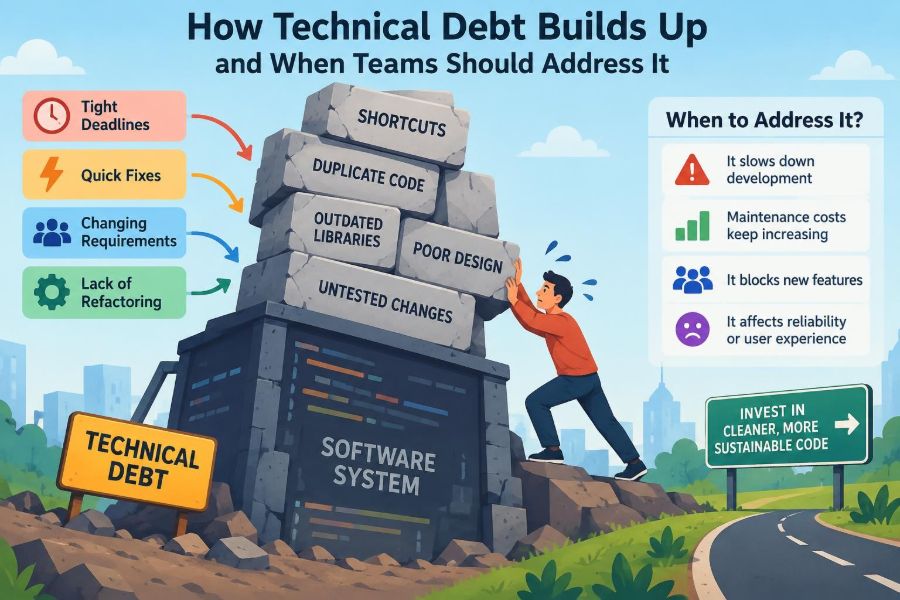
That accumulated burden is commonly called technical debt. Understanding how it builds—and deciding when it deserves attention—helps teams move beyond the unhelpful choices of “clean everything now” or “ignore it until it hurts.”
🧱 Technical Debt Is a Trade-Off, Not Just Bad Code
Technical debt is the future cost created when a team chooses a quicker or narrower solution instead of one that would better support likely future needs. The metaphor comes from financial debt: borrowing can be useful, but interest makes later work more expensive.
The “interest” is not usually a literal bill. It appears as longer lead times, fragile changes, confusing onboarding, recurring incidents, and more effort to verify that a change is safe.
Crucially, technical debt is not synonymous with ugly code. A small, direct implementation can be a wise choice when a product idea is uncertain. Debt becomes troublesome when its consequences are hidden, unmanaged, or allowed to compound.
🧭 A Shortcut Is Sometimes the Responsible Choice
Suppose a team needs to test whether users want a new export format. Building a flexible reporting platform first could delay the learning that matters. A focused export path may be the right decision, provided the team records its limits.
A shortcut is healthier when the team can answer three questions:
- What assumption makes this simpler approach reasonable?
- What signal will tell us the assumption no longer holds?
- Who will revisit it, and roughly when?
Without those answers, a temporary choice often becomes permanent by default. The danger is not speed; it is speed without a way to recognize the bill later.
💳 The Interest Shows Up in Daily Work
Teams rarely experience debt as a single dramatic event. More often, a developer spends an extra day tracing hidden dependencies, a reviewer cannot confidently assess a risky change, or a release requires a long manual checklist.
These costs interact. Slow tests make engineers run them less often. Less frequent feedback increases the chance of defects. Defects trigger urgent fixes, and urgent fixes tend to add more special cases.
Because this friction is distributed across many tasks, it can be underestimated. A backlog item labeled “refactor module” may look optional, while the repeated delay it causes in ordinary feature work remains invisible.
🏗️ Design Debt Begins with Mismatched Structure
Design debt occurs when the shape of the system no longer matches the problem it must solve. A service that originally handled one payment provider may grow branches for five providers until every new integration requires edits across unrelated code.
The answer is not always a grand abstraction. Prematurely creating a plugin framework for one provider can itself create unnecessary complexity. The need becomes clearer when variations repeat and changes consistently cross the same boundaries.
Good design debt work often clarifies responsibilities: isolate provider-specific behavior, give concepts accurate names, and make dependencies explicit. Its aim is easier and safer change, not architectural elegance for its own sake.
🧩 Code Debt Grows Through Local Complexity
Code debt is the accumulated difficulty inside implementation details: duplicated logic, unclear names, long methods, inconsistent error handling, and deeply nested conditions. Each issue may be survivable alone. Together, they make correct modification difficult.
Consider a discount rule copied into web checkout, mobile checkout, and an administrative tool. Initially, copying may feel faster than coordinating a shared component. Later, a policy change demands three edits and invites inconsistent behavior.
Useful repairs are usually modest and close to active work: extract a clearly named rule, remove duplication after behavior is protected by tests, or replace a tangled conditional with a model that reflects the domain.
🗃️ Data Debt Is Harder to Undo
Data models persist beyond a deployment. Ambiguous fields, duplicate records, missing ownership rules, and uncontrolled schema changes can constrain a product for years because old data must remain interpretable.
For example, a field named status may gradually represent payment state, fulfillment state, and customer eligibility in different contexts. Renaming or splitting it is not just a code edit; it requires migration, compatibility planning, and careful validation.
Data debt deserves early attention when it affects correctness, reporting, privacy boundaries, or financial records. A migration strategy—often adding new fields, backfilling, reading both forms temporarily, then retiring the old path—reduces risk.
🔌 Integration Debt Lives at System Boundaries
External APIs, message queues, vendor services, and internal service contracts can accumulate debt when assumptions are undocumented or failures are handled inconsistently. A dependency may be reliable most of the time yet still require timeouts, retries, idempotency, and monitoring.
Integration debt often reveals itself during incidents: duplicate requests create duplicate orders, a changed response shape breaks a workflow, or a partner outage causes worker queues to pile up.
Teams should avoid treating every external call as a simple function invocation. A narrow adapter, explicit contract tests where feasible, and meaningful failure behavior make a boundary easier to evolve and diagnose.
🧪 Test Debt Reduces Confidence, Not Just Coverage
Test debt is not merely having too few tests. It also includes tests that are slow, brittle, unclear, dependent on execution order, or so broad that they fail without explaining what went wrong.
A suite can report high coverage while offering little confidence if it checks implementation details rather than useful behavior. Conversely, a few well-chosen tests around valuable business rules and risky boundaries may prevent many regressions.
When a change is hard to test, that is often design feedback. It may indicate hidden dependencies, too much work in one unit, or unclear inputs and outputs. Improving testability can therefore improve the production design itself.
🚀 Delivery Debt Hides in the Release Process
Manual deployments, undocumented rollback steps, environment drift, and permissions known only to one person create delivery debt. The application may be well designed, but releasing it remains stressful and error-prone.
A team does not need a sophisticated platform immediately. It does need repeatable basics: versioned configuration where appropriate, a tested build, clear deployment ownership, observable release status, and a practical way to recover.
Delivery debt deserves priority when it blocks frequent safe releases or turns routine changes into risky events. Faster feedback to users is a product capability, not simply an engineering convenience.
📚 Documentation Debt Is Lost Context
Documentation debt appears when critical knowledge exists only in conversations, memory, or old tickets. It harms new team members first, but it also slows experienced people when they revisit rarely changed systems.
Useful documentation is not a giant static manual. It is a small set of maintained decision records, onboarding notes, operational runbooks, ownership information, and explanations of non-obvious constraints.
Document the “why” when code alone cannot reveal it: why an unusual retry exists, why a compatibility layer remains, or why a seemingly simple rule has an exception. Those notes prevent well-meaning reversals of necessary decisions.
👥 Organizational Debt Can Create Technical Symptoms
Some recurring technical problems begin outside the repository. Constantly changing priorities, unclear product ownership, separated development and operations responsibilities, or teams that cannot coordinate on shared systems all encourage short-term local fixes.
If engineers are rewarded only for shipping visible features, invisible maintenance will predictably lose. If a team owns a service but cannot access production signals, it cannot learn whether its design behaves well in practice.
Calling this “technical debt” should not obscure the cause. Better code alone cannot solve an approval process that makes fixes take weeks or a roadmap that leaves no room for operational work.
⏱️ Deadline Pressure Turns Exceptions into Defaults
Urgency compresses discovery, design, review, and validation. That can be appropriate during an outage or a fixed market event, but repeated emergency mode changes the system’s baseline.
One common pattern is the feature flag that was meant to be removed after a launch. Months later, it controls an old path nobody understands. Another is a manual data correction script that becomes a recurring operational procedure.
After a deadline, reserve a short follow-up window to remove scaffolding, confirm assumptions, and record remaining compromises. This is often far cheaper than rediscovering the context six months later.
🌫️ Uncertainty Creates Debt Even with Good Intentions
Requirements are often incomplete because users, markets, and regulations evolve. Teams may build the simplest thing that can answer a question, then learn that the question was larger than expected.
That is not failure. The problem begins when uncertainty is mistaken for certainty and the provisional solution is treated as a stable foundation. Labels such as “experimental,” “single-tenant,” or “temporary compatibility path” can make constraints visible.
Design for the uncertainty you actually have, not every imaginable future. A clean seam around a volatile decision is usually more valuable than a complex framework predicting possibilities that never occur.
🧑🤝🧑 Team Change Leaves Gaps Behind
Reorganizations, turnover, rapid hiring, and handoffs can expose debt that was manageable while its original authors were available. The code may contain reasonable decisions, but the rationale and operating knowledge have disappeared.
Shared review practices, pairing on high-risk areas, and rotating operational responsibilities distribute context. They do not eliminate specialization; they reduce the danger of a system becoming effectively owned by one unavailable person.
When inheriting a codebase, resist the urge to rewrite it immediately. First learn what it does, where it fails, which paths are valuable, and which odd-looking choices protect real constraints.
📈 Growth Makes Earlier Assumptions Expensive
Growth changes scale, usage patterns, team size, and business expectations. A synchronous report generation path may work for a handful of users but become unreliable when reports are larger or requested concurrently.
Similarly, a shared database can help a small team move quickly before it later creates coordination friction between services. The original choice was not necessarily wrong; its operating context changed.
The practical lesson is to make assumptions observable. Track queue depth where queues matter, measure slow operations, and understand capacity limits. Evidence provides a better trigger for redesign than abstract anxiety about scale.
🔍 Recognize the Signals That Debt Is Becoming Costly
Debt warrants attention when it has a clear, repeated effect on outcomes. Useful signals include:
- The same area causes frequent defects, incidents, or support work.
- Ordinary changes require edits across many unrelated components.
- Engineers cannot estimate work without extended investigation.
- Tests or deployments are too slow or unreliable to support safe iteration.
- A known limitation blocks an important customer, product, security, or reliability need.
One complaint is not always a pattern. Look for repeated friction and ask what mechanism creates it. That moves the conversation from taste—“this code is messy”—to impact.
🛡️ Security and Reliability Debt Need a Different Threshold
Some debt should not wait for a convenient maintenance sprint. Weak access controls, exposed secrets, unpatched dependencies with relevant risk, missing backups, and unsafe failure modes may require prompt action.
Prioritization still needs judgment. Not every outdated library represents the same exposure, and changes intended to improve security can introduce regressions. Understand reachability, exploitability, data sensitivity, and available mitigations.
Reliability has similar urgency when a known weakness can cause material data loss, prolonged unavailability, or repeated operational overload. Clear incident learning should feed directly into planned engineering work.
🎯 Tie Remediation to Product Outcomes
The strongest case for addressing debt explains what future work becomes easier, safer, or possible. “Refactor the billing module” is vague. “Separate tax calculation so regional pricing can be changed without editing checkout, invoices, and refunds” describes a concrete capability.
This framing helps product and engineering leaders make trade-offs together. It also prevents cleanup projects from becoming open-ended attempts to improve every imperfection.
When outcomes are uncertain, define a small discovery task first. Map dependencies, identify the narrowest useful intervention, and estimate using what is learned rather than guessing at a full rewrite.
⚖️ Prioritize by Impact, Likelihood, and Cost of Delay
Teams need a repeatable way to compare debt with feature work and with other debt. A simple decision framework can make the discussion explicit.
| Question | What it reveals | Example |
|---|---|---|
| How often is the area changed? | How much interest is likely to recur | Checkout rules change every release |
| What happens if it fails? | Risk to users and the business | Incorrect invoices versus a cosmetic layout issue |
| What opportunity does it block? | Value unlocked by remediation | A contract redesign enables a new partner |
| How reversible is the current state? | Whether delay increases migration difficulty | Bad data semantics become harder to repair over time |
| What is the smallest safe improvement? | Whether work can be staged | Add observability before replacing a queue |
There is no universal scoring formula. The value of a framework is its transparency: people can challenge assumptions rather than argue from intuition alone.
🔧 Fix Debt While Working in the Neighborhood
The “boy scout rule”—leave code cleaner than you found it—works best when interpreted proportionally. Rename a misleading variable, remove dead code, or add a focused test while changing that area. Do not turn every feature into an unbounded renovation.
For recurring pain, include targeted cleanup in the feature plan. If adding a payment method requires touching a tangled abstraction, first create a seam that makes the new method and future ones easier to add.
This approach keeps maintenance close to observed value. It also allows improvements to be verified through the feature that motivated them.
🗓️ Reserve Planned Capacity for System Health
Some problems are too broad to fit naturally inside a feature. Teams may reserve capacity in their planning cycle for reliability, developer experience, dependency maintenance, or architectural work.
The exact allocation should not become a ritual detached from evidence. A stable, low-risk product may need little dedicated remediation for a period, while a service with frequent incidents may need concentrated investment.
Make the work visible alongside product initiatives. Hidden maintenance is easy to postpone; visible work can be prioritized, sequenced, and evaluated against its intended result.
🧱 Use Incremental Refactoring Instead of Big-Bang Rewrites
A rewrite promises a clean slate, but it also risks losing undocumented behavior, delaying feature delivery, and creating two systems to maintain. Sometimes replacement is justified, especially when a platform cannot meet essential requirements. It should be a reasoned decision, not a reflex.
Incremental techniques lower risk: route new traffic through a new component, migrate one data slice at a time, place an adapter around a legacy interface, or replace a path behind a controlled switch.
Small steps create feedback. They also make it easier to pause if product priorities change without wasting all prior investment.
🚦 Make Debt Visible Without Creating a Graveyard
A debt register can be useful when it records more than a complaint. Each item should name the affected area, consequence, triggering condition, likely owner, and a possible next action.
For example: “Order retry job is not idempotent; duplicate fulfillment is possible after timeouts; address before increasing retry volume; fulfillment team owns investigation.” That is actionable in a way that “clean up retries” is not.
Review the register regularly and delete stale items. A giant backlog of undifferentiated cleanup tasks creates guilt, not decisions.
📊 Measure Friction Carefully
Metrics can reveal trends, but they are incomplete representations of engineering work. Lead time, change failure patterns, incident frequency, flaky-test rates, build duration, and time spent on support can all provide useful clues.
Do not use a single metric as proof that a team has too much debt or as a target to game. A shorter lead time achieved by skipping review or tests is not an improvement.
Combine numbers with qualitative evidence from retrospectives, support tickets, code review observations, and engineers who work in the affected area. The goal is better diagnosis, not a dashboard verdict.
🧾 Define Done to Prevent New Debt
A practical definition of done can reduce accidental debt by making quality expectations explicit. Depending on the work, it may include automated checks, observability, documentation of a non-obvious decision, rollback considerations, and removal plans for temporary paths.
This is not a demand for maximum ceremony on every change. A typo fix and a payment workflow deserve different scrutiny. The standard should scale with risk and reversibility.
Teams also benefit from naming deliberate debt in the pull request, ticket, or decision record where it was introduced. Future maintainers then know it was a conscious trade-off rather than an unexplained defect.
🤝 Create Shared Ownership of Quality
Technical debt cannot be assigned solely to “the engineers,” nor can engineers solve it without product context. Product leaders help explain which capabilities matter and what delays cost; engineers explain constraints, risks, and feasible paths.
Healthy conversations avoid using debt as a veto against all deadlines or using deadlines as a reason to ignore all maintenance. The question is: what are we borrowing, why is it worth borrowing now, and what makes repayment necessary?
When that discussion happens early, teams can choose staged delivery rather than discovering late that the only options are a risky shortcut or a missed commitment.
🚫 Avoid the Most Common Debt-Reduction Mistakes
One mistake is treating cleanup as inherently virtuous. Refactoring code that rarely changes may consume effort without improving a meaningful outcome. Another is treating all debt as optional until a crisis forces rushed, expensive work.
Other traps include:
- Starting broad rewrites without a migration plan or measurable goal.
- Improving internal structure while changing behavior unintentionally.
- Adding abstractions before repeated variation justifies them.
- Creating a ticket for every small issue instead of fixing cheap local problems.
- Assuming a tool adoption will solve unclear ownership or weak decisions.
Effective debt work is deliberately scoped, validated, and connected to real operational or product needs.
🧠 Teach the Team to See Trade-Offs
Engineers develop judgment by seeing why past decisions were made and how their costs changed over time. Design reviews, incident reviews, pairing, and short architecture notes can turn everyday work into shared learning.
Ask concrete questions: What is the simplest design that supports the next likely change? What behavior must remain stable? Which dependency is hardest to reverse? What would make this safe to modify next month?
These questions do not eliminate debt. They make the debt a visible choice, which is the foundation of managing it well.
🌱 A Sustainable Approach Beats a Perfect Codebase
No production system is free of compromises. Code ages, dependencies change, requirements evolve, and teams learn. Chasing a permanently perfect architecture can become its own source of delay and complexity.
A sustainable team notices where friction is accumulating, protects high-risk areas, makes small improvements continuously, and schedules larger repairs when evidence justifies them. It treats the codebase as a living asset that needs stewardship.
The core principle is simple: technical debt is manageable when teams understand the trade-off, observe the interest, and repay the parts that constrain valuable work or create unacceptable risk.
Technical debt becomes dangerous not because teams ever take shortcuts, but because they lose sight of what those shortcuts will cost and when that cost must be paid. Build with intention, revisit assumptions, and keep improvement connected to real outcomes. 🧱🔧🌱