
At 9:15 on a Tuesday, a mobile app starts showing empty profile cards. The profile service is healthy, its deployment succeeded, and its unit tests are green. Yet the app expected displayName, while the latest API response now contains name.
No individual change looked dangerous. One team cleaned up a response model, another team released a client built against yesterday’s behavior, and the failure appeared only after both versions met in a shared environment.
This is the difficult reality of distributed software: an API is not merely code behind a URL. It is an agreement between independently changing systems, people, and release schedules.
Contract testing makes that agreement executable. It exposes mismatches while they are still a pull-request conversation rather than a production incident. 🧪
🔌 1. An API Is a Promise
An API contract describes what one system promises to provide and what another system is allowed to rely on. It includes more than an endpoint path and an HTTP method.
For an HTTP API, the promise can cover request fields, response fields, data types, status codes, headers, authentication rules, and meaningful error behavior. Event-driven systems have similar promises about topics, message shapes, and delivery expectations.
- A client promises to send a valid request.
- A provider promises to handle that request in an agreed way.
- Both sides promise not to silently reinterpret shared data.
🧩 2. Separate Services Create Separate Assumptions
In a monolith, a compiler often reveals when a method signature changes. In a distributed system, the caller and implementation may live in different repositories, use different languages, and deploy at different times.
That separation is useful for team autonomy, but it removes many automatic safety checks. A provider can compile successfully even when a consumer’s assumptions are no longer true.
Contract tests restore a focused form of feedback across that boundary without requiring every team to coordinate a full end-to-end release.
💥 3. Small Changes Can Be Breaking Changes
Breakages are often introduced by changes that appear harmless locally. Renaming a JSON field, making a previously optional value required, or returning a different error status can break a real consumer.
Even an additive change can be risky when clients use strict schema validation, exhaustively match enum values, or render every returned field. Compatibility depends on actual consumer behavior, not just a provider team’s intent.
Common accidental breaks
- Changing
201 Createdto200 OKwhere clients branch on the status. - Returning
nullinstead of omitting a field. - Changing an identifier from a string to a number.
- Replacing a stable error code with a human-readable message.
🧪 4. What Contract Testing Means
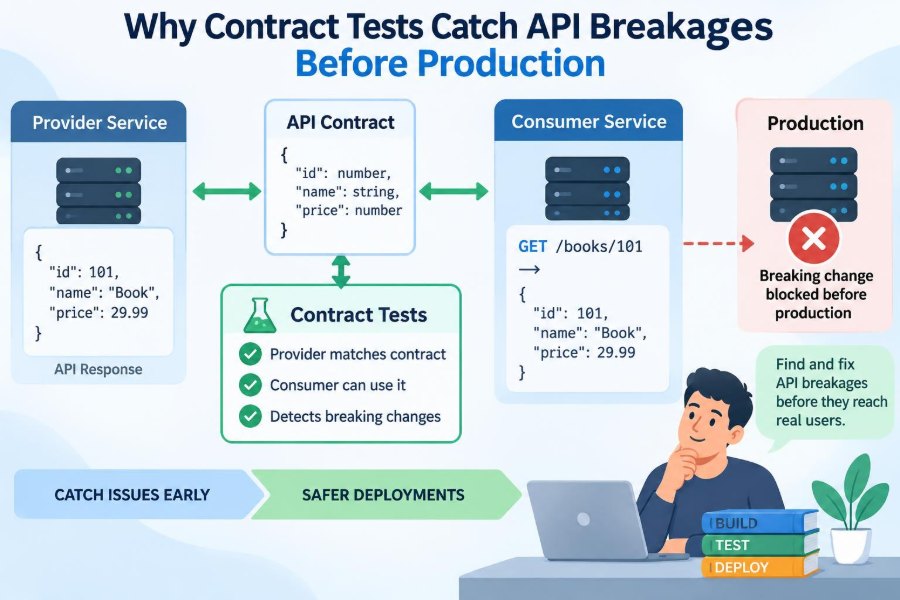
Contract testing verifies that interactions expected by a consumer are supported by a provider. The contract is a machine-readable description of a request and the response or outcome the consumer needs.
A consumer-side test records or defines an interaction. A provider-side verification then checks its implementation against that interaction. If the provider cannot satisfy it, the build can fail before deployment.
Contract testing is not a single product or file format. It is a testing approach that can use specifications, schemas, interaction files, or a shared compatibility service.
🤝 5. The Consumer Defines Its Need
A useful consumer contract is intentionally narrow. It describes the portion of provider behavior that a particular consumer requires, rather than attempting to document every possible API response.
For example, an order page may need an order identifier, a state, and a total. It does not need to assert every field that the order service happens to return.
GET /orders/42
Accept: application/json

200 OK
{
  "id": "42",
  "status": "confirmed",
  "total": 79.50
}
This interaction gives the provider a concrete compatibility target while leaving room for unrelated evolution.
🏭 6. The Provider Proves the Promise
Provider verification runs the provider against each relevant contract. Depending on the tooling and architecture, it may call a running test instance, invoke an application handler, or validate messages produced by the service.
The important distinction is ownership: the provider team owns proving that its current implementation can meet consumers’ published expectations. It does not merely trust a document to remain accurate.
Verification should run against realistic application behavior, including serialization, routing, validation, and error mapping where possible.
🧱 7. Contracts Sit Between Unit and End-to-End Tests
Different tests answer different questions. A healthy strategy uses several layers rather than expecting one category to find every defect.
| Test type | Primary question | Typical scope |
|---|---|---|
| Unit test | Does this component behave correctly? | One function, class, or module |
| Contract test | Can this provider satisfy this consumer interaction? | One service boundary |
| Integration test | Do connected technical components work together? | Several local components |
| End-to-end test | Does an important user journey work? | Multiple deployed systems |
Contract tests offer fast, targeted boundary feedback. They do not replace broader tests, but they reduce the number of surprises those slower tests must discover.
⚡ 8. Why Feedback Arrives Earlier
A provider change can be verified in continuous integration before the provider is released. If it removes a field used by a consumer, verification identifies the conflict while the change is still small and its author has context.
Without this check, the issue may remain hidden until a consumer deploys, a staging workflow runs, or production traffic reaches the changed code. Each later stage adds diagnosis time and coordination cost.
Early failure is valuable because it turns compatibility into a normal engineering constraint, like compilation or linting.
🔍 9. Contract Tests Detect Semantic Mismatches
Many API failures are not connectivity failures. A request may reach a healthy service and receive valid JSON, yet the meaning of the response can still violate what the caller expects.
Contract assertions can cover the details that matter: a required field exists, a value follows an expected pattern, a status code represents the correct outcome, or an error body includes a stable machine-readable code.
This matters because “the endpoint returned 200” is often far too weak a definition of compatibility.
📦 10. They Also Apply to Events and Messages
HTTP is not the only integration boundary. A publisher and subscriber of a queue or stream have a contract about message structure and meaning.
A consumer-driven message contract can state that an OrderConfirmed event contains an order ID, a timestamp, and an amount in an agreed representation. The publisher verifies that it emits a compatible event.
For asynchronous systems, contracts are especially helpful because the producer and consumer may never be running at the same time during a test.
🗣️ 11. Consumer-Driven Contracts Change the Conversation
Traditional API documentation is often provider-led: a team publishes an interface and asks clients to follow it. Consumer-driven contract testing adds evidence about which parts are actually relied upon.
That evidence does not give consumers unlimited authority. Providers still need to design coherent APIs, set lifecycle policies, and reject unreasonable dependencies. But it makes impact visible.
Instead of asking, “Could anyone be using this field?”, a provider can ask, “Which verified contracts require it?”
🎯 12. Test Behaviors, Not Incidental Details
Contracts become noisy when they assert everything in a payload, every header, or exact formatting that has no consumer value. Such tests make harmless refactoring look like a breaking change.
Prefer assertions that express a real dependency. A client may need a non-empty identifier and a known status, but it may not need the provider’s internal sorting of unrelated metadata.
- Assert required fields and important types.
- Assert values or patterns with business meaning.
- Allow extra fields unless the consumer truly cannot tolerate them.
- Avoid copying complete production responses by default.
🧭 13. Define Compatibility Deliberately
Compatibility is a policy decision as well as a technical property. Teams need to decide what clients may assume and how long providers will preserve those assumptions.
For JSON responses, a common compatible direction is adding optional fields while preserving existing required fields and meanings. However, strict clients, generated code, and security-sensitive data can make even additions consequential.
Write down the rules that fit your ecosystem. Then make contracts enforce the rules that matter to real consumers.
📐 14. Schemas and Contracts Solve Different Problems
Schema validation checks whether data conforms to a structural definition. It is excellent for documenting payloads, generating clients, and rejecting malformed input.
Interaction contracts add context about usage: given this request or event, this consumer needs this outcome. They can verify status codes, request matching, headers, and scenarios that a response schema alone may not capture.
Many teams use both. A schema provides a broad interface vocabulary; consumer contracts show the specific sentences that consumers speak with it.
🧾 15. Examples Must Remain Executable
Static API examples can drift from code because they are easy to update separately or forget entirely. A contract artifact gains value when it participates in automated verification.
Executable examples also clarify ambiguity. “Returns an error when an order is missing” leaves questions unanswered; a contract can specify the request, the status, and the error shape a client handles.
The goal is not to encode every scenario. It is to preserve the interactions that would cause consumer failure if changed.
🧪 16. A Simple HTTP Example
Imagine a billing UI that displays an invoice balance. Its contract might require a successful lookup to return a string identifier and a numeric balance.
GET /invoices/inv-7

200 OK
{
  "invoiceId": "inv-7",
  "balance": 125.00,
  "currency": "USD"
}
If the billing service later changes balance to amountDue, its own unit tests might still pass. Provider verification against the UI contract fails, exposing the incompatible change before release.
🚫 17. Error Responses Are Part of the Contract
Happy paths are only half an API. Consumers frequently depend on errors to decide whether to retry, show a validation message, ask a user to sign in, or stop processing.
A good contract can specify meaningful distinctions, such as a malformed request receiving a client error and a missing resource receiving a not-found response. It can also require a stable error code without pinning a sentence intended for humans.
Testing errors prevents a common regression: a broad exception handler turns every failure into the same generic response.
🔐 18. Headers, Auth, and Content Negotiation Matter Too
Contracts may include request and response headers when they affect behavior. Authorization schemes, idempotency keys, content types, correlation IDs, and version headers can all be meaningful boundary requirements.
Do not add headers merely because a captured request included them. Assert them when the consumer relies on their presence or semantics.
For example, a client that sends an idempotency key during payment creation needs confidence that the provider continues to honor that behavior.
🧑🤝🧑 19. Contracts Clarify Team Ownership
Each consumer should own the expectations it publishes, because it best understands what it needs. Each provider should own verification, because it controls whether the implementation keeps its promises.
A platform or quality team can supply tooling and conventions, but it should not become the bottleneck for every interaction. The workflow works best when compatibility is part of ordinary service development.
Clear ownership avoids the unhelpful situation where everyone assumes another team is testing the boundary.
📚 20. Store and Share Contracts Carefully
Contracts need a discoverable home so providers can find the versions relevant to them and consumers can publish changes reliably. Some teams keep artifacts with source code; others use a dedicated contract repository or broker-like service.
The storage choice matters less than traceability. A provider should be able to identify which consumer version produced a contract and which provider build verified it.
That record is useful during release decisions: it connects an interface promise to actual builds rather than an unversioned document.
🔄 21. Add Verification to Continuous Integration
A practical pipeline usually has two directions. A consumer runs its contract tests against a local stub and publishes the resulting contract artifact. A provider retrieves applicable artifacts and verifies them against its current build.
When verification fails, treat it as actionable build feedback. The provider may restore compatibility, the consumer may update its expectation, or both teams may agree on a managed migration.
- Run consumer tests on consumer changes.
- Run provider verification on provider changes.
- Record successful verification with build versions.
- Use release gates appropriate to the service’s risk level.
🚦 22. Use Deployment Decisions, Not Just Test Results
A passing test suite is useful, but the most powerful workflows connect verification to deployment compatibility. Before releasing a provider, ask whether its candidate version has verified all consumer contracts that must remain supported.
Before releasing a consumer, ask whether its contract has been verified by the provider version already deployed or scheduled to deploy. This avoids shipping a consumer that requires behavior no available provider supplies.
The exact policy differs by organization, especially during phased rollouts. The principle is to make compatibility evidence visible at the release boundary.
🛠️ 23. Versioning Is Still Necessary
Contract tests identify incompatible changes; they do not eliminate the need to manage them. Sometimes a break is intentional, justified, and impossible to avoid.
In those cases, use a migration plan. You might support old and new fields temporarily, expose a new endpoint or media type, publish a new event version, or coordinate a cutover with consumers.
Version labels alone do not guarantee safety. Verified contracts show whether the versions actually coexist as intended.
🌱 24. Start with Critical Boundaries
Trying to create contracts for every endpoint on day one can produce a large, brittle project. Begin with integrations where independent deployment, business impact, or change frequency makes breakages expensive.
Choose a small number of important consumer journeys and capture their essential interactions. Establish naming, publishing, and verification conventions before expanding coverage.
A modest suite that teams trust is more valuable than a comprehensive-looking suite that everyone bypasses. 🌱
⚠️ 25. Avoid Over-Specification
The most common contract testing mistake is turning a contract into a snapshot of a provider response. Exact timestamps, generated IDs, unordered collections, and unrelated optional fields create unstable tests without protecting consumer needs.
Use matchers or flexible assertions where supported. For example, require an ISO-like timestamp format rather than one fixed instant, and require an identifier to be non-empty rather than equal to a test fixture value.
Precision should follow dependency. If a detail changes consumer behavior, specify it; otherwise, leave the provider room to evolve.
🧯 26. Know What Contract Tests Cannot Catch
Contract tests do not prove that a provider is correct for every input, that a database migration is safe, or that a full user journey works under real infrastructure conditions. They are not load tests, security tests, or a replacement for monitoring.
They can also miss undocumented consumers, contracts that were never published, and bugs in shared assumptions that both sides encode identically. A passing contract proves compatibility with the tested expectation, not universal quality.
Keep unit, integration, end-to-end, operational, and security testing in the broader strategy.
📈 27. Improve Contracts When Incidents Teach You
When an integration incident occurs, ask whether a meaningful contract could have detected it earlier. If yes, add or refine an interaction after fixing the immediate problem.
Do not respond by asserting every observed byte. Identify the real missing promise: perhaps an error code, a pagination rule, a nullability guarantee, or a message ordering assumption.
Over time, the suite becomes a living record of the boundaries that matter most to your system.
🏁 28. The Core Principle: Make Dependencies Executable
Contract tests work because they make cross-service assumptions visible, versioned, and automatically checked. They give providers direct evidence of what consumers need and give consumers a way to state those needs precisely.
The goal is not to freeze every API forever. It is to enable safe evolution: preserve valid dependencies, expose intentional breaks early, and manage migrations before users encounter them.
When an API promise is executable, a breaking change can fail in CI instead of failing for a customer in production. 🧪🚦🤝