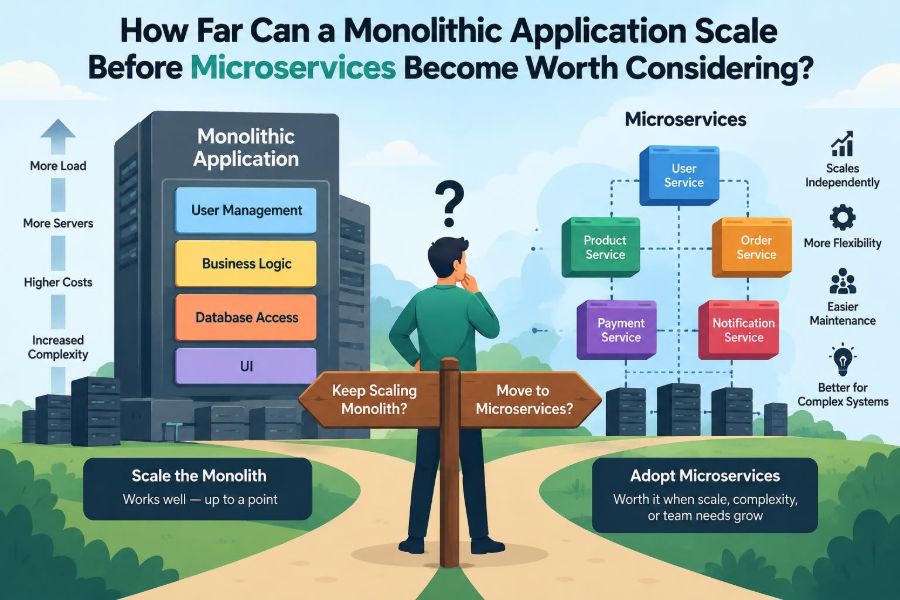

A product team launches with one application, one deployment pipeline, and one codebase. Orders, accounts, notifications, reporting, and admin tools all live together. The system is not glamorous, but it is understandable—and customers are happy.
Then traffic grows. A slow reporting query affects checkout. A change to email preferences requires testing parts of the application nobody touched. Deployments become cautious because one mistake can disrupt the whole product.
At this point, “Should we move to microservices?” starts appearing in planning meetings. It is a reasonable question, but it often hides a more useful one: which specific constraint is the monolith creating, and would distributed services actually remove it?
A monolith can scale far beyond its early-stage reputation. Microservices can solve real organizational and technical problems, but they also turn in-process complexity into networked complexity. The right decision depends less on user count than on workload shape, team structure, operational maturity, and the cost of change.
🏗️ Start With What “Monolith” Actually Means
A monolithic application is deployed as one unit. Its modules may be well organized internally, but they run in one process or closely coupled runtime and are released together.
This does not mean the application uses one database table, one server, or poor design. A monolith can have modular code, background workers, caches, replicas, queues, and multiple instances behind a load balancer.
The defining feature is the deployment and runtime boundary: a code change normally results in releasing the whole application artifact.
🧩 Separate Architecture From Deployment Shape
Teams often call a codebase “a monolith” when the deeper problem is tangled design. Those are related but different issues.
A well-structured modular monolith keeps domains such as billing, catalog, and identity behind clear internal interfaces. A poorly structured system lets every feature reach directly into everyone else’s data and logic.
Splitting tangled code into services does not automatically untangle it. It can simply replace direct function calls with fragile HTTP calls and duplicate the confusion across repositories.
📈 Scale Is More Than Request Volume
“Can it scale?” is not a single measurement. A system may handle many web requests while struggling with report generation, media processing, search indexing, or a seasonal import job.
Useful dimensions include:
- Traffic scale: requests, messages, and concurrent users.
- Data scale: database size, query cost, and write contention.
- Workload scale: CPU, memory, storage, and asynchronous jobs.
- Change scale: how difficult it is to alter and safely release the system.
- Team scale: how many people and teams work on it independently.
Microservices are most often a response to the latter two, not simply to a rising request counter.
🚦 A Monolith Can Scale Horizontally
Many stateless web applications scale by running several identical copies behind a load balancer. Requests are distributed across instances, allowing capacity to grow without changing the application’s architectural style.
Sessions should not be stored only in an individual process if requests may land on different instances. Shared session storage, signed tokens, or carefully configured affinity can address that concern.
Horizontal scaling is not unlimited, but it is often the first practical answer to ordinary traffic growth. It is simpler than introducing independently deployed services.
🗄️ The Database Is Often the Real Constraint
When a monolith slows down, the application process is frequently blamed first. In practice, expensive queries, missing indexes, lock contention, inefficient transactions, or a saturated database connection pool may be the bottleneck.
Breaking the application into services does not make those database problems disappear. If every new service still reads and writes the same overloaded database, the critical bottleneck remains.
Investigate with measurements: query plans, slow-query logs, lock waits, CPU use, memory pressure, and connection utilization. Architecture should follow evidence, not a fashionable diagnosis.
🔍 Find the Bottleneck Before Redrawing the System
A useful performance investigation asks where time and resources are actually spent. Is the delay in application code, a remote dependency, the database, a queue, disk input/output, or an external API?
For example, a hypothetical marketplace may see checkout latency rise during its nightly seller reports. The cause might be analytical queries competing with transactional queries—not that checkout and reporting share one executable.
A read replica, precomputed report data, a separate analytics store, or scheduled batch processing could solve that case without service extraction.
⚡ Treat Different Workloads Differently
Interactive requests and long-running work have different needs. A customer expects a product page promptly; generating a large export can take longer without blocking that page.
Queues and worker processes let a monolith move suitable work out of the request path. Common candidates include email delivery, image conversion, invoice generation, imports, notifications, and scheduled reconciliation.
This is an important middle ground: asynchronous processing is not the same thing as microservices. It can provide isolation while retaining a simpler deployment model.
📦 Use Caching With a Clear Purpose
Caching can reduce repeated computation and database reads for data that is expensive to obtain but safe to serve briefly out of date. Product catalogs, public profiles, configuration, and rendered pages are common examples.
It is not a universal speed switch. A cache introduces expiration, invalidation, memory use, and consistency decisions. A stale price or permission decision can be worse than a slower response.
State explicitly what may be cached, for how long, and what event invalidates it. That discipline matters more than the particular cache technology.
🧱 Build a Modular Monolith Before You Split
A modular monolith organizes code around business capabilities rather than technical layers alone. Instead of every feature scattering changes through controllers, generic services, and shared data helpers, a domain owns its behavior and rules.
Clear module boundaries make dependencies visible. They also create a potential future extraction path because the team can see what a module needs and what it exposes.
This approach delivers benefits now: easier review, better tests, fewer accidental couplings, and less cognitive load—without paying the full cost of distributed systems.
🔒 Protect Boundaries Inside the Codebase
Internal boundaries need enforcement. A billing module should not casually query identity tables or alter fulfillment records just because it can access the same database connection.
Use module-level APIs, restricted imports, code ownership, and architectural tests where your language and tooling support them. The goal is to make the intended path easier than the shortcut.
Shared data is especially risky. Once many modules rely on the same undocumented fields, changing a schema becomes a system-wide negotiation.
🧭 Know When Independent Deployment Matters
Microservices become more compelling when a bounded capability genuinely needs to be released on a different cadence. Perhaps a fraud-rules team updates logic frequently while the core transaction workflow needs unusually conservative releases.
Independent deployment is valuable only if the service can be changed, tested, deployed, and observed independently in practice. A service that always requires coordinated releases with five others has gained little autonomy.
Ask whether release coupling is a recurring, costly problem rather than an occasional inconvenience.
👥 Team Boundaries Can Be a Stronger Signal Than Traffic
A small team can often work efficiently in one codebase, even when the product receives substantial traffic. Shared context helps people understand consequences across the system.
As organizations grow, many teams editing the same areas can create review queues, merge conflicts, unclear ownership, and deployment coordination. A service boundary can give one team a clearer operational and delivery responsibility.
But service ownership is a commitment. The owning team needs time for alerts, upgrades, incidents, security fixes, documentation, and support—not just feature development.
🧠 Cognitive Load Is a Scaling Limit
Developers need a workable mental model of the code they change. When a straightforward feature requires understanding a huge, tightly connected system, change becomes slow and risky.
A well-designed module lowers cognitive load without requiring a separate deployment. It gives people a smaller, coherent area to reason about.
Extracting a service can reduce local complexity, but it also adds contracts, client libraries, failure modes, dashboards, and versioning. Measure the total cognitive load, not only the size of one repository.
🌐 A Network Call Is Not a Function Call
Inside a monolith, a function call usually either returns quickly or raises an error in a predictable local context. Between services, requests can time out, arrive late, be retried, fail partially, or succeed when the caller never receives the response.
That means every remote operation needs policies for timeouts, retries, backoff, idempotency, and degraded behavior. Idempotency means repeating an operation does not produce an unintended extra effect, such as charging a card twice.
These concerns are manageable, but they are real engineering work—not incidental wiring.
🔗 Distributed Data Changes the Consistency Model
A monolith can often update related records in one database transaction. Separate services should usually own their own data, which makes cross-service transactions harder and often undesirable.
Instead, systems may use events and compensating actions. For example, an order might be accepted, then inventory reservation may later succeed or fail. The user experience and business rules must account for that intermediate state.
This is called eventual consistency when related data becomes consistent over time rather than instantly. It is appropriate for some workflows, but not a free replacement for transactional guarantees.
📨 Events Help, but They Need Discipline
Events can decouple services: the order module publishes that an order was placed, and fulfillment or analytics can react without the order module calling them directly.
However, event consumers must tolerate duplicate delivery, delayed delivery, out-of-order messages, and schema evolution. An event stream is not automatically a clean source of truth.
Define event ownership, stable meanings, retention expectations, and compatibility rules. Avoid publishing internal database changes as if they were deliberate business events.
🛡️ Security Boundaries Multiply Too
One application has one obvious perimeter, though it still needs strong internal authorization. Many services introduce more identities, credentials, endpoints, network policies, and opportunities for misconfiguration.
Service-to-service authentication, authorization, secret rotation, input validation, and audit trails need consistent implementation. A platform can help, but it does not remove accountability.
Do not adopt microservices solely to claim “better security.” They can create useful isolation when designed well, or a larger attack surface when designed casually.
📊 Observability Must Precede Complexity
When a monolith request fails, logs and a trace may live in one place. In a distributed workflow, the failure may cross several services and a message broker before users notice anything wrong.
Before extracting critical functionality, establish structured logs, metrics, request correlation IDs, tracing where feasible, alerting, and dashboards tied to user-facing outcomes.
If a team cannot diagnose a slow monolith reliably, it will have a harder time diagnosing a slow set of services. Observability is an operating capability, not a finishing task.
🚨 Reliability Includes Partial Failure
Service dependencies create chains. If profile lookup is unavailable, should checkout fail, use cached information, or continue without a personalized recommendation? Each answer is a product and risk decision.
Design explicit fallbacks and circuit breakers where appropriate. A circuit breaker temporarily stops requests to a repeatedly failing dependency, protecting both the caller and the downstream system from a failure cascade.
Keep dependency paths short for critical flows. A page that needs six synchronous services before it can respond has six opportunities to become slow or unavailable.
💸 Count the Operational Cost Honestly
More deployable units mean more pipelines, environments, containers or processes, configuration, dependency upgrades, on-call surfaces, and incident runbooks. Infrastructure automation can reduce the burden, but it cannot erase it.
There is also financial cost: idle capacity, monitoring volume, network transfer, managed service usage, and engineering time. The largest expense is often the attention required to operate the system safely.
A monolith is not “cheap by definition,” and microservices are not “expensive by definition.” Compare the recurring costs against a specific problem they solve.
🧪 Testing Becomes a Contract Problem
Unit tests remain useful in either architecture. The difference is that service boundaries require confidence in contracts: request formats, response semantics, events, error cases, authentication, and version compatibility.
End-to-end tests can catch integration problems, but a huge suite of slow, fragile end-to-end tests is difficult to maintain. Combine focused unit tests, contract tests, a smaller number of critical workflow tests, and production monitoring.
Consumers should not depend on accidental behavior. Document what an API guarantees and treat changes to that guarantee as deliberate compatibility work.
🚧 Avoid the Distributed Monolith
A distributed monolith is a group of services that must deploy together, share a database, make long synchronous call chains, and cannot function independently. It combines many operational costs of microservices with little autonomy.
Warning signs include a “shared common” library containing business logic, database tables modified by several services, and releases that require all teams in a coordination call.
If these patterns already exist, first reduce coupling. More service boundaries will not compensate for unclear ownership.
🪓 Extract a Vertical Slice, Not a Random Layer
When extraction is justified, choose a coherent business capability with clear ownership and a limited interface. Examples might include document conversion, search indexing, notification delivery, or a specialized recommendation workflow.
Avoid extracting a generic “database service” or “validation service” merely because it looks reusable. Those layers often become highly coupled central dependencies.
A vertical slice owns enough behavior and data to deliver a meaningful outcome. This makes its boundary easier to test, operate, and explain.
🧳 Use a Gradual Migration Path
Migration need not be a rewrite. A common approach is to place a stable interface in front of a module, route selected calls through it, and progressively move responsibility behind that interface.
For data, teams may first replicate or publish changes, then move writes carefully once ownership is established. During transition, define which system is authoritative for each piece of data.
Run old and new paths in parallel only when the comparison has a clear purpose and an exit plan. Permanent dual writes are a frequent source of mismatched records.
🧰 Fix the Easier Problem First
Before extracting services, consider lower-cost interventions: profile hot code paths, add indexes, tune queries, introduce caching, move jobs to workers, add read replicas, enforce module boundaries, or improve deployment automation.
These changes may solve the immediate constraint and reveal what remains. They also build capabilities—measurement, testing, automation, ownership—that a later service architecture will need anyway.
The best next step is usually the one that reduces the most demonstrated risk with the least irreversible complexity.
📋 Use a Decision Checklist, Not a Threshold
There is no universal number of users, requests, engineers, or lines of code at which a monolith “expires.” Instead, look for a sustained pattern across several questions.
| Question | What a “yes” may indicate |
|---|---|
| Does one capability need materially different scaling? | It may deserve isolated resources. |
| Do teams repeatedly block each other’s releases? | Ownership and deployment boundaries may help. |
| Can the capability own its data and contract? | Its boundary may be viable. |
| Can the team operate it with monitoring and on-call support? | The operational foundation may exist. |
| Have simpler fixes failed or been ruled out by evidence? | Extraction has a stronger rationale. |
One “yes” is a prompt to investigate. Several persistent “yes” answers, backed by observed costs, make a stronger case.
🧭 Match the Architecture to the Stage
Early products usually benefit from speed of learning. A modular monolith lets a small team change assumptions quickly while the domain is still unclear.
Growing products may add workers, caches, queues, stronger modules, and database improvements. These are not signs of architectural failure; they are normal forms of evolution.
Mature systems sometimes need independently operated services because domains, teams, risk profiles, and workloads have diverged. The transition should follow that divergence rather than attempt to predict it years ahead.
🎯 The Core Principle: Optimize for the Problem You Have
Microservices are worth considering when independent ownership, deployment, scaling, or reliability isolation solves a recurring and measurable problem that a modular monolith cannot address cleanly.
They are not a reward for growth, nor a required milestone for serious software. A monolith can support large workloads when its code is modular, its data access is disciplined, and its operational bottlenecks are understood.
The most durable architecture is one that makes the next important change safer and clearer. Sometimes that means extracting a service; often it means improving the application already serving customers.
A monolith should be split because a well-defined boundary delivers more value than the distributed complexity it adds—not because scaling has reached a mythical cutoff. Start with evidence, strengthen boundaries, and let real constraints guide the design. ⚙️📈🧭