
A developer opens a pull request before lunch, expecting the usual round of small fixes: update a dependency, add a validation rule, repair a failing test. By the afternoon, an AI tool may have inspected the repository, proposed a plan, edited several files, run tests, and prepared a draft pull request for review.
That workflow feels very different from asking a chatbot to explain an error message or autocomplete the next line of code. The tool is no longer only responding to a prompt. It is attempting to complete a bounded piece of engineering work across files, tools, and feedback loops.
This shift matters because software development is largely coordination: understanding requirements, locating the right code, making safe changes, validating them, and communicating what happened. Coding agents promise to help with that entire chain, not just code generation.
They also introduce a harder question: when a system can take actions in a real repository, what should it be trusted to do alone? The answer depends far less on impressive demos than on task design, guardrails, evidence, and human accountability.
🧭 From Code Completion to Goal Completion
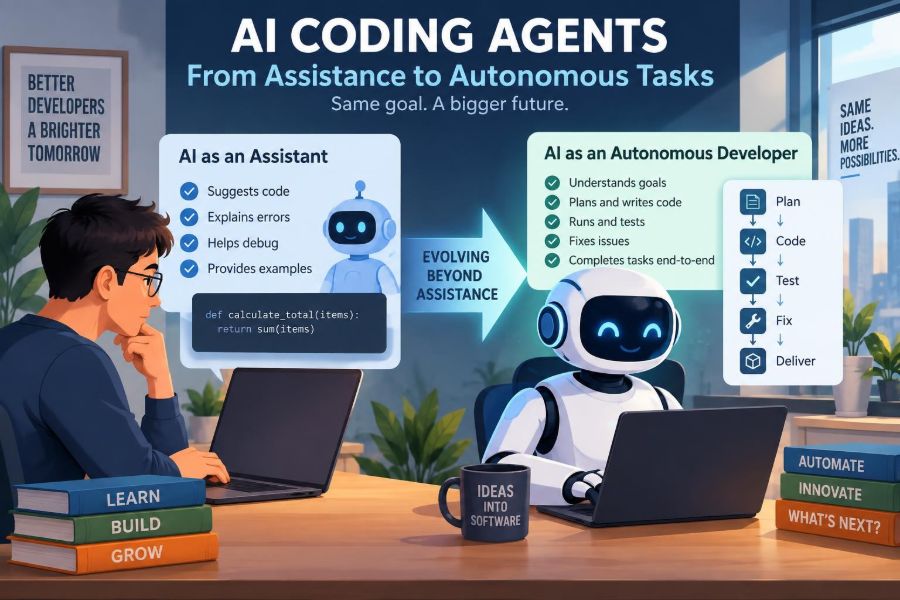
Traditional AI coding assistance is usually local. It suggests a function body, explains a stack trace, converts code between languages, or answers a question about an API. A developer decides what to ask, where to paste the result, and whether it is correct.
An AI coding agent is aimed at a broader outcome. Given a goal such as “fix this bug and add regression coverage,” it can break the work into steps, inspect a codebase, make edits, invoke tools, observe results, and revise its approach.
The distinction is not that agents are magically independent. It is that they operate through a loop: decide, act, observe, and adjust. Their value comes from carrying context across that loop.
🧩 What Makes a Coding System an Agent
There is no single universal definition, but capable coding agents commonly combine several parts. A language model interprets the task; tools provide access to files, terminals, tests, issue trackers, or browsers; and an execution loop lets the system react to results.
- Planning: turning a request into smaller, ordered actions.
- Context gathering: searching code, reading configuration, and tracing dependencies.
- Tool use: editing files, running commands, querying documentation, or creating a draft change.
- Verification: using tests, linters, type checks, builds, or other observable checks.
Without useful tools and feedback, an agent is often just a conversational code generator with a longer prompt.
🔄 The Agent Loop in Practice
Consider a hypothetical task: a checkout service rejects valid postal codes containing a space. An agent might first locate the validation rule, inspect related tests, normalize the input, add a test case, and run the targeted test suite.
If a test fails, the result becomes new input. The agent may discover that normalization belongs at the API boundary rather than inside the validator, revise the patch, and rerun checks. This iterative behavior is the practical meaning of “autonomous task execution.”
Autonomy is therefore not a single on/off property. It is the degree to which the system can advance work without another person choosing every next action.
🎚️ Autonomy Is a Spectrum, Not a Switch
It is helpful to distinguish levels of responsibility rather than calling every advanced assistant autonomous. A tool that drafts code after explicit instructions has less freedom than one that opens a pull request after resolving a ticket.
| Mode | Typical behavior | Human role |
|---|---|---|
| Suggestive | Completes or explains code | Chooses and applies output |
| Collaborative | Plans and edits with frequent confirmation | Directs each meaningful step |
| Bounded agentic | Completes a defined task in a sandbox or branch | Reviews result and evidence |
| Operational | Acts on recurring, low-risk workflows | Sets policies and handles exceptions |
Most sensible current uses sit in the bounded category. A well-defined task and a reviewable output make failure easier to detect and reverse.
🗺️ Planning Before Editing
Reliable engineering rarely starts by changing the first plausible file. A good agent first forms a working model: what the request means, which component owns the behavior, what constraints apply, and how success will be checked.
Plans should remain revisable. A plan based on an initial search can be wrong when the agent finds feature flags, generated code, compatibility layers, or an architectural convention that changes the right solution.
For teams, visible plans are useful even when the agent is capable of acting immediately. They reveal assumptions early and give reviewers a compact rationale for the eventual patch.
🔍 Repository Understanding Is the Hard Part
Writing a few lines of syntax is often the easy portion of a maintenance task. The difficult portion is discovering how a particular repository expresses its rules: naming conventions, layering, error handling, test fixtures, deployment assumptions, and undocumented history.
Large codebases contain near-duplicates and misleading names. A search result may identify three validators, while only one serves external requests. An agent that edits the first match can create a patch that looks plausible but changes nothing important.
Strong agents use search, symbol navigation, call chains, tests, and configuration files as evidence. Even then, repository understanding remains probabilistic, especially when documentation is stale.
🧰 Tools Turn Language into Action
A model cannot meaningfully repair a build if it cannot inspect the build output. Tool access gives an agent the ability to exchange guesses for observations.
Useful tools include a read-only code search, a controlled file editor, a shell in an isolated environment, test runners, static analysis, dependency scanners, and issue-tracker context. Each tool expands capability, but it also expands the possible damage from a mistaken action.
Tool design should follow the principle of least privilege: grant only the access required for the task. An agent fixing unit tests rarely needs production credentials, deployment permissions, or broad access to organizational data.
🧪 Verification Is the Difference Between a Patch and a Claim
Generated code is not validated code. A patch becomes more credible when the agent can show what it checked: targeted tests, broader test suites, type checking, linting, compilation, or a reproducible manual scenario.
Verification must match the risk. A documentation correction may need only a preview or spell check. A change to authentication, data migration, concurrency, or payment logic needs deeper review and more layers of testing.
An agent should report failed checks honestly. Treating an incomplete test run as a successful task is a dangerous form of automation theater.
📏 Define Done Before the Agent Starts
Vague requests encourage vague results. “Improve error handling” can mean clearer messages, fewer crashes, structured logs, retries, or a different API contract. An agent needs a concrete completion definition.
A useful task brief identifies the desired behavior, scope boundaries, constraints, and acceptance checks. For example: preserve the public interface, reject malformed input with the existing error type, add regression coverage, and do not modify unrelated modules.
Clear definitions help humans too. They reduce the chance that a polished-looking implementation solves a different problem than the requester intended.
📦 Small, Bounded Tasks Are the Best Starting Point
Early adoption works best on tasks with a limited blast radius and objective checks. Examples include updating a localized configuration, adding tests for a known bug, renaming an internal symbol, or migrating a repetitive API call pattern.
These tasks let a team evaluate whether an agent can navigate its own codebase without entrusting it with ambiguous architecture or irreversible operations. They also create reusable patterns for prompts, permissions, and review.
“Build an entire feature” is usually a poor first task. Features involve product interpretation, trade-offs, interaction design, operational concerns, and decisions that may not be represented in the repository.
🧱 Why Multi-File Changes Raise the Stakes
Many useful tasks cross boundaries: a schema changes, a service maps the new field, a user interface displays it, and tests update at each layer. Agents can reduce the mechanical effort of tracing those connections.
But multi-file consistency is where shallow understanding becomes costly. An agent may update a type but miss a serializer, change a route but not an authorization policy, or add a test that accidentally mocks away the real behavior.
Reviewers should inspect the change as a system, not as a collection of individually plausible edits.
🧠 Context Windows Are Not Understanding
Modern systems can process substantial amounts of text, but a large context capacity does not guarantee correct prioritization. Dumping an entire repository into a prompt can obscure the few files and constraints that actually matter.
Effective agent workflows retrieve relevant information progressively. They begin with the task and local conventions, then expand through references and test failures. This resembles how experienced developers investigate unfamiliar systems.
Teams can help by maintaining concise architecture notes, setup instructions, and directory-level guidance. Good documentation is not merely for people; it improves the quality of automated work as well.
🧾 Instructions Need a Hierarchy
Repositories often contain instructions in readme files, contribution guides, build scripts, and comments. An agent needs to know which instructions are authoritative, which are local, and which are outdated examples.
Clear project guidance should state how to install dependencies, run relevant checks, format code, handle generated files, and avoid sensitive operations. Place rules near the work they govern, but avoid contradictory copies across many folders.
Ambiguous instructions produce inconsistent behavior from both humans and agents. A short, maintained contribution guide can prevent many avoidable edits.
🔐 Secrets and Credentials Need Strong Boundaries
An agent with terminal access may encounter environment variables, configuration files, logs, tokens, or customer-like test data. It may also be manipulated by text embedded in a repository, an issue, or external documentation.
Use ephemeral credentials where possible, isolate execution environments, redact secrets from logs, and avoid passing sensitive values into prompts unless there is a justified and approved reason. Treat output channels carefully too: generated summaries and pull request descriptions can leak context.
Security review is not a feature to add after agents are deployed. Permission design determines what an agent can expose or alter when it makes a bad decision.
🛡️ Prompt Injection Is an Operational Risk
Prompt injection occurs when untrusted content tries to influence an AI system’s instructions. A malicious issue comment might tell an agent to ignore repository rules, print secrets, or run a destructive command.
Agents that read tickets, web pages, logs, and code comments should treat those sources as data, not as higher-priority commands. System-level policies, tool restrictions, approval gates, and isolation reduce the impact of malicious or accidental instructions.
No single filter solves this problem. The practical defense is layered: limit access, label trusted sources, require confirmation for consequential actions, and retain audit records.
🧯 Sandboxes Make Experimentation Safer
A sandbox is an isolated environment where an agent can inspect code and run approved commands without affecting production systems or shared developer machines. It is especially valuable when a task may execute package scripts or modify many files.
Isolation does not make every action harmless. Builds can still consume expensive resources, tests can contact external services if badly configured, and dependency installation can introduce supply-chain concerns. Network and resource controls may still be needed.
The goal is not to eliminate all risk. It is to make mistakes contained, observable, and easy to discard.
👀 Human Review Changes Rather Than Disappears
When agents create larger patches, review moves from line-by-line typing oversight toward judgment about intent, correctness, and system effects. Reviewers should ask whether the patch solves the stated problem, preserves invariants, and provides meaningful tests.
A clean diff is not enough. Review the agent’s evidence: commands run, failures encountered, assumptions made, files intentionally left unchanged, and areas it could not verify.
This can make review more efficient for routine work, but it can also create fatigue if agents submit many noisy changes. Quality thresholds and task selection matter.
🧑⚖️ Accountability Stays Human
An agent may draft a change, but organizations still need people who own requirements, approvals, releases, and incidents. Calling a tool autonomous does not transfer legal, professional, or operational responsibility to it.
Clear ownership prevents a common failure mode: everyone assumes someone else validated the generated change. The task requester, code reviewer, and release owner should know their distinct responsibilities.
For consequential systems, decision records can be useful. Record why a change was approved, what was verified, and which uncertainty remained at release time.
🚨 Hallucinations Become More Serious When They Act
A language model can confidently invent an API, misread a library’s behavior, or infer a nonexistent requirement. In a chat response, that may waste a few minutes. In an agent workflow, the same error can become a misleading patch or a destructive command.
Tool feedback helps, but it does not catch every mistake. Tests can be incomplete, mocks can conceal integration failures, and a command succeeding does not prove a design is correct.
Countermeasures include constrained tools, independent checks, tests based on real behavior, review by domain-aware engineers, and explicit uncertainty in the agent’s final report.
🧱 Legacy Code Demands Extra Caution
Legacy systems often lack reliable tests and contain behavior that users depend on even if nobody can clearly explain it. An agent may identify a pattern as redundant when it is actually a workaround for an old integration or a compatibility promise.
Before allowing autonomous edits, teams should improve observability and characterize current behavior with tests. A characterization test does not claim behavior is ideal; it records what the system currently does so a change can be evaluated safely.
In these systems, agents may be most useful first as investigators: mapping dependencies, summarizing flows, and proposing changes for humans to assess.
🏗️ Architecture Requires Product and System Judgment
Agents can generate alternatives for an architectural decision, trace affected modules, or create a proof of concept. Those are valuable supporting tasks. They should not be confused with resolving the decision itself.
Architecture involves constraints that may live outside code: organizational ownership, reliability targets, user workflows, operating costs, compliance needs, and plans that have not yet been documented. A locally elegant refactor can be globally wrong.
Use agents to accelerate evidence gathering, not to bypass the conversations that establish technical direction.
⚙️ Repetitive Maintenance Is a Strong Use Case
Many engineering tasks are repetitive but not trivial: updating deprecated calls, adding missing metadata, normalizing test conventions, or applying a mechanical change after a library upgrade. Agents can search broadly, make consistent edits, and report exceptions.
The best candidates have a recognizable pattern and a reliable verification method. A team might first ask an agent to produce a report of candidate files, then approve the transformation, then review the resulting batch.
This staged approach is safer than granting immediate authority to edit every match in a large repository.
🐛 Bug Fixing Works Best with Reproduction Steps
A bug report that says “sometimes fails” offers little for an agent or a human to verify. A report with inputs, expected behavior, actual behavior, environment details, and a minimal reproduction creates a concrete target.
For a well-scoped defect, an agent can often help trace execution, propose hypotheses, add a failing test, and iterate toward a fix. The failing test is especially valuable because it prevents the fix from becoming a one-time guess.
When a bug cannot be reproduced, an agent should be able to say so and collect diagnostic evidence rather than fabricate confidence.
📚 Documentation Is Part of the Delivery
Autonomous work becomes easier to review when the agent explains what changed and why. A useful summary names the behavior affected, key files modified, checks run, known limitations, and any follow-up work.
Documentation changes may also be part of the task itself: migration notes, configuration examples, release notes, or comments explaining a non-obvious constraint. These should be reviewed with the same care as code because they guide future decisions.
Good documentation reduces the next agent’s uncertainty, but more importantly, it reduces the next engineer’s uncertainty.
📊 Measure Outcomes, Not Activity
Counting generated lines or closed tickets can reward the wrong behavior. An agent that creates many large patches may appear productive while increasing review burden, defects, or rework.
Useful evaluation asks whether the workflow reduces time to a verified change, improves consistency, lowers repetitive toil, or helps engineers focus on higher-value decisions. Track negative signals too: reverted changes, failed builds, security findings, and reviewer time.
Compare against the previous process for similar tasks. The meaningful question is not whether an agent did work, but whether the team delivered safer, clearer software.
🧑💻 Skills Shift Toward Supervision and System Thinking
Developers still need programming fundamentals. In fact, understanding types, tests, data flow, concurrency, and failure modes becomes more valuable when reviewing rapidly produced changes.
Additional skills matter as well: writing precise task briefs, recognizing weak evidence, setting permissions, reading diffs critically, and designing tests that distinguish a real fix from a superficial one.
For students, this is a reason to learn how systems work rather than relying on generated code. For professionals, it is a reason to invest in review, architecture, and operational judgment.
🛠️ A Practical Team Adoption Path
Adoption should be incremental and evidence-driven. Start where success is easy to observe and failure is easy to reverse.
- Choose one repetitive, low-risk workflow with existing tests.
- Define allowed tools, repository instructions, and a clear definition of done.
- Run the agent in an isolated branch or sandbox.
- Require a human to review the diff and validation evidence.
- Record failures, ambiguous cases, and time spent in review.
- Expand scope only when the workflow consistently produces useful, trustworthy results.
This process turns experimentation into engineering rather than a contest to automate the most work as quickly as possible.
🚫 Common Mistakes to Avoid
One mistake is treating every task as suitable for delegation. Another is granting broad permissions because narrow setup feels inconvenient. Both increase risk without necessarily improving outcomes.
- Accepting a patch because it compiles, without checking whether it meets the requirement.
- Letting an agent change generated files or lockfiles without understanding the cause.
- Using production-like secrets or unrestricted network access in routine experiments.
- Skipping code review because the change was “only automated.”
- Assuming an agent’s explanation is proof of its reasoning or correctness.
The remedy is disciplined workflow design: small scopes, explicit checks, reversible changes, and accountable reviewers.
🌱 The Near-Term Future Is Supervised Autonomy
Near-term progress is likely to look less like unattended software factories and more like reliable delegated work inside carefully designed boundaries. Agents will handle more investigation, implementation, testing, and maintenance tasks while people retain authority over goals and consequential trade-offs.
The practical frontier is not simply making models write more code. It is building environments where an agent can get the right context, act safely, test its work, communicate uncertainty, and hand results to a responsible human.
Teams that improve those foundations will get more value than teams that merely add an agent to an unclear process.
🎯 The Core Principle: Earn Autonomy with Evidence
AI coding agents are moving from assistance to autonomous tasks because they can now combine planning, repository navigation, tool use, and feedback. That capability can remove tedious work and shorten the path from a well-defined request to a reviewable change.
But autonomy should be earned task by task. The right amount depends on the consequences of failure, the quality of tests and documentation, the permissions granted, and the ability of humans to detect and reverse mistakes.
The most effective agent workflow is not the one that removes people fastest; it is the one that produces verifiable progress while keeping human judgment in control.
AI coding agents can become dependable teammates when their goals are clear, their actions are bounded, and their results are tested rather than merely trusted. That is a more durable breakthrough than code generation alone. 🤖🧪🛡️