
A developer opens a modern project, writes a few lines of code, presses Run, and expects a useful result within seconds. Autocomplete suggests names, a compiler points to mistakes, and version control records every change. That smooth experience can make programming feel like a solved activity.
Early programmers worked in a very different environment. They often had to express instructions in forms close to machine hardware, wait for scarce computer time, and investigate failures with far less diagnostic help. A small error could waste an expensive run.
The first programming languages did more than make computers easier to command. They changed who could program, what kinds of problems were practical to automate, and how teams could organize software work.
Understanding those languages is useful far beyond a history lesson. Many current debates—readability versus speed, abstraction versus control, domain-specific tools versus general-purpose languages—began when software development itself was taking shape.
🧭 What “Early Programming Languages” Means
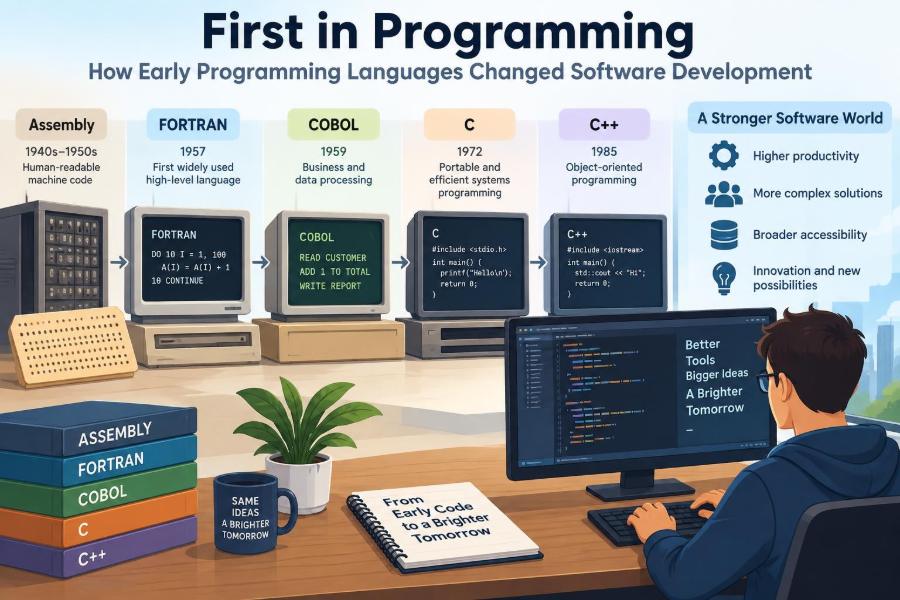
There was no single first programming language in every sense. Machine code came first as a way to directly specify processor instructions. Assembly languages followed by replacing numeric operation codes with readable abbreviations.
Later languages such as FORTRAN, COBOL, Lisp, and ALGOL introduced higher-level ways to describe computation. They are called high-level languages because a programmer can focus more on formulas, records, symbols, or procedures than on individual processor operations.
The important historical shift was not one magic invention. It was a sequence of abstractions that made software more expressive, portable, and maintainable.
🔢 Before Languages: Instructions as Numbers
Early computers executed instructions represented as numbers stored in memory. A programmer needed to know the machine’s instruction set, memory layout, registers, and often the exact location of data.
For example, adding two values was not written as total = a + b. It required a sequence of hardware-specific actions: load a value, perform an arithmetic operation, store a result, and control the next instruction.
This direct approach gave fine control, but it made programs difficult to read and easy to break. Changing one instruction could require adjusting addresses elsewhere in the program.
🧩 Assembly Added Human-Readable Symbols
Assembly language introduced mnemonic names such as ADD, LOAD, and JUMP. Labels also allowed programmers to name locations instead of manually calculating every branch target.
An assembler translated these symbolic instructions into machine code. This was an early example of a software tool reducing repetitive, error-prone work for other software creators.
Assembly remains valuable when software must interact closely with hardware or meet strict resource constraints. Its limitation is that each assembly language is tied closely to a processor family, so programs do not travel easily between different machines.
📝 The Stored-Program Idea Made Software Separate
Earlier calculating machines were often configured by changing physical wiring, switches, or plugboards. The stored-program model placed instructions in memory alongside data, allowing a computer to run a new program without being physically rewired.
This made software a distinct artifact: something that could be written, revised, loaded, and shared. Programming languages became the medium through which people created those artifacts.
The change also created a practical need for better notation. If programs could grow and change, they needed to be understandable by more than the person who first encoded them.
🧮 FORTRAN Made Scientific Formulas Practical
FORTRAN, short for Formula Translation, was designed for scientific and engineering calculations. Its notation let programmers write algebra-like expressions and loops that were much closer to the mathematics of their problems.
A scientist modeling a trajectory could describe repeated calculations without hand-writing every low-level arithmetic and branch instruction. The compiler handled the translation into machine-level operations.
FORTRAN’s success challenged a common concern of its era: that a high-level language would necessarily produce code too slow for serious work. Compiler optimization became a central engineering goal partly because users needed both productivity and performance.
⚙️ Compilers Changed the Division of Labor
A compiler translates an entire source program, or substantial parts of it, into another form such as machine code. Rather than requiring every programmer to manually perform translation decisions, a compiler could apply those decisions systematically.
This shifted work from individual coding sessions into reusable tools. Compiler writers encoded knowledge about a machine, while application programmers could concentrate more on the problem domain.
That division is familiar today. Frameworks, build systems, static analyzers, and cloud platforms all package specialized knowledge so that other developers can work at a higher level.
📦 COBOL Treated Business Data as a First-Class Concern
Business software deals heavily with records: customers, invoices, payroll entries, accounts, and reports. COBOL was designed to express these structured data-processing tasks in a form intended to be readable by people involved in business operations.
Its data descriptions made fields and record layouts explicit. That mattered when a program had to process large, regular collections of administrative information reliably.
COBOL is sometimes caricatured as merely old-fashioned, but its lasting presence in some long-lived systems reflects a real lesson: software survives when it continues to serve essential organizational processes. Replacing such systems is often harder than rewriting syntax.
🏢 Readability Became a Team Requirement
When programs were short and their authors were nearby, private shorthand could sometimes survive. As software became larger and teams grew, code had to communicate intent to maintainers, reviewers, operators, and future developers.
Early languages made readability an explicit design concern in different ways. COBOL emphasized record-oriented description, while ALGOL advanced clean notation for algorithms. Neither solved every maintenance problem, but both reinforced that source code is documentation as well as instruction.
A modern naming convention serves the same purpose. A clear variable name may cost a few characters, yet save hours of mistaken interpretation later.
🧠 Lisp Put Symbols and Lists at the Center
Lisp took a markedly different path from formula-oriented and business-oriented languages. It treated symbolic expressions and lists as core data structures, making it natural to manipulate program-like structures as data.
This was useful for work involving symbolic reasoning, language processing, and experimentation with artificial intelligence. Lisp also popularized powerful ideas around recursion, automatic memory management, and functions as values.
Not every application needs Lisp’s style, but its influence appears in functional programming, macro systems, interactive development environments, and languages that let developers build expressive abstractions.
🔁 Recursion Offered a Different Way to Think
Recursion describes a solution in terms of smaller versions of the same problem. For example, traversing a tree can mean visiting one node and then applying the same process to each child.
Early Lisp made recursive programming especially natural. This was not only a syntactic preference; it helped programmers express structures such as nested lists and symbolic expressions more directly.
Recursion is not automatically clearer or faster than iteration. On deeply nested input, it can also exhaust available call-stack space in some environments. The enduring lesson is to choose the control structure that matches the shape of the problem.
🧱 ALGOL Clarified the Shape of Algorithms
ALGOL, short for Algorithmic Language, had enormous conceptual influence even where it was not the dominant commercial choice. It helped establish block structure, nested scopes, and a notation for describing algorithms precisely.
A scope defines where a name is visible. Local variables inside a block reduce accidental interference with unrelated parts of a program, an idea that is fundamental to modern language design.
ALGOL also influenced how programming languages are specified. Clear definitions of syntax and behavior make it possible for independent compiler implementations to agree on what a program means.
📐 Formal Syntax Made Languages Shareable
A programming language needs more than appealing examples. It needs rules that determine which sequences of symbols are valid and how they should be interpreted. Formal grammar notation gave language designers a rigorous way to state those rules.
That rigor helped separate a language from any single machine or compiler. Developers could implement the same language on different systems while aiming at a common definition.
Modern developers see the benefit whenever a parser, formatter, linter, and compiler all understand the same source code. Precise syntax does not eliminate ambiguity in requirements, but it greatly reduces ambiguity in the language itself.
🌍 Portability Became a Software Goal
Machine code and assembly are tightly coupled to hardware. High-level source code offered the possibility that the same program could be compiled for more than one kind of computer, provided a suitable compiler existed.
Portability was never effortless. Programs can still depend on word sizes, file formats, operating systems, libraries, or undefined language behavior. Yet separating source code from machine instructions made cross-platform software imaginable and increasingly practical.
This is why language standards matter. They define a shared baseline, while platform-specific details must be treated consciously rather than discovered accidentally.
🗂️ Data Types Reduced Ambiguity
Early language design gradually made different kinds of values more explicit: numbers, characters, arrays, records, and later richer user-defined structures. A data type tells the language and the reader what operations make sense for a value.
Knowing that a value is a date, account identifier, or list of measurements prevents some categories of confusion before a program runs. Type checking cannot verify every business rule, but it can catch mismatches such as treating text as arithmetic input.
Modern static typing, schemas, and API contracts extend this old idea: make key assumptions visible at boundaries where mistakes are costly.
🧵 Subroutines Encouraged Reuse
As programs grew, developers needed ways to package a repeated task once and call it from several places. Subroutines, procedures, and functions provided that structure.
A payroll system, for instance, might keep tax calculation separate from report formatting. Each part can then be tested and changed with a more limited set of consequences.
Reuse is not automatically good when it creates a confusing, overly general utility. The useful principle is cohesion: group operations that belong together for a clear reason.
🧰 Libraries Turned Code into Infrastructure
Once languages supported reusable routines, collections of tested routines could become libraries. Mathematical functions, input/output procedures, and data-handling utilities no longer had to be recreated in every program.
Libraries changed software economics. Effort could move from repeatedly solving common technical problems to improving a shared implementation or tackling domain-specific needs.
They also introduced dependency concerns. A library saves time only when its behavior, compatibility, maintenance status, and licensing fit the project. This is a modern issue with very old roots.
🐞 Debugging Became Part of the Workflow
Early programming was not a clean sequence of writing and immediately running code. Input could be prepared on physical media, submitted for execution, and examined later. Slow feedback amplified the cost of simple errors.
Languages, assemblers, and compilers gradually made mistakes easier to locate by reporting invalid syntax, unknown names, or incompatible operations. These messages were imperfect, but they made failures more interpretable.
Today’s rapid feedback can encourage trial and error, which is often useful. The deeper practice remains the same: form a hypothesis, isolate the failure, inspect evidence, and verify the fix rather than merely making an error disappear.
⏳ Batch Processing Shaped Programming Habits
Many early systems used batch processing: jobs were collected and run with limited direct interaction. A programmer might prepare a job, wait for it to execute, and receive output or an error listing afterward.
This encouraged careful preparation. Developers had strong incentives to inspect inputs, reason through control flow, and test small components before spending a run on a larger program.
Interactive tools have removed much of that waiting, but expensive operations still exist: large test suites, data migrations, production deployments, and machine-learning jobs. Thoughtful preflight checks remain valuable in those settings.
🖨️ Input and Output Were Design Constraints
Programs had to work with the devices and media available: cards, paper tape, printers, disks, terminals, and later networks. Input formats were not an afterthought; they shaped program structure and user expectations.
A business program built around fixed-width records makes sense when the surrounding process produces fixed fields. A modern web service faces a comparable design task when it validates JSON requests or processes event streams.
The medium changes, but the lesson persists: define input contracts, account for malformed data, and make output useful for the people or systems that must consume it.
🧪 Testing Had to Be Deliberate
Early programmers learned that a program compiling or running once did not establish correctness. Boundary values, unusual records, arithmetic limits, and missing input could reveal faults hidden by a happy-path demonstration.
Formal automated testing practices matured over time, but the basic discipline is older: choose cases that challenge assumptions. If a calculation handles a typical positive number, also consider zero, a negative value where permitted, a maximum-sized input, and an empty collection.
For working developers, this history is a reminder that testing is not paperwork added after coding. It is a way to turn an informal expectation into an executable check.
📏 Efficiency Was a Necessity, Not a Slogan
Early machines had limited memory and processing capacity, and computer time could be scarce. Developers had to consider memory layout, instruction counts, and input/output costs much more directly than many application programmers do now.
High-level languages did not remove efficiency concerns; they changed where they were handled. Compiler writers optimized common patterns, while programmers chose algorithms and data representations suited to their workload.
That balance still matters. Premature micro-optimization can obscure code, but ignoring an algorithm that scales poorly can make a system unusable. Measure relevant behavior before deciding where low-level control is justified.
⚖️ Abstraction Always Has a Trade-Off
Every early language raised a version of the same question: what should the programmer describe, and what should the language implementation decide? Higher abstraction can improve clarity and reduce repeated work, but it can also conceal costs or restrict unusual operations.
| Approach | Main strength | Typical trade-off |
|---|---|---|
| Machine code | Maximum direct hardware control | Very difficult to write and maintain |
| Assembly | Readable instruction-level control | Hardware-specific and verbose |
| High-level language | Expresses domain logic more directly | Depends on compiler and runtime choices |
There is no permanently correct layer. Embedded firmware, a database query, and a browser interface have different constraints. Good engineers understand the layers beneath their tools without insisting that every task be solved at the lowest one.
👥 Languages Expanded Who Could Contribute
Programming has always involved people with varied mathematical, scientific, operational, and administrative expertise. Higher-level languages made it easier for domain specialists to express problems without first mastering every detail of a specific machine.
This did not mean that programming became effortless. Clear problem decomposition, data modeling, and validation still require careful thinking. But language design lowered some barriers between subject-matter knowledge and executable systems.
Teams benefit when the people closest to a problem can participate meaningfully in defining and reviewing the software that addresses it.
🗣️ Language Design Reflects Its Domain
FORTRAN, COBOL, Lisp, and ALGOL did not compete on a single scoreboard. Each emphasized different kinds of work: numerical computation, business records, symbolic manipulation, or algorithm description.
This is why language choice should begin with the problem rather than popularity alone. A language’s ecosystem, deployment model, safety features, performance characteristics, and team familiarity can matter as much as its syntax.
Domain-specific languages carry the idea further. SQL expresses data queries well because it lets developers state the desired result rather than manually describe every retrieval step.
🔄 The Ideas Outlived Individual Languages
Many early languages have evolved, declined in new projects, or remained active in specialized environments. Their individual syntax is less important than the ideas they established.
- FORTRAN demonstrated practical compilation for numerical work.
- COBOL centered business records and readable data descriptions.
- Lisp advanced symbolic processing, recursion, and programmable abstraction.
- ALGOL shaped block structure, scope, and formal language definition.
Modern languages often combine these ideas. A single application may use typed records, functional transformations, structured blocks, optimized compilation, and a query language—all descendants of earlier design choices.
🏗️ Software Engineering Emerged from Scale
As programs became more capable, the hardest problems were increasingly about coordination: understanding requirements, dividing work, reviewing changes, controlling versions, testing interactions, and operating systems safely over time.
Programming languages helped by providing structure, but no language alone solves these organizational issues. A beautifully designed language cannot compensate for unclear ownership, missing tests, or unexamined assumptions about users.
This is the bridge from programming to software engineering: building dependable software requires technical expression plus repeatable processes for people, change, and evidence.
🚧 A Common Mistake: Treating History as Obsolete
It is tempting to view older languages only as primitive steps toward modern tools. That misses why their designers made particular choices. Constraints such as scarce memory, expensive execution, and structured business records produced techniques that can still be useful.
For example, explicit data layouts matter in network protocols and storage formats. Careful resource use matters in mobile, embedded, and high-volume systems. Clear formal specifications matter wherever independent implementations must interoperate.
Historical understanding should not become nostalgia. The goal is to recognize enduring constraints and avoid rediscovering old lessons under new names.
🧑💻 What Students Can Learn from Early Languages
Learning a little assembly can clarify what a compiler, stack, register, and memory address actually do. Reading a small Lisp example can sharpen thinking about recursion and data structures. Looking at COBOL-style records can illuminate data modeling.
You do not need to become an expert in every historical language. A productive approach is to choose one idea and connect it to a current tool:
- Trace a simple high-level function down to compiled or interpreted operations.
- Implement the same task iteratively and recursively.
- Model a real-world record with explicit fields and validation rules.
- Read a language specification or grammar for a feature you use often.
These exercises build mental models, not merely trivia.
🔍 What Working Professionals Can Reuse
Professionals can apply the early-language mindset by making translation boundaries explicit. Know what your build process produces, where data is converted, which assumptions are enforced by types, and what runtime costs matter for the system you operate.
Also favor source code that survives handoff. Clear interfaces, stable data contracts, small cohesive functions, and diagnostics that help the next responder are practical forms of the readability goals early language designers pursued.
When evaluating a new framework or language, ask what complexity it removes, what complexity it relocates, and how your team will debug it under real operational pressure.
🧭 Choosing the Right Level of Control
Modern developers rarely need to choose between raw machine code and a high-level language as an all-or-nothing decision. Most systems use layers: a managed application may call a database engine, native library, operating system, and hardware beneath it.
The useful skill is knowing when to move down a layer. Do so when measurement reveals a bottleneck, a platform interface demands it, or safety and timing requirements make the abstraction insufficient. Otherwise, clearer high-level code is often the more economical choice.
Early language history gives this decision context. Abstraction was created to solve real human and engineering limits, not to hide understanding.
🌱 The Core Lesson from Programming’s First Languages
Early programming languages changed software development by turning computer instructions into forms people could reason about, share, and improve. They made it possible to describe formulas, records, symbols, procedures, and algorithms at levels better suited to human thought.
They also revealed a lasting tension: software must be understandable enough for people to change and dependable enough for machines to execute. Languages, compilers, type systems, libraries, and development practices are all attempts to manage that tension.
The central principle is simple: the best programming abstraction is one that makes the problem clearer while preserving the control the system genuinely requires.
From symbolic assembly instructions to modern frameworks, progress in programming has come from giving people better ways to express intent without losing sight of how software behaves. That is why the earliest languages still belong in every developer’s mental toolkit. 💾 🧠 🌱