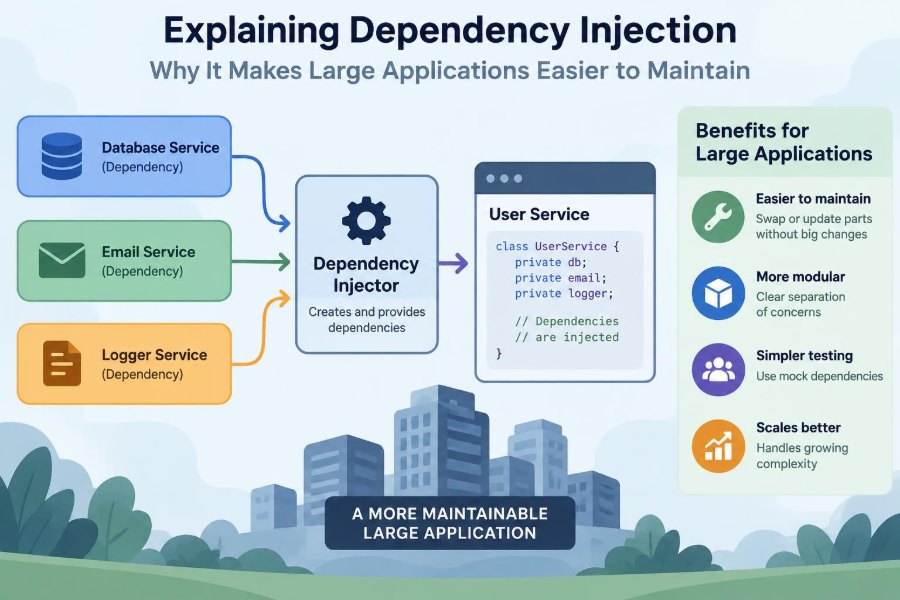

A small application can feel wonderfully direct. A controller creates a service, the service opens a database connection, and a helper sends an email. Everything is close together, and a new feature may take only a few lines.
Then the application grows. The same service is needed by an API, a background worker, and a command-line tool. Tests need a fake payment provider. Production needs credentials and retry policies. A seemingly harmless new statement now decides far more than object creation.
This is where teams often discover that changes are difficult not because the business rules are complex, but because those rules are tightly tied to databases, web frameworks, clocks, file systems, and third-party services.
Dependency injection is a design technique for separating what code does from the supporting things it needs to do it. Used thoughtfully, it makes a large application easier to test, evolve, understand, and run in different environments.
🧩 Start with the meaning of a dependency
A dependency is anything one piece of code needs in order to do its job. It may be another object, a configuration value, a logging facility, a network client, or even a source of the current time.
For example, an order service that charges a card depends on a payment gateway. If it stores an order, it also depends on some form of repository or database access. These dependencies are not inherently bad; useful software must collaborate with something.
The design question is who chooses and constructs those collaborators.
🏗️ The hidden cost of constructing collaborators
Consider a hypothetical notification service:
class NotificationService {
  sendWelcomeMessage(user) {
    const client = new EmailClient("smtp.example");
    return client.send(user.email, "Welcome");
  }
}
The method appears self-contained, but it silently commits to one email client and one configuration approach. Calling it in a test may attempt a real network connection unless the code provides a special escape route.
It also makes changes spread outward. Switching providers, adding message tracing, or supporting a local mail catcher may require editing business-oriented code that should only decide when to send a welcome message.
💉 What dependency injection actually means
With dependency injection, an object receives its dependencies from outside rather than constructing them internally. The notification service is given an email sender:
class NotificationService {
  constructor(emailSender) {
    this.emailSender = emailSender;
  }

  sendWelcomeMessage(user) {
    return this.emailSender.send(user.email, "Welcome");
  }
}
Something else creates the concrete email sender and passes it in. That outside act of supplying a dependency is the “injection.” The concept is simple; its consequences become significant as an application gains more moving parts.
🔄 Inversion of control is the broader idea
Dependency injection is one way to apply inversion of control. Normally, a class controls the creation and selection of the objects it uses. With inversion of control, that selection is moved to an outer layer.
The class still controls its business decisions. It decides whether an order may be placed, for example. But it does not need to control the mechanics of obtaining a database client or selecting a payment provider.
Dependency injection is often discussed alongside inversion of control, but they are not interchangeable terms. Inversion of control is the principle; injection is a practical technique.
🧠 Separate policy from mechanism
Business logic expresses policy: “do not ship unpaid orders” or “lock an account after repeated failed attempts.” Database queries, HTTP calls, and framework-specific APIs are mechanisms used to carry out that policy.
When policy constructs mechanisms directly, the two become entangled. Injecting a repository, gateway, or clock lets the policy remain focused on decisions while infrastructure handles communication with the outside world.
This does not mean every class must be abstract. It means boundaries should be chosen where a likely variation or external effect exists.
🚪 Constructor injection as the default
Constructor injection supplies required dependencies when an object is created. It makes an object’s needs visible in its constructor and prevents an incomplete object from existing accidentally.
class OrderService {
  constructor(orderRepository, paymentGateway) {
    this.orderRepository = orderRepository;
    this.paymentGateway = paymentGateway;
  }
}
This style is usually a strong default because required collaborators are explicit, stable after creation, and straightforward to supply in tests.
🧰 Other injection styles and their trade-offs
Dependencies can also arrive through a method or a writable property. Neither approach is automatically wrong, but each communicates a different lifecycle.
| Style | Useful when | Main risk |
|---|---|---|
| Constructor injection | The dependency is required for normal operation | Long constructors can reveal an oversized class |
| Method injection | A collaborator is needed for one operation only | Repeated parameters may clutter a frequently used API |
| Property or setter injection | A dependency is truly optional or configured later | The object may be used before it is fully configured |
For example, passing a report formatter into one export method can be clearer than storing it on the report service. Conversely, an order repository that every operation needs belongs in the constructor.
🧪 Testing becomes more focused
A unit test should usually examine a small unit’s decisions without requiring a real database, email server, or payment account. Injection makes this possible because tests can provide controlled substitutes.
A test for an order service might pass an in-memory repository and a fake gateway that records charge requests. It can then verify that an unpaid order is not persisted or that a declined charge produces the expected result.
This is not merely about making tests fast. It allows tests to describe business behavior without turning setup into a miniature deployment environment.
🎭 Fakes, stubs, and mocks are different tools
A fake is a working but simplified implementation, such as an in-memory repository. A stub returns prepared answers, such as a gateway that always declines. A mock is commonly used to verify interactions, such as whether a sender was called once.
Dependency injection enables all three, but it does not require heavy mocking. Overly detailed interaction tests can become fragile when internal implementation changes while observable behavior remains correct.
Prefer a fake when it makes a test read like a realistic scenario. Use a mock when the interaction itself is the behavior that matters, such as ensuring a message is not sent before a transaction succeeds.
🔌 Program to a capability, not a vendor
The order service does not need to know a payment vendor’s complete API. It needs a smaller capability: perhaps charge(amount, token). Defining the dependency around that capability narrows the coupling.
In statically typed languages, this is often expressed through an interface or protocol. In dynamically typed languages, the expected methods can be documented, tested, and kept deliberately small.
The goal is not abstraction for its own sake. A useful boundary represents language your application genuinely understands, rather than exposing vendor-specific concepts throughout the codebase.
🗺️ The composition root assembles the application
Objects still need to be created somewhere. The place where the real application graph is assembled is often called the composition root.
At startup, it might create a database-backed repository, an HTTP payment adapter, and an order service that receives both. A web route then receives the assembled order service rather than constructing it itself.
Keeping wiring near startup provides a practical map of production choices. It also keeps framework and configuration details from leaking into core application code.
🌳 Think in object graphs, not isolated classes
In a large system, dependencies form an object graph. A route needs an application service; that service needs repositories and domain services; those may need database clients, loggers, and configuration.
Dependency injection makes this graph explicit. That visibility helps identify circular dependencies, duplicated clients, incorrect lifetimes, and components that know too much about one another.
If assembling one feature requires reaching across unrelated modules, the graph is revealing a design problem rather than creating one.
⏳ Object lifetime must match the dependency
Not every dependency should live for the same duration. A database connection pool may be shared by the application, a request context may live for one HTTP request, and a formatter may be created only when needed.
Using the wrong lifetime can cause subtle failures. A singleton service that stores request-specific user data can leak context across requests. A new expensive client for every operation can waste resources or defeat connection pooling.
Whether a framework manages lifetimes or your code does, decide deliberately which dependencies are shared, scoped, or transient.
⚙️ Dependency injection containers are optional
A dependency injection container is a library or framework facility that creates objects and resolves their dependencies according to registrations. It can reduce repetitive wiring in a large application.
Containers are not dependency injection itself. Manual construction at a composition root is still injection, and it is often clearer for small or medium-sized systems.
Introduce a container when the benefits of lifecycle management and centralized registrations outweigh the extra indirection. Do not introduce one merely because a framework includes it.
🔍 Avoid the service locator trap
A service locator lets code ask a global registry for dependencies whenever it needs them. It can look convenient:
class InvoiceService {
  create(invoice) {
    const repository = container.get("invoiceRepository");
    // ...
  }
}
But the class now has a hidden dependency on both the repository and the container. A reader cannot see its full requirements from the constructor, and a test must configure global state.
Passing dependencies in makes requirements explicit. A locator can have limited use at the application boundary, but using it throughout business code often recreates the coupling injection was meant to reduce.
🧱 Keep framework code at the edges
Web frameworks, ORMs, and message brokers solve valuable problems, but their types and conventions can become expensive if they spread everywhere. An application service that accepts raw HTTP requests is harder to use from a worker or command-line tool.
Instead, let edge code translate framework inputs into application-level values. Inject application services inward; implement repositories, handlers, and adapters outward.
This arrangement is often associated with layered, hexagonal, or clean architecture. The labels differ, but the practical idea is stable: core rules should not depend unnecessarily on delivery technology.
🔧 Adapters translate external systems
An adapter wraps an external tool behind an application-shaped dependency. A payment adapter might translate a vendor response into a simple result such as approved, declined, or temporarily unavailable.
This protects the rest of the codebase from vendor naming, request formats, and error types. It also gives one focused place to implement retries, observability, or API-version changes.
Injection then supplies the adapter wherever the capability is needed. The business layer asks for a payment operation, not a particular SDK object.
🕰️ Inject time, randomness, and identifiers when behavior depends on them
Not all dependencies are services. The current time, random number generation, and identifier creation can make behavior difficult to test when accessed globally.
A subscription-renewal service can receive a clock. Tests then use a fixed clock to examine expiry boundaries without waiting for real time. A token generator can similarly be replaced with predictable values when testing a workflow.
Do not inject every utility reflexively. Do so where controlling the value makes logic deterministic or where the implementation has an external effect.
🔐 Treat configuration as a dependency too
URLs, feature flags, retry limits, and credentials influence runtime behavior. Reading environment variables deep inside domain code hides those inputs and makes local behavior harder to reason about.
Read raw configuration near startup, validate it, and pass a focused configuration object to infrastructure components. An email adapter may need SMTP settings; an order policy should normally receive a meaningful setting, not access to an entire environment map.
Keep secrets out of logs and source control. Dependency injection improves structure, but it does not replace sound secret management or deployment practices.
📡 Observability fits naturally around injected boundaries
Logging, metrics, and tracing are cross-cutting concerns: many parts of an application need them, but they are not the main business purpose of those parts. Injected abstractions or decorators can add this behavior consistently.
For example, a tracing payment gateway can wrap the real gateway, record duration and outcome, then delegate the charge. The order service does not need tracing code in every branch.
Use care with data collection. Logs and traces should avoid exposing credentials, payment details, or unnecessary personal information.
🪆 Decorators can add behavior without changing callers
A decorator implements the same capability as the object it wraps. This makes it suitable for caching, retries, authorization checks, logging, or rate limiting.
A caching product repository can sit in front of a database repository. Callers receive the caching decorator as their repository dependency and do not need to know whether a cache exists.
Decorators are most useful when the added behavior is broadly applicable. Do not hide business rules inside generic decorators; a pricing decision belongs where pricing is understood.
🚦 Failure handling belongs at the right boundary
External systems fail differently from ordinary business decisions. A payment gateway timeout is not the same as a card decline, and a database outage is not the same as “the item is out of stock.”
Adapters should translate low-level failures into meaningful application-level outcomes where possible. Higher layers can then decide whether to retry, show an unavailable message, queue work, or stop the operation.
Injection helps because a failure policy can be tested against controlled gateway outcomes. It does not eliminate the need for idempotency, timeouts, transaction design, or operational monitoring.
🧹 Constructors with too many dependencies are feedback
A constructor containing eight or ten dependencies is often a sign that a class has accumulated too many responsibilities. The fix is rarely to hide them in a container or bundle unrelated objects into a vague “context.”
Look for a cohesive concept that can be extracted. Perhaps validation, pricing, fulfillment, and notification workflows have been combined in one order manager. Smaller services with focused responsibilities often produce simpler dependency lists.
There is no universal “correct” number. The important question is whether the dependencies form one understandable responsibility.
🧬 Do not create an interface for every class
A common reaction to dependency injection is to add a matching interface, abstract base class, and factory for every concrete type. This can create layers that provide no useful variation and make simple code harder to navigate.
Introduce an abstraction when there is a meaningful boundary: an external system, a volatile implementation, a test seam with real value, or a domain capability with multiple legitimate implementations.
A pure calculation service with no external effects may be easiest to instantiate directly. Good design uses indirection to manage change, not to satisfy a pattern checklist.
📦 Module boundaries matter as much as injection
Injection cannot rescue a module structure in which every feature imports every other feature. It works best alongside clear ownership: one module defines an application capability, another provides an adapter, and the composition root connects them.
Keep dependency direction intentional. Core rules can define the interfaces they need; outer infrastructure can implement them. This prevents a database package from becoming the center of every design decision.
Build tools, package boundaries, and code review conventions can reinforce these decisions, but architecture ultimately depends on everyday choices by the team.
🔁 Refactor gradually instead of rewriting everything
Legacy code often creates its own dependencies everywhere. Replacing all construction at once can be risky and distracting. Start at a point where change is already needed: a difficult test, a provider migration, or an unreliable integration.
- Identify the external collaborator and the small capability the code needs.
- Introduce that capability at the boundary of the affected class.
- Pass the existing concrete implementation from the caller.
- Add a focused test using a fake or stub.
- Move construction upward toward a composition root over subsequent changes.
This incremental approach delivers local value without requiring a grand architectural conversion.
🧭 A practical checklist for new code
Before adding a dependency, ask a few concrete questions:
- Is this collaborator required for the object to perform its normal role?
- Does it communicate with an external system or depend on changing configuration?
- Could a test benefit from controlling its behavior?
- What is the smallest capability this class actually needs?
- Where should the real implementation be assembled and how long should it live?
If the answers reveal a meaningful boundary, inject the dependency. If not, direct construction may be the clearer and more maintainable choice.
⚖️ Recognize when injection is not the best answer
For a small script, a stable value object, or a simple one-off transformation, injection can add ceremony with little return. Passing a string utility through five constructors does not automatically improve architecture.
Likewise, introducing interfaces solely to make every class mockable can obscure simple relationships. Tests should support confidence, not dictate needless layers.
The value of dependency injection grows with variability, external effects, reuse across entry points, and the cost of change. Context matters more than fashion.
🧑🤝🧑 Make dependencies understandable to the team
A maintainable design is not only one that can technically substitute components. It is one that a new teammate can inspect and explain. Clear names such as InvoiceRepository or ExchangeRateProvider communicate intent better than generic containers full of unrelated utilities.
Keep wiring conventions consistent, document surprising lifecycle choices, and make local tests demonstrate how important dependencies are replaced. These habits reduce the mental overhead of a growing object graph.
The best dependency setup is usually unsurprising: readers can see what a class needs, why it needs it, and where the production implementation comes from.
🎯 The core principle: make change local
Dependency injection does not promise that large applications become simple. They still contain competing requirements, unreliable integrations, and evolving business rules. What it offers is a way to keep many changes from spreading unnecessarily.
When a class receives a small, explicit set of capabilities, its behavior can be understood and tested without knowing every infrastructure choice. When real implementations are composed at the edge, changing a vendor, runtime environment, or delivery mechanism is less likely to disturb core rules.
That is why the pattern matters most in long-lived software: it turns dependencies from hidden assumptions into visible design decisions.
Dependency injection makes large applications easier to maintain because it keeps business behavior explicit while moving construction and infrastructure choices to well-defined boundaries. Use it where those boundaries are real, keep abstractions purposeful, and let the resulting code be easier for people to change with confidence. ⚙️🧩🚀