
You finish a difficult feature, untangle a production bug, and help a teammate understand an unfamiliar part of the codebase. Then you see a job posting for a role with a noticeably higher salary and wonder what, exactly, separates that engineer from you.
The answer is rarely just “knows more programming languages.” Software pay reflects a mix of business value, technical depth, scope of responsibility, market conditions, location, and the ability to solve expensive problems reliably.
That can make career planning feel frustratingly vague. A trendy framework may appear to promise opportunity, while a less glamorous skill such as database design or stakeholder communication may matter more in the role you actually want.
Understanding the mechanisms behind compensation helps you make deliberate choices: which skills to deepen, which roles to target, and when changing companies, teams, or responsibilities may matter more than learning one more tool.
🧭 Salary Is a Market Signal, Not a Personal Score
A software engineer’s salary is a price set in a particular labor market, not a complete measure of talent or potential. Companies pay for capabilities they need, within their budget, compensation philosophy, and local hiring conditions.
Two equally capable engineers can earn very different amounts because one works on revenue-critical systems, has scarce domain knowledge, lives in a different market, or has negotiated a different package. Treat salary as useful career information, but avoid treating it as a verdict on your worth.
💼 Understand Total Compensation Before Comparing Offers
Base salary is only one part of compensation. An offer can also include a bonus, equity, retirement contributions, health coverage, paid leave, learning support, and benefits with real financial value.
Equity deserves especially careful interpretation. Its eventual value can change, may vest over several years, and may be difficult to sell in a private company. Compare the guaranteed components separately from uncertain components rather than assuming every stated number is equivalent.
- Base pay: predictable cash paid through payroll.
- Annual bonus: often tied to company, team, or individual performance.
- Equity: shares, options, or similar ownership awards with variable value.
- Benefits: non-cash support that can substantially affect your overall position.
📈 The Core Driver: Economic Leverage
Higher-paid engineering work often has greater economic leverage: one person’s decisions influence a large number of users, substantial revenue, major costs, or significant risk. Designing a reliable payment platform, for example, may affect far more of a business than implementing an isolated internal page.
Leverage does not mean that small tasks lack value. It means compensation commonly rises when an engineer can make sound decisions in systems where mistakes are costly and improvements scale widely.
🧠 Strong Fundamentals Create Long-Term Earning Power
Languages and frameworks change quickly. Core knowledge travels with you: data structures, algorithms, networking, operating systems, databases, testing, security principles, and system design.
These fundamentals help you learn unfamiliar tools faster and diagnose issues beyond the surface symptom. An engineer who understands latency, caching, transactions, and failure modes can make better choices whether the application is written in Java, Go, Python, TypeScript, or another language.
🧩 Depth Beats a Long List of Keywords
A broad skills list can get attention, but employers usually pay more for demonstrated competence than for a collection of tutorial-level tools. Depth means you can explain trade-offs, maintain systems after launch, and recognize where a solution will fail under real constraints.
For example, “knows PostgreSQL” is less persuasive than being able to model data, read an execution plan, design indexes, manage schema changes, and reason about transaction isolation. Build a visible specialty, then add adjacent skills that make it more useful.
🏗️ System Design Raises the Ceiling
System design is the practice of shaping a service or application so it meets requirements for scale, reliability, security, cost, and maintainability. It becomes more valuable as work moves beyond a single feature or code file.
A strong design discussion starts with constraints. How many users? What response time is acceptable? What data is sensitive? What happens when a dependency fails? Engineers who ask these questions early can prevent expensive rewrites and incidents.
🔍 A practical design habit
When proposing a solution, state the trade-off explicitly: “A cache reduces database load, but we need an invalidation strategy and must decide whether slightly stale results are acceptable.” This is more valuable than presenting technology as universally good.
☁️ Cloud Skills Matter When They Include Operations
Cloud platforms are widely used, but simply deploying an application through a console is not the same as engineering cloud systems. Valuable cloud capability includes identity and access management, networking, observability, cost controls, resilience, and automated infrastructure.
Infrastructure as code, where infrastructure is defined in version-controlled configuration, makes changes repeatable and reviewable. It can be especially valuable because it connects application development with dependable delivery and operational discipline.
⚙️ DevOps and Platform Engineering Reduce Friction
DevOps describes practices that improve collaboration between development and operations, including automated testing, deployment pipelines, monitoring, and shared ownership of production quality. Platform engineering builds internal tools and services that help other engineers deliver safely and efficiently.
These roles can command strong pay when they remove recurring bottlenecks across many teams. A well-designed deployment platform does not just save minutes; it can reduce outages, shorten feedback loops, and let dozens of engineers spend more time on product work.
🔐 Security Expertise Protects High-Value Systems
Security engineering becomes especially valuable when software handles customer data, money, identity, or essential services. The work includes secure architecture, threat modeling, access control, vulnerability management, incident response, and secure development practices.
Security is not merely finding bugs after release. An engineer who can make secure choices during design helps avoid problems that are expensive to fix later. Demand varies by industry, but security knowledge is a durable differentiator across many technical roles.
📊 Data Engineering Connects Software to Decisions
Data engineers build the pipelines, storage systems, and quality checks that make data useful for analytics, reporting, machine learning, and product decisions. Their work often sits close to business questions, which can increase its impact.
The valuable part is not moving data from one place to another. It is making the flow reliable, understandable, governed, and economical. Skills in SQL, data modeling, orchestration, distributed processing, and data quality are particularly relevant in organizations that depend heavily on data.
🤖 AI Skills Need an Engineering Foundation
Demand for AI-related work has created opportunities, but job titles can hide very different responsibilities. Some roles focus on model research, others on machine learning infrastructure, data preparation, evaluation, product integration, or building applications that use models.
For many software engineers, the most practical path is learning how to build reliable AI-enabled features: manage data, evaluate outputs, control cost and latency, protect privacy, and design sensible fallbacks. Tool familiarity alone is not enough when systems must work for real users.
📱 Product Engineering Can Have Broad Business Impact
Product engineers turn customer and business needs into usable software. Front-end, mobile, and full-stack work can be highly valued when it improves activation, retention, accessibility, conversion, or workflow efficiency.
The misconception is that user-interface work is inherently less technical. Complex client applications involve performance, state management, security, offline behavior, accessibility, and careful product judgment. Pay tends to improve when an engineer pairs implementation skill with measurable product understanding.
🗄️ Backend and Distributed Systems Reward Reliability
Backend engineers build the services, APIs, databases, and asynchronous processes behind an application. As systems grow, the work often involves concurrency, data consistency, queues, rate limits, retries, and partial failures.
Distributed systems are difficult because components can fail independently and network communication is never perfectly reliable. Engineers who can build and operate dependable systems in this environment are solving problems that are costly for businesses to get wrong.
🧪 Quality Engineering Is More Than Manual Testing
Quality engineering focuses on preventing defects and making delivery safer. Modern roles may involve test automation, integration testing, performance testing, test strategy, release controls, and improving the architecture so software is easier to validate.
A quality engineer who only executes repetitive checks may have limited leverage. One who builds trustworthy test systems, identifies systemic risk, and helps teams detect defects earlier can influence the speed and reliability of an entire organization.
🩺 Reliability Work Makes Invisible Value Visible
Site reliability engineering and related production roles focus on keeping services dependable. Typical concerns include monitoring, incident response, capacity planning, error budgets, automation, and resilience testing.
Reliable systems protect revenue and customer trust, but this value is often invisible until something breaks. Learn to describe reliability work concretely: reduced manual recovery steps, improved alert quality, faster diagnosis, or a prevented class of failure. Outcomes make operational expertise easier to recognize and reward.
🎯 Specialized Domains Can Increase Scarcity
Technical capability becomes more valuable when combined with knowledge of a difficult domain. Finance, healthcare, cybersecurity, manufacturing, developer tools, and regulated industries each have concepts, workflows, and constraints that take time to learn.
Domain specialization can create a strong advantage, but it can also narrow mobility if your knowledge becomes too tied to one employer’s processes. Keep your engineering fundamentals current so you gain the benefits of specialization without becoming dependent on a single niche.
👥 Seniority Is About Scope, Not Years Alone
Titles vary widely, so years of experience are an imperfect guide to level. A senior engineer is generally trusted to own ambiguous work, make sound trade-offs, improve systems beyond one task, and raise the effectiveness of people around them.
Staff, principal, and similar roles often expand scope further: cross-team architecture, long-term technical direction, and problems that do not arrive with a neat specification. Compensation rises because the consequences of decisions and the sphere of influence become larger.
🗣️ Communication Turns Technical Work Into Influence
Clear communication is a compensation skill because engineering decisions must be understood by teammates, managers, product partners, and sometimes customers. The ability to explain risk or trade-offs can change what gets funded and how quickly a team moves.
Good communication is not about using less technical language in every setting. It is about choosing the right level of detail. A design document for engineers needs different information from an update for a business leader deciding between speed, cost, and risk.
🤝 Leadership Has More Than One Career Path
Management is one route to higher compensation, but it is not the only route. Engineering organizations often provide an individual-contributor path for people who lead through technical strategy, mentoring, design reviews, and cross-team coordination.
Choose management because you want to develop people, set priorities, and handle organizational work—not because it seems like the automatic next step. A poorly matched move can reduce both job satisfaction and performance.
🌍 Location, Remote Work, and Hiring Markets Change the Equation
Compensation depends on where a company hires, where you are expected to work, and how it adjusts pay for location. Remote work broadens access to opportunities, but it does not guarantee that every employer pays one global rate.
Cost of living also matters, though it should not be confused with quality of life. Compare housing, taxes, commuting, benefits, family needs, and local opportunity—not just a headline salary. The best financial outcome is personal, not universal.
🏢 Company Stage Shapes Both Pay and Risk
Large established companies may offer clearer salary bands, mature benefits, and more predictable pay processes. Smaller companies may offer wider responsibility, faster learning, and potentially more equity upside, but with greater uncertainty.
| Company context | Possible compensation pattern | Career consideration |
|---|---|---|
| Established organization | More structured base pay and benefits | Specialized roles and defined promotion processes |
| Growing company | Mix of cash, equity, and expanding scope | Chance to build systems and processes from scratch |
| Early-stage company | Equity may form a larger, uncertain share | Broad ownership alongside higher business risk |
Neither setting is automatically better. Assess what you can learn, how stable the business is, and whether the package fits your financial needs.
🧾 Make Your Impact Legible
Good work does not always speak for itself. Keep a private record of projects, decisions, incidents resolved, process improvements, mentoring, and feedback. Include the context, your specific role, and the result.
For example, “rebuilt the checkout service” is vague. “Led a staged migration that removed a recurring deployment failure and gave the team a safer rollback path” communicates ownership, judgment, and business relevance without requiring questionable numerical claims.
🧱 Build a Portfolio of Evidence
A portfolio is not limited to public side projects. It can include well-written design documents, code samples where sharing is permitted, technical talks, open-source contributions, certifications with practical relevance, and thoughtful explanations of problems you solved.
For working professionals, interview stories are often the most useful portfolio asset. Prepare examples involving ambiguity, disagreement, failure, technical trade-offs, delivery pressure, and collaboration. Be honest about what you personally did versus what the team did.
🧭 Choose Skills From Your Target Role Backward
Learning becomes more effective when it starts with a destination. Gather several job descriptions for roles you genuinely want, then identify repeated responsibilities rather than chasing every listed tool.
- Choose a role family, such as backend, security, mobile, platform, or data engineering.
- List the recurring technical and non-technical expectations.
- Find your largest capability gap.
- Build one project or work initiative that demonstrates that capability.
- Review the target again after you have evidence, not just course completion.
This approach helps you avoid spending months on technologies that are fashionable but irrelevant to your preferred work.
🎓 Certifications and Degrees Are Signals, Not Substitutes
Degrees and certifications can help at certain employers, especially early in a career or in specialized fields. They may demonstrate structured learning and make your résumé easier to filter, but they rarely replace evidence of practical engineering judgment.
Before paying for a credential, check whether target roles actually mention it. A cloud certification may support a cloud-focused transition; it will be less useful if you cannot explain architecture choices or show that you can operate the systems involved.
🪜 Promotions Require the Work Before the Title
Waiting for a promotion before taking on broader work can create a stalemate. Where reasonable, start demonstrating the next level through ownership: improve a recurring process, lead a cross-functional decision, mentor someone, or take responsibility for a neglected service.
That does not mean quietly doing a higher-level job forever. Discuss expectations with your manager, ask what evidence is needed, and agree on a review timeline. If recognition repeatedly fails to follow sustained scope growth, it may be time to assess other options.
💬 Negotiate With Preparation, Not Pressure
Negotiation works best as a professional conversation about scope, market context, and the value you can bring. Know the full package, clarify the role level, and ask how salary, bonus, and equity are determined.
You do not need to bluff or issue threats. A clear statement such as “Based on the responsibilities and the total package I am considering, is there flexibility in the base salary or equity grant?” is direct and constructive. If an offer is not negotiable, ask about level, review timing, or other meaningful components.
⚠️ Common Salary-Growth Mistakes
Some habits slow growth even when an engineer works hard. The issue is usually not effort; it is effort aimed at work with limited visibility, limited leverage, or weak connection to a career goal.
- Chasing every new framework instead of mastering transferable concepts.
- Equating long hours with high-impact ownership.
- Ignoring communication because “the code should speak for itself.”
- Accepting a title without understanding the actual scope and compensation band.
- Comparing offers without accounting for risk, benefits, location, and equity uncertainty.
- Changing jobs frequently without building a coherent story of increasing responsibility.
🧮 A Practical 12-Month Pay-Growth Plan
Start by choosing one valuable direction rather than attempting a complete reinvention. A backend engineer might deepen database performance and service reliability; a front-end engineer might build accessibility and performance expertise alongside product analytics.
In the first few months, close a foundational gap. Next, apply it to a project with visible outcomes. Then document the work, seek feedback, and compare your demonstrated scope with target roles. This cycle creates evidence for a raise, promotion, or better-positioned job search.
Revisit the plan when your interests or the market shift. Career growth is not a one-time optimization exercise; it is a sequence of deliberate bets based on what you enjoy, what you can become excellent at, and what organizations need.
🌟 The Core Principle: Become Valuable in Context
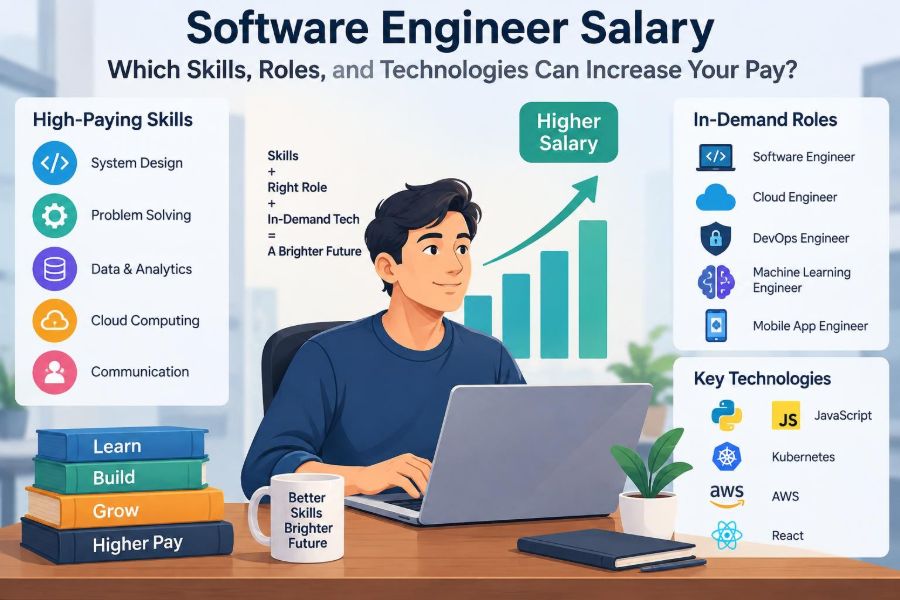
The highest-paying skills are not simply the newest or hardest to learn. They are skills that help an organization solve consequential problems: building reliable systems, protecting sensitive assets, improving product outcomes, reducing operational cost, or helping other engineers work more effectively.
Pair enduring fundamentals with a useful specialization, develop the communication to make your impact clear, and seek roles whose scope matches your growing ability. Compensation often follows when technical capability, business relevance, and trusted ownership reinforce one another.
A stronger software engineering salary is usually the result of becoming reliably valuable at problems that matter, not collecting the most keywords. Build that value deliberately, make the evidence visible, and choose opportunities that reward the kind of work you want to keep doing. 💻📈🧭