
A customer taps “place order” in a food-delivery app. Within seconds, a restaurant receives the request, a payment service checks the card, a courier is assigned, the customer gets a notification, and an operations dashboard updates.
Those actions do not need to happen inside one giant request or one giant application. They are reactions to a sequence of meaningful changes: an order was created, a payment was authorized, a courier became available, and a delivery status changed.
That is the practical appeal of event-driven architecture. It helps software respond to changes as they happen while allowing individual parts of a system to work independently.
For teams building real-time and scalable systems, the challenge is not simply sending messages quickly. It is designing events, data ownership, error handling, and observability so that speed does not create confusion.
⚡ What Event-Driven Architecture Means
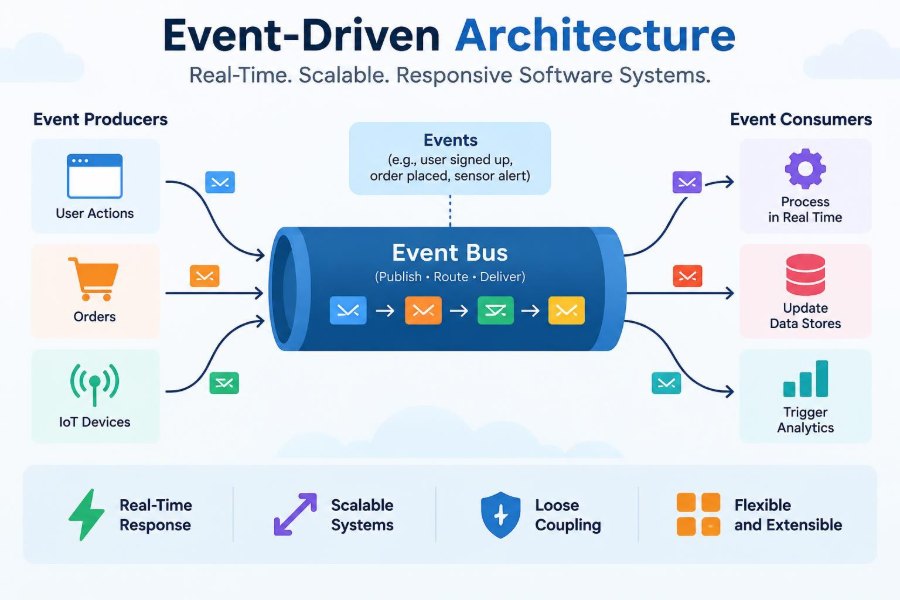
Event-driven architecture (EDA) is a design approach in which software components communicate by producing and reacting to events. An event is an immutable record that something meaningful happened, such as OrderPlaced, PaymentFailed, or TemperatureExceeded.
A producer emits the event. One or more consumers receive it and perform their own work. The producer does not need detailed knowledge of every consumer, which reduces direct coupling between services.
📬 Events Are Facts, Not Commands
A useful distinction is that events describe facts in the past tense. InvoiceGenerated says an invoice exists; GenerateInvoice tells another component what to do.
Commands can be appropriate when one service intentionally requests an action from another. Events are more flexible when several systems may independently care about the outcome.
- Command: “Reserve inventory for this order.”
- Event: “Inventory was reserved for this order.”
Confusing the two often creates hidden dependencies and unclear ownership.
🔗 The Core Building Blocks
An event-driven system usually includes producers, an event broker or stream, consumers, and persistent storage. The broker is infrastructure that accepts events and distributes them to interested consumers.
Common patterns include queues, where one worker generally handles a message, and publish-subscribe topics, where multiple consumer groups may receive the same event. Event streams may also retain records for a period, allowing consumers to replay history.
🧭 Why This Fits Real-Time Software
Real-time software is often concerned with timely reaction rather than instant completion of every task. A fraud signal may need a rapid response, while a weekly analytics report can process the same underlying data later.
EDA separates these response paths. A checkout service can record an order and emit an event quickly, while notifications, loyalty points, analytics, and recommendations proceed asynchronously.
This improves responsiveness only if critical work is correctly identified. Payment authorization or safety checks may still need synchronous confirmation before the user sees a final result.
🏗️ Decoupling Services Without Losing Meaning
In a tightly coupled system, a checkout service might call inventory, billing, email, search, and analytics services directly. Every dependency increases the chance that one slow or unavailable service delays the original request.
With events, checkout can publish OrderPlaced. Inventory updates stock, email prepares a receipt, and analytics records the sale independently. The order service owns the fact that an order was placed; other services own their reactions.
Decoupling does not mean “no relationships.” It means relationships are expressed through stable event contracts rather than a web of direct calls.
📈 Scaling Workload Spikes
Traffic is rarely even. A ticket release, flash sale, product launch, or breaking news alert can create a short, intense burst of activity.
A broker can act as a buffer between incoming events and downstream processing. If notifications are temporarily slower than order creation, events can wait in the stream or queue while additional notification workers are started.
This does not remove capacity limits. It gives teams a controlled way to absorb spikes instead of forcing every downstream component to keep pace at the exact same moment.
🛒 E-Commerce Order Processing
Order workflows are one of the clearest applications of EDA because one customer action creates several independent responsibilities. A hypothetical online retailer may publish OrderPlaced after validating the cart.
- Inventory reserves or releases stock.
- Payments authorize, capture, or reverse funds.
- Fulfillment creates a picking task.
- Customer communication sends status updates.
- Analytics records demand and conversion data.
These reactions should be designed for partial failure. A delayed marketing update should not make a customer’s valid order disappear.
🚚 Delivery and Logistics Tracking
Delivery platforms must coordinate changing locations, assignments, pickup scans, and delivery confirmations. Each scan or location update can become an event that feeds customer tracking, route optimization, support tooling, and operational monitoring.
Location data deserves careful treatment. Publishing every GPS reading may produce unnecessary volume and expose more personal data than needed. Systems often emit meaningful state changes, such as “courier arrived at pickup,” alongside selectively sampled telemetry.
💳 Fraud Detection and Payment Reactions
Payment systems often need both immediate and asynchronous processing. A transaction may require a synchronous authorization decision, yet the resulting event can trigger risk analysis, ledger updates, receipts, reconciliation, and anomaly detection.
Fraud models may evaluate event sequences: a new device, unusual purchase value, repeated failed attempts, or rapid geographic changes. The model’s response must be calibrated to the risk; not every alert should automatically decline a legitimate payment.
Because financial operations are sensitive, teams need durable records, access controls, audit trails, and carefully designed reversal processes.
📡 Internet of Things and Sensor Streams
Connected devices naturally produce events: a machine reports vibration, a thermostat changes state, or a vehicle sends a diagnostic reading. Event streams let many consumers use that data without embedding every use case inside the device-facing service.
For example, a manufacturing platform might route sensor events to a live dashboard, a rule engine, long-term storage, and a maintenance workflow. Not every sensor change needs human attention; thresholding and aggregation help turn noisy measurements into actionable signals.
🎮 Multiplayer Games and Live Collaboration
Games, shared documents, whiteboards, and chat applications all respond to actions from many users. Events can represent player movement, document edits, cursor changes, messages, or room membership changes.
Low latency matters, but consistency matters too. A collaborative editor may show a local change immediately while reconciling concurrent edits through specialized conflict-resolution techniques. EDA transports and distributes changes; it does not automatically solve collaboration conflicts.
🏥 Monitoring Operational Systems
Operations teams use events to understand the state of software and infrastructure. Deployment completed, service health changed, storage capacity crossed a threshold, or an error rate rose above an expected range.
Alerting systems should avoid treating every signal as equally urgent. Repeated low-value alerts train people to ignore notifications. Good event design includes severity, context, affected resource, correlation identifiers, and a clear route for escalation.
📊 Streaming Analytics and Immediate Insight
Traditional analytics commonly moves data in batches: collect records, run a scheduled job, then produce a report. Streaming analytics processes events as they arrive, enabling dashboards and operational decisions that reflect recent activity.
A retailer might detect a sudden rise in checkout failures, while a media service might observe demand for a live program. These signals can guide action quickly, but near-real-time dashboards still require validation: delayed, duplicated, or malformed events can distort results.
🔄 Eventual Consistency Explained
When services react asynchronously, they may not all agree at the same instant. This is called eventual consistency: if processing succeeds and no newer changes occur, related views converge over time.
For example, immediately after a purchase, the order page may show “processing” while the inventory view catches up moments later. That can be acceptable when the user experience clearly communicates the pending state.
It is not acceptable for every domain. Teams must identify decisions that require a strongly consistent answer and keep those checks inside an appropriate transaction or synchronous workflow.
🧾 Event Schemas Are Public Contracts
Once multiple consumers depend on an event, its structure becomes a contract. Seemingly minor changes, such as renaming a field or changing a value’s meaning, can break downstream systems.
A useful event includes an identifier, event type, occurrence time, schema version, relevant business data, and correlation information. Avoid copying an entire internal database record into every message; expose the minimum information consumers need.
🧬 Versioning Without Breaking Consumers
Schema evolution is unavoidable. A new field is usually safer than removing or changing an existing field, provided consumers can ignore unfamiliar data.
When a semantic change is substantial, publish a new version or a clearly distinct event type rather than quietly changing the old meaning. Compatibility rules should be tested in automated pipelines, not remembered only as team folklore.
🔁 Duplicate Delivery and Idempotent Consumers
Many messaging systems prioritize reliable delivery by allowing an event to be delivered more than once. A consumer can also receive a message again after a crash during processing.
Consumers should therefore be idempotent: processing the same event repeatedly produces the same intended final result. For example, a billing handler can store a processed event ID before creating a charge, or use a unique business key that prevents duplicate records.
“Exactly once” is often discussed as a goal, but end-to-end guarantees depend on the broker, databases, external systems, and application logic. Idempotency remains a practical safeguard.
🧩 Ordering Is More Limited Than It Looks
Teams often assume all events arrive in one universal order. In distributed systems, that assumption is usually too strong. Different partitions, consumers, retries, and network delays can change observed order.
Instead, identify where order is truly required. Events for one order, account, or device may share a partition key so they are processed sequentially within that key. Global ordering is expensive and frequently unnecessary.
🛡️ Failure Handling, Retries, and Dead Letters
Temporary failures happen: a database is busy, an external provider is unavailable, or a consumer is being deployed. Retrying can help, but immediate repeated retries can amplify an outage.
Use bounded retries with delays or backoff. Events that repeatedly fail can move to a dead-letter queue, an isolated location for investigation and safe replay.
A dead-letter queue is not a solution by itself. Someone needs ownership of diagnosing failures, correcting data or code, and deciding whether replay is safe.
🧯 The Outbox Pattern for Reliable Publishing
A common failure occurs when an application writes to its database successfully but crashes before publishing the related event. The reverse can also happen: an event is published for data that was never committed.
The outbox pattern addresses this by writing the business change and an outgoing event record in the same database transaction. A separate process reads the outbox and publishes events reliably, marking them as sent afterward.
This pattern adds operational complexity, but it prevents a dangerous gap between a system’s local state and the events other services depend on.
🧵 Long-Running Workflows and Sagas
A business process spanning services cannot usually use one shared database transaction. A travel booking, for example, may involve flights, hotels, payments, and notifications.
A saga coordinates a sequence of local transactions through events or a central orchestrator. If a later step fails, earlier actions may need compensating actions, such as releasing a reservation.
Compensation is not the same as undo. A shipped parcel cannot be “unshipped,” so workflows must model realistic recovery states and human intervention where necessary.
🔍 Observability Across Asynchronous Boundaries
Debugging becomes harder when a user action travels through many independent consumers. Logs from one service are not enough to explain why a notification was delayed or an account view became incorrect.
Attach correlation IDs and causation IDs to events. A correlation ID ties activity to one business flow, while a causation ID can identify the event or command that directly triggered another event.
Combine structured logs, metrics, traces, consumer lag measurements, and dashboards. Observability should answer practical questions: What is waiting? What failed? Which version processed it? Who owns the consumer?
🔐 Security and Data Minimization
Events can spread quickly to many teams and systems, making careless data sharing especially risky. Treat event streams as governed interfaces rather than an unrestricted internal dumping ground.
- Include only data needed for the event’s purpose.
- Protect topics with authentication and authorization.
- Encrypt data in transit and at rest where appropriate.
- Define retention and deletion practices for stored streams.
- Audit access to sensitive event categories.
For personal or regulated data, requirements vary by jurisdiction and organization. Engineering teams should involve security, privacy, and compliance specialists early.
⚖️ Choosing Between Events, Requests, and Batches
Event-driven architecture is not a replacement for every communication style. A user checking whether a username is available usually needs a direct request and immediate answer. A nightly regulatory export may be simpler as a batch job.
| Need | Usually suitable approach | Reason |
|---|---|---|
| Immediate answer to one caller | Synchronous request | The caller needs a result before proceeding. |
| Independent reactions to a state change | Event publication | Multiple consumers can act without direct coupling. |
| Large scheduled data processing | Batch processing | Latency is less important than efficient throughput. |
Mature systems often combine all three approaches rather than treating architecture as an ideological choice.
🧱 When a Simple Monolith Is Better
For a small product with one team, limited traffic, and a straightforward workflow, a well-structured monolith may be easier to build, test, and operate. Introducing brokers, schemas, retries, and distributed tracing too early can slow delivery.
Events become compelling when independent capabilities need to evolve separately, workload spikes must be absorbed, several consumers need the same business fact, or external integrations make direct coupling fragile.
🚧 Common Design Mistakes
Several mistakes create systems that are technically event-driven but operationally difficult:
- Publishing vague events such as
DataUpdatedwith no business meaning. - Using events as hidden remote procedure calls.
- Ignoring duplicate delivery and replay behavior.
- Letting consumers query a producer’s private database.
- Publishing sensitive data broadly “just in case.”
- Creating event chains with no ownership, tracing, or recovery plan.
The recurring problem is treating asynchronous messaging as a transport detail instead of a product and operational contract.
🧪 Testing Event-Driven Systems
Unit tests can verify that a producer creates the right event and a consumer handles valid and invalid inputs. Contract tests verify that producers and consumers agree on schemas and compatibility rules.
Integration tests should exercise real broker behavior where possible, including retries, duplicate messages, ordering assumptions, and unavailable dependencies. A happy-path test alone will not reveal whether recovery is safe.
Replay tests are valuable too. They show whether a new consumer can process retained historical events and whether old event versions remain understandable.
🗺️ A Practical Adoption Path
Start with one business event that has clear ownership and more than one useful consumer. For instance, publishing OrderPlaced for analytics and notifications is often less risky than immediately distributing every database change.
- Define the business fact and its owner.
- Specify a minimal, versioned event contract.
- Build idempotent consumers and failure handling.
- Add tracing, dashboards, and ownership documentation.
- Measure operational behavior before expanding the pattern.
Incremental adoption gives teams time to learn the failure modes without turning every service into a distributed workflow at once.
🎯 Designing for Meaningful Reactions
The strongest event-driven systems are organized around meaningful domain changes, not merely technical updates. SubscriptionRenewed tells consumers something useful about the business; subscriptions_table_row_changed exposes an implementation detail.
The core principle is simple: publish durable facts, let responsible services react independently, and design explicitly for delay, duplication, failure, and change. When those conditions are visible in the design, EDA can support responsive experiences without making every component depend on every other component.
Event-driven architecture is most valuable not because it makes software magically faster, but because it gives growing systems a disciplined way to react, scale, and recover as real-world activity changes. ⚙️📬📈