
A product team launches a popular service with a straightforward application, one deployment pipeline, and one database. For a while, changes are easy: a developer can trace a user request through one codebase, run the system locally, and release a complete update.
Then growth arrives unevenly. Search traffic spikes, image processing consumes more CPU, the checkout path needs stricter reliability, and several teams begin changing adjacent parts of the application at once. The question is no longer simply “Can this system handle more users?” It becomes “Where is the work actually happening, and what makes change safe?”
Microservices are often presented as the answer to scale. Monoliths are often presented as the starting point teams eventually outgrow. Neither shortcut is reliable. Both architectures can run large systems; both can become inefficient in very different ways.
Efficiency at scale includes infrastructure cost, latency, developer time, operational effort, reliability, and the speed at which a business can safely change software. Looking at all of those dimensions produces a more useful comparison than asking which architecture is universally better.
🧭 Efficiency Means More Than Server Capacity
When people say an application is efficient, they may mean it uses few machines. They may instead mean it responds quickly, costs less to operate, or lets teams deliver changes with less delay. These are related, but they are not interchangeable.
A microservice design can reduce waste by scaling only a busy component. Yet it can also add network calls, duplicated infrastructure, and coordination work. A monolith can use resources efficiently because calls remain in memory, while still becoming slow for teams to change.
The right comparison starts by naming the constraint. Is the limiting factor CPU, database throughput, release safety, team ownership, or the ability to isolate failures?
🏗️ What a Monolithic Application Is
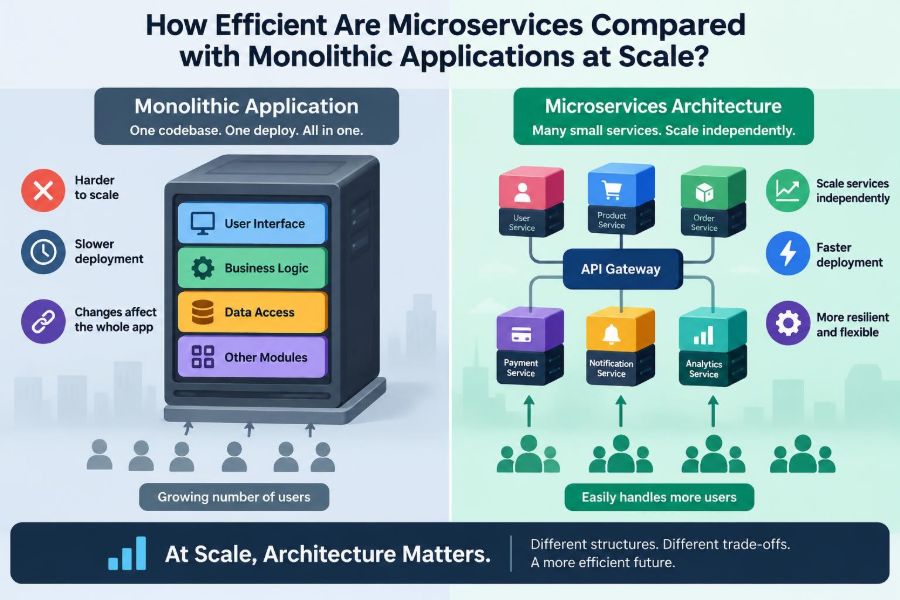
A monolith is an application deployed as one unit. Its modules may be well organized internally—accounts, payments, catalog, notifications—but they run in one process or tightly coupled set of processes and commonly share a database.
That does not mean “badly designed” or “small.” A modular monolith can enforce clean boundaries in code, expose stable internal interfaces, and support multiple teams. The defining feature is the deployment and runtime boundary: the application moves together.
🧩 What Microservices Change
Microservices split an application into independently deployable services, usually aligned with business capabilities such as orders, inventory, or identity. Each service owns its behavior and ideally controls access to the data it is responsible for.
Communication moves across process boundaries, commonly through HTTP, remote procedure calls, queues, or event streams. This independence enables targeted changes, but every remote boundary introduces latency, partial failure, versioning, authentication, and observability concerns.
📏 Scale Has Several Different Shapes
“At scale” is not a single threshold. A system may have high request volume, large data volume, many engineers, demanding availability requirements, or highly variable traffic. An architecture that helps with one kind of scale may not help with another.
- Traffic scale: more requests, concurrent users, and background jobs.
- Data scale: more records, larger files, and harder queries.
- Organizational scale: more teams making changes simultaneously.
- Operational scale: more deployments, regions, integrations, and failure modes.
A monolith may be excellent for traffic scale if it can be replicated and its database is designed well. Microservices are most compelling when technical scaling and organizational boundaries genuinely line up.
⚖️ A Quick Comparison of Trade-offs
| Dimension | Monolith | Microservices |
|---|---|---|
| In-process calls | Fast and simple | Usually become network calls |
| Deployment | One coordinated release unit | Potentially independent releases |
| Scaling | Scale the whole application | Scale selected services |
| Data consistency | Often simpler transactions | Cross-service consistency is harder |
| Operations | Fewer runtime components | More infrastructure and tooling |
| Team autonomy | Depends on code boundaries | Can be stronger with clear ownership |
This table is a map, not a verdict. A poorly modularized monolith can be painful, while a poorly bounded microservice estate can turn every small feature into a distributed coordination project.
🚀 Why Monoliths Often Start Efficiently
A monolith has a low operational surface area. One build, one deployable artifact, one place to inspect logs, and often one local development environment reduce the number of things a team must understand.
Calls between modules are ordinary function calls rather than network requests. They avoid serialization, connection management, retries, timeouts, and many forms of partial failure. For an early product, that simplicity often translates directly into faster learning.
Starting with a monolith is not a lack of ambition. It can be a deliberate choice to postpone distributed-systems costs until there is evidence that independence is worth paying for.
🔌 The Network Tax of Microservices
Within one process, a function call either returns or raises an error immediately. Across a network, a request can be slow, lost, duplicated, rejected, or completed after the caller has stopped waiting. The caller cannot always know what happened.
Each service-to-service call adds serialization, routing, encryption, and scheduling overhead. One remote call may be acceptable; a request path that synchronously visits many services can accumulate noticeable latency and become fragile.
Teams address this with timeouts, bounded retries, circuit breakers, caching, and asynchronous messaging. These are valuable patterns, but they are work that a local method call did not require.
📈 Selective Scaling Is a Real Microservice Advantage
Imagine a hypothetical online learning platform where video transcoding is CPU-intensive but enrollment is mostly database reads. In a monolith, the team may replicate the full application to obtain more transcoding capacity, including modules that do not need it.
With a separate transcoding service, capacity can be added only where demand exists. Services can also use different runtime settings or hardware profiles when justified. This can reduce resource waste when workloads are clearly uneven.
However, selective scaling helps only after measurement. If the database, a shared cache, or an external provider is the real bottleneck, splitting the application will not remove it.
🧮 Resource Efficiency Is Not Just Container Counts
Small services can appear economical because each has a narrow purpose. In practice, every production service may need replicas, health checks, logging, metrics, secrets, deployment capacity, and sometimes a separate data store. Idle overhead can add up.
A monolith shares memory pools, database connections, and runtime infrastructure across modules. It may therefore be more compute-efficient for moderate workloads. Microservices may win when they prevent expensive over-scaling of a dominant workload.
Compare actual utilization and end-to-end cost rather than counting services or virtual machines. Architectural efficiency is an outcome of workload patterns, not a property of the diagram.
⏱️ Latency Grows Along Request Paths
Users experience the total time of a request, not the speed of an individual service. If a page waits for profile, recommendations, pricing, and inventory services, the slowest dependency can dominate the result.
Parallel requests can reduce waiting when dependencies are independent, but they increase fan-out: one user action may trigger many downstream operations. That raises load and complicates tracing during incidents.
A useful design habit is to draw the critical request path. Keep user-facing synchronous chains short, set explicit deadlines, and move nonessential work—such as analytics updates or confirmation emails—to asynchronous processing.
💾 Database Boundaries Define Much of the Difficulty
A shared database makes it tempting for services to read and modify each other’s tables. That shortcut weakens autonomy because a schema change or heavy query in one area can unexpectedly affect another.
Giving each service ownership of its data improves independence, but it changes how teams answer cross-domain questions. A report that once used one SQL join may need a read model, a data pipeline, or an API composition layer.
Data ownership is therefore not an implementation detail. It is the boundary that determines who can change data safely and how much coordination a feature will require.
🔄 Consistency Becomes a Design Choice
In a monolith with one relational database, a transaction can often update related records atomically: either all changes commit or none do. That model is powerful for operations where intermediate states would be unacceptable.
Across independent services, distributed transactions are possible in limited contexts but often introduce coupling and operational complexity. Many systems instead use eventual consistency: one service records its change, publishes an event, and another service updates later.
This can be appropriate, but it requires product decisions. What should a customer see while an update is still propagating? How are duplicate events handled? How can a failed consumer safely retry? These are business behavior questions as much as technical ones.
🧯 Failure Isolation Is Conditional, Not Automatic
A separate service can contain a failure. If recommendations are unavailable, an application may still show a usable page without personalized suggestions. This is a meaningful resilience benefit.
But separation alone does not create isolation. If checkout synchronously requires inventory, tax, payment, fraud, and notification services, any unavailable dependency can still stop checkout. Shared databases, queues, DNS, and deployment platforms can also create common failure points.
Graceful degradation must be designed intentionally: define fallbacks, protect dependencies from overload, and decide which capabilities are essential for each user journey.
🔍 Observability Changes From Helpful to Essential
Debugging a monolith often begins with one log stream and one stack trace. In a distributed system, a request may cross several services and asynchronous workers before an error is visible.
Useful observability combines structured logs, metrics, traces, and meaningful alerts. A correlation identifier lets engineers follow one request across boundaries; tracing shows where time was spent; metrics reveal whether a problem is isolated or systemic.
Without this foundation, microservices can make failures harder to understand rather than easier to isolate. Build diagnostic capability before service count grows, not during the first major incident.
🛠️ Deployment Independence Can Improve Flow
A focused service can be deployed without rebuilding unrelated functionality. That may reduce the blast radius of a release and allow a team to ship a small fix quickly.
Independence is valuable only when contracts are stable and teams can verify compatibility. If a change requires synchronized releases across five services, the system has retained coordination costs while adding distributed complexity.
Automated tests, backward-compatible APIs, staged rollout practices, and rapid rollback capability make independent deployment credible. Otherwise, “independent” is merely an aspiration.
👥 Team Topology Often Matters More Than Code Size
As organizations grow, a single codebase can create contention: teams wait for reviews, releases collide, and ownership becomes unclear. Well-chosen service boundaries can give a team a clearer area to operate and improve.
Yet services should not be split according to temporary reporting lines. Teams change. More durable boundaries tend to follow business capabilities and data ownership, such as fulfillment or billing, rather than technical layers such as “all database code.”
A modular monolith can also support ownership through directories, interfaces, and review rules. Extract a service when the organizational and operational benefit exceeds the new integration cost.
🧠 Cognitive Load Is an Operating Cost
Every service has an API, deployment process, failure behavior, dashboard, permissions, and on-call story. A developer working on one feature may need to understand several of them, plus local development tools that reproduce the interactions.
Platform engineering can reduce this burden with standard templates, shared observability, service catalogs, and paved deployment paths. These investments are often what make microservices manageable at scale.
Without them, developers spend growing portions of their time on configuration and coordination rather than product behavior. That is inefficiency even when servers are lightly utilized.
🧪 Testing Moves From Internal Tests to Contract Tests
Unit tests remain fast and valuable in either architecture. The difference appears at boundaries: a service can pass its own tests while sending a response another service cannot interpret.
Contract testing checks agreed request and response behavior between consumers and providers. Integration tests validate important real connections, while end-to-end tests cover a few critical journeys. No single test layer is sufficient.
A practical approach is to keep a small number of high-value end-to-end tests, because they are slower and more brittle, while using contracts to catch compatibility breaks earlier.
🔐 Security Boundaries Multiply Too
Microservices can enforce least-privilege access: a reporting service need not receive payment credentials, for example. Separate boundaries can limit the impact of one compromised component.
They also create more identities, secrets, endpoints, certificates, and authorization decisions to manage. An internal network is not automatically trustworthy, particularly in complex cloud environments.
Service-to-service authentication, authorization, secret rotation, and auditability need consistent automation. A monolith has a smaller perimeter, though its internal modules still need careful access controls around sensitive actions.
💸 Cost Models Include People and Tools
Compute bills are visible, but engineering time is often the larger long-term cost. A service estate may require orchestration, message brokers, gateways, monitoring systems, registry tools, and staff who can operate them confidently.
A monolith may cost more during a traffic surge because it scales broadly, yet cost less overall if a small team can maintain it with simple tooling. Conversely, a large organization may justify platform costs because they unblock many teams.
Estimate both recurring infrastructure expense and the operational labor required to keep the system reliable. Do not evaluate microservices solely through a cloud-cost lens.
📦 Service Granularity Can Make or Break the Design
A service should be large enough to own a coherent capability and small enough that its team can change it without excessive coordination. Extremely tiny services often create chatty networks and a maze of dependencies.
For example, separating “create order,” “calculate order total,” and “validate order address” into independent network services may be less useful than one order service with well-structured internal modules. They often change together and need the same data.
Prefer cohesion: keep behavior and data that evolve together close together. A service boundary should simplify a meaningful ownership problem, not merely reduce line count.
🧱 A Modular Monolith Is a Serious Middle Path
A modular monolith preserves a single deployment while enforcing internal boundaries. Modules expose explicit interfaces, avoid reaching into each other’s internals, and can own database access through defined rules.
This approach offers cheap local calls and straightforward transactions while teaching the discipline needed for future extraction. If a module later has distinct scaling, reliability, or ownership needs, its interface provides a starting seam.
It is not a temporary fake architecture. For many products, it is the long-term design that best balances simplicity and maintainability.
🪓 Extract Services From Evidence, Not Fashion
A sensible extraction begins with a concrete pressure: one component consumes disproportionate resources, needs a distinct reliability target, changes on a different cadence, or blocks a team due to ownership conflicts.
Start with a boundary that has limited dependencies and a clear data story. Build its interface, migrate one workflow, monitor behavior, and learn before extracting another area. Large “big bang” rewrites make it difficult to separate architectural problems from migration problems.
There is no universal extraction sequence. Background processing, file handling, or an external integration may be suitable early candidates because they can often be isolated without fragmenting core transactional flows.
🧰 Design Practices That Preserve Efficiency
Whether an application is one deployable or many, several practices reduce waste and surprise:
- Measure request paths, saturation, errors, and queue depth before changing architecture.
- Use explicit timeouts and bounded retries for every remote dependency.
- Make message consumers idempotent, meaning a repeated message does not create an unintended second effect.
- Version APIs carefully and remove old behavior only after consumers migrate.
- Document ownership, dependencies, and recovery procedures.
These practices do not eliminate complexity. They make it visible and manageable, which is the foundation of reliable scaling.
🚧 Common Migration Mistakes
One common mistake is extracting services while retaining a shared database and unrestricted cross-service queries. This creates hidden coupling without the convenience of one codebase.
Another is replacing simple internal calls with synchronous calls across many services, then discovering that an ordinary page load depends on a long dependency chain. A third is assuming asynchronous events solve every problem; events need schemas, ordering expectations, replay strategies, and monitoring.
A safer rule is to preserve a working product path at each step. Migration should improve one constraint while keeping behavior observable and reversible.
📊 How to Evaluate Your Own System
Architecture choices should be tested against evidence from the current system and expected near-term changes. Gather data before scheduling an extraction or a rewrite.
- Identify the slowest or least reliable user journeys.
- Find the actual bottleneck: code, database, dependency, team workflow, or deployment process.
- Map which modules and data change together.
- Estimate the new operational responsibilities a service would create.
- Run a small, measurable experiment before committing broadly.
If the issue is an unindexed query or an unclear release process, microservices are unlikely to be the cheapest fix. If one domain repeatedly causes contention and needs separate scaling, the case becomes stronger.
🎯 Choosing for the Next Constraint
Architecture is not a permanent identity. A monolith can be carefully modularized, replicated, and improved for years. A microservice system can merge services when boundaries prove artificial or operational costs become excessive.
The best choice is usually the one that addresses the next significant constraint with the least irreversible complexity. That may mean keeping a single application, extracting one focused service, or investing first in databases, delivery automation, and observability.
Microservices are efficient at scale when their independence matches real differences in workload, ownership, and reliability needs; otherwise, their distributed overhead can outweigh their flexibility.
Choose the architecture that makes the system easier to understand, operate, and change for the problems you actually have—not the problems an impressive diagram suggests you might someday have. ⚙️📈