
A customer reports that a checkout page fails only on mobile devices. A developer reproduces it, opens a ticket, finds a small CSS regression, writes a test, submits a pull request, and waits for review. Within hours, the fix can be tested and deployed.
That ordinary sequence would have looked very different a few decades ago. A change might have waited for the next planned release, passed through several handoffs, and reached users months later. The code was only part of the work; the workflow around it determined the pace.
Software development has changed because software itself has become more connected, continuously delivered, and central to daily business operations. Teams now need to learn quickly without treating production systems or customer data as experiments.
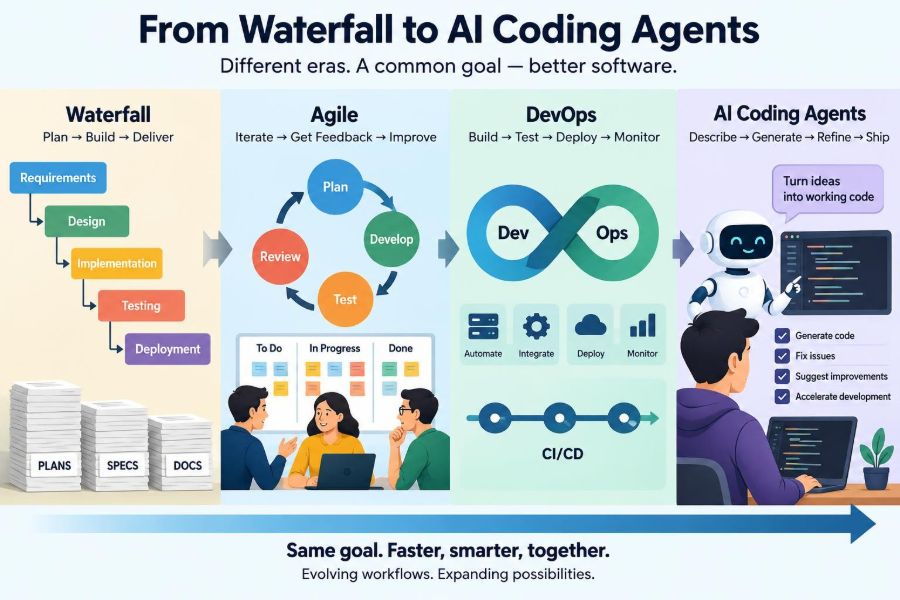
AI coding agents are the newest visible shift in this long evolution. They can draft code, inspect repositories, run tools, and propose changes, but they do not remove the need for engineering judgment. Understanding the path from Waterfall to agents helps explain what should change—and what should remain carefully human.
🏗️ Software Workflow Is More Than Writing Code
A development workflow is the repeatable path from an idea to software that users can rely on. It includes discovery, design, implementation, testing, review, deployment, monitoring, and maintenance.
Teams often describe their process by one label—Waterfall, Agile, DevOps, or AI-assisted development. In practice, useful workflows combine methods. A team may use iterative delivery while requiring formal approval for security-sensitive releases.
🌊 The Waterfall Model Made Work Visible
Waterfall organizes work into largely sequential phases: requirements, design, implementation, testing, deployment, and maintenance. Each phase produces artifacts that guide the next one, such as specification documents, architecture diagrams, and test plans.
This structure made complex work easier to plan and govern, especially where changes were costly or formal documentation mattered. Its key assumption was that major requirements could be understood well enough before extensive building began.
📋 Why Sequential Planning Was Sensible
Early software projects often ran on expensive shared machines, had infrequent release windows, and served narrowly defined operational needs. Reworking code late could be difficult because builds, tests, and deployments required substantial coordination.
For systems with stable rules—such as a bounded internal reporting replacement—a detailed up-front plan can still be helpful. The weakness is not planning itself; it is treating uncertain assumptions as permanent facts.
🧱 The Cost of Late Feedback
In a strict sequential process, users may not see a working version until implementation is far advanced. By then, a misunderstood workflow or missing edge case can require changes to requirements, design, code, and tests.
Consider a hypothetical appointment-booking system. A document may say “allow cancellation,” while reception staff actually need cancellation reasons, waitlist promotion, notifications, and audit records. A demo exposes those details much earlier than prose alone.
🔄 Iterative Development Changed the Rhythm
Iterative development breaks a large goal into smaller increments and revisits decisions as the team learns. Rather than betting everything on one final delivery, teams build a usable slice, collect feedback, and adjust the next slice.
This does not mean skipping design. It means making design decisions at an appropriate time, when the team has enough evidence to make them responsibly.
🏃 Agile Brought Short Feedback Cycles
Agile is a family of values and practices emphasizing collaboration, working software, adaptation, and frequent feedback. Frameworks such as Scrum and Kanban offer different ways to organize that work, but neither is a substitute for technical discipline.
A short cycle can reveal whether a feature solves the intended problem. It cannot automatically ensure that a service is secure, accessible, maintainable, or aligned with long-term architecture.
🎯 User Stories Made Needs Concrete
Teams commonly express desired behavior as a user story: who needs something, what they need, and why. Acceptance criteria then define observable conditions for success.
For example, “As a support agent, I can search orders by email so I can respond quickly” becomes more useful when it specifies permissions, partial matches, empty results, response expectations, and how personal data is protected.
🧩 Backlogs Turned Planning Into a Living Activity
A backlog is a prioritized list of potential work, not a promise that every item will be built. It can contain features, defects, technical debt, research tasks, operational improvements, and compliance work.
Good prioritization weighs value, urgency, risk, dependencies, and effort. A polished feature may wait if the team first needs to address a fragile database migration path or a serious reliability issue.
🗣️ Daily Coordination Replaced Long Status Chains
Frequent, lightweight communication helps teams surface blockers while they are still small. A developer waiting on a product decision or a test environment should not need to wait for a weekly status meeting.
However, meetings are not evidence of collaboration. Clear tickets, written decisions, shared dashboards, and well-maintained code can reduce interruption while preserving visibility, especially for distributed teams.
🧪 Testing Moved Closer to Development
Older workflows often treated testing as a late phase performed by a separate group. Modern teams increasingly test throughout delivery: developers write unit tests, services are checked through integration tests, and realistic workflows are validated end to end.
Different tests catch different failures. A unit test can confirm a tax calculation, while an end-to-end test may reveal that the checkout form fails to send an address field to the payment service.
✅ Test Automation Changed What “Done” Means
Automated tests provide fast, repeatable checks whenever code changes. They are most valuable when they protect important behavior, run reliably, and give failures that people can diagnose.
A green test suite is not proof that a release is safe. Tests may miss new behavior, environment differences, performance limits, accessibility concerns, or misunderstandings of the actual user need.
🔀 Version Control Enabled Parallel Work
Version control systems record changes, preserve history, and let several people work on the same codebase. Branches and merges made parallel development more manageable, although they also created a need to resolve conflicts and keep changes integrated.
Small, frequent integrations are usually easier to understand than large changes that diverge for weeks. The goal is not a particular branching fashion; it is keeping the shared codebase trustworthy.
👀 Code Review Became a Shared Quality Gate
A pull request gives peers a focused place to inspect a proposed change before it merges. Review can catch defects, unclear naming, missing tests, insecure assumptions, and unintended architectural drift.
Its deeper value is knowledge sharing. If only one person understands a critical subsystem, the organization carries a delivery risk even when that person writes excellent code.
🤝 Product, Design, and Engineering Started Working Earlier
Handoffs are necessary, but isolated handoffs lose context. When product managers, designers, engineers, and domain specialists collaborate during discovery, they can identify constraints before they become rework.
An engineer might point out that a requested real-time dashboard needs a new data pipeline. A designer might uncover that a “simple” permission screen has confusing states. Early conversation makes trade-offs explicit.
🚢 Continuous Integration Reduced Integration Surprises
Continuous integration, often called CI, means regularly merging changes into a shared repository and automatically building and testing them. The central idea is to discover incompatible changes soon after they are made.
A typical pipeline may format code, run static analysis, execute tests, package an artifact, and report results. Fast, dependable feedback encourages small changes; slow or flaky pipelines encourage risky batching.
📦 Continuous Delivery Made Releases Routine
Continuous delivery keeps software in a deployable state, so releasing is a deliberate business decision rather than a special technical event. Continuous deployment goes further by automatically releasing qualifying changes to production.
Neither approach requires reckless speed. Teams can use approvals, staged environments, feature flags, and release checks when the consequences of an error demand additional control.
🚩 Feature Flags Separated Deployment From Exposure
A feature flag is a configuration control that enables behavior for selected users or environments. It allows code to be deployed before it is broadly visible, which can reduce the size of a release and support gradual rollout.
Flags add complexity, though. Old flags can create confusing paths through the code, and poorly designed flags can expose unfinished behavior. Every flag needs an owner, a purpose, and a removal plan.
🔭 Observability Extended Work Into Production
Monitoring tells a team that a system has a problem; observability helps them investigate why through signals such as logs, metrics, traces, and meaningful application events. Production feedback is part of the development loop.
For example, a rise in payment failures is more actionable when a trace shows latency in a dependency and logs identify a particular error category. Collecting data also requires restraint: logs must not casually expose secrets or personal information.
🛠️ DevOps Connected Building With Running Software
DevOps is not merely a job title or a collection of deployment tools. It is an approach that reduces the divide between people who create software and people accountable for operating it.
When teams share operational responsibility, they tend to design for recoverability, clear alerts, capacity limits, and simpler deployment. Operations specialists remain essential; the change is that reliability becomes a shared engineering concern.
🏛️ Platform Engineering Reduced Repeated Setup Work
As organizations grew, individual teams repeatedly solved infrastructure tasks: creating environments, managing secrets, configuring pipelines, and meeting baseline security requirements. Platform engineering builds internal capabilities that make safe defaults easier to use.
A good internal platform offers a paved road, not a rigid prison. Teams should be able to use supported templates and self-service tools for common needs while having a clear path to handle legitimate exceptions.
🔐 Security Shifted Left—and Stayed Throughout
“Shift left” means considering security earlier in design and development rather than only before release. Threat modeling, dependency review, secure coding practices, and automated scanning can expose risks while fixes are less disruptive.
Security also continues after release through patching, access review, incident response, and monitoring. Automated scanners help find known patterns, but they cannot determine whether a business workflow leaks sensitive information or grants the wrong authority.
🧱 Architecture Evolved for Independent Change
Monoliths, where much of an application lives in one deployable unit, can be practical and straightforward. Microservices split responsibilities into separately deployable services, potentially allowing teams to change areas independently.
Microservices also introduce network failures, distributed data challenges, deployment coordination, and harder debugging. The workflow lesson is simple: choose architecture based on real boundaries and operational capability, not fashion.
📈 Metrics Made Flow Problems Easier to See
Teams increasingly examine workflow signals such as lead time, deployment frequency, change failure patterns, review wait time, and incident recovery. These are prompts for learning, not scorecards for pressuring individuals.
If pull requests regularly wait days for review, adding more coding tasks may increase queue length rather than delivery. Improving ownership, reducing change size, or protecting review time may address the actual constraint.
🧹 Technical Debt Became a Product Decision
Technical debt is the future cost created by expedient design or implementation choices. Some debt is intentional: a team may build a limited prototype to test a market assumption. Trouble begins when temporary shortcuts become invisible and permanent.
Modern workflows work best when debt is recorded, discussed, and repaid according to risk. A brittle authentication module deserves attention sooner than a cosmetic code cleanup, even if both are inconvenient.
🌐 Remote Work Made Written Engineering Stronger
Distributed teams cannot rely on overheard conversations or a quick desk visit. Decision records, architecture notes, clear pull requests, incident summaries, and concise asynchronous updates preserve context across time zones.
Writing does not eliminate conversation. It gives conversations a durable outcome, helping new team members understand why a decision was made and what assumptions may need revisiting.
🧠 Generative AI Entered the Developer Toolchain
Generative AI tools can explain code, draft tests, suggest refactoring steps, produce documentation, and help translate an intention into a starting implementation. They are particularly useful when a developer can clearly describe the local problem and evaluate the result.
These tools generate plausible output, not guaranteed truth. They may invent APIs, misunderstand repository conventions, reproduce insecure patterns, or produce code that appears correct but fails under realistic conditions.
🤖 Coding Agents Go Beyond Autocomplete
A coding agent is typically designed to pursue a bounded task using tools: it may read files, search a repository, edit code, run tests, inspect errors, and revise its approach. This differs from simple autocomplete, which primarily predicts the next piece of text.
An agent might be asked to add validation to an API endpoint. It can locate related handlers, update tests, run the suite, and present a patch. Its ability to act makes task boundaries, permissions, and review especially important.
🧭 Agents Need Clear Scope and Reliable Context
Agent performance depends heavily on the context it receives. A vague request such as “clean up billing” can trigger broad, risky edits. A bounded request identifies the affected component, expected behavior, constraints, and verification steps.
- State what must change and what must not change.
- Point to relevant specifications, tests, and repository conventions.
- Define success with observable checks.
- Limit access to only the tools and environments required.
Good task definition is valuable whether the implementer is a person or an agent.
🧑⚖️ Human Review Remains an Engineering Responsibility
Reviewing agent-generated code means more than checking whether it compiles. A reviewer should examine the design choice, failure behavior, data handling, authorization assumptions, test quality, and whether the change fits the system’s operating model.
Developers should be cautious about approving unfamiliar code simply because it looks polished. The practical standard is ownership: if the change causes an incident, someone must be able to explain, maintain, and safely modify it.
🛡️ Data, Secrets, and Permissions Require Boundaries
AI-enabled tools may send prompts, code, or tool outputs to external services depending on configuration. Organizations need to understand data handling rules before placing proprietary code, credentials, customer records, or production logs into those tools.
Agents should use least privilege: the minimum access needed for the assigned task. A tool that can read a repository does not automatically need permission to deploy, alter cloud resources, or access production databases.
⚠️ Automation Can Amplify Mistakes
Automation reduces repetitive work, but it can also repeat a bad decision at speed. A flawed migration generated across many services, or an agent granted broad write access, can create a wider blast radius than a single manual error.
Useful safeguards include isolated environments, protected branches, required checks, small pull requests, rollout controls, audit logs, and reversible changes. The right guardrail depends on the consequence of failure.
🔬 Evaluation Must Test Real Work, Not Demos
A compelling agent demonstration may solve a tidy example while failing on a large, inconsistent codebase. Teams should evaluate tools using representative tasks, realistic permissions, actual test suites, and the review effort required to reach a safe result.
Ask practical questions: Does it reduce time to a correct change? Does it create understandable patches? Does it improve test coverage or merely add superficial tests? What new security and support work does it introduce?
🧑💻 The Developer Role Is Moving Up the Stack
As tools handle more boilerplate, developers can spend more time framing problems, modeling domains, designing interfaces, assessing trade-offs, and improving system reliability. This is not a reduction in rigor; it is a shift in where rigor is applied.
Foundational skills remain essential. A person who cannot read a stack trace, understand data flow, reason about concurrency, or evaluate a test cannot reliably supervise an automated collaborator.
🗺️ A Practical Workflow for AI-Assisted Changes
A safe workflow treats an agent as a contributor within existing engineering controls, not as a shortcut around them. Start with a task small enough that a reviewer can understand the intended behavior and the complete diff.
- Clarify the user outcome, constraints, and acceptance criteria.
- Inspect the relevant code and tests before asking for changes.
- Give the agent bounded instructions and limited access.
- Review the diff, including every generated test and configuration change.
- Run automated checks and perform targeted manual verification.
- Deploy gradually when impact or uncertainty is high.
- Monitor results, remove temporary flags, and document useful lessons.
⚖️ The Core Principle: Faster Feedback, Accountable Decisions
From Waterfall through Agile, DevOps, and AI coding agents, the lasting direction is not simply “move faster.” It is to shorten the time between an assumption and trustworthy feedback while keeping responsibility visible.
Sequential planning still has a place when requirements are stable or risks demand formal control. Iteration is valuable when learning is unavoidable. Automation is valuable when it makes reliable practices easier to repeat. AI is valuable when it strengthens human capability without obscuring judgment.
The healthiest workflow is one that matches controls to consequences. A typo fix and a payments migration should not travel through identical gates, but both deserve a process that makes behavior, ownership, and recovery clear.
Software workflows have changed most successfully when they help teams learn sooner, deliver safely, and remain accountable for the systems they build. The next tool should serve that principle—not replace it. ⚙️🧠🚀