
A small product team launches a useful app. At first, traffic arrives in short bursts: a few users in the morning, a promotional spike at lunch, and a quiet evening. The team wants to ship features, not tune servers that spend most of the day waiting.
Then the app grows. Background jobs take longer, the database becomes busy, a new region matters, and a sudden campaign brings far more requests than expected. The architectural choice that felt simple at launch starts to shape cost, reliability, and the team’s daily workload.
Serverless computing is often presented as the answer: deploy code, let a cloud provider run it, and pay only when it executes. Traditional cloud servers can sound old-fashioned by comparison. But growing applications rarely fit a slogan.
The more useful question is not whether serverless is universally better. It is whether its operating model fits a particular workload, team, budget, and stage of growth.
🧭 Start With the Actual Decision
“Serverless versus servers” is a shorthand for several separate design choices. A team may compare function-as-a-service platforms, managed containers, virtual machines, Kubernetes, managed databases, queues, and content delivery networks.
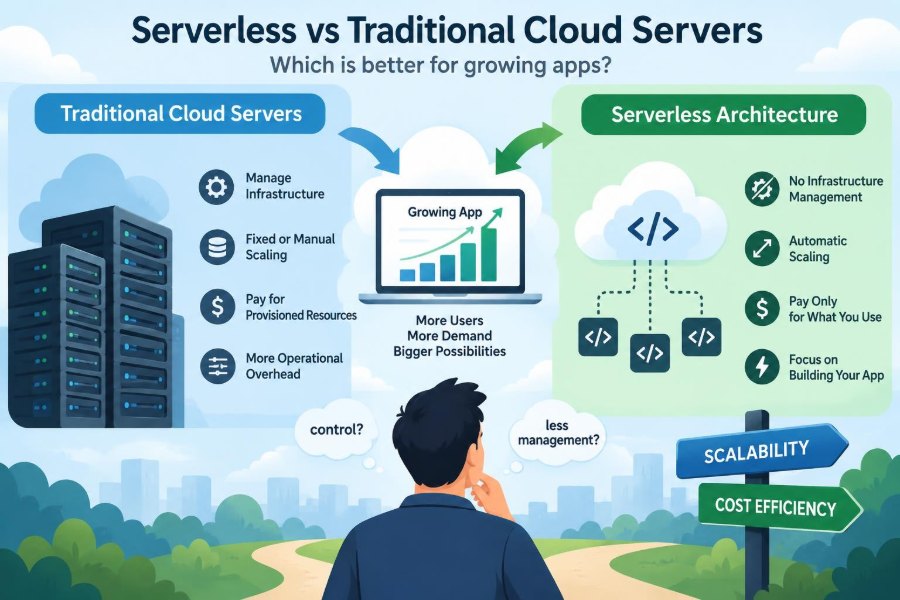
Serverless usually means that the provider manages the underlying machines and automatically allocates execution capacity. Developers deploy a function or service and configure events, permissions, limits, and observability. Traditional cloud servers usually mean virtual machines or long-running containers that the team sizes and operates more directly.
Neither approach removes operations. It changes which operational problems the team owns.
🏗️ What Traditional Cloud Servers Mean
A traditional cloud server is a virtual machine or a continuously running container service. It has allocated CPU, memory, storage, networking, and an operating environment, whether requests arrive or not.
The team selects instance types, sets capacity rules, deploys application processes, applies system updates, and decides how many replicas should run. Managed platforms can reduce that work, but the application is still designed around persistent processes.
This model resembles leasing a workspace that stays open all day. It costs money while empty, but the equipment is already arranged when customers walk in.
⚡ What Serverless Architecture Means
In a serverless model, code commonly runs in response to an event: an HTTP request, a message entering a queue, a file upload, a database change, or a scheduled task. The platform starts or reuses isolated execution environments as demand appears.
A function should generally be short-lived and stateless. “Stateless” means it should not depend on memory from a prior request being available next time. Durable state belongs in a database, object store, cache, or another managed service.
Serverless is not literally server-free. Servers still exist; the provider manages their fleet, placement, patching, and much of their scaling behavior.
📈 Why Growth Makes This Choice Harder
At low traffic, both models can work well. A small virtual machine may be inexpensive and easy to understand, while serverless can eliminate deployment infrastructure almost entirely.
Growth introduces uneven demand, larger teams, integrations, and workloads with different shapes. A public API may have sharp peaks, while video processing needs steady compute. A reporting task may run once nightly but consume substantial memory.
Architecture becomes a portfolio decision. Choosing one platform for every component simply because it is familiar can create avoidable constraints later.
🔄 Understand Workload Shape Before Platform Choice
The most revealing question is: how does work arrive, and how long does it run? Request frequency, burstiness, execution duration, memory needs, and network behavior matter more than an architecture label.
| Workload pattern | Often a strong fit | Reason |
|---|---|---|
| Occasional webhooks or scheduled jobs | Serverless functions | Capacity can be near zero between events. |
| Highly variable request traffic | Serverless or autoscaled containers | Capacity can follow demand. |
| Always-busy API with stable traffic | Long-running servers or containers | Reserved capacity may be simpler and economical. |
| Long compute, custom runtimes, persistent connections | Servers or managed containers | Fewer execution limits and more process control. |
This is a guide, not a rule. Providers offer many variants, and application behavior can change after launch.
💸 The Appeal of Paying for Execution
Serverless pricing commonly tracks invocations, execution time, memory allocation, data transfer, and connected services. For an application that receives intermittent traffic, that can avoid paying for idle compute.
A hypothetical appointment-reminder system that sends messages at scheduled times may be a good example. Functions can wake up for each task instead of keeping a web process running all month.
But “pay only for what you use” is not the same as “pay little.” Very frequent requests, high memory settings, excessive retries, and data movement can create meaningful costs.
🧾 Why Serverless Cost Can Be Hard to Predict
Traditional servers make base compute spend visible: a chosen number of instances runs for a chosen period. Serverless converts much of that fixed cost into usage-based cost, which is helpful but more variable.
Teams must also account for related services. API gateways, databases, queues, logs, monitoring, network egress, and workflow orchestration may cost more than function execution itself.
Use budgets, usage alerts, and cost tags from the beginning. A simple request-level cost model is more useful than assuming either model wins automatically.
⏱️ Cold Starts and User-Facing Latency
A cold start occurs when a platform needs to create a new execution environment before handling work. Startup time can depend on runtime, dependency size, initialization code, network setup, and the provider’s platform.
For a background thumbnail generator, an occasional startup delay may be irrelevant. For an interactive checkout endpoint, it can be noticeable and worth designing around.
Keeping initialization lightweight, reducing package size, reusing clients when supported, and selecting an appropriate deployment model can help. Still, latency-sensitive paths deserve measurement under realistic traffic rather than optimistic local tests.
📦 Stateless Code Changes Application Design
Serverless encourages small units of work with clear inputs and outputs. That often improves modularity: a payment event triggers one workflow, a file upload triggers another, and each can scale independently.
The trade-off is that local in-memory state becomes unreliable. A session stored only in process memory, a long-lived local cache, or a temporary file should not be treated as durable application state.
Externalizing state improves resilience, but it adds network calls, service dependencies, and decisions about consistency. The design is cleaner when this is intentional rather than discovered during an outage.
🔗 Event-Driven Systems Can Reduce Coupling
Serverless works naturally with event-driven architecture. Instead of making one service wait while another sends an email or updates analytics, it can publish an event to a queue or event bus.
That separation lets the request return quickly and lets downstream work retry independently. It also prevents a temporary slowdown in a nonessential integration from blocking the main user action.
Events introduce their own discipline. Messages may be delivered more than once, arrive later than expected, or be processed out of order. Consumers must be designed for those realities.
🪪 Idempotency Prevents Duplicate Side Effects
Idempotency means an operation can be repeated without producing an unintended additional effect. It is essential when a serverless platform or queue retries work after a timeout or transient failure.
Consider a hypothetical order handler. If it charges a card every time it receives an “order paid” event, a retry could be harmful. Instead, it should use a durable order or payment identifier to recognize work already completed.
Idempotency is valuable on servers too, but event-driven serverless systems make the need impossible to ignore.
🌊 Scaling Automatically Has Boundaries
Serverless platforms can create many concurrent executions quickly, which is excellent for a burst of independent requests. Yet downstream systems may not share that elasticity.
A function that scales from a few calls to many calls can overwhelm a database connection limit, a third-party API quota, or an internal legacy service. The bottleneck simply moves.
Use concurrency limits, queues, backpressure, caching, and connection-aware database patterns. Fast scaling is useful only when the whole request path can absorb it.
🗃️ The Database Is Often the Real Constraint
Many growing applications spend more effort on data access than on HTTP compute. Relational databases, in particular, can be stressed when many short-lived function instances each open connections.
Connection pooling, proxies, managed database features, or a service layer can reduce pressure. The right option depends on the database engine and platform, so teams should validate behavior under concurrent load.
Serverless does not remove data modeling work. Indexes, transaction boundaries, migration procedures, backups, and recovery plans remain fundamental.
🔒 Security Moves From Hosts to Permissions
Serverless reduces some host-level responsibilities, such as operating system patch management. It does not make security automatic. The main security surface shifts toward identities, permissions, secrets, event sources, and API exposure.
Each function should receive only the permissions it needs. A thumbnail generator should not be able to modify billing records merely because both run in the same cloud account.
Store secrets in a dedicated secret-management service, validate untrusted input, encrypt sensitive data as appropriate, and review access policies regularly. Small functions are not small risks when they have broad credentials.
🧪 Testing Distributed Flows Requires More Than Unit Tests
Unit tests can verify business logic, but they cannot fully prove that a queue trigger, permission policy, retry rule, and database configuration interact correctly. Serverless applications benefit from layered testing.
- Unit-test pure validation and transformation logic.
- Integration-test cloud resources and error paths in an isolated environment.
- Exercise retries, duplicate delivery, timeout behavior, and malformed events.
- Run load tests that include downstream services, not only the function endpoint.
Local emulators are useful for fast feedback, but provider behavior and managed-service limits should be checked in a real nonproduction environment before release.
🔍 Observability Becomes a Design Requirement
A request on one server can often be inspected through one process log. A serverless workflow may cross an API, function, queue, database, and several downstream functions within seconds.
Structured logs, correlation IDs, metrics, traces, dashboards, and alerts help reconstruct that path. A correlation ID is a shared identifier attached to one user action as it travels through components.
Log carefully. Capturing every payload may expose personal data and increase cost, while sparse logs can make an incident impossible to diagnose.
🧯 Failures Need Deliberate Retry Policies
Retries help when a dependency briefly fails. They hurt when the error is permanent, such as invalid input or a revoked credential. Blind retries can amplify load during an outage.
Classify errors where practical. Retry transient failures with bounded attempts and delay; route unrecoverable messages to a dead-letter queue or another review path; make failures visible to people who can act on them.
A dead-letter queue is not a solution by itself. It is a holding area, and teams need ownership and a procedure for inspecting, correcting, and replaying messages.
🧰 Traditional Servers Offer Valuable Control
Long-running servers remain attractive when an application needs custom operating-system packages, unusual networking, specialized hardware, long jobs, or continuous processes. They also suit software that expects a stable local environment.
Persistent connections, such as some real-time protocols, can be simpler on an always-running service, although managed alternatives exist. So can workloads that benefit from warm in-memory caches or finely tuned process behavior.
Control is not nostalgia. It can be a practical requirement when the workload does not naturally divide into short, independent events.
🛠️ Server Management Is Work, but It Can Be Mature Work
Running servers means handling images, patching, health checks, autoscaling, deployment rollbacks, capacity planning, and incident response. That is a real burden for a small team with limited operational experience.
However, infrastructure-as-code, managed load balancers, managed container platforms, and automated patching have made traditional deployments far less manual than they once were. The choice is not “operations” versus “no operations.”
It is often a choice between managing fleet behavior directly and managing many cloud service integrations indirectly.
👥 Team Skills Change the Best Answer
A team experienced with event processing, cloud permissions, and managed services may move quickly with serverless. A team with strong container operations and a mature deployment pipeline may be more productive with long-running services.
Learning curves matter during growth. A platform that is theoretically elegant but poorly understood can slow debugging and make incident response riskier.
Choose tools the team can operate at 2 a.m., document clearly, and onboard new engineers to without relying on one specialist.
🧩 Monoliths Can Run on Serverless Too
Serverless does not require turning every business action into a separate function on day one. A modest application can package a cohesive web application behind a serverless HTTP entry point, while keeping domain logic organized within a codebase.
Likewise, traditional servers do not require a giant monolith. A container-based application can expose clean services and publish events.
The key distinction is deployment and execution behavior, not whether the source repository has many folders. Avoid premature fragmentation just to look “cloud native.”
🧱 Microservices Are Not a Required Upgrade
Function boundaries can tempt teams into creating many tiny services, each with its own deployment, permissions, logs, and failure modes. This can increase cognitive load before the product has stable boundaries.
Split components when they have independently changing responsibilities, markedly different scaling needs, security isolation requirements, or clear ownership. Do not split merely because a platform makes deployment easy.
A well-structured modular application is often a better starting point than a distributed system assembled from dozens of functions.
🚚 Vendor Lock-In Deserves a Specific Discussion
Serverless applications often use provider-specific triggers, identity systems, configuration formats, and workflow services. Those features can deliver speed, but migrating later may require meaningful redesign.
Traditional deployments also have lock-in through networking, managed databases, monitoring, and infrastructure automation. The question is not whether lock-in exists; it is whether the value gained justifies the dependency.
Keep core business rules separate from platform adapters where reasonable. This improves testability today and gives future migration options without pretending portability is free.
📏 Limits Are Architectural Inputs
Every serverless platform defines limits around execution duration, memory, package size, concurrency, request size, networking, and supported runtimes. These limits should be reviewed before a team commits to a critical design.
A job that sometimes takes much longer than expected may fail at the platform boundary. A workload that needs a large temporary workspace or a nonstandard library may be awkward even if its average execution time is short.
Read current provider documentation during design, then test the edge cases that matter. Limits and product behavior can change, so old assumptions should be revisited.
🧮 Measure With a Small Architecture Review
Before choosing, write down a few concrete scenarios: typical traffic, peak traffic, background processing volume, data sensitivity, latency expectations, and recovery objectives. Then map each scenario to dependencies and likely failure modes.
Build a narrow proof of concept for the riskiest path, not a demo that only handles the happy path. For example, test a burst of queued jobs against the actual database connection strategy, then observe latency, retries, and cost signals.
This kind of experiment turns architecture from opinion into evidence relevant to the application.
🧭 A Practical Decision Framework
Serverless is often a strong starting point when demand is variable, work is event-driven, tasks are short, and the team values reduced infrastructure administration. It is also useful for asynchronous jobs around an existing application.
Traditional servers or managed containers are often stronger when traffic is steady, processes must remain warm, jobs are long-running, customization is extensive, or predictable reserved capacity is valuable.
Ask these questions:
- Can the work be expressed as independent, bounded events?
- What happens if an event runs twice or arrives late?
- Which downstream service limits scaling first?
- What latency is acceptable on a cold path?
- Can the team monitor, secure, and debug the resulting system?
- What would the cost look like at quiet, normal, and peak usage?
🔀 Hybrid Architectures Are Usually Sensible
Growing apps commonly combine approaches. A continuously running API may handle interactive traffic, while serverless functions process uploaded files, scheduled reminders, webhooks, and queue-based work.
This hybrid approach lets each component use a fitting execution model. It also avoids a disruptive rewrite based on the belief that one platform must win everywhere.
The cost is architectural variety. Keep interfaces clear, standardize logging and deployment practices, and avoid introducing more platforms than the team can comfortably operate.
🚫 Common Serverless Mistakes
One common mistake is treating functions as miniature permanent servers: storing sessions in memory, assuming a local file will remain, or relying on a specific instance handling the next request. Another is allowing unbounded concurrency to reach a fragile database.
Teams also underestimate permissions, omit idempotency, and discover too late that a long-running task exceeds platform limits. These are design issues, not minor deployment details.
Address them early with explicit state ownership, queues, least-privilege access, timeouts, concurrency controls, and operational runbooks.
✅ Common Traditional Server Mistakes
On the server side, teams frequently overprovision for a peak that happens rarely, postpone patching, and rely on manual production changes. A single instance can become an unnoticed availability risk.
Another mistake is assuming stable traffic means capacity never needs review. Growth can expose memory leaks, slow queries, uneven load balancing, and noisy-neighbor effects.
Automated deployments, health checks, backups, scaling rules, and regular load testing make long-running infrastructure safer and more predictable.
🎯 Better Means Better for the Constraints
Serverless can be better for growing apps when it turns unpredictable, event-driven demand into a system the team can build and operate with less idle capacity. It can be worse when its execution model fights the workload or obscures important operational costs.
Traditional cloud servers can be better when stable, controlled, long-running compute is central to the product. They can be worse when a small team spends disproportionate time maintaining capacity that the application rarely uses.
The right architecture is the one that makes the application reliable, understandable, secure, and economically sustainable for its real workload—not the one with the most fashionable label.
Start with how work behaves, test the riskiest assumptions, and allow different parts of the system to use different tools. A growing app benefits most from deliberate trade-offs, not a permanent allegiance to serverless or servers. ⚙️📈☁️