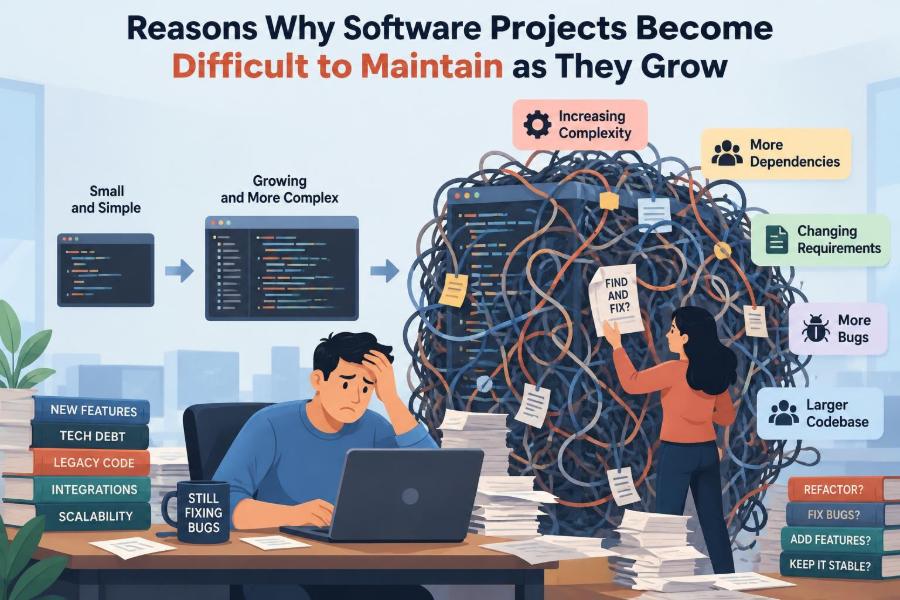

A small application can feel wonderfully straightforward. One developer understands the code, deployments are manual but quick, and a feature request can be completed by opening a few familiar files.
Then the product succeeds. More users arrive, more integrations are added, regulations change, and the team grows. A seemingly modest request—such as adding a field to a checkout page—now touches APIs, databases, analytics, permissions, tests, mobile clients, and support documentation.
At that point, people often call the system “legacy code,” even if it was written only a few years ago. The problem is rarely that the original engineers were careless. Software becomes difficult to maintain because its complexity grows faster than a team’s shared understanding unless the team actively manages it.
Maintainability matters because most software costs occur after the first release. The ability to safely diagnose, change, test, deploy, and operate a system determines whether growth feels sustainable or increasingly fragile.
🧩 Maintainability Is More Than Code Readability
Maintainability is the practical ease of modifying software without creating unacceptable risk. Readable code helps, but maintainability also depends on architecture, tests, deployment processes, operational knowledge, documentation, and ownership.
A tidy function is not very helpful if nobody knows which service calls it, what data it changes, or how to safely release a change. Conversely, an older codebase may remain maintainable when its boundaries, behavior, and operating procedures are clear.
📈 Growth Multiplies Connections, Not Just Lines of Code
A growing project does not merely gain more files. It gains relationships: between modules, teams, environments, customer workflows, third-party services, and historical decisions.
Suppose an account record is used by billing, notifications, permissions, reporting, and customer support tools. Changing one field can affect every consumer. This is why a small-looking edit may require a large investigation: engineers are tracing dependencies, not simply typing code.
🕸️ Hidden Coupling Makes Changes Travel
Coupling describes how strongly parts of a system depend on one another. Some coupling is necessary; software components must communicate. The problem is coupling that is broad, implicit, or difficult to see.
For example, several services may silently rely on the exact text of a status value such as pending_review. Renaming it appears harmless until reports fail and an external integration rejects messages. Explicit interfaces and well-defined contracts make those dependencies visible.
🏗️ Early Architecture Meets New Requirements
Early designs are usually optimized for the knowledge available at the time. A single application and database can be an excellent choice for a new product because they reduce deployment and coordination overhead.
Difficulty begins when the original assumptions no longer fit: one region becomes many, one payment method becomes several, or synchronous processing cannot handle long-running work. The issue is not that the first architecture was “wrong.” It is that an architecture is a set of trade-offs that may need revisiting as constraints change.
🧱 Monoliths Are Not the Same as Messes
A monolith is an application deployed as one unit. It can be highly maintainable when internal modules have clear responsibilities, dependencies flow in sensible directions, and teams can test and release it reliably.
Breaking a poorly understood monolith into services can make maintenance harder by adding network failures, distributed data concerns, and more deployments. Split systems when independent scaling, ownership, or release needs justify the operational cost—not merely because the codebase has become large.
🔀 Unclear Boundaries Create Responsibility Confusion
Code becomes difficult to change when nobody can answer a basic question: which component owns this rule? Business logic then leaks into controllers, database queries, frontend validation, scheduled jobs, and integration adapters.
Imagine a discount rule implemented separately in a web page, an API endpoint, and a nightly invoice task. Each location may evolve differently. A clear boundary assigns the rule to one authoritative place, while other layers ask that place for the result.
🧪 Missing Tests Turn Every Change Into a Guess
Tests do not prove that software has no defects, but they provide fast evidence that known behavior still works. Without them, maintenance relies heavily on memory, manual checking, and confidence that can be misleading.
The most useful test suite is not necessarily the largest one. It checks important behavior at appropriate levels: small unit tests for complex rules, integration tests for component interactions, and a limited set of end-to-end tests for critical user journeys.
🎭 Brittle Tests Can Also Slow the Team
Tests become a maintenance burden when they depend on irrelevant details. A test that fails whenever HTML structure changes, even though user behavior is unchanged, teaches developers to distrust the suite.
Likewise, tests that require many unrelated services or complicated setup can be slow and unreliable. Prefer assertions about observable behavior and contracts. Keep test fixtures focused so a failure communicates a useful signal rather than creating another mystery.
🗃️ Data Outlives Application Code
Application code can be replaced in a deployment. Production data carries customer history, legal obligations, audit needs, and compatibility expectations. That makes schema changes especially consequential.
Adding a required database column, changing a value format, or deleting records may disrupt older application versions, background jobs, reports, and imports. Safe evolution often requires transitional steps: add compatible structures, migrate data gradually, update readers and writers, then remove the old path only after it is no longer used.
📜 Historical Data Contains Unexpected States
Real production data often includes conditions that current validation would reject: incomplete imports, records created before a policy changed, manually corrected entries, or values from retired integrations.
Maintenance work fails when engineers assume the database contains only ideal examples. Before changing a rule, inspect representative data and decide how older states should behave. A migration plan should include exceptions rather than discovering them during an incident.
🔌 Third-Party Dependencies Change Independently
Libraries, cloud platforms, payment providers, identity systems, and browser APIs evolve on their own schedules. A dependency may deprecate an endpoint, change an authentication requirement, or introduce a security fix that forces an upgrade.
Pinning versions can make builds reproducible, but it does not remove the need to review updates. Teams need a routine for evaluating dependencies, testing upgrades, and removing unused packages. An abandoned dependency is both technical debt and a future decision waiting to become urgent.
🔐 Security Requirements Add Necessary Complexity
As a system handles more valuable data or reaches more users, it commonly needs stronger access controls, audit logs, encryption, retention practices, and incident response procedures. These are not optional “extra features” when the risk profile changes.
Security can become hard to maintain when it is scattered. Authorization checks copied into dozens of endpoints are easy to miss during a new feature. Central policies, consistent identity models, and automated security checks reduce the chance that one path behaves differently.
🌍 Environment Differences Cause Surprises
Development, test, staging, and production environments often drift apart. A local machine may use a small database, permissive settings, fake credentials, and a different operating system than production.
The wider that gap becomes, the less confidence a successful local test provides. Configuration should be explicit, secrets should be handled safely, and environments should resemble production where it matters—especially for integrations, permissions, data volumes, and deployment behavior.
🚀 Manual Deployments Do Not Scale Gracefully
A release process based on a few remembered commands works until more people release software, changes occur more frequently, or a rollback is needed under pressure. Manual steps invite variation and make it difficult to reconstruct what happened.
Automated delivery pipelines create a repeatable path from validated code to a deployment. They should not be treated as magic: pipelines themselves need maintenance, clear ownership, and feedback that tells engineers why a build or release failed.
🧯 Weak Observability Extends Every Incident
Observability is the ability to understand a running system from signals such as logs, metrics, traces, and meaningful alerts. Without it, a production issue becomes a search through incomplete clues.
Good observability answers practical questions: Which request failed? Which version handled it? Did a dependency slow down? How many users are affected? Logging sensitive data indiscriminately is not the answer; useful telemetry must also respect privacy and security boundaries.
⏳ Background Work Hides Important Behavior
Queues, scheduled tasks, retries, and event handlers are valuable for work that should not block a user request. They also move behavior outside the request-response path that developers most often inspect.
A customer may submit an order successfully while a later job fails to send confirmation or reserve inventory. Background processes need visibility, idempotency—safe repeated execution—and clear failure handling. Otherwise, important business behavior becomes difficult to trace and repair.
📨 Distributed Systems Introduce Partial Failure
When components communicate over a network, one service can be available while another is slow, unreachable, or returning stale information. Unlike a local function call, a network request can fail after the remote system has already performed the work.
This creates difficult questions about retries, duplicate messages, timeouts, and consistency. Distributed architecture can solve genuine scale or ownership problems, but every remote boundary should be designed with failure behavior in mind, not only the successful path.
📚 Documentation Decays When It Is Separate From Work
A useful document explains decisions that code alone cannot: why a trade-off was chosen, how a system is operated, what a migration requires, or which team owns an interface. Documentation becomes harmful when it confidently describes a past reality.
Keep operational instructions and interface definitions close to the work that changes them. Short, maintained records of significant decisions are often more valuable than a large overview document nobody updates.
🧠 Knowledge Becomes Concentrated in Individuals
Every mature system has areas understood deeply by only a few people. This is normal to a degree, but it becomes risky when a release, incident, or design decision cannot proceed without one specific person.
Reduce that risk through pairing, code review, shared on-call responsibilities, architecture walkthroughs, and written runbooks. The goal is not for everyone to know everything; it is for critical knowledge to be discoverable and shared enough that work does not stop when someone is unavailable.
👥 Team Growth Changes Communication Costs
A small team can coordinate through conversation. As teams grow, informal agreement becomes less reliable. Two groups may both modify a shared API, interpret a requirement differently, or schedule incompatible releases.
Maintainability therefore has a social dimension. Clear ownership, lightweight design reviews, versioned interfaces, and predictable planning practices lower coordination cost. Process should clarify decisions and handoffs, not become a substitute for engineering judgment.
🎯 Product Pressure Encourages Local Shortcuts
Under a deadline, a narrowly scoped workaround can be rational. The danger appears when temporary code remains unnamed, untracked, and repeatedly built upon because there is no time to revisit it.
Technical debt is best understood as the future cost of a shortcut, not as a moral failure. Record why the shortcut was taken, what assumption makes it temporary, and what signals should trigger cleanup. That makes trade-offs visible instead of silently permanent.
🧷 Feature Flags Need a Retirement Plan
Feature flags allow teams to release code gradually, test a capability with selected users, or disable a risky path quickly. They are valuable operational tools, especially when a full rollback would be costly.
But each long-lived flag creates multiple possible behaviors. Combinations of old flags can make the system difficult to reason about and test. Give every flag an owner and an expected removal date or condition, then delete obsolete branches after a decision is settled.
🧭 Requirements Become More Ambiguous at Scale
“Add approval” sounds simple until a team asks who can approve, whether approval can be revoked, what happens during a role change, how it appears in reports, and whether old records need the same rule.
Ambiguity is not merely a product problem; it becomes code complexity when assumptions are embedded in different places. Engineers and stakeholders should explore edge cases early, particularly permissions, failure behavior, data migration, and compatibility with existing workflows.
🧾 APIs Become Long-Term Promises
Once other applications, teams, or customers depend on an API, changing it is no longer an internal refactor. Field names, error formats, ordering assumptions, and even undocumented behavior may have consumers.
Versioning is one option, but not the only one. Additive changes, deprecation periods, compatibility adapters, and consumer-focused tests can often evolve an interface safely. The key is to treat an interface as a commitment rather than a convenient implementation detail.
⚡ Performance Fixes Can Add Operational Debt
Caching, database replicas, batching, and asynchronous processing can improve response times or reduce load. They also introduce expiry rules, stale data, invalidation logic, synchronization delays, and new monitoring needs.
Performance work should begin with measurement and a concrete bottleneck. A cache added without a clear ownership model may make the system faster in one scenario while making correctness failures much harder to diagnose elsewhere.
🧹 Refactoring Needs a Safety Net and a Purpose
Refactoring changes structure while preserving behavior. It is essential for keeping design aligned with current needs, but broad cleanup without tests, observability, or a clear target can create risk without delivering value.
Prefer incremental refactoring around active work: isolate a dependency before replacing it, add characterization tests that capture current behavior, and make small deployable changes. This approach keeps learning close to the code and avoids a long-lived rewrite branch.
🔄 Rewrites Rarely Erase the Real Complexity
A rewrite can be appropriate when technology is unsupported, the architecture prevents critical progress, or the existing system cannot meet essential requirements. Yet a rewrite does not automatically carry over years of edge-case knowledge embedded in the old system.
Before replacing everything, identify which problems are structural and which are caused by missing tests, unclear ownership, or neglected operations. Strangling parts of a system gradually—routing one capability at a time to a replacement—can preserve learning and reduce cutover risk.
🛠️ Use a Maintainability Feedback Loop
Healthy teams notice friction early. They watch for slow delivery, repeated incidents, confusing onboarding, flaky tests, difficult releases, and recurring defects in the same area. These are signals to investigate, not just inconveniences to tolerate.
A practical loop includes:
- making work visible through issue tracking, incident reviews, and delivery metrics;
- reserving capacity for reliability, upgrades, and small structural improvements;
- choosing changes that remove repeated sources of effort;
- checking whether the improvement actually reduced risk or time spent.
Not every rough edge deserves immediate work. Prioritize based on frequency, impact, and the likelihood that upcoming features will touch the area.
🧰 Practical Habits That Preserve Changeability
Maintainable systems are built through repeated ordinary choices rather than one grand cleanup. Teams benefit from treating code, operations, and communication as connected parts of the same product.
- Keep modules focused and make dependencies explicit.
- Automate builds, tests, deployments, and rollback procedures where practical.
- Review production incidents for systemic lessons, not individual blame.
- Document important decisions, operational steps, and interface expectations.
- Plan data and API changes for compatibility before implementation begins.
- Delete dead code, expired flags, unused dependencies, and obsolete documentation.
🌱 The Core Principle: Preserve the Ability to Change
Software becomes difficult to maintain when complexity accumulates faster than understanding, feedback, and coordination. Code quality matters, but so do data evolution, system boundaries, production visibility, team knowledge, and disciplined delivery.
The goal is not a perfectly clean system; real products must make trade-offs under uncertainty. The goal is a system whose risks are visible, whose behavior can be checked, and whose next change does not require heroic guesswork.
The most maintainable software is software that a changing team can understand, modify, verify, and operate with confidence. Treat maintainability as continuous product work, and growth becomes a challenge the system can absorb rather than a burden it cannot carry. ⚙️🌱