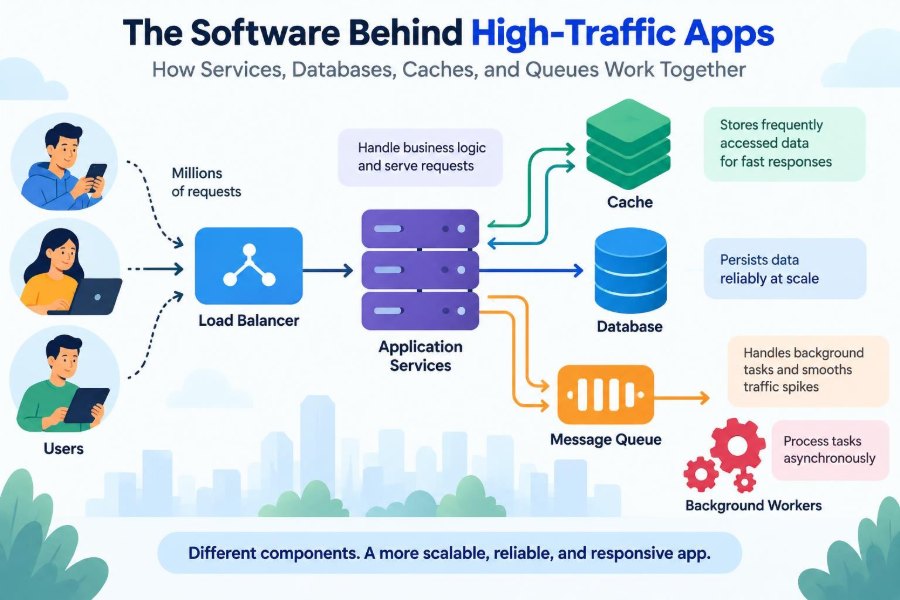

You open a ticketing app just as concert sales begin. Thousands of people are searching for seats, refreshing availability, and trying to pay at nearly the same moment. The app may feel like one simple screen, but behind it is a carefully coordinated system.
Or consider a food-delivery app during dinner. It must show nearby restaurants, calculate delivery estimates, accept orders, notify kitchens, charge payments, and update couriers—without making every customer wait for every background task.
High-traffic software is not usually a single giant program connected to one database. It is a collection of components with different jobs, connected in ways that keep fast work fast and slow work reliable.
Understanding this arrangement helps students reason about system design and helps working engineers diagnose the frustrating question behind many incidents: if the app is slow, which part is actually struggling?
🏙️ A High-Traffic App Is a System, Not a Server
A high-traffic application is one that receives enough concurrent requests that a single machine, process, or database connection pool becomes a practical constraint. “High traffic” is relative: a campus project can have a bursty registration deadline, while a global consumer platform handles steady demand across regions.
The key idea is coordination under load. A request may travel through an edge service, an application server, a cache, one or more databases, and a queue. Each layer should do a narrow job well.
Adding more machines alone does not solve every problem. A bottleneck can move from web servers to a shared database, a payment provider, a network link, or a slow dependency.
📨 Start with the Life of One Request
Imagine a user opening a product page. Their browser sends an HTTPS request to the application’s public address. A routing layer chooses a healthy application instance, which checks whether product information is already cached.
If the cache has fresh data, the service can respond quickly. If not, it reads the database, may place the result in the cache, and returns a response. This path is called the request path, and its speed strongly shapes the user experience.
Not every action belongs on this path. Sending a receipt email or generating recommendations can happen later, after the user has received confirmation.
🚪 Edge Layers Handle the First Contact
Before traffic reaches application code, it often passes through edge infrastructure. This can include DNS, content delivery networks (CDNs), web application firewalls, TLS termination, and rate limits.
A CDN stores copies of static files such as images, JavaScript bundles, and style sheets near users. It can also cache suitable public responses. Serving those files at the edge avoids repeatedly asking the application to do work that does not change per user.
Edge controls are also a useful protection boundary. They can reject malformed requests, absorb some abusive traffic, and enforce simple request limits before expensive backend resources are involved.
⚖️ Load Balancers Spread Work, Not Magic
A load balancer receives requests and forwards them to one of several application instances. Its goal is to avoid concentrating work on one unhealthy or overloaded machine.
Common strategies include round robin, least-connections routing, and routing based on health checks. Health checks matter because sending traffic to a process that is running but unable to reach its database is rarely helpful.
A load balancer improves availability only when the application can run in multiple places. If every request depends on one fragile shared component, that component still determines the system’s resilience.
🧩 Services Divide Responsibilities
A service is a deployable piece of software responsible for a capability, such as accounts, catalog search, checkout, notifications, or billing. Services can be separate processes, separate applications, or modules inside a larger codebase; the operational boundary matters more than the label.
Separating responsibilities can let teams scale and change parts independently. A search service may need very different storage and performance tuning from an order service.
However, splitting software too early creates network calls, deployment coordination, and failure modes that a modular monolith avoids. Service boundaries should reflect real ownership and data needs, not fashion.
🧱 The Modular Monolith Is Often a Strong Beginning
A modular monolith is one deployable application with well-separated internal modules. It can be easier to test, debug, and deploy than many distributed services because calls inside the process are direct and transactions can be simpler.
For an early product, this design often handles substantial traffic when paired with stateless application instances, a well-managed database, and caching. It also preserves clear domain boundaries that can later become service boundaries if necessary.
The warning sign is not “the application is one repository.” It is “every change is risky because unrelated features are tightly coupled.”
🧠 Stateless Services Make Horizontal Scaling Possible
A service is stateless when any healthy instance can handle a request without relying on private memory left behind by an earlier request. User sessions, uploaded files, and shared counters must live in shared systems rather than on one application server’s disk or memory.
This enables horizontal scaling: operators add more identical instances when demand rises. A load balancer can then distribute requests without needing to remember which server a user visited previously.
Some temporary local state is harmless, such as in-process computation during one request. The problem is durable or user-specific state that disappears when an instance restarts or cannot be reached from another instance.
🗃️ Databases Preserve the Source of Truth
A database holds information that must survive process restarts and be read or changed consistently: users, orders, balances, inventory records, and permissions. For many transactional applications, a relational database is a natural choice because it supports structured queries, constraints, and transactions.
Calling a database the “source of truth” does not mean it is the only storage system. Search indexes, caches, analytics warehouses, and object storage may contain copies optimized for other jobs.
It means that when copies disagree, the authoritative record defines the business outcome. An order confirmation should ultimately be grounded in durable order data, not merely in a cached screen response.
🔒 Transactions Protect Related Changes
A transaction groups database operations so they succeed or fail together according to defined rules. For example, creating an order and reserving inventory may need to be handled atomically, depending on the product’s business model.
Transactions help preserve invariants: rules that should always remain true, such as “an account balance cannot fall below an allowed limit” or “a seat cannot be sold twice.” Database constraints can enforce some invariants even if application code has a bug.
Long transactions are costly under contention. They hold resources while other requests wait, so engineers should keep the transactional portion focused and avoid doing remote calls, slow computation, or email delivery inside it.
📚 Read Replicas Help When Reads Dominate
Many products receive far more reads than writes. A catalog page may be viewed repeatedly while its product data changes less often. Read replicas can copy data from a primary database and serve some read queries.
This reduces pressure on the primary, but introduces an important trade-off: replicas may lag behind recent writes. A user who changes their profile might briefly see older data if immediately routed to a replica.
Systems therefore choose consistency deliberately. Sensitive read-after-write flows may read from the primary, while less critical browsing can tolerate slightly delayed copies.
🧭 Sharding Solves a Different Database Problem
When one database cannot store or process all required data comfortably, sharding divides records across multiple database partitions. A routing rule—often based on tenant, customer, or another key—determines where a record belongs.
Sharding can increase capacity, but cross-shard queries, reporting, rebalancing, and transactions become harder. A poorly chosen shard key can create hot partitions, where one popular customer or region receives disproportionate traffic.
It is usually a later-stage technique. Good indexes, query tuning, archiving, caching, and read scaling should be examined before introducing sharding’s permanent operational complexity.
🔎 Indexes Trade Write Work for Faster Reads
A database index is a data structure that helps locate rows without scanning an entire table. An index on a user email can make login lookup fast; a composite index may support a common query that filters by account and sorts by creation time.
Indexes are not free. Every insert, update, and delete may need to update each relevant index. Too many indexes increase storage and write cost, while missing indexes can turn ordinary user requests into expensive scans.
Engineers should inspect real query patterns and execution plans rather than guessing. The best index depends on filters, joins, ordering, data distribution, and how much data the query actually returns.
⚡ Caches Store Answers That Are Expensive to Rebuild
A cache keeps data that can be retrieved faster than recomputing it or rereading it from a primary store. It may live in application memory, a shared in-memory data store, a CDN, or a specialized cache service.
A cache is useful when data is read frequently, changes relatively infrequently, or costs meaningful time to compute. Examples include product details, feature flags, rendered fragments, permissions, and aggregation results.
The cache is usually a performance layer, not the only durable record. A cache restart should cause more database work temporarily, not the permanent loss of orders or accounts.
🧊 Cache-Aside Is the Common Starting Pattern
With cache-aside, the application first looks in the cache. On a hit, it returns the value. On a miss, it fetches the value from the database, stores it in the cache with an expiration policy, and then returns it.
This is straightforward, but cached data can become stale after updates. One approach is to invalidate or update the relevant cache key when the authoritative record changes. Another is to use a short time-to-live, accepting temporary staleness.
There is no universal invalidation rule. A social feed, stock count, and account permission have different correctness requirements, so each needs an explicit freshness decision.
🌊 Cache Stampedes Can Turn a Miss into an Outage
If a popular cache key expires, many simultaneous requests may all miss and query the database at once. This is a cache stampede, and it can overload the very system the cache was intended to protect.
Typical defenses include locking or request coalescing so one request refreshes the value, serving a slightly stale value while a refresh occurs, and adding randomized expiry jitter so related keys do not expire together.
Negative caching can also help when clients repeatedly request something absent, such as an invalid identifier. It must be brief and carefully scoped so newly created data does not remain invisibly cached as missing.
📬 Queues Move Slow Work Off the Critical Path
A message queue stores tasks or events until a worker can process them. Instead of making checkout wait for a receipt email, the order service can commit the order and publish a “receipt requested” message.
A worker consumes that message and sends the email asynchronously. The user gets a fast order response, while the email process can retry independently if its provider is unavailable.
Queues do not make work disappear. They change when and where it happens, which is valuable when a task is slow, bursty, retryable, or not required to complete before the user continues.
🏭 Workers Turn Messages into Background Progress
Workers are processes that consume jobs from queues. They may generate thumbnails, process imports, recalculate reports, dispatch notifications, or synchronize data with another system.
Worker concurrency needs limits. Too many workers can overwhelm a database, API provider, or CPU pool; too few create a growing backlog. Teams monitor queue depth, job age, processing duration, failure rate, and downstream capacity.
Backpressure is the ability to slow intake or processing when downstream systems are saturated. It is better to delay nonessential work deliberately than to let an uncontrolled burst destabilize every dependency.
🔁 Delivery Is Usually At-Least-Once
Many practical queue systems offer at-least-once delivery: a message is delivered one or more times if failures occur. A worker may finish an action but crash before acknowledging the message, causing it to be delivered again.
That means consumers should be idempotent: processing the same message multiple times produces the intended final result. A payment-related workflow might store a unique operation key and recognize that a prior attempt already succeeded.
“Exactly once” is often a business-level design goal rather than a simple broker setting. Durable records, deduplication, and carefully designed side effects are usually required.
🧾 The Outbox Pattern Prevents a Dangerous Gap
Consider an order service that writes an order to its database and then publishes an event. If the database commit succeeds but the process crashes before publishing, other systems never learn about the order.
The outbox pattern writes the business record and an event record in the same database transaction. A separate publisher reads unsent outbox records and safely publishes them, marking progress afterward.
This does not eliminate duplicate events, so consumers still need idempotency. It does close the more serious gap between durable state changes and the messages meant to describe them.
🕸️ Synchronous Dependency Chains Create Latency
A request that calls five services in sequence inherits delays from each one. If each call is normally quick, the total may still be noticeable; if one dependency stalls, user-facing work can pile up waiting for it.
Parallel calls can help when results are independent, but they can also amplify traffic. A fan-out request sent to many services may turn one user action into dozens of downstream calls.
Keep the synchronous path narrow. Ask which data is truly required to answer now, which can be precomputed, and which can arrive later through an asynchronous update.
🛡️ Timeouts, Retries, and Circuit Breakers Need Discipline
Every network call needs a timeout. Without one, threads or asynchronous tasks may wait far longer than the user experience allows, exhausting connection pools and preventing useful work.
Retries are appropriate only for failures likely to be temporary and only when the operation is safe to repeat. Exponential backoff with jitter reduces the chance that thousands of clients retry in lockstep.
A circuit breaker temporarily stops calls to a dependency that is failing repeatedly. It can return a fallback, cached result, or clear error while giving the dependency time to recover. Retrying every failure immediately often makes an outage worse.
📏 Rate Limits Protect Shared Capacity
Rate limiting caps how often a client, account, IP address, or API key can make requests over a period. It protects expensive endpoints from accidental loops, abusive automation, and uneven resource consumption.
Limits should match the operation. A public search endpoint, password-reset endpoint, and bulk export endpoint impose very different costs and risks. Returning a clear response that asks clients to slow down is better than silently allowing overload.
Rate limits are not only a security feature. They are a capacity-management tool that helps preserve fair access when demand exceeds what a component can safely handle.
📈 Observability Answers What the System Is Doing
Observability combines logs, metrics, and traces to help engineers infer internal behavior from system outputs. Metrics show trends such as latency, error rate, CPU use, queue depth, and database connections.
Logs capture structured events and diagnostic context. Distributed traces attach a request identifier across service calls, revealing where time was spent in a path that crosses several systems.
Useful monitoring focuses on user-visible symptoms as well as infrastructure. A server can show low CPU while users experience failures because a payment service, database pool, or DNS dependency is the actual constraint.
🚨 Alerts Should Point to Actionable Problems
An alert should signal a condition that needs human attention, not merely an interesting metric. Frequent noisy alerts teach people to ignore pages, which defeats the purpose of detection.
Good alerts combine a meaningful threshold with duration and context. A brief spike in error rate may resolve automatically; sustained failures on checkout or a rapidly aging queue likely deserve a response.
Runbooks turn alerts into action. They document likely causes, safe checks, ownership, and escalation paths, reducing the need to rediscover operational knowledge during an incident.
🧪 Load Testing Reveals Limits Before Users Find Them
Load testing sends controlled traffic through a realistic environment to observe latency, errors, resource use, and bottlenecks. The goal is not simply to achieve a large requests-per-second number; it is to learn how the system behaves as demand changes.
A useful test includes realistic mixes: reads and writes, authenticated and anonymous traffic, cache warm-up, slow dependencies, and data volumes similar to expected production conditions. A benchmark against an empty database can be misleading.
Failure testing is equally valuable. Temporarily simulating a failed cache, delayed provider, unavailable replica, or worker backlog exposes whether timeouts, fallbacks, and dashboards behave as intended.
🧯 Graceful Degradation Preserves Core Tasks
When capacity is limited or a dependency fails, the application should prioritize its essential user promise. A commerce site might keep browsing and ordering available while temporarily delaying recommendations, review summaries, or nonessential analytics.
Fallbacks must be honest. Showing “inventory unavailable—confirming at checkout” may be safer than displaying a confidently wrong stock count. Disabling an optional feature is often preferable to making every request wait on it.
Graceful degradation is designed ahead of time. Teams identify critical journeys, decide what can be deferred, and test those decisions before an incident makes the choices urgent.
🔐 Security and Reliability Often Reinforce Each Other
Authentication, authorization, input validation, secret management, encryption, and audit trails are security practices, but they also affect reliability. For example, authorization checks should be efficient and consistently applied; a slow, scattered permissions design can become both a security and performance problem.
Least-privilege access limits damage when a service account is misconfigured or compromised. Rotating secrets and separating environments reduce the chance that one mistake affects every system.
Security controls consume resources, so they should be included in capacity planning. Encryption, token verification, and abuse detection belong in realistic performance tests rather than being treated as invisible overhead.
🧰 A Practical Design Exercise
Suppose a hypothetical learning platform publishes a popular course enrollment at noon. Students browse course pages, check remaining seats, enroll, receive confirmation, and later receive a welcome email.
- A CDN serves course images and static application files.
- Stateless application instances handle browsing and enrollment requests.
- A cache serves frequently read course descriptions, but seat reservations use the authoritative database.
- A database transaction records the enrollment and updates capacity according to the platform’s rules.
- An outbox event leads to queued work for welcome emails and analytics updates.
- Workers process those jobs at a controlled rate, with idempotent handling if messages repeat.
This design does not promise unlimited scale. It separates fast browsing, correctness-sensitive enrollment, and slower follow-up work so each can be monitored and evolved independently.
🧱 Common Mistakes in Early Architectures
One mistake is treating the database as a general-purpose queue, cache, reporting engine, and transactional store without considering competing workloads. Another is introducing many microservices before the team has reliable deployment, tracing, and operational ownership.
- Keeping sessions only in local server memory: users fail when requests land on another instance.
- Retrying without limits: temporary outages become self-inflicted traffic floods.
- Caching without a freshness policy: stale permissions or inventory can create correctness problems.
- Doing all work synchronously: one slow email or third-party API delays an otherwise complete request.
- Ignoring connection pools: application instances can overwhelm a database with too many concurrent connections.
Most of these failures are not caused by ignorance of a particular tool. They come from unclear ownership of data, work, and failure behavior.
🗺️ Design from Workflows and Constraints
Start system design with the user journeys that matter: sign in, browse, pay, upload, publish, or collaborate. For each journey, identify the data it reads, the data it changes, the response time users expect, and the failures that are unacceptable.
Then classify each operation. Is it a strongly consistent write? A cacheable read? A long-running job? An integration with an unreliable external system? The classification suggests suitable tools without forcing a predetermined architecture.
Capacity planning is similarly concrete. Estimate traffic patterns, payload sizes, data growth, peak bursts, and dependency limits. Revisit those assumptions as production behavior teaches you more.
🧑💻 What Engineers Should Practice
Students can build small systems that include a relational database, a cache, and a background worker, then deliberately break one component. Add a timeout, observe a failed job, retry safely, and inspect what happens when cached data is stale.
Working engineers can improve one request path at a time: measure it, identify its slowest dependency, make a targeted change, and verify the effect under realistic load. Architecture is usually an iterative practice, not a one-time diagram.
Most valuable skills are transferable across tools: modeling data ownership, designing idempotent operations, reading query plans, setting timeouts, interpreting metrics, and making trade-offs explicit.
🎯 The Core Principle: Put Each Kind of Work in the Right Place
Services organize business capabilities. Databases preserve authoritative state. Caches accelerate repeatable reads. Queues and workers absorb asynchronous work and smooth bursts. Load balancers, limits, and observability keep those parts operating as a system.
None of these components is automatically required, and none is a cure for poor data models or unclear workflows. Their value comes from matching a component’s strengths to a specific need while acknowledging its failure modes.
The most reliable high-traffic applications are not those with the most elaborate diagrams. They are the ones where engineers can explain what happens to a request, what happens when a dependency fails, and how the system protects the work users care about most.
High-traffic software succeeds when fast requests, durable data, reusable results, and background work are designed as cooperating responsibilities rather than one overloaded task. Build the simplest system that makes those responsibilities clear, then evolve it with evidence as demand grows. ⚙️📈🧩