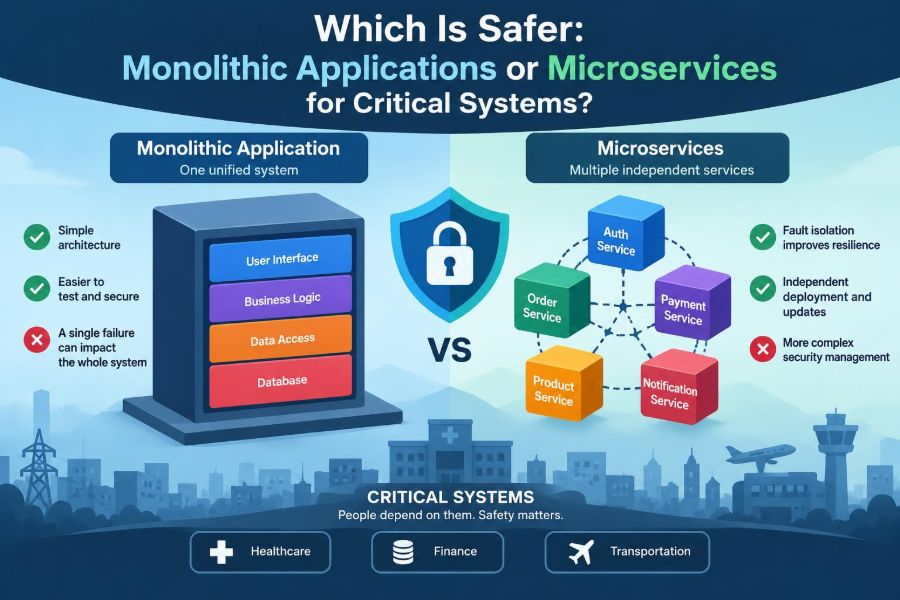

A hospital medication system stops responding during a network incident. An engineer needs to know whether the problem is isolated to a reporting feature or whether it can interfere with dose verification. The architecture is no longer an abstract diagram: it shapes the next safe action.
Similar questions arise in payment processing, industrial control, emergency communications, transport, and public infrastructure. Critical systems can cause serious harm when they produce a wrong result, lose essential data, expose protected information, or simply become unavailable at the wrong time.
Teams often hear that microservices are more resilient because services are independent. Others argue that a monolith is safer because it is simpler. Both statements contain some truth, but neither is a reliable decision rule.
The safer architecture is the one whose failures, changes, operations, and recovery procedures the organization can understand and control. That requires looking beyond deployment style.
🧭 Start by Defining “Safe”
Safety is broader than keeping an application online. In a critical system, it usually includes preventing harmful actions, preserving correct state, protecting confidentiality, and allowing people to detect and recover from failures.
A service that remains available while approving an unsafe transaction is not safe. Likewise, a system that correctly rejects bad input but cannot be restored after an outage may still fail its mission.
🎯 Criticality Changes the Architecture Question
A critical system has consequences that justify unusually careful engineering. The consequence might be physical injury, financial loss, legal exposure, loss of essential service, or irreversible corruption of trusted records.
Criticality is rarely uniform. A dashboard may tolerate delayed updates, while the command path that starts machinery cannot. Architecture decisions should follow the risk of each function rather than labeling the whole product “critical” and treating every component identically.
🏢 What a Monolithic Application Is
A monolith is an application deployed as one primary unit. Its modules may be well separated in source code, but they generally run in one process or tightly coordinated runtime and are released together.
That does not mean a monolith must be poorly designed. A modular monolith can have explicit internal boundaries, separate ownership, disciplined interfaces, and strong tests without requiring network calls between its modules.
🧩 What Microservices Are
Microservices divide a system into independently deployable services that communicate across a network. A service commonly owns a focused capability and may own its own data store or data boundary.
This creates useful separation, but it also turns ordinary internal calls into distributed-system interactions. Networks delay, duplicate, reorder, or lose messages; a caller may not know whether a timed-out operation happened.
⚖️ There Is No Universally Safer Choice
A small, well-operated monolith can be safer than a microservice platform maintained by an overstretched team. Conversely, a carefully isolated service architecture can limit the blast radius of failures that would threaten a single deployment.
The useful question is: which design makes the important hazards easier to prevent, detect, contain, and recover from in this organization? The answer depends on failure modes and operational capability, not fashion.
🧠 Simplicity Is a Safety Feature
Every component, protocol, deployment pipeline, permission boundary, and runtime dependency creates behavior engineers must reason about. Fewer moving parts can mean fewer states that have not been tested.
A monolith often gives developers a single codebase, a single deployment artifact, local function calls, and one primary transaction boundary. These properties reduce cognitive load, especially while diagnosing an incident under pressure.
🌐 Distribution Introduces New Failure Modes
In a monolith, a function call either returns, throws an error, or the process fails in a comparatively direct way. In microservices, a timeout is ambiguous: the remote service may be down, slow, or already processing the request.
Teams must design for partial failure. Retries can duplicate commands, queues can accumulate stale work, and independently deployed versions can disagree about message formats. These are manageable problems, but they require deliberate engineering.
🧱 Isolation Can Limit Blast Radius
Microservices can contain a problem when boundaries align with real risk. For example, a failure in a recommendation service should not prevent an authenticated operator from viewing an emergency record.
Isolation is not automatic. If every service depends on the same identity provider, message broker, database cluster, or configuration system, one shared dependency can still disable the whole workflow.
🔗 Shared Dependencies Are Often the Real Weak Point
Architecture diagrams sometimes show many independent services while hiding a small number of indispensable platform components. DNS, secrets management, logging pipelines, certificate authorities, and cloud control planes can become common-mode failure sources.
Map the dependencies required for each critical action, including human dependencies such as on-call access and runbook permissions. A service boundary does not protect an operation from infrastructure it cannot function without.
💾 Data Integrity Is Usually the Hardest Part
Critical workflows often require correct relationships between records: an order must correspond to an authorization, an account balance must reflect completed transfers, or a device command must have a valid current state.
A monolith can often enforce these rules within one database transaction. This does not eliminate bugs, but atomic updates and constraints give engineers a powerful consistency tool.
🔄 Distributed Data Requires Explicit Consistency Design
When multiple microservices own related data, one cross-service transaction is often impractical or undesirable. The system may instead use asynchronous events and eventual consistency, meaning different views converge after a delay.
That delay can be acceptable for notifications or analytics. It needs more caution when a decision must reflect current truth. A workflow may need reservations, compensating actions, idempotency keys, or a centralized decision point rather than assuming messages will arrive exactly once.
🧾 Idempotency Prevents Repeat Harm
An operation is idempotent when safely repeating it produces the same intended result as performing it once. This is vital when clients retry after losing a response.
Consider a hypothetical payment request. If a gateway processes the charge but the caller times out, a retry must not charge the customer again. A durable request identifier and a recorded outcome are often safer than guessing whether the first attempt succeeded.
🚦 Synchronous Chains Can Undermine Availability
A request that must pass through six services is only as available as the chain and its dependencies. Long call paths amplify latency and create many places where a transient fault can block a critical action.
For essential paths, keep synchronous dependencies few and purposeful. Use local, validated data when appropriate, and separate nonessential work such as reporting or email from the command that must complete safely.
🛑 Fail-Safe Is Not the Same as Fail-Open
A fail-safe response moves the system into a state that reduces unacceptable risk when it cannot establish what is true. For an access-control decision, that may mean denying a request; for a safety monitor, it may mean raising an alarm and handing control to a safe fallback.
But automatic denial can itself cause harm in some contexts. An emergency workflow might need a controlled override with auditing and dual authorization. The correct failure behavior comes from hazard analysis, not a universal rule.
🔐 Security Boundaries Need Careful Interpretation
Microservices can support least privilege because each service can receive only the permissions it needs. A compromise of a reporting component need not grant direct access to command functions.
They also create more endpoints, service identities, certificates, secrets, and authorization decisions. A monolith has fewer network-exposed interfaces, yet a compromise may reach more functionality if internal authorization is weak. Security depends on the implementation of boundaries, not their count.
🧪 Testing a Monolith Has Useful Advantages
End-to-end tests can run through substantial monolithic workflows with fewer external substitutes. Developers can exercise real transaction behavior and trace a request within one executable environment.
The risk is false confidence from a huge test suite that is too slow to run frequently. Good monolith testing still needs focused unit tests, integration tests against realistic persistence, and tests of dangerous business rules.
🧬 Testing Microservices Means Testing Interactions
Service-level tests are necessary but insufficient. A service may correctly publish an event that another service cannot interpret after a version change.
Microservice teams benefit from contract tests, compatibility rules, realistic integration environments, and fault-injection exercises. The goal is not merely to prove each component works alone; it is to expose what happens when dependencies are slow, absent, stale, or inconsistent.
🔍 Observability Determines Whether Failures Can Be Understood
Observability means gathering enough evidence from logs, metrics, traces, and audit records to infer what a running system is doing. In critical systems, it supports both rapid response and later accountability.
Microservices usually need correlation identifiers that follow a request across services. A monolith benefits from them too, especially when handling asynchronous jobs. Record meaningful business events, not only technical exceptions.
📋 Audit Trails Must Preserve Decisions
An audit trail should answer who initiated an action, what information or policy was used, what decision was made, what changed, and when it occurred. Logging every raw request without context rarely answers these questions.
For sensitive operations, protect audit records from casual alteration and control access to them. Logging also has risks: never treat logs as a safe place for secrets, personal data, or credentials.
🚀 Deployment Frequency Is Not Automatically Safety
Independent deployment lets a microservice team patch one capability without releasing the entire application. That can reduce the scope of a change and shorten exposure to a known defect.
Yet frequent releases can be unsafe without compatibility checks, rollback plans, reviewed configuration, and monitoring. A monolith may release less often but have a more comprehensible, rehearsed release process. Change control should be proportionate, not ceremonial.
↩️ Rollbacks Become Harder When State Changes
Rolling back code is simple only when the new version has not changed persistent state in an incompatible way. This is true in any architecture, but independent services increase the number of versions that may coexist.
Prefer additive database and message changes first: add a field, support both formats, migrate data, then remove the old path later. For irreversible commands, plan a compensating operation rather than assuming a deployment rollback can undo reality.
👥 Team Boundaries Should Reflect System Boundaries
Microservices work best when teams can genuinely own them: development, testing, deployment, monitoring, incident response, and lifecycle maintenance. A service abandoned after launch becomes a hidden liability.
If the same small group must coordinate changes across every service, an elaborate decomposition may create paperwork and delays without meaningful independence. A modular monolith can preserve code boundaries until operational ownership is ready.
🧯 Incident Response Must Work at 3 A.M.
During an incident, responders need to identify the failing path, reduce immediate risk, communicate status, and restore service without creating a worse problem. A simple architecture can make that path clearer.
Microservices require mature operational tooling: health signals that reflect real readiness, dependency dashboards, safe traffic controls, and runbooks that explain degraded modes. Practice scenarios where telemetry is incomplete, not only ideal failures.
🧑⚖️ Human Overrides Need Guardrails
When automation cannot safely decide, people may need to intervene. An override should state its scope, duration, authorization requirements, and audit record; it should not be an undocumented back door.
Design for stressful conditions. Clear screens, unambiguous status, confirmation of high-impact actions, and recovery guidance reduce the chance that a human response turns one failure into several.
📊 A Practical Comparison
| Concern | Monolith tendency | Microservice tendency |
|---|---|---|
| Reasoning about one workflow | Often simpler, with local calls and transactions | Requires tracing across network and data boundaries |
| Containing a component failure | Can be broad unless modules are strongly isolated | Can be narrow if dependencies are truly separated |
| Data consistency | Usually easier to enforce atomically | Needs explicit distributed consistency patterns |
| Release scope | Often one coordinated deployment | Potentially smaller, independent deployments |
| Operational burden | Fewer runtime units to operate | More routing, identity, monitoring, and versioning work |
These are tendencies rather than guarantees. A poorly structured monolith and a poorly governed service platform can both be dangerous.
🛠️ When a Modular Monolith Is Often Safer
A modular monolith is a strong default when the domain is still changing, the team is small, critical rules require tightly consistent data, or the organization lacks deep distributed-systems operations experience.
Use explicit module interfaces, prevent casual cross-module database access, and make dependencies visible. This preserves a path to later extraction without paying the network and platform cost before there is a clear reason.
🏗️ When Microservices Can Improve Safety
Microservices can be justified when a subsystem has a distinct risk profile, scaling pattern, deployment cadence, security boundary, or availability requirement that cannot be managed well inside one deployment.
For example, isolating externally facing document conversion from a core authorization workflow may reduce exposure and let a failure degrade a nonessential feature. The extraction should have a specific safety case, not merely a desire for smaller services.
⚠️ Common Architecture Mistakes
- Splitting services around technical layers rather than meaningful business capabilities.
- Using synchronous calls for every interaction and creating fragile dependency chains.
- Assuming a message broker guarantees correct business processing.
- Giving every service broad database or administrator permissions.
- Measuring only uptime while ignoring incorrect decisions and data integrity.
- Extracting services before teams can monitor, secure, and support them.
These mistakes are not unique to microservices, but distribution makes their effects harder to see and repair.
🗺️ Build a Safety Case Before Choosing
A safety case is a structured argument that a system is acceptably safe for its intended use, supported by evidence. Its form varies by domain, but the discipline is broadly valuable.
- Identify unacceptable outcomes and the workflows that could produce them.
- List technical, operational, security, and human failure modes.
- Choose controls that prevent, detect, contain, or recover from each material risk.
- Define evidence: tests, reviews, monitoring, drills, and operational records.
- Revisit the argument when the architecture, workload, or operating context changes.
This process may reveal that a service boundary is essential—or that a local transaction and a clearer operational procedure address the risk more directly.
📈 Measure the Signals That Reflect Real Risk
Useful measures include failed safety checks, time to detect and reconcile inconsistent records, unsuccessful recovery drills, change-related incidents, and the age of unresolved high-risk defects. The right signals depend on the domain.
Do not reward teams only for release speed or raw availability. A system that quickly ships changes while silently producing incorrect outcomes is optimizing the wrong thing.
🧭 Migration Should Be Incremental and Reversible
Moving from a monolith to microservices—or consolidating services into a monolith—should be treated as risk-bearing change. Begin with a bounded capability, establish observability, and validate degraded behavior before expanding.
Keep interfaces stable where possible and migrate data with verification and reconciliation. The safest migration is often the one that can pause without leaving two conflicting sources of truth.
🧩 The Core Principle: Control Complexity Where It Matters
Monoliths concentrate complexity inside one deployable system. Microservices distribute it across communication, data ownership, security, and operations. Neither removes complexity; each moves it.
For critical systems, choose the arrangement that makes high-consequence behavior most explicit and controllable. Use strong modularity, least privilege, integrity checks, meaningful telemetry, rehearsed recovery, and clear ownership regardless of deployment model.
The best architecture is not the most fashionable diagram. It is the one whose assumptions remain visible when a dependency fails, an urgent change is needed, or an operator must make a decision with incomplete information.
Critical-system safety comes from disciplined risk control, not from choosing “monolith” or “microservices” as a label. Start with hazards, build only the boundaries you can operate well, and continually test how the system behaves when normal conditions disappear. ⚙️🛡️🔍