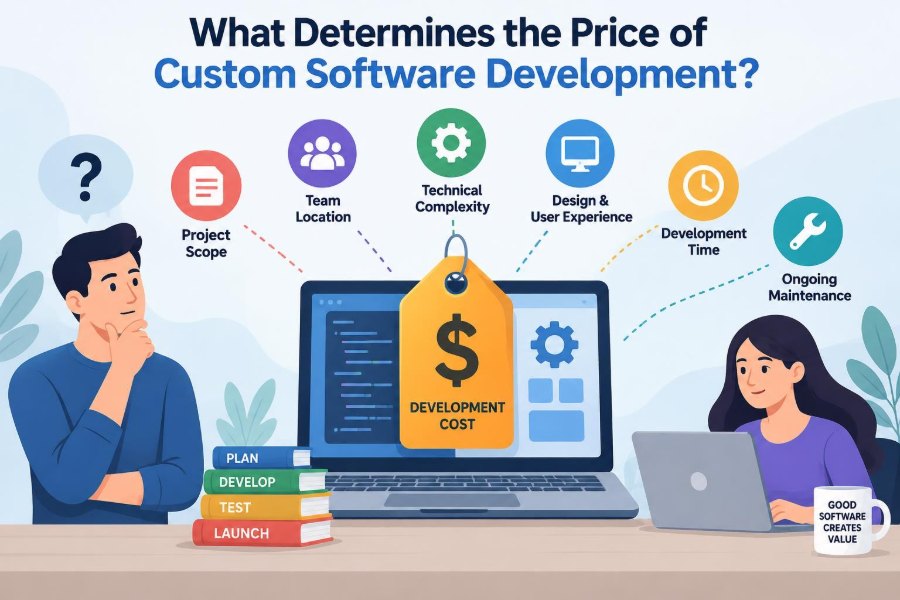

A team has a promising idea: a customer portal, a scheduling platform, a mobile app, or a replacement for a spreadsheet-driven internal process. The first question often sounds simple: “What will it cost?”
Then proposals arrive with very different estimates. One vendor describes a small project; another sees months of discovery, design, integrations, testing, and support. Neither number is meaningful without knowing what work sits behind it.
Custom software is not a shelf product with a fixed sticker price. It is a professional service that turns uncertain business needs into a maintainable system, and the uncertainty is often as costly as the code.
Understanding the drivers of software development cost helps buyers plan realistically and helps engineers explain estimates without reducing complex work to an arbitrary hourly total.
🧭 Start with the actual problem
The price of custom software begins with the problem being solved, not with a programming language. A simple request such as “build a booking app” can mean an online calendar, a marketplace connecting many parties, or an operations system with payments, rules, notifications, and reporting.
Clear problem statements reduce waste because the team can evaluate whether each feature supports an outcome. Vague objectives force developers to make assumptions, revisit decisions, and absorb discovery work later.
📦 Scope is more than a feature list
Scope includes every capability the system must provide, but it also includes what users can do within each capability. “Users can upload files” may require size limits, virus scanning, access control, previews, version history, retention rules, and audit records.
A feature list is therefore a starting point, not a reliable estimate by itself. The useful question is: what behavior must exist in normal, unusual, and failure cases?
🧩 Feature complexity changes the effort
Two features with similar labels can require very different work. A basic form that saves a request is straightforward; a form that changes fields by user role, validates data against an external system, routes approvals, and creates reminders is a workflow engine.
Complexity grows through rules, dependencies, edge cases, and consequences of errors. The user interface may look small while the underlying decisions are substantial.
👥 User roles multiply scenarios
Software used by one type of employee is usually simpler than software used by customers, managers, administrators, partners, and support staff. Each role needs appropriate screens, permissions, actions, and error messages.
For example, a manager may approve an expense, an employee may submit it, finance may correct it, and an administrator may configure policy. That single “expense feature” contains several distinct user journeys.
🔐 Security requirements have real implementation cost
Security is not a decorative lock added near release. It affects authentication, authorization, session handling, data storage, logging, backups, deployment, and incident response.
The required level depends on the system. An internal prototype and an application holding sensitive customer or business information should not be treated alike. Features such as multi-factor authentication, detailed audit trails, encryption management, and privileged-access controls add effort because they must be designed and tested across the product.
⚖️ Compliance can shape the architecture
Some organizations operate under contractual, industry, privacy, accessibility, or record-keeping obligations. The specific obligations depend on the location, sector, users, and data involved, so legal and compliance advice should come from qualified specialists.
From an engineering perspective, these requirements may influence where data is stored, who can access it, how consent is recorded, how long information is retained, and what evidence the system must produce. Discovering these constraints late is expensive because they can alter foundational choices.
🗃️ Data volume and data quality matter
A system that stores a few hundred records behaves differently from one that searches, aggregates, and reports across years of operational data. Larger volumes can require indexing, archival strategies, performance testing, and more careful database design.
Messy source data also increases cost. Importing a legacy spreadsheet may involve duplicate records, inconsistent names, missing values, and unclear ownership. Data migration is both technical work and a business decision about what should be kept.
🔌 Integrations are separate products at the boundary
Connecting to payments, accounting, identity providers, maps, email platforms, hardware, or a legacy database is rarely “just an API call.” An integration must manage credentials, changing external interfaces, retries, duplicate events, rate limits, and useful failure messages.
Its estimate should reflect what is known about the other system. A stable, well-documented service is usually less uncertain than a legacy application maintained by another team with limited access.
📱 The number of platforms affects cost
A responsive web application can serve many users efficiently, but it is not identical to building native applications for iOS and Android. Native apps may be justified by offline behavior, device features, app-store distribution, or a particular user experience.
Each additional platform creates design, implementation, testing, release, and support work. Reusing a backend can help, but it does not remove platform-specific decisions.
🎨 UX and visual design prevent expensive confusion
User experience design determines how people move through tasks; visual design determines how the interface communicates hierarchy, feedback, and brand. Both influence development cost because developers need clear interaction rules, states, and responsive layouts.
Skipping design may look cheaper at first. It often transfers uncertainty into implementation, where a team repeatedly revises screens after stakeholders finally see a working version.
♿ Accessibility is a product requirement
Accessible software considers people using keyboards, screen readers, zoom, alternative input methods, or different visual and cognitive needs. It involves semantics, contrast, focus behavior, labels, error handling, and interaction design—not merely larger text.
Building accessibility into components and design reviews is generally more efficient than repairing inaccessible patterns across a finished product. The exact standard or legal duty applicable to a project should be assessed in its proper context.
🏗️ Architecture should fit the problem
Architecture is the set of structural decisions that lets software evolve and operate. A small internal tool may need a modest, maintainable application; a high-availability service used across regions may need redundancy, observability, and carefully separated components.
More architecture is not automatically better. Overengineering raises initial cost and operating complexity. Underengineering can make a growing product fragile and costly to change. The appropriate price reflects the risks the system truly needs to handle.
☁️ Infrastructure creates both build and running costs
Applications need environments for development, testing, and production, along with databases, storage, networking, monitoring, backups, and deployment automation. Engineers spend time configuring these systems and keeping them dependable.
Cloud services can reduce the need to manage physical servers, but they do not make operations free. Usage-based bills, managed services, logs, data transfer, and third-party subscriptions should be considered separately from the initial development budget.
🧪 Testing is the cost of confidence
Testing includes more than checking whether a button works. Teams may test business rules, APIs, browser behavior, mobile devices, security-sensitive paths, performance under expected load, and recovery from failures.
Automation can make repeated checks faster, while exploratory testing finds problems that scripted tests miss. The right balance depends on the risk and expected lifespan of the software, but eliminating testing is usually a false economy.
🚦 Quality attributes often hide behind simple requirements
People naturally describe what a system should do. They may not initially describe how quickly it should respond, how often it should be available, how it behaves during an outage, or how easily support staff can investigate a problem.
These are often called non-functional requirements. They can significantly affect cost because performance, reliability, recoverability, and observability must be designed into the system rather than bolted on casually.
📝 Discovery turns assumptions into decisions
Discovery is the structured work of learning about users, processes, constraints, existing systems, and success measures. It can include workshops, process mapping, prototypes, technical investigation, and prioritization.
A discovery phase has a cost, but it can reduce the risk of funding the wrong build. It is particularly valuable when stakeholders disagree, the current process is poorly documented, or the project depends on unfamiliar technology.
📐 Estimates are forecasts, not guarantees
An estimate is a reasoned forecast based on available information. It becomes more reliable when the scope is understood, dependencies are known, and the team has experience with similar work.
Early estimates should often be expressed as ranges or scenarios rather than a misleadingly precise single figure. A fixed budget may still be useful, but it should be paired with explicit assumptions, exclusions, and a process for handling change.
🔄 Requirements change has a timing effect
Change is normal: users learn from prototypes, markets shift, and new constraints appear. The cost of change depends heavily on when it occurs and how broadly it affects completed work.
Changing a label during design is usually inexpensive. Changing a data model, permissions scheme, or integration after dependent features have been built can require redesign, migration, retesting, and release coordination.
🛠️ Team composition influences the rate and outcome
Custom software commonly involves product or business analysis, design, frontend and backend development, quality assurance, delivery or platform engineering, and project leadership. One person may cover multiple roles on a small engagement, but the responsibilities do not disappear.
A lower hourly rate is not the only comparison point. Experience in the relevant domain, communication quality, review practices, and the ability to identify risk can change total cost and delivery reliability.
🌍 Location and engagement model affect pricing
Labor markets, taxes, currency, time-zone overlap, and local operating costs affect vendor rates. Onshore, nearshore, offshore, freelance, agency, and in-house arrangements each have different trade-offs.
Distance is not inherently a problem, but coordination has a cost. A model with limited overlapping hours may need stronger documentation, clearer handoffs, and more deliberate decision-making.
⏱️ Communication is productive work
Planning, demonstrations, design reviews, backlog refinement, technical discussions, and stakeholder decisions consume time because they prevent misunderstandings. Treating all communication as waste encourages a team to build in isolation.
The goal is not endless meetings. It is a reliable rhythm in which questions are answered quickly enough that developers do not proceed on guesses that later become rework.
📊 Project management keeps dependencies visible
Project management coordinates scope, priorities, risks, decisions, schedules, and people. On a simple project this may be lightweight; on a multi-team initiative it can be a substantial discipline.
Its value is most visible when something changes: an integration slips, a stakeholder requests a new workflow, or a release must be coordinated with training. Without ownership, these issues can quietly become expensive delays.
🚀 Deployment and release work are part of delivery
Writing code is not the same as safely releasing it. A production release may involve environment configuration, database changes, approvals, rollback planning, monitoring, documentation, app-store review, or coordinated communication.
For a business-critical system, teams may also use staged releases or feature flags, which allow a change to be enabled gradually. These practices add effort but can reduce the impact of defects.
🧰 Maintenance begins after launch
Software needs ongoing attention: security updates, dependency upgrades, defect fixes, monitoring, backups, user support, and adjustments as browsers, devices, and external services change. Maintenance is an operating responsibility, not evidence that the original project failed.
Buyers should ask what happens after handover. Who owns source code, cloud accounts, credentials, documentation, alerts, and the authority to make urgent fixes?
📉 Technical debt can defer rather than remove cost
Technical debt describes shortcuts that make current delivery faster while making future change harder. Some debt is a rational choice, such as a temporary manual process used to test demand. Problems arise when shortcuts are undocumented or treated as permanent.
A practical team records these trade-offs and revisits them when the product proves its value. The cheapest first release may not be the cheapest system over several years.
💵 Pricing models distribute risk differently
| Model | Best fit | Main trade-off |
|---|---|---|
| Time and materials | Evolving scope and learning-oriented work | Budget requires active prioritization |
| Fixed price | Well-defined, stable deliverables | Change needs formal handling; vendors price uncertainty |
| Dedicated team | Longer-term product development | Requires strong product direction and ongoing commitment |
| Phased engagement | Uncertain ideas needing discovery before build | Requires decisions between phases |
No model eliminates uncertainty. It simply decides whether the buyer, supplier, or both parties carry more of it, and how changes are governed.
🧮 A hypothetical estimate breakdown
Imagine a company commissioning a web portal for service requests. A credible estimate may include discovery, interface design, account management, request workflows, administrator tools, notifications, one or two integrations, automated checks, manual testing, deployment, training material, and a launch period.
The visible portal screen is only one piece. If the company later adds multiple approval levels, imports historical records, and requires offline mobile use, the estimate changes because the system’s behavior and risks have changed—not because the team has arbitrarily raised a price.
🚩 Warning signs in unusually low quotes
A low quote is not automatically poor, especially for a narrow, familiar project. It deserves closer questions when it omits discovery, testing, design, deployment, security, documentation, or post-launch responsibility.
- What assumptions make this price possible?
- Which integrations, devices, user roles, and edge cases are excluded?
- Who pays when an external dependency behaves differently than expected?
- What quality checks and handover materials are included?
Comparison is fair only when proposals describe comparable work.
🧱 Reduce cost by reducing uncertainty
The most reliable savings usually come from narrowing the first release to the smallest useful outcome. This does not mean stripping quality from critical paths; it means choosing a focused problem, a defined user group, and measurable learning goals.
Reusable components, managed services, existing design systems, and proven integrations can also help when they fit the need. Reuse saves money only when customization does not exceed the value of starting from scratch.
🗺️ Prepare before requesting proposals
Buyers can improve estimates by bringing concise, honest context rather than a lengthy wish list. Explain the users, current workflow, business objective, known constraints, desired launch window, existing systems, and decisions that are still open.
- Identify the primary problem and the first users.
- Separate must-have outcomes from later ideas.
- List systems, data sources, and stakeholders involved.
- State security, compliance, accessibility, and hosting expectations.
- Ask vendors to identify assumptions and major risks.
This preparation does not replace discovery, but it gives discovery a much stronger starting point.
🤝 A healthy client-team relationship protects value
Software projects work best when business stakeholders make timely decisions and delivery teams make trade-offs visible. Both sides should be able to say, “If we add this, what moves, costs more, or becomes riskier?”
Transparency is more useful than false certainty. Regular demonstrations let stakeholders inspect real progress, while a prioritized backlog makes it possible to invest in the next most valuable piece of work.
🎯 The core principle: pay for outcomes, clarity, and sustainable delivery
Custom software cost is determined by the work required to understand a problem, build an appropriate solution, verify that it works, release it safely, and keep it useful. Features, integrations, quality expectations, uncertainty, team expertise, and operating needs all contribute.
The right question is rarely “What is the cheapest way to get this built?” A better question is: what level of investment is appropriate for the value, risk, and expected life of this system? That framing leads to more honest scope decisions and more useful estimates.
Custom software is priced most responsibly when scope, uncertainty, quality expectations, and long-term ownership are discussed together—not treated as separate concerns. A well-defined first step is often more valuable than a deceptively cheap final number. ⚙️🧭🤝