
You open a food-delivery app, search for dinner, add a meal to your cart, and pay. The experience feels immediate: screens change, prices appear, and a confirmation arrives seconds later.
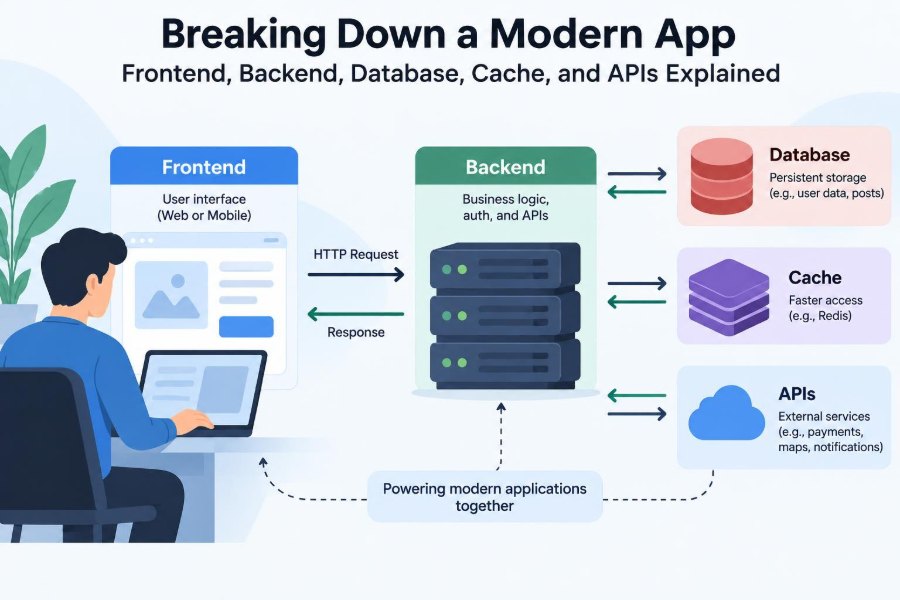
Behind that small sequence is a coordinated system. Your phone renders an interface, servers apply business rules, databases store durable facts, caches accelerate repeated reads, and APIs carry requests between components.
Modern applications can seem mysterious because users see only the polished surface. For software engineers, though, understanding the layers underneath makes design discussions, debugging sessions, and architectural trade-offs much easier to navigate.
A useful mental model is not that an app is one program. It is a set of specialized parts with clear responsibilities, communicating under real constraints such as latency, failures, security, changing requirements, and growing traffic.
🧭 The App as a Coordinated System
A modern application is usually a distributed system: multiple programs, often running on different machines, cooperate to deliver one user-facing product. A web browser, mobile app, API server, database, payment provider, and notification service may all participate in one checkout.
Each part exists because it solves a different problem well. The frontend focuses on interaction, the backend coordinates rules and workflows, the database preserves data, and the cache makes selected data faster to retrieve.
🏗️ A Simple Layered Picture
A useful first approximation is a request flowing through layers: user interface, API, application logic, data storage, then back again. Real systems are less linear, but this model gives you a place to start when tracing behavior.
| Layer | Primary responsibility | Example |
|---|---|---|
| Frontend | Display and interaction | Product search screen |
| Backend | Rules and orchestration | Validate an order |
| Database | Durable source of truth | Orders and accounts |
| Cache | Fast temporary access | Popular restaurant list |
| API | Communication contract | Request order details |
The boundaries are conceptual, not always separate machines. A small application may run several roles in one deployment, while a large one may split each role into many services.
🖥️ What the Frontend Actually Does
The frontend is the part a person directly uses: a website in a browser, a mobile application, or even a desktop interface. It turns data and application state into buttons, forms, text, images, navigation, and feedback.
Its job is not merely visual styling. A strong frontend handles loading states, input validation, accessibility, local interactions, error messages, and the transition between screens without making users wonder what happened.
🎨 Rendering the Interface
Rendering means producing the visible interface from the current state. If a user adds an item to a cart, the frontend updates the cart count, line items, and total based on the information it currently has.
In web applications, browsers interpret HTML, CSS, and JavaScript. Frameworks such as React, Vue, Angular, and others help developers organize interfaces, but the underlying goal remains the same: reflect state accurately and efficiently.
🧠 Frontend State Is Not One Thing
State is information that can change over time. Some state is temporary, such as whether a menu is open; some belongs to a form; some is remote data fetched from the server, such as a customer’s recent orders.
Confusing these categories creates bugs. A dropdown’s open/closed status usually should not be stored in a database, while an order’s paid status should not exist only in a browser tab.
- UI state: selected tab, modal visibility, animation progress.
- Form state: field values, validation messages, unsaved edits.
- Server state: data owned by the backend and retrieved through an API.
📱 Clients Come in Different Forms
A frontend is often called a client because it requests work from a server. A browser is one kind of client, but a native iOS app, Android app, command-line tool, partner integration, and internal admin dashboard can all use the same backend API.
This is why backend APIs should not be designed only around one screen’s immediate needs. They should express stable business capabilities while still being practical for clients to consume.
🌐 The Request-Response Cycle
When a user searches for “noodles,” the frontend commonly sends an HTTP request to an API endpoint. The server processes it and returns a response, often encoded as JSON, which the frontend uses to render results.
GET /api/restaurants?query=noodles

200 OK
{
  "results": [{"id": "r42", "name": "Noodle House"}]
}
This exchange sounds simple, but it raises design questions: Who may make the request? What happens if it takes too long? How are errors represented? Can the response safely be cached?
🔌 APIs Are Contracts, Not Just URLs
An application programming interface, or API, is an agreed way for software components to communicate. A URL and HTTP method are only part of that agreement; request fields, response shapes, authentication, error behavior, and compatibility expectations matter too.
A dependable API lets clients evolve with confidence. If a mobile app expects a field called total, silently renaming it to amount can break installed versions that cannot be updated immediately.
📬 Common API Styles
REST-style HTTP APIs are common because they map naturally to resources and HTTP methods. For example, GET retrieves information, POST commonly creates or triggers work, and DELETE requests removal.
Other approaches solve different needs. GraphQL allows clients to request selected fields from a typed schema. RPC-style APIs model operations directly, such as submitOrder. Event streams and WebSockets support ongoing, near-real-time communication.
No style automatically produces a good system. The better choice depends on data access patterns, team knowledge, client requirements, observability, and operational constraints.
🧑🍳 The Backend Is the Coordinator
The backend runs code on servers and enforces the rules that must be trusted. It may calculate a price, check inventory, authorize a user, create an order, request payment, and schedule a receipt.
Think of it as the kitchen and operations desk behind a restaurant app. The frontend can show a customer’s choices, but it should not be the final authority on whether a discount is valid or a payment succeeded.
📏 Business Logic Belongs Where It Can Be Trusted
Business logic translates product rules into software behavior. “A coupon cannot be used after expiry” and “only a team owner can delete a project” are business rules, not mere interface preferences.
Client-side checks still improve usability by giving fast feedback. But a user can modify browser requests or call an API directly, so security-sensitive and financially meaningful checks must be repeated on the backend.
🧩 Services and Modular Boundaries
Within a backend, code is often grouped into modules such as accounts, catalog, billing, and notifications. Good boundaries make ownership clearer and reduce accidental coupling: changing notification delivery should not require rewriting order calculation.
A module is not necessarily a microservice. A modular monolith keeps related modules in one deployable application, which can be simpler to test and operate. Microservices introduce independent deployment and scaling, but also network failures, monitoring complexity, and consistency challenges.
🗃️ Why Databases Exist
A database stores information so it survives process restarts, deployments, and device changes. It is commonly the durable record for entities such as users, products, orders, permissions, and audit events.
Without durable storage, an order might disappear when a server restarts. A database therefore does more than hold values: it provides querying, indexes, constraints, backup mechanisms, and concurrency controls.
🧱 Relational Data and Relationships
Relational databases organize data into tables with rows and columns. They are particularly effective when data has clear relationships: an order belongs to a customer, and order items belong to an order.
SQL databases can enforce rules close to the data, such as unique email addresses or foreign-key relationships. Those protections do not replace application validation, but they help prevent invalid states from entering the durable record.
📄 Document and Specialized Databases
Document databases store flexible records, often shaped like JSON. They can work well when records vary substantially or when a document is frequently retrieved and updated as a whole.
There are also key-value stores, graph databases, time-series databases, and search engines. Selecting one should follow the access patterns and correctness requirements, not a fashionable label. Many systems use more than one storage technology for different jobs.
🔐 Transactions Protect Related Changes
A transaction groups operations so they succeed or fail together according to the database’s guarantees. In a simplified transfer, subtracting money from one account and adding it to another should not leave only the first step completed.
Transaction behavior varies by database and configuration, especially across services. Engineers need to understand the guarantees they actually have rather than assuming every sequence of writes is automatically atomic.
⚡ What a Cache Is For
A cache keeps a temporary copy of data that is expensive or slow to retrieve again. Common candidates include popular product pages, computed summaries, session data, and the results of repeated queries.
Memory is generally faster to access than a database or remote service, so caching can reduce latency and lower pressure on downstream systems. It does not make a system inherently better; it trades some simplicity and freshness for speed.
🥫 Cache-Aside in Practice
A common pattern is cache-aside. The application looks in the cache first. On a miss, it retrieves the value from the database, places a copy in the cache with an expiration time, then returns it.
- Request the product record from the cache.
- If present, return the cached value.
- If absent, read the database.
- Store the result temporarily and return it.
This works especially well for data read much more often than it changes. It needs careful behavior for missing records, expired values, and sudden bursts of requests for the same uncached key.
⏳ The Hard Part: Cache Invalidation
When source data changes, a cached copy may become stale. If a restaurant closes but the cache still returns its old status, the user sees information that is no longer accurate.
Common strategies include short expiration times, deleting or updating cache entries during writes, and versioned keys. Each has trade-offs. Short expirations reduce stale periods but can increase database traffic; explicit invalidation can be precise but is easy to overlook in a new update path.
🚦 Load Balancers and Many Servers
One backend process eventually becomes insufficient for reliability or traffic. A load balancer distributes incoming requests across multiple healthy server instances, preventing one machine from doing all the work.
This changes design requirements. Any server might handle the next request, so keeping essential user state only in one server’s memory is fragile. Shared stores, signed tokens, or dedicated session storage are more suitable.
🔑 Authentication and Authorization Are Different
Authentication answers “who is making this request?” A password, passkey, session, or token can help establish an identity. Authorization answers “is this identity allowed to perform this action?”
A logged-in employee may be authenticated but not authorized to view payroll records. Treating login as permission is a common security mistake; each sensitive operation needs an appropriate authorization decision.
🛡️ Validate Every Trust Boundary
Data arriving from browsers, mobile apps, integrations, queues, and even internal services should be treated as untrusted until validated. Validate type, length, format, range, and whether the requested action is allowed in the current state.
Use parameterized database queries rather than assembling query strings from input. Store secrets outside source code, restrict access using least privilege, and avoid returning internal error details to ordinary users.
🧯 Failure Is a Normal Operating Condition
Networks time out, processes restart, dependencies slow down, and users retry after seeing a spinner. A reliable backend plans for partial failure instead of assuming every call completes once and only once.
Timeouts keep requests from waiting indefinitely. Retries can help with temporary failures, but unsafe retries can duplicate work. For actions such as charging a card or creating an order, an idempotency key lets the server recognize repeated submissions of the same intended operation.
📨 Background Jobs Keep Requests Responsive
Some work should not hold up a user request: sending email, generating a report, resizing an upload, or notifying multiple systems. A queue can record the work for a background worker to perform later.
This improves responsiveness and absorbs bursts, but it introduces delayed processing. The user interface should communicate honestly when work is pending rather than claiming completion before it has occurred.
🔄 Consistency Across Components
Within one database transaction, strong consistency may be achievable. Across a payment service, order database, cache, search index, and email queue, immediate agreement is much harder.
Many distributed workflows use eventual consistency: components converge after a delay. That can be acceptable for search results or analytics, but less acceptable for a final payment decision. The right requirement depends on the consequence of temporarily showing old information.
📈 Observability Turns Symptoms into Evidence
When users report that checkout is slow, “the system seems fine” is not enough. Observability provides evidence through logs, metrics, and traces.
- Logs record discrete events and contextual details.
- Metrics show measurements over time, such as request rate or error count.
- Traces follow one request across services and reveal where time was spent.
Use correlation or trace IDs so related events can be connected without placing sensitive personal data in logs.
🧪 Testing at More Than One Level
Unit tests examine a small piece of logic quickly, such as discount eligibility. Integration tests verify that components work together, such as an API handler writing the expected database record. End-to-end tests exercise a user journey through realistic boundaries.
No single category catches every issue. A broad test suite should focus effort where failure would be costly: authorization rules, money calculations, migrations, data transformations, and critical workflows.
🚀 Deployment Is Part of Engineering
Code is not useful until it runs reliably in an environment users can reach. Deployment includes building artifacts, applying configuration, migrating data carefully, monitoring behavior, and having a rollback or mitigation plan.
Database changes deserve special caution. A safer approach often adds a compatible column or table first, deploys code that can handle both forms, migrates data, and removes old structure only after it is no longer needed.
📉 Performance Is About Bottlenecks
Performance work begins with measurement. A slow page may be caused by a large frontend bundle, a waterfall of API requests, a missing database index, an overloaded dependency, or unnecessary serialization of data.
Optimizing the wrong layer adds complexity without improving the user experience. Profile queries, inspect request traces, measure page behavior, and identify the limiting resource before introducing a cache or redesign.
🧭 A Walkthrough: Placing an Order
Consider a hypothetical food-order request. The frontend sends the selected items, delivery address identifier, and a client-generated idempotency key to the order API. The backend authenticates the customer, validates the cart against current prices and availability, and calculates the final total.
The backend stores a pending order in the database, calls a payment provider, then records the outcome. It may publish an event for a background worker to send a confirmation. A cache holding the restaurant menu may be invalidated if availability changed.
Every stage has a distinct owner and failure mode. That separation is not bureaucracy; it makes it possible to reason about what happened if payment succeeds but notification delivery is delayed.
🧰 Common Architecture Mistakes
Beginners often place too much trust in the client, treat a cache as the source of truth, or split a small product into many networked services before there is a practical need. These choices can make a system insecure or unnecessarily difficult to operate.
Other recurring problems include unbounded queries, missing pagination, vague API errors, no timeouts on outbound calls, and schema changes made without a compatibility plan. The remedy is usually not a new framework; it is clearer responsibilities and deliberate operational design.
🧱 Start Simple, Preserve Good Boundaries
A small application can begin with one backend, one relational database, and a straightforward HTTP API. This is often easier to understand, deploy, and debug than a distributed collection of services.
Simple does not mean careless. Keep modules separate in code, make database ownership clear, define API contracts, validate inputs, and instrument important requests. These practices preserve options if the product later needs more scale or specialization.
🎯 The Core Principle: Clear Responsibilities
The frontend should provide a usable experience, the backend should apply trusted rules, the database should preserve authoritative data, the cache should accelerate carefully chosen reads, and APIs should provide dependable communication contracts.
These boundaries are guides, not rigid laws. A server may render initial HTML, a database may provide caching features, and a frontend may validate input. The key question is always: which component can own this responsibility safely, clearly, and reliably?
Modern app architecture becomes manageable when you follow data, identify ownership, and design every boundary for change and failure. Once you can trace a request from a click to durable data and back, the apparent complexity resolves into understandable engineering decisions. ⚙️🧩🚀