
A checkout page can look perfect in one team’s local environment and still fail the moment it meets the payment service in production. The frontend sends currency; the backend now expects currencyCode. Both changes may be reasonable on their own. Together, they can stop customers from paying.
This is a familiar problem in systems built from independent services. Teams deploy at different times, work in different repositories, and make decisions without seeing every downstream dependency. A service can be internally correct while being externally incompatible.
Traditional test suites catch many defects, but they often stop at a service boundary. Unit tests validate local logic. End-to-end tests validate a few critical journeys. Neither necessarily tells a team, early enough, that it has broken a promise another service relies on.
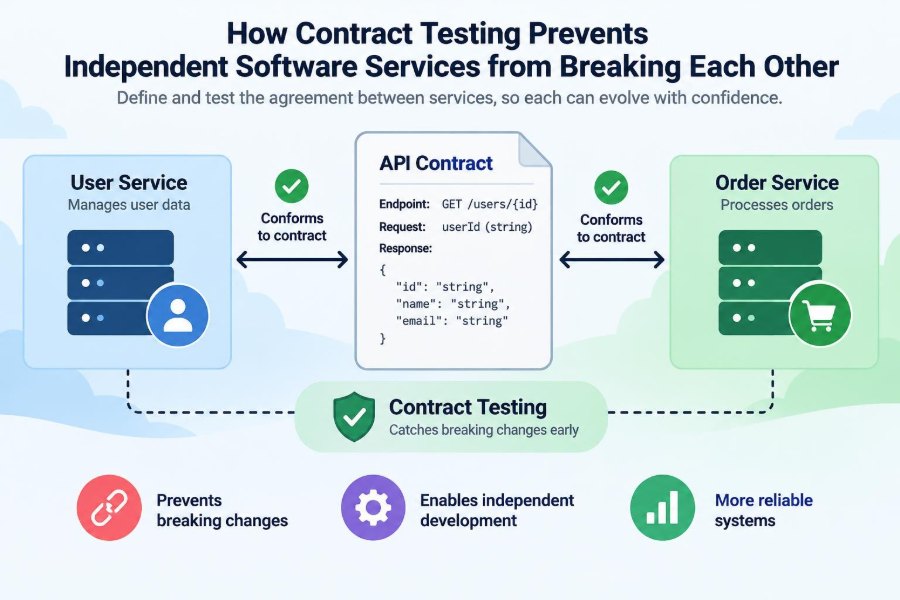
Contract testing addresses that missing conversation. It turns the assumptions between services into executable checks, so incompatible changes are found before they become cross-team incidents.
🧩 The Problem with Independent Services
Microservices, modular backends, and separately deployed APIs give teams autonomy. A catalog team can release a product-search improvement without waiting for the order team, and a mobile team can evolve its application on its own schedule.
That autonomy creates a coordination challenge: each boundary becomes an agreement. The agreement includes routes, request fields, response fields, status codes, headers, message formats, and sometimes timing or authentication expectations.
Without a reliable way to verify these agreements, teams discover mismatches late: during integration, staging, or after a deployment. Contract testing makes those agreements visible and testable.
📜 What a Software Contract Really Is
A software contract is not necessarily a legal document or a long specification. It is the observable behavior one component promises to another at an interface.
For an HTTP API, a contract may say that GET /products/42 returns status 200 and a JSON object containing an identifier, name, and price. For an event stream, it may say that an event named OrderPlaced contains an order ID and an event timestamp.
The key word is observable. A consumer should not depend on private classes, database tables, or internal implementation choices. It should depend only on behavior exposed across the boundary.
🔍 Interfaces Carry More Than Data Shapes
Developers often reduce a contract to a JSON schema. Shape matters, but a dependable contract is broader. A consumer may rely on which status code indicates a missing resource, whether a field can be absent, or whether a list is paginated.
- Request expectations: method, path, query parameters, headers, and body.
- Response expectations: status, headers, body fields, types, and permitted values.
- Failure behavior: validation errors, authorization failures, and retryable conditions.
- Interaction rules: event names, routing keys, correlation IDs, or message acknowledgements.
A useful contract captures the parts a consumer actually needs, rather than every incidental property of an implementation.
🧪 Contract Testing in Plain Language
Contract testing checks whether two independently built components agree about their shared interface. Usually, it does this without requiring both complete applications to run together for every test.
One side records or defines an expected interaction. The other side verifies that it can honor that expectation. If the provider changes behavior in a way that violates the expectation, the verification fails in continuous integration.
Think of it as checking that a plug and socket still fit before shipping either appliance. It does not prove that the entire house has power, but it catches a specific and common kind of incompatibility.
👥 Consumers and Providers
Most contract-testing discussions use two roles. The consumer is the component that calls an API or receives a message. The provider is the component that offers that API or publishes that message.
A web application requesting shipping quotes is a consumer of a shipping service. The shipping service is the provider. The same shipping service might be a consumer of a postal-code validation API, so these roles are relative to a particular interface.
Clear roles prevent a common confusion: contract testing is about a relationship, not a hierarchy. A service can participate in many contracts from both directions.
🧭 Consumer-Driven Contracts
In a consumer-driven contract approach, consumers describe the interactions they need. For example, the checkout service may state that it needs a response with quoteId, amount, and estimatedDays after requesting a shipping quote.
The provider then verifies that its current implementation satisfies all published consumer expectations. This is valuable because it tests compatibility from the perspective of code that would otherwise break.
Consumer-driven contracts are not permission for every consumer to dictate the provider’s entire design. They should document legitimate needs at the boundary, with provider teams retaining responsibility for coherent API design.
📐 Provider-Defined Contracts
Some organizations begin with a provider-owned API description, often expressed in a machine-readable format. Consumers generate clients, validate requests, or run conformance tests against that description.
This model works especially well when an API is designed as a product for many consumers, including external clients. It creates a central published source of intended behavior.
The trade-off is that a description can be broader than real usage. A provider may not learn that an apparently minor change breaks a specific consumer unless consumer tests or usage knowledge supplement the specification.
⚖️ Choosing a Contract Direction
Neither direction is universally superior. Consumer-driven contracts are strong at protecting known dependencies. Provider-defined contracts are strong at establishing a stable, discoverable public interface.
| Approach | Best fit | Main watch-out |
|---|---|---|
| Consumer-driven | Internal services with known callers | Too many narrow or duplicate expectations |
| Provider-defined | Public or broadly shared APIs | Specification may drift from actual consumer needs |
| Combined | Important APIs with varied consumers | Requires clear ownership and review practices |
Many teams combine them: a provider publishes a baseline specification, while important internal consumers add focused compatibility checks.
🧱 What a Good Contract Includes
A contract should be precise enough to prevent meaningful breakage and flexible enough to allow implementation evolution. It describes required behavior, not every byte of an example response.
For a product lookup, a consumer might require id as a string and availability as one of several recognized values. It usually should not require the provider’s fields to appear in a particular JSON order, because order is irrelevant for JSON objects.
This distinction matters. Overly strict contracts create noisy failures; vague contracts let real regressions through.
🧷 Matching Rules Prevent Brittle Tests
Suppose an order ID changes on every request. A contract that demands the literal value order-123 is fragile. A better contract says that the field must be a nonempty string matching the identifier format the consumer can handle.
Matching rules express this intent through types, regular expressions, minimum sizes, enumerated values, or structural requirements. They let examples illustrate an interaction without accidentally turning sample data into a permanent rule.
Match on meaning, not on convenient test fixtures. This is one of the most important habits in sustainable contract suites.
🚦 Status Codes and Error Paths Matter
Happy-path contracts are necessary but incomplete. Consumers also make decisions based on failure behavior. A client may show “address not found” for a 404, request new credentials after a 401, and retry only for selected server failures.
If a provider changes a validation failure from 400 to 500, the response body may still be valid JSON while the consumer’s behavior becomes incorrect. Contract tests can make these error semantics explicit.
Test the errors that drive real branches in consumer code, especially authorization, validation, absence, conflict, and temporary unavailability.
📨 Contracts for Asynchronous Messages
HTTP is only one form of integration. Services also communicate through queues, streams, webhooks, and scheduled file exchanges. In these systems, producer and consumer may never be online at the same time.
A message contract can verify the event topic, metadata, payload structure, required fields, and field constraints. For example, an inventory service publishing StockReserved can verify that every consumer receives a valid reservation ID and quantity.
Asynchronous contracts should also clarify event meaning. “Order updated” is often too ambiguous: does it mean payment changed, shipping changed, or any field changed? Better event names and payloads reduce guesswork.
🔁 Event Evolution Requires Extra Care
Events are frequently retained, replayed, or processed later by services that were not deployed alongside the producer. That makes destructive changes particularly risky.
Adding an optional field is commonly easier to evolve than removing a required field or changing its meaning. A field named amount should not quietly switch from cents to dollars just because its type remains numeric.
When a change is truly incompatible, publish a new event version or a new event type, run both paths during migration where practical, and retire the old version deliberately.
🧰 The Contract Test Workflow
A typical workflow starts when a consumer writes a test around its integration client. The test defines a request and the response behavior needed for a scenario. The test runs against a stub built from that contract, allowing consumer development to proceed independently.
The generated contract is then made available to the provider team, often through a shared repository, artifact store, or contract broker. The provider’s pipeline retrieves relevant contracts and verifies them against its implementation.
- Define the consumer’s required interaction.
- Run the consumer test against a contract-aware stub.
- Publish or share the contract.
- Verify the provider against that contract in CI.
- Use the result to decide whether a change is safe to release.
Tools automate parts of this workflow, but the essential value comes from the agreement and verification, not from a particular product.
🏗️ Provider Verification Is the Critical Check
A mock can always return what the consumer expects because the consumer controls it. The meaningful question is whether the real provider can produce that behavior under representative conditions.
Provider verification starts the provider in a testable environment or invokes its handlers directly. It places the provider into known states, sends the contract’s requests, and compares actual results with the contract’s rules.
This is where a renamed field, changed status code, or missing header is caught. Without provider verification, a contract can become an optimistic document rather than a compatibility safeguard.
🌱 Provider States Keep Tests Realistic
Many interactions depend on data: a product exists, an account is suspended, or an order has already been shipped. Provider states describe these preconditions in business terms, such as “a reservable item exists.”
The provider verification setup then creates suitable data through fixtures, database setup, test APIs, or isolated environments. The exact mechanism is internal; the contract does not need to dictate it.
Keep states focused on conditions that affect the interface. A state named “database row 17 contains X” leaks implementation detail and makes harmless refactoring harder.
🧑💻 A Concrete API Example
Imagine a billing service that calls an accounts service before creating an invoice. It needs to know whether the account is active and which billing currency applies.
GET /accounts/a-482

200 OK
{
  "id": "a-482",
  "status": "active",
  "billingCurrency": "USD"
}
A useful contract could require the three fields above and define status as a supported status value. If the accounts team later replaces billingCurrency with currency, provider verification fails before that version is released to billing.
The contract does not need to assert unrelated profile fields. Billing cannot be broken by fields it neither receives nor uses.
🧪 How Contract Tests Differ from Unit Tests
Unit tests isolate a small unit of code, often with dependencies replaced by fakes or mocks. They are fast and excellent for validating local rules: tax calculations, parsing, validation, and branching behavior.
Contract tests sit at an integration boundary. They ask whether the boundary still behaves as another component expects. A unit test may prove that a controller maps a field correctly according to its local assumptions; a contract test checks whether those assumptions are compatible with a caller.
Both belong in a healthy test strategy. Contract tests are not a replacement for detailed local tests.
🗺️ How They Differ from End-to-End Tests
End-to-end tests exercise a complete user flow across multiple real components. They can reveal wiring problems, authentication configuration issues, browser behavior, and deployment mistakes that contract tests do not cover.
However, they are often slower, more environment-dependent, and harder to diagnose. A failed checkout journey may have dozens of possible causes. A failed provider contract usually points directly to an interface mismatch.
The practical goal is not to eliminate end-to-end tests. It is to reserve them for a smaller set of high-value journeys while using contract tests to cover many service boundaries earlier.
🚫 What Contract Tests Cannot Prove
Passing contracts do not prove that a provider’s business logic is correct, its database is reliable, or its performance meets production demand. They do not prove that a consumer uses the API sensibly in every circumstance.
They also cannot detect dependencies that have never been captured in a contract. If a client parses an undocumented error message, but no test describes that dependency, a change may still break it.
Use contracts alongside unit, integration, security, performance, observability, and selected end-to-end testing. Each technique exposes different failure modes.
🧼 Avoid Testing Implementation Details
A contract becomes costly when it freezes details consumers do not need. Requiring an exact generated timestamp, a database-derived sort order that was never promised, or every optional response field turns normal maintenance into apparent breakage.
Ask a simple question for each assertion: “Would this difference require the consumer to change its behavior?” If the answer is no, it may not belong in the contract.
This does not mean contracts should be weak. It means strictness should correspond to a real dependency, such as a required field, semantic error, or supported value.
📦 Backward Compatibility Is a Release Strategy
Contract testing works best with an API evolution mindset. Providers should assume that consumers may deploy later than the provider and may not upgrade in lockstep.
A safe sequence is often additive first: introduce a new optional field or endpoint, let consumers adopt it, verify usage, then deprecate the old behavior after a communicated migration period. Removing or redefining a field first reverses that safety.
Contracts expose current compatibility, but teams still need policies for versioning, deprecation, ownership, and release coordination when a breaking change is unavoidable.
🔀 Versioning Is Not a Substitute for Compatibility
Putting /v2 in a URL or adding a version field to an event can make incompatible changes explicit. It does not automatically make migrations easy. Providers may need to operate multiple versions, and consumers still need time to switch.
Version only when it communicates a meaningful compatibility boundary. For routine additive evolution, a new version can create unnecessary duplication and operational burden.
Contract verification helps here too: it shows which consumer expectations each provider version satisfies, making migration decisions based on behavior rather than guesswork.
🧯 Common Failure: Contracts That Are Too Broad
One common anti-pattern is treating contract testing as a way to snapshot an entire API response. Such tests fail whenever a provider adds harmless metadata, reorders irrelevant output, or makes an internal cleanup.
Another broadness problem is a contract that represents every possible scenario in one massive interaction. It becomes difficult to understand why it exists and difficult to update safely.
Prefer small, named interactions tied to a consumer decision: “active account can be invoiced” or “unknown account returns not found.” Each should communicate a real requirement.
🪤 Common Failure: Mocking Away Reality
Teams sometimes generate contracts from mocks that do not reflect the provider’s authentic behavior, then stop before running provider verification. This creates confidence in an agreement that only one side has seen.
Another issue is provider verification against an overly artificial layer that bypasses routing, serialization, validation, or authentication behavior relevant to the public interface.
Choose a verification level that exercises the boundary meaningfully. It can still use controlled test data and replace expensive external dependencies, but it should validate the provider behavior consumers actually receive.
🧑🤝🧑 Ownership and Collaboration
Contracts are technical artifacts, but their value depends on team behavior. Consumer teams should describe genuine needs and remove contracts when they no longer use an interaction. Provider teams should treat verified contracts as compatibility commitments.
When a verification fails, the right response is not automatically “update the consumer contract.” First determine whether the provider change is intentional, whether it is compatible, and whether consumers have a migration path.
A lightweight review process helps. Discuss proposed breaking changes early, assign ownership for contracts, and make it clear who can approve deprecations.
🔐 Sensitive Data and Test Environments
Contracts can accidentally preserve realistic examples containing names, email addresses, account numbers, access tokens, or internal identifiers. Treat contract artifacts as code and data that may be stored, shared, and retained.
Use synthetic values, redact secrets, and ensure provider states do not require production data. If a contract needs a token format, verify the format or use a safe placeholder rather than embedding an active credential.
This practice improves security and makes tests easier to run consistently in isolated environments.
⚡ Keeping the Pipeline Fast Enough to Matter
A compatibility check is most useful before deployment decisions are expensive. If provider verification takes hours or depends on a fragile shared environment, developers may bypass it or wait until changes accumulate.
Keep contract suites focused, run them in isolated environments where possible, and separate fast pull-request checks from broader scheduled verification when necessary. Cache dependencies and avoid requiring unrelated services for every test.
Speed is not merely convenience. Fast feedback lets teams fix an interface mismatch while the change and its intent are still clear.
📊 Reading a Contract Failure Productively
A failed verification is evidence of a disagreement, not automatically evidence that one team made a mistake. Start by identifying the exact mismatch: missing field, changed type, unexpected status, invalid request, or unmet provider state.
Then ask which behavior is intended and which versions are currently deployed. Sometimes the provider needs to retain old behavior. Sometimes the consumer contract is stale because the consumer has already changed. Sometimes both teams need a planned migration.
Good failure messages include the interaction name, request, expected rule, actual response, and provider state. Invest in readable test names; they reduce cross-team debugging time.
🪜 Introducing Contract Testing Incrementally
You do not need to model every dependency at once. Start with an interface that changes often, has caused integration regressions, or supports a business-critical workflow such as authentication, pricing, orders, or payments.
- Choose one consumer-provider relationship with a clear owner on each side.
- Cover a small number of high-value success and error paths.
- Add provider verification to the normal build pipeline.
- Refine matching rules after observing noisy or missed failures.
- Expand only when the first contracts are useful and maintained.
This gradual approach teaches teams how to write meaningful contracts before the suite becomes large.
🎯 Deciding What Deserves a Contract
Not every function call needs a contract test. In-process modules can often rely on compile-time types and conventional integration tests. Stable third-party APIs may be better covered by adapter tests and monitoring, depending on what you can verify.
Contract testing is most valuable where independently deployed components have a meaningful compatibility risk. Consider deployment independence, frequency of change, number of consumers, business impact, and the cost of discovering a mismatch late.
Use the technique where it buys clarity and early feedback, not as a ritual applied uniformly to every line of integration code.
🧠 The Core Principle: Test the Promise at the Boundary
Independent services can evolve safely only when their shared promises evolve safely. Contract testing makes those promises executable: consumers state what they depend on, providers verify that they still deliver it, and pipelines expose incompatibility before deployment.
It is not an all-purpose testing replacement. It will not validate complete user journeys or guarantee correct business decisions. Its strength is narrower and highly practical: protecting the interface where independently changing systems meet.
When contracts focus on meaningful behavior, use flexible matching, include important failures, and receive regular provider verification, they reduce accidental breakage without forcing every team to release together.
Contract testing protects autonomy by making compatibility a tested promise rather than an assumption. That is what lets services change independently without repeatedly surprising the systems that depend on them. ⚙️ 🤝 🚀