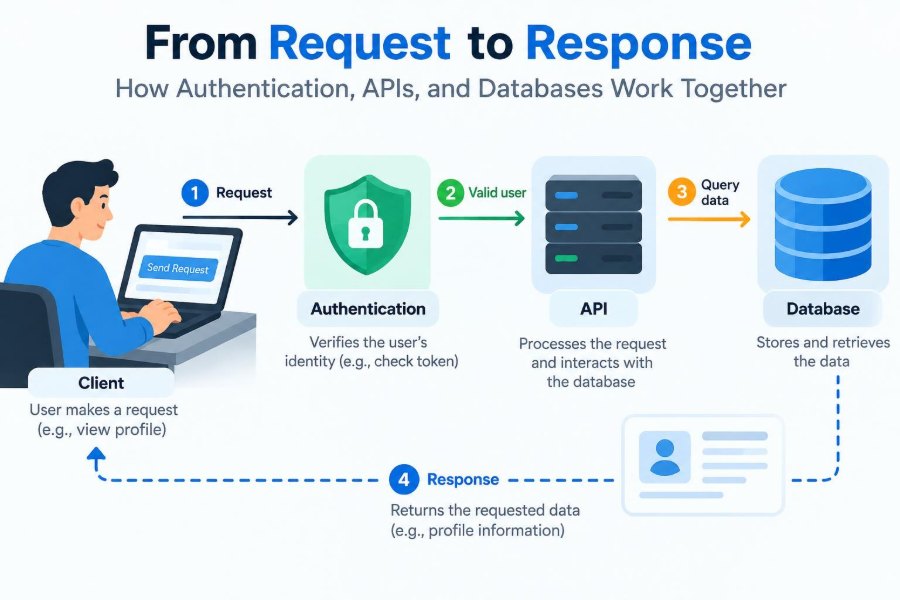

You open a banking app, enter a passcode, and see your balance. Or you sign in to a shopping site, add an item to a cart, and receive an order confirmation a moment later. Each action feels immediate, but several systems have coordinated behind the screen.
A simple button click can trigger identity checks, permission decisions, application logic, database queries, network messages, and error handling. If any one part is designed poorly, users may see incorrect data, lose access, wait too long, or—more seriously—reach information they should never be allowed to see.
Understanding this path is useful far beyond backend development. Frontend engineers need to know what the server expects. Product teams need realistic expectations about data and security. Developers debugging a failed request need a mental model of where it might have broken.
Follow one hypothetical request through a typical web application, and the relationship between authentication, APIs, and databases becomes much easier to reason about.
🧭 The Journey Begins With a Request
A request is a message from a client to a server asking it to do something. The client may be a browser, mobile app, command-line tool, or another service.
For example, a mobile app might send a request asking for the signed-in customer’s recent orders. The server receives it, decides whether the requester is allowed to ask, retrieves the relevant information, and sends a response back.
That simple description hides many choices: how identity is proved, where business rules live, how data is stored, and what happens when something fails.
📱 Clients Are More Than Browsers
People often picture a browser when they hear “client,” but a client is any program that consumes a server’s capabilities. A checkout page, an iOS app, a warehouse scanner, and an internal reporting job can all call the same API.
This matters because the server should not blindly trust the interface a user happens to see. A determined user can modify browser requests or call an API directly. Security decisions must be enforced by the server, not merely hidden behind buttons in the user interface.
🛣️ HTTP Gives Requests a Shared Language
Most web APIs use HTTP, the protocol that defines how clients and servers exchange messages. An HTTP request commonly includes a method, a path, headers, and sometimes a body.
GET /api/orders?status=recent
Authorization: Bearer <token>
Accept: application/json
The method signals intent. GET usually reads data, POST commonly creates something, PATCH changes part of an existing resource, and DELETE requests removal. These conventions make APIs easier to predict, though correct authorization remains necessary for every method.
🚪 An API Is the Application’s Contract
An API, or application programming interface, defines how one software component asks another for work. A web API exposes selected application functions through endpoints such as /api/orders or /api/profile.
Think of an API as a restaurant menu, not the kitchen itself. It tells callers what they can request and what shape of result to expect. It does not require callers to know the database schema, the internal programming language, or every business rule.
This boundary lets internal implementation change without forcing every client to change at the same time.
🔐 Authentication Answers “Who Are You?”
Authentication establishes an identity claim. When a person signs in with a password, a passkey, a one-time code, or an organization’s identity provider, the system is trying to establish who is making the request.
Authentication is not the same as proving that a request is safe or allowed. It is possible to identify a user correctly and still deny a particular action.
For example, the server may authenticate Maya as a valid employee, then reject her attempt to approve her own expense report.
🪪 Credentials Should Not Become Everyday Requests
A password, private key, or authenticator proof is a sensitive credential. Well-designed systems generally use it during sign-in, then issue a temporary artifact—often a session identifier or token—for later requests.
This reduces how often the primary credential travels through the application. It also makes expiration, sign-out, device management, and session revocation more manageable.
Credentials still require careful handling: transport must be encrypted, password storage must use purpose-built password hashing, and logs must never record secrets.
🍪 Sessions Keep Track of Signed-In Users
With a server-side session, the server creates a record containing session state and gives the client an opaque session ID, often in a cookie. On future requests, the browser returns that cookie, allowing the server to look up the associated user.
An opaque ID has no useful meaning to the client. The server remains the source of truth for whether it is valid, expired, or revoked.
Cookies can be configured with protections such as HttpOnly, which prevents normal page scripts from reading them, and Secure, which restricts transmission to HTTPS connections. These settings help but do not replace broader security design.
🎟️ Tokens Carry a Verifiable Claim
In token-based designs, the client sends a token—often in an Authorization header—with each request. A signed token can contain claims such as a user identifier, expiration time, and intended audience.
Some tokens are self-contained and can be validated cryptographically without a database lookup. Others are opaque references that the server checks against an authorization service. Neither approach is automatically superior; the right choice depends on revocation needs, system architecture, and operational constraints.
A token is still a credential. Anyone who obtains a usable token may be able to act as its holder until it expires or is invalidated.
⏳ Expiration Limits the Cost of Theft
Sessions and access tokens should have lifetimes. Short-lived access tokens reduce the window in which a stolen token can be used, while refresh mechanisms may let legitimate users continue working without repeated sign-in.
There is a trade-off. Very short expiration can create friction or extra infrastructure work. Very long expiration increases the damage from lost devices, leaked browser storage, or copied logs.
For sensitive applications, teams also consider explicit sign-out, password changes, suspicious activity, and administrative account disablement when deciding how tokens should be revoked.
🛂 Authorization Answers “May You Do This?”
Authorization decides whether an authenticated identity may perform a requested action on a particular resource. It follows authentication because a system usually needs to know who is asking before it can judge permissions.
Consider the difference between these two rules: “a signed-in user may view orders” and “a signed-in user may view their own orders.” The second rule requires checking ownership, not just the presence of a valid login.
Authentication establishes identity; authorization applies policy. Confusing them is a common source of security defects.
👥 Roles, Permissions, and Ownership
Applications often combine several authorization approaches. A role might identify an administrator or support agent. A permission might allow refund approval. Ownership might allow a customer to edit only their own delivery address.
| Approach | Useful for | Example decision |
|---|---|---|
| Role-based access | Broad job responsibilities | Only administrators can manage users. |
| Permission-based access | Specific capabilities | Staff with refund approval can issue refunds. |
| Ownership checks | Individual resources | A customer can read only orders tied to their account. |
| Attribute-based rules | Context-sensitive policy | A manager can view reports for their assigned region. |
Real applications often need more than one. A support agent may have a support role but still be restricted to a particular region or tenant.
🧱 Middleware Handles Cross-Cutting Work
Many server frameworks process requests through a pipeline called middleware. Each middleware component can inspect or modify a request before the request reaches its endpoint handler.
Typical middleware concerns include request IDs, HTTPS enforcement, authentication, rate limiting, parsing JSON, and logging. Centralizing these concerns prevents every endpoint from reimplementing the same logic.
Order matters. An authorization check cannot use an identity that authentication middleware has not established yet.
🧩 Routing Selects the Right Handler
After preliminary processing, the server’s router matches the HTTP method and path to application code. GET /api/orders/42 may reach an order-reading handler, while POST /api/orders reaches order creation logic.
Routing is not authorization. A route can be publicly reachable at the network level while its handler correctly denies unauthorized users. Conversely, hiding a route name provides no meaningful access control.
✅ Validation Checks Whether Input Makes Sense
Before data reaches business logic or a database, the server should validate it. Validation checks shape, type, required fields, allowed values, length limits, and relationships that can be checked at the application boundary.
If an order request says the quantity is -4, the API should reject it clearly rather than passing an impossible value deeper into the system. Validation also reduces accidental errors and narrows opportunities for malformed input to cause trouble.
Client-side validation improves user experience, but server-side validation is essential because clients can be bypassed or altered.
🧠 Business Logic Applies the Real Rules
Business logic is where the application translates a request into domain behavior. Creating an order may involve confirming inventory rules, calculating taxes, applying eligible discounts, reserving stock, and choosing an order state.
This layer should not merely copy request fields into a database table. It is where the software protects rules that matter to the organization and its users.
For example, an API may accept a requested price field for display purposes, but the server should calculate the final charge from trusted product and pricing data rather than accepting a client-supplied total.
🗄️ Databases Provide Durable State
A database stores information so it remains available after a server process stops or a request ends. User accounts, orders, inventory, audit events, and application settings all commonly need durable storage.
Relational databases organize data into related tables and are especially useful when consistency across records matters. Other database models can suit document-shaped content, caching, search, analytics, or large-scale event streams.
The key point is that the API is usually the controlled path to data. Clients should not receive unrestricted direct access to production database tables.
🔎 Queries Turn Questions Into Data Access
A database query asks for specific data: perhaps the recent orders belonging to the authenticated user. The application builds or chooses that query, sends it through a database driver, and receives rows or documents in return.
Queries should be parameterized rather than assembled by concatenating untrusted text. Parameterization keeps data values separate from the query’s structure and is a central defense against injection vulnerabilities.
SELECT id, status, total
FROM orders
WHERE customer_id = ? AND id = ?
The placeholders are bound as values by the database interface. The exact syntax differs across languages and database libraries, but the principle remains the same.
🔒 Data Access Must Enforce Scope
One of the most damaging API mistakes is fetching an object by its ID without confirming that the requester may access it. If a customer can request /orders/1042, the server must verify that order 1042 belongs to that customer or that another policy permits access.
Changing the number in a URL should never reveal another person’s record. This failure is often called an insecure direct object reference or broken object-level authorization.
Ownership checks can appear in service logic, query conditions, database policies, or a combination of layers. What matters is that the decision is reliable and consistently applied.
🔄 Transactions Protect Multi-Step Changes
Some operations update several records that must remain consistent together. A money transfer, for instance, should not debit one account successfully and then fail before crediting the other.
A transaction groups related database changes so they either succeed together or are rolled back together when an error occurs. This is not a cure-all: external actions such as sending an email or calling a payment provider may require additional coordination.
Still, transactions are a crucial tool whenever partial completion would create an invalid state.
📦 The Response Is a Deliberate Product
After business logic and data access succeed, the server builds a response. For APIs, this is frequently JSON paired with an HTTP status code.
A good response returns what the client needs, not every field stored internally. An order list may include its status and total but omit internal fraud notes, supplier cost, database implementation details, and secrets.
Response design is part of security and usability. Returning less sensitive data reduces exposure, while stable field names and predictable structures make clients easier to maintain.
🚦 Status Codes Communicate Outcomes
HTTP status codes give clients a compact first signal about the result. Their details vary by API design, but the major categories are broadly consistent.
- 2xx: the request succeeded, such as
200 OKor201 Created. - 4xx: the client sent an invalid request, lacks permission, or is not authenticated.
- 5xx: the server could not complete an otherwise valid request because of an internal or dependency failure.
A missing or invalid login commonly produces 401 Unauthorized, while an authenticated user lacking permission commonly receives 403 Forbidden. APIs should avoid leaking sensitive details in error messages, especially on login and permission failures.
🧯 Errors Need Safe, Useful Boundaries
Users and API consumers need enough information to correct a request: which field failed validation, for example, or whether a resource does not exist. They do not need stack traces, raw SQL errors, internal hostnames, or secrets.
A practical pattern is to return a stable error code and human-readable message to the client while recording detailed diagnostic context on the server. A request ID can connect the client-visible failure with the relevant log entries.
Unexpected failures should be handled centrally where possible so every endpoint does not invent a different error format.
📊 Observability Makes the Invisible Traceable
Once a request crosses multiple services, debugging by guesswork becomes expensive. Observability means collecting enough signals—logs, metrics, and traces—to understand what the system is doing.
Structured logs can record the request ID, route, outcome, latency, and non-sensitive user or tenant identifier. Metrics reveal trends such as error rates or slow database calls. Distributed traces show how one request moved through services.
Observability must be designed with privacy in mind. Passwords, access tokens, payment details, and unnecessary personal data do not belong in logs.
⏱️ Latency Accumulates Along the Path
A response can be slow even when no single component appears disastrous. Network travel, token verification, application work, database queries, cache misses, and downstream service calls each add time.
Teams should measure before optimizing. An index may improve a frequently used database query, while a cache may help repeated reads; neither fixes a slow external dependency or inefficient response payload automatically.
Performance work also has trade-offs. Caching creates freshness questions, and extra indexes can make writes more expensive.
🧰 Caches Change Where Data Comes From
A cache stores reusable results closer to the code that needs them. For a product catalog, the API may return a recently cached product description instead of querying the primary database every time.
Caches are helpful when data is read often and can tolerate a short period of staleness. They are risky when used carelessly for rapidly changing balances, permissions, or inventory counts.
Authorization data deserves particular caution. If permissions change, an old cached decision must not continue granting access longer than policy allows.
🔁 Retries and Idempotency Prevent Duplicate Work
Networks fail in ambiguous ways. A client may time out after the server has already created an order, leaving the client unsure whether retrying will create a second one.
Idempotency means repeating an operation has the same intended effect as performing it once. For sensitive creation requests, clients can send an idempotency key; the server records the outcome associated with that key and returns it again on a retry.
This pattern is especially valuable for payments, bookings, and provisioning. It requires careful storage and expiration policies, not just a header name.
🧪 Test the Whole Contract, Not Just Functions
Unit tests can verify a pricing rule or permission function in isolation. They are valuable, but they do not prove that routing, authentication middleware, serialization, database mappings, and error responses work together.
Integration tests exercise meaningful paths through real or realistic components. Useful cases include expired credentials, one user attempting to read another user’s object, invalid input, duplicate retries, and database failures.
Contract tests can also help when separate teams own a client and an API, ensuring that expected request and response shapes do not drift unexpectedly.
🚫 Common Design Mistakes to Avoid
Many incidents come from ordinary shortcuts rather than exotic attacks. The following mistakes deserve explicit review during design and code review:
- Trusting a user ID, role, price, or ownership field supplied by the client.
- Checking only that a user is signed in, not whether they may access this specific resource.
- Returning entire database records because it is convenient.
- Building database queries from string concatenation.
- Logging authorization headers, passwords, or raw personal data.
- Treating every server failure as a generic success or hiding meaningful client errors.
Most of these problems are prevented by clear boundaries: validate inputs, derive identity from trusted authentication, apply authorization close to the protected action, and expose intentional response models.
🧑💻 A Walkthrough: Viewing an Order
Suppose a customer opens an order details screen. Their app sends GET /api/orders/1042 with a valid session cookie or bearer token.
- The server receives the request and assigns a request ID.
- Authentication verifies the session or token and identifies the customer.
- Routing selects the order-details handler.
- Authorization checks whether that customer owns order 1042.
- The data layer performs a parameterized query scoped to the customer and order ID.
- The server maps permitted order fields into JSON and returns a success response.
If order 1042 belongs to another customer, the server denies or safely conceals access according to its API policy. The critical point is that the server—not the screen layout or URL pattern—enforces the boundary.
🧭 Designing for Change and Failure
Production systems evolve. Fields are renamed, permission models grow, databases are maintained, and dependent services become temporarily unavailable. APIs benefit from clear versioning or compatibility practices, documented contracts, and graceful failure behavior.
Use timeouts when calling dependencies, distinguish temporary failures from invalid requests, and avoid assuming every response will arrive. For asynchronous work, a request may return quickly with an accepted status while a background worker completes the longer task.
Resilience is not pretending failures cannot occur. It is making their effects understandable, bounded, and recoverable.
🌐 Trust Boundaries Define the Core Principle
The request path is a sequence of trust boundaries. The browser is not fully trusted. A token must be verified. A signed-in user is not automatically authorized. Input is not valid just because it is formatted as JSON. Database results are not automatically safe to expose.
At each boundary, the application should make an explicit decision: authenticate identity, authorize the action, validate the data, enforce business rules, query safely, and return only what the caller needs.
Reliable applications emerge when every request is treated as a controlled journey from an untrusted input to an intentional response.
Once you can trace that journey, authentication, APIs, and databases stop looking like separate topics. They become cooperating layers that protect data, implement product rules, and make a user’s simple tap produce a trustworthy result. ⚙️🔐🗄️