
A customer opens a shopping app, adds an item to a cart, and checks out. The order service needs a payment provider, an inventory service, a fraud check, and a notification service. Most of the time, those calls finish so quickly that nobody thinks about them.
Now imagine the payment provider becomes slow. Requests wait, application threads become occupied, queues grow, and retry logic sends even more traffic toward the struggling dependency. A local slowdown can spread through services that were healthy a moment ago.
This is a common risk in distributed systems: one component’s failure can consume the resources of another. The original outage may be small, but its effects can become much larger.
The circuit breaker pattern is a way to contain that spread. It recognizes when calls to a dependency are unlikely to succeed, temporarily stops making those calls, and gives the dependency room to recover.
🔌 What the Circuit Breaker Pattern Is
A circuit breaker is a resilience pattern placed around a remote operation, such as an HTTP request, database call, message publication, or SDK call to a third-party platform. It watches outcomes and decides whether a new attempt should be allowed.
The name comes from an electrical circuit breaker. When a circuit carries unsafe current, the breaker opens and interrupts the flow. In software, the pattern interrupts requests to a dependency that appears unhealthy.
It is not designed to make a failed dependency work. Its job is to fail quickly and predictably, preserving resources for work that can still succeed.
🌐 Why Distributed Calls Create Fragility
A function call inside one process usually has a simple failure model: it returns, throws an error, or consumes local CPU time. A network call adds latency, packet loss, connection limits, service saturation, DNS issues, and failures that may be partial rather than absolute.
One service may also depend on several others. If a request waits on each dependency in sequence, even modest delays compound. If many incoming requests do this concurrently, waiting itself becomes a source of pressure.
A circuit breaker narrows the failure boundary. Rather than allowing every request to discover that a dependency is unavailable, it lets the application remember that recent attempts are failing.
💥 Understanding Cascading Failures
A cascading failure happens when trouble in one component causes other components to fail or degrade. The cascade often travels through shared resources: worker threads, connection pools, memory, CPU, queues, or rate limits.
Consider a hypothetical product catalog service calling a recommendation service. If recommendations take too long, catalog workers remain blocked. Eventually the catalog service cannot respond promptly even to requests that do not need recommendations. Upstream services then time out and retry.
The recommendation service started the incident, but the catalog service’s exhausted capacity makes the user-facing impact broader. Circuit breakers help stop this amplification path.
🚦 The Three Core States
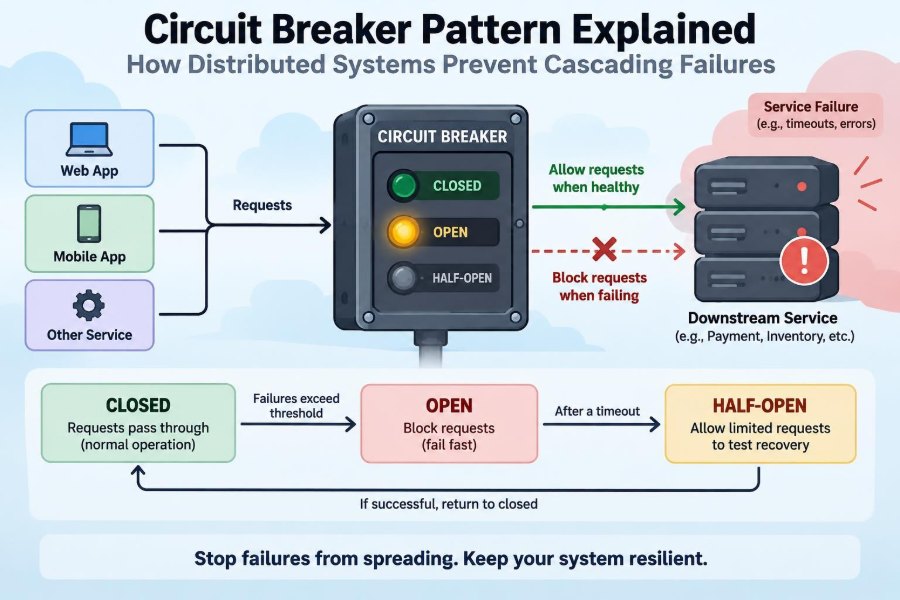
A conventional circuit breaker has three states: closed, open, and half-open. These states describe whether calls are flowing normally, being rejected, or being cautiously tested.
| State | What happens to calls | Purpose |
|---|---|---|
| Closed | Calls proceed and results are measured. | Normal operation while detecting unhealthy behavior. |
| Open | Calls fail immediately or use a fallback. | Protect local resources and reduce pressure on the dependency. |
| Half-open | A limited number of test calls proceed. | Determine whether recovery is real before restoring traffic. |
The state machine is simple, but the policy behind each transition determines whether a breaker is helpful or disruptive.
✅ Closed Does Not Mean “Ignore Failures”
When closed, a breaker behaves like a transparent wrapper: requests are allowed through. At the same time, it records data such as failures, slow calls, timeouts, and sometimes rejected responses.
A single failed request usually should not open the circuit. Networks have transient faults, clients cancel requests, and some errors may be expected business outcomes. The breaker needs enough evidence that a dependency is presently unreliable.
Many implementations use a rolling time window or a recent-call count. This keeps decisions tied to current behavior instead of an old incident from hours ago.
🛑 Open Means Fail Fast
Once open, the breaker rejects protected calls without contacting the dependency. The rejection should happen quickly, before a thread waits for a connection or a remote timeout.
Failing fast is valuable because a slow failure is often more expensive than an immediate one. A request that waits for several seconds can occupy a worker and connection while producing no useful result.
Applications should return a controlled result where possible: a fallback value, a clear error response, a queued operation, or a feature-specific degradation. What is appropriate depends on the operation’s business meaning.
🩺 Half-Open Tests Recovery Carefully
An open breaker should not remain open forever merely because no normal request is allowed through. After a configured wait period, it moves to half-open and permits a small number of probe calls.
If the probes succeed, the breaker can close and gradually resume ordinary traffic. If they fail, it reopens and waits again. Limiting probes matters: sending a sudden full load to a recovering service can cause a second failure.
Half-open behavior is one reason a circuit breaker is more useful than a fixed “disable this feature for ten minutes” switch. It can respond to recovery rather than relying only on a calendar.
📏 Choosing What Counts as a Failure
Not every unsuccessful-looking response should count against the breaker. A payment API returning “card declined” may be a valid business response, while a connection timeout or HTTP 503 response suggests operational trouble.
Define failure categories deliberately. Typical operational failures include connection refusal, DNS failure, timeout, certain server-side status codes, and errors from an overloaded dependency.
Client-side validation errors and authorization failures usually should not open a circuit. Counting them can hide an application bug behind what looks like dependency protection.
⏱️ Slow Calls Can Be Warning Signals
A service does not need to return errors to harm its callers. If its latency rises sharply, callers can run out of worker threads and connection-pool slots while waiting for answers.
For this reason, some breakers consider a call failed when it exceeds a latency threshold, even if a response eventually arrives. This is often called a slow-call rate or latency-based rule.
The threshold must fit the user journey and service-level expectations. A background report can tolerate a different delay than an interactive checkout request.
🪟 The Importance of the Measurement Window
Breakers need a window over which to calculate error or slow-call rates. A count-based window might inspect the last 50 calls; a time-based window might inspect calls from the last minute.
A small window reacts quickly but can be noisy. A large window smooths random variation but may continue allowing too many failing calls before opening.
There is no universal setting. Choose a window based on request volume, normal error behavior, and how expensive it is for callers to wait. Low-traffic integrations often need a minimum-call threshold so two failures do not trigger a misleading conclusion.
🎚️ Thresholds Are Operational Decisions
The failure-rate threshold, open duration, and number of half-open probes are policy choices, not magic constants. A breaker set too aggressively can reject useful work during brief turbulence. One set too loosely may open only after local resources are already strained.
Start from the dependency’s role. A nonessential image enrichment API can open relatively quickly because the page still works without it. A payment authorization path may require more cautious handling, specialized fallbacks, and close operational review.
Test settings under realistic load. The useful question is not merely “Does the breaker open?” but “Does the overall system remain responsive when this dependency slows down?”
🧱 Timeouts Come Before Circuit Breakers
A circuit breaker observes failures, but it cannot reliably contain calls that wait indefinitely. Every remote call should have a sensible connection timeout, response timeout, and, where relevant, an overall request deadline.
Without timeouts, a breaker may not receive enough completed failures to open before threads are exhausted. With excessively long timeouts, it may technically work while still allowing severe resource contention.
Timeouts define how long one attempt may consume resources. Circuit breakers define when repeated attempts should stop. They solve related but distinct problems.
🔁 Retries Can Help or Hurt
A retry handles a transient failure by trying again. This can be sensible for an idempotent read or a request known not to have reached the remote service. But retries multiply traffic precisely when a dependency may be overloaded.
Combining retries and circuit breakers requires a clear budget. A common approach is a small number of retries with exponential backoff and jitter, followed by a breaker decision if failures persist.
Do not let every layer retry independently. If an API gateway, service client, and business workflow each retry twice, one original request can turn into many downstream attempts.
🧭 Circuit Breakers and Bulkheads
A bulkhead partitions resources so one workload cannot consume everything. The term comes from compartments in a ship: flooding in one compartment should not sink the whole vessel.
For example, reserve separate thread pools or connection pools for a slow external reporting API and for core internal services. A circuit breaker reduces bad calls; a bulkhead limits the damage from calls already in progress.
These patterns work well together. The breaker responds to unhealthy dependency behavior, while the bulkhead preserves capacity for unrelated work.
🧯 Fallbacks Need Honest Semantics
A fallback is the behavior used when a protected call cannot proceed. It might return cached data, omit an optional page component, use a default recommendation list, or place a request into a queue for later processing.
A fallback should not silently claim that an action completed when it did not. For example, saying an order was confirmed when payment authorization was never attempted creates a correctness problem, not resilience.
Good fallbacks are explicit about what can be safely degraded. Optional personalization can disappear; a financial transfer may need a clear “temporarily unavailable” response instead.
🛒 Example: Protecting an E-Commerce Checkout
Suppose a checkout service calls a tax calculation provider. During ordinary operation, the breaker remains closed and records outcomes. If timeouts and service errors rise beyond the configured threshold, it opens.
While open, checkout could use a legally and operationally approved alternative, such as postponing tax finalization where the business process permits it, or it could ask the customer to try again. The correct choice depends on jurisdiction, business rules, and transaction design.
The important point is that checkout workers are no longer all waiting on an unreachable provider. Other parts of the platform retain a better chance of serving users.
🧾 Idempotency Matters for Write Operations
Read operations are often easier to protect because retrying or falling back to cached data may be acceptable. Writes are harder because a timeout does not always reveal whether the remote system completed the operation.
For example, a payment request may time out after the provider has accepted it. Retrying without protection could produce a duplicate charge. An idempotency key lets the receiver recognize repeated attempts as the same logical operation.
Circuit breakers do not remove this ambiguity. For important writes, pair them with idempotency, durable state tracking, reconciliation processes, and carefully defined customer messaging.
📬 Asynchronous Designs Change the Options
Synchronous calls require one service to wait for another. Where the workflow permits it, a queue or event stream can decouple the immediate user request from slower downstream processing.
For instance, an account creation service might publish an event for a welcome email rather than waiting for the email provider during registration. If the provider is unavailable, the event can remain available for later processing.
Asynchronous messaging is not a universal replacement for circuit breakers. Consumers can still become overloaded, and queues need monitoring, retry policies, and dead-letter handling. It does, however, change where backpressure and failure are managed.
📍 Where to Place a Circuit Breaker
Place a breaker at the boundary where one component calls another independently failing component. Common locations include service-to-service clients, outbound HTTP clients, database access layers, and adapters for external APIs.
Scope matters. A separate breaker per dependency operation is often safer than one global breaker for an entire vendor. A failing “search suggestions” endpoint should not automatically block a healthy “account lookup” endpoint from the same provider.
In multi-tenant systems, teams may also need isolation by tenant or region. Overly broad sharing can let one tenant’s unusual traffic open a breaker for everyone.
🧩 Client-Side, Proxy, and Service Mesh Choices
A breaker can live in application code, in a local proxy, or in infrastructure such as a service mesh. Application-level placement has rich business context, making it easier to choose meaningful fallbacks and classify errors.
Infrastructure-level controls can provide consistency across many services and reduce duplicated client configuration. They may be especially useful for generic transport concerns such as connection handling and outlier detection.
Neither location eliminates the need for design decisions. A proxy cannot always know whether a response is a business rejection or an operational failure, and application code cannot centrally enforce every networking policy.
📊 Observability Makes Breakers Trustworthy
An open circuit is a useful signal, not merely an exception to suppress. Monitor state transitions, rejection counts, failure categories, latency, probe outcomes, and fallback use.
Logs and traces should make it clear whether a request failed because the downstream service was contacted and failed, or because the breaker rejected it before a call was attempted. Those are operationally different events.
Alerting should focus on user impact and sustained abnormal states. A breaker opening briefly during a small transient may be expected; a breaker remaining open for a critical dependency deserves investigation.
🧪 Test the Failure Paths on Purpose
Unit tests can verify state transitions: enough qualifying failures open the circuit, the wait period leads to half-open, and successful probes close it. Integration tests can simulate timeouts, connection failures, and slow responses.
Load tests are valuable because cascading failures are about contention. Verify that thread pools, queues, and connection pools remain bounded when a dependency becomes slow.
In controlled environments, fault injection can reveal assumptions that ordinary tests miss. The goal is not to create chaos for its own sake, but to learn whether the system degrades in the way its designers intended.
⚠️ Common Mistake: One Global Breaker
A single breaker shared across unrelated operations creates an unnecessarily large blast radius. If one endpoint fails, healthy operations may be rejected because they share the same state.
Use keys that reflect a meaningful failure domain: destination service, endpoint, method, region, or operation type. Do not fragment so far that every individual request has its own breaker, because then the system cannot accumulate useful evidence.
The right granularity maps to components that tend to fail together and should be protected together.
⚠️ Common Mistake: Treating Every Error Alike
Opening a circuit for invalid input, a known “not found” response, or an expired user credential confuses normal application behavior with dependency instability. The result is a breaker that masks bugs and rejects unrelated users.
Create an error taxonomy. Decide which failures are transient, which are permanent for that request, and which indicate a broad dependency problem. Review those decisions when API contracts change.
This classification is often more valuable than tweaking a percentage threshold repeatedly.
⚠️ Common Mistake: Forgetting the Fallback’s Cost
A fallback can itself overload another system. If every failed live request suddenly reads from a shared cache or calls a secondary provider, that alternative becomes the next bottleneck.
Model the fallback path under incident volume. Cache entries may be stale, queues may grow, and a secondary service may have its own quotas or limits.
Sometimes the safest fallback is a small, honest response: omit a nonessential feature and preserve the core transaction.
🧠 Circuit Breakers Are Not a Substitute for Reliability
A breaker controls the effects of failure; it does not fix the underlying cause. A dependency that frequently triggers protection may have capacity problems, an inefficient query, a deployment issue, an incompatible client change, or poor network behavior.
Use breaker data to investigate and improve the dependency. Otherwise, the system may settle into a cycle of temporary rejection and recurring outage.
Likewise, do not use circuit breakers to conceal a dependency that is fundamentally unsuitable for a critical synchronous path. Architectural changes may be needed.
📝 A Practical Implementation Checklist
- Set explicit connection and response timeouts before tuning breaker thresholds.
- Define the dependency and operation scope for each breaker.
- Classify operational failures separately from business outcomes.
- Choose a rolling window and minimum-call count that fit request volume.
- Limit half-open probes so recovery is tested gently.
- Design fallbacks that preserve correctness, especially for writes.
- Coordinate retry budgets across layers and add jitter where retries are used.
- Monitor state changes, rejections, latency, and fallback behavior.
- Test slowdowns and saturation, not only clean error responses.
Keep configuration close to the client that owns the dependency behavior, while making it visible to operations teams. Resilience settings are part of production design, not an afterthought.
🏁 The Core Principle: Contain Failure Early
Distributed systems cannot assume that every dependency will always respond quickly and correctly. A circuit breaker accepts that uncertainty and prevents repeated attempts from turning one unhealthy component into a platform-wide resource problem.
The pattern works best alongside deadlines, bounded retries, bulkheads, observable fallbacks, and thoughtful asynchronous workflows. Its value is not that users never see an error; its value is that errors remain contained, understandable, and less likely to spread.
A well-designed circuit breaker protects the healthy parts of a system by stopping work that is unlikely to succeed. It gives services, operators, and users a clearer path through inevitable dependency failures. ⚙️🛡️