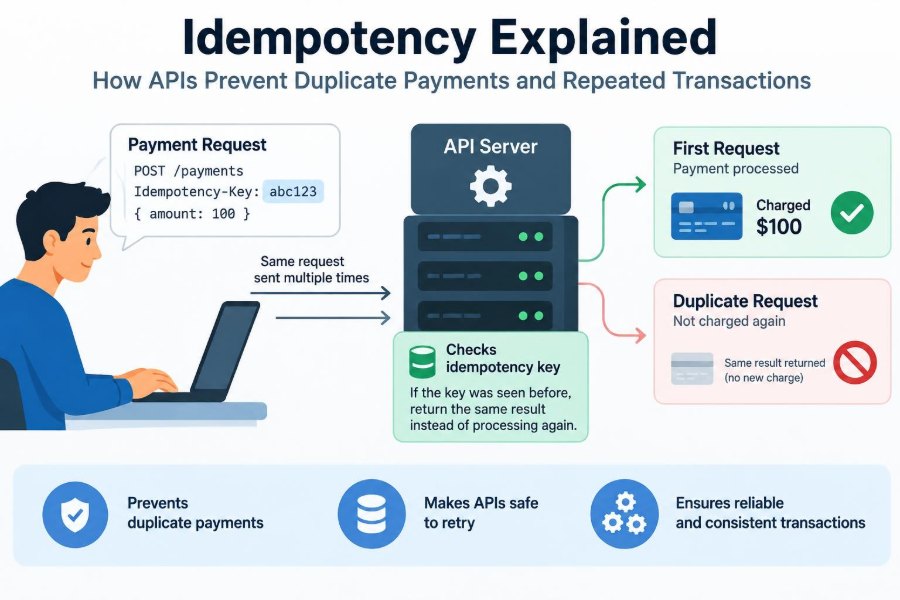

You tap “Pay,” then the loading spinner freezes. Did the payment fail, or did the bank receive it? A reasonable reaction is to tap again, refresh the page, or let a mobile app retry in the background.
For a payment system, that small moment of uncertainty can become a costly bug. The first request may have completed successfully even though its response never reached the customer. A second request can then create a second charge, order, transfer, or reservation.
This is not only a payments problem. Network timeouts, browser refreshes, queue redelivery, server restarts, and impatient users can all cause the same logical operation to arrive more than once.
Idempotency is a design approach that lets a system recognize a retry and return the original outcome instead of performing the operation again. It turns an unavoidable fact of distributed systems—messages can be duplicated—into behavior an API can handle safely.
🔁 The plain-English meaning of idempotency
An operation is idempotent when doing it multiple times has the same intended effect as doing it once. The first call may change state; equivalent later calls do not create additional change.
Think of setting a thermostat to 21°C. Pressing “set to 21°C” several times should leave it at 21°C, not raise the temperature with every press. By contrast, “increase temperature by one degree” is not idempotent.
For an API, the key phrase is usually same logical request. Repeating a request to create a payment should not create additional payments merely because the caller did not receive a response.
💳 Why payments make the problem obvious
A duplicate email is inconvenient. A duplicate charge may require refunds, support work, accounting corrections, and a loss of customer trust. Financial workflows also often trigger downstream effects such as inventory allocation, receipts, tax records, and merchant settlement.
Suppose a checkout service sends a request to charge $45. The payment provider authorizes and records it, but a network interruption prevents the checkout service from receiving the success response. If the checkout service retries without protection, it may ask for another $45 charge.
Idempotency gives that retry a stable identity: “this is the same requested charge as before.”
🌐 Why unreliable networks create duplicate requests
Networks do not provide a simple, reliable answer to “did the other side act on my request?” A client may lose its connection before sending anything, while sending bytes, after the server commits work, or while the response travels back.
A timeout therefore describes what the caller knows: it did not receive a timely response. It does not prove that the server did nothing.
This uncertainty is sometimes called the ambiguous outcome problem. Retrying is usually sensible, but only if the server can distinguish a retry from a genuinely new request.
📨 Delivery guarantees are not business guarantees
Engineers often hear terms such as “at most once,” “at least once,” and “exactly once.” They describe delivery behavior, but they do not automatically guarantee correct business outcomes.
| Delivery idea | Practical meaning | Typical trade-off |
|---|---|---|
| At most once | A message is not deliberately retried. | Duplicates are less likely, but work can be lost. |
| At least once | A message is retried until acknowledgement. | Work is less likely to be lost, but duplicates can occur. |
| Exactly once | A system aims to process a logical event once within defined boundaries. | Requires carefully limited assumptions and coordination. |
Most real systems must tolerate at-least-once delivery somewhere. Idempotent business handling is what makes duplicate delivery safe enough for operations such as charging, provisioning, or sending a payout.
🧭 Idempotency is about effects, not identical replies
An idempotent API commonly returns the same response for a repeated request, because that is useful to clients. But the deeper requirement is that it must not repeat the protected side effect.
For example, a retry of a successful payment creation might return the original payment identifier and status. A later retrieval of that payment can legitimately show an updated status, such as a completed settlement, without violating the original create operation’s idempotency.
Carefully define which effect is protected: creating a charge, issuing a refund, starting a transfer, or submitting an order.
🗝️ The idempotency key pattern
The most common approach is an idempotency key: a client-generated, opaque, unique value included with a request that performs a sensitive action. It is often sent in a request header, though an API may accept it in a body field.
The client generates one key for one intended operation. If it must retry because of a timeout or temporary failure, it sends the same key again. When the customer intentionally starts a new purchase, the client generates a new key.
Keys should have enough randomness that two unrelated operations are extraordinarily unlikely to choose the same value. UUID-style values are a common choice; their exact format matters less than uniqueness and consistent reuse on retries.
🧾 A payment request, step by step
Consider this hypothetical request:
POST /payments
Idempotency-Key: pay_7d3f...

{
  "amount": 4500,
  "currency": "USD",
  "order_id": "order_812"
}- The API receives the request and claims the key before processing the payment.
- It calls the payment workflow and records the resulting payment ID, status, and response data.
- If the caller retries with the same key and equivalent request, the API returns the stored result.
- The payment workflow runs only once for that key.
The amount is commonly represented in the smallest currency unit, but APIs must document their monetary representation clearly. The idempotency mechanism protects the operation; it does not replace validation of amount, currency, or authorization.
🧠 A key identifies intent, not a request attempt
A frequent client-side mistake is generating a new idempotency key on every HTTP retry. That labels each attempt as a new operation and defeats the protection.
The right lifecycle is usually attached to user intent. A checkout submission gets a key when the customer initiates payment. That key survives automatic retries, app restarts where practical, and a manual retry for that same unresolved checkout.
Conversely, reusing one old key for every future checkout is also wrong. The server will reasonably treat later requests as repeats of the first intent.
🔒 The server must claim the key atomically
Two identical retries can arrive nearly simultaneously. If both handlers first check “does this key exist?” and both see nothing, both may proceed to charge the customer.
The server needs an atomic claim: one indivisible database or coordination operation that says only one request may own a particular key in its scope. A database uniqueness constraint on a suitable key is often the strongest practical foundation.
The winning request processes the operation. Other requests either wait for its result, receive an “in progress” response, or retrieve the completed stored response according to the API contract.
🧱 A durable idempotency record
An idempotency record usually stores more than a key. The system needs enough data to safely replay or explain the outcome.
- The idempotency key and its scope, such as customer or merchant account
- A request fingerprint or hash of relevant normalized fields
- Processing state: in progress, completed, or failed in a retryable way
- The resulting resource identifier and, often, response status and body
- Creation and expiry times for retention management
Durable storage matters. A process-local memory cache disappears on restart and is not shared across multiple application servers. It can improve speed, but it should not be the only duplicate defense for financial effects.
🧬 Bind the key to the request payload
What happens if the same key appears with a different amount or destination account? Treating it as the original operation silently could hide a client bug or, in some contexts, enable harmful confusion.
Servers commonly store a canonical fingerprint of the meaningful request fields. On reuse, they compare the incoming fingerprint with the stored one. A mismatch should produce a clear client error rather than run either version unpredictably.
Canonicalization deserves care. Differences such as JSON property order should not create a false mismatch, while meaningful differences such as amount, currency, recipient, or payment method must be detected.
⏳ The dangerous “in progress” window
The hardest state is not success; it is uncertainty while work is happening. A first request may hold the key while a payment processor call is still pending, and a retry arrives before the result is known.
One design returns a conflict-like response telling the client that the operation is already processing. Another waits briefly and returns the final result if it becomes available. Neither is universally better: waiting can improve convenience but consumes server resources and risks long request chains.
Whatever the choice, document it. Clients need a predictable next action, usually polling a status endpoint or retrying with bounded backoff using the same key.
⚠️ Crashes expose the limits of a single database transaction
Imagine the application charges an external provider successfully, then crashes before it records success locally. On recovery, its idempotency row may still say “in progress,” even though money moved.
A local database transaction cannot roll back a completed action at an external payment provider. This is why idempotency is a workflow design problem, not simply a database setting.
Robust systems use provider-side idempotency too when available, persist an external reference before or during processing, and reconcile uncertain cases by querying the provider. The exact recovery path depends on the provider’s API and business rules.
🔗 Idempotency works best across service boundaries
A checkout API can prevent duplicate calls into its own code, but a complete payment flow often crosses several systems: payment provider, fraud service, order service, inventory service, notification service, and accounting ledger.
Pass a stable operation identifier through the workflow where appropriate. Each service should make its own state-changing handler idempotent with respect to the event or command it receives.
Do not assume one upstream idempotency key magically protects every downstream effect. Each boundary has its own failure modes, storage, and ownership rules.
📮 The outbox pattern prevents a common split-brain failure
After creating a payment record, an application may need to publish a “payment succeeded” event. If it commits the database update and crashes before publishing, downstream services may never learn about it. If it publishes first and then the database transaction fails, consumers may observe an event for work that never committed.
The transactional outbox pattern writes the business change and an outbound event record in one local database transaction. A separate publisher reliably sends pending outbox records later.
The publisher may send an event more than once, so consumers still need idempotent processing. The outbox reduces the gap between local state and publication; it does not eliminate duplicate delivery by itself.
📬 Consumers need deduplication too
A queue or webhook receiver can receive the same event again after a lost acknowledgement. A consumer that sends an email, grants a subscription, or updates a ledger must therefore remember which event it has handled.
A common technique stores the event identifier in a processed-events table with a unique constraint, alongside the consumer’s state change where possible. If the same event returns, the consumer recognizes it as already handled.
For external effects such as email, perfect deduplication may depend on the vendor’s capabilities. Design user-facing messaging and operational procedures with that residual uncertainty in mind.
🛠️ HTTP methods help, but they are not enough
HTTP defines GET, PUT, and DELETE as idempotent in intended semantics. For example, deleting a resource twice should leave it deleted, though the second response may differ.
POST is commonly used to create resources and is not inherently idempotent. Payment APIs often use POST because “create a payment” is a command, then add an idempotency key to make retries safe.
Using PUT does not automatically solve duplicate business effects. A PUT request that causes a new external charge on every handling is not safe simply because its URL uses an idempotent-looking method.
🧮 Natural idempotency versus key-based idempotency
Some operations are naturally idempotent because their desired final state has a stable identifier. “Set shipment address for order 812 to this address” can be implemented as an update to one known resource.
Other operations create a new fact each time: “transfer $100,” “issue a refund,” or “send a withdrawal.” These usually need an explicit client operation ID or idempotency key because identical-looking requests may sometimes be legitimate separate actions.
Do not deduplicate merely by amount and timestamp. Two customers can make matching purchases, and one customer can deliberately make two identical purchases. Identity must express intent, not guess from similarities.
🧷 Choose the right scope for uniqueness
Is a key unique globally, per API endpoint, per merchant, or per customer? There is no single answer. A globally unique random key is simple conceptually, but scoped keys can make storage and access rules clearer.
A useful rule is that two operations sharing a key must be intended as the same action within the chosen scope. The uniqueness constraint and lookup query must enforce that exact rule.
For multi-tenant systems, scoping records by tenant or account is often essential. It prevents one tenant’s key from affecting another’s operation and supports access control during replay.
🗓️ Retention is a product and risk decision
Keeping idempotency records forever is expensive and may retain sensitive metadata longer than needed. Deleting them too quickly lets a delayed retry become a new operation.
Select a retention period based on client retry behavior, asynchronous processing duration, provider reconciliation needs, and the cost of a duplicate. A payment workflow may need a longer window than a low-risk draft update.
When a key has expired, document the behavior. The API may reject it, treat it as new, or require clients to query the original resource through another identifier. Silent surprises are the risky option.
🧯 Retrying requires discipline on the client
Idempotency makes retries safer; it does not mean retry every error forever. A malformed request, invalid card, or authorization failure usually needs user correction, not automatic repetition.
Clients should distinguish temporary transport failures and selected server failures from definitive client errors. Use bounded exponential backoff with jitter, which spreads retries rather than making many clients retry at the same instant.
- Reuse the same key for retries of the same intent.
- Set a retry limit and surface an unresolved state to the user.
- Query status when the API offers a resource or operation endpoint.
- Never create a fresh key merely because a timeout occurred.
🧑💻 User interfaces should represent uncertainty honestly
A button can be disabled briefly after submission, but disabling it is not a correctness mechanism. Users can reload, use another device, or encounter a retry performed by the app itself.
After a timeout, the best interface often says that payment status is being confirmed rather than declaring failure immediately. The client can resume using the stored operation key and show the eventual result.
Clear order identifiers, payment history, and support-visible operation IDs also reduce confusion when a workflow remains unresolved for longer than expected.
🧪 Test failure paths, not only happy paths
A test that sends one successful request proves little about duplicate safety. Deliberately simulate the cases that production systems encounter: duplicate requests, concurrent duplicates, lost responses, retries after restart, and delayed messages.
For a payment creation test, assert both that repeated calls return a consistent result and that the external provider received only one logically distinct charge request. Test mismatched payload reuse as well.
Fault injection can be especially valuable: force a crash after an external call but before local persistence, then verify recovery and reconciliation behavior. These are the gaps ordinary unit tests often miss.
📊 Observe keys, states, and reconciliation queues
When duplicate complaints occur, engineers need to trace a logical operation across logs and services. Include an operation ID or idempotency key in structured logs and tracing context, while avoiding sensitive payment data.
Useful operational signals include rising key conflicts, unusually long in-progress records, replayed responses, provider timeouts, and reconciliation backlog. None alone proves a defect, but patterns can reveal a bad deployment or downstream outage.
Alerting should focus on actionable conditions. An old in-progress payment may require automated recovery or human review; a normal retry replay often does not.
🧾 Idempotency does not replace a ledger
Preventing duplicate commands is different from maintaining correct financial records. A ledger records debits, credits, adjustments, and the relationships between them so balances can be derived and audited.
Idempotency helps ensure that one command does not create two ledger postings. The ledger, in turn, helps detect and correct exceptional cases such as provider discrepancies, reversals, or manual adjustments.
For money movement, use both concepts deliberately. A key protects request handling; an accounting model protects financial truth over time.
🚫 Common implementation mistakes
Several shortcuts look plausible until a timeout or race condition occurs.
- Checking then inserting: separate read and write operations permit concurrent requests to slip through.
- Using an in-memory map: it fails across restarts and multiple server instances.
- Caching only success: ambiguous in-progress work still needs a recovery plan.
- Ignoring payload mismatches: a reused key can mask a serious client error.
- Assuming a message broker removes duplicates: consumers can still see redelivery.
- Calling external systems without their reference IDs: reconciliation becomes much harder after a crash.
📝 Document an explicit API contract
Clients cannot use idempotency correctly if its behavior is implicit. Document where the key goes, its allowed format, scope, required endpoints, retention window, mismatch behavior, and response for an in-progress request.
Also explain which errors are safe to retry and how clients can retrieve operation status. SDKs can help by generating a key at the right moment and preserving it through retry logic, but the API contract remains the source of truth.
Examples should cover a first request, a successful replay, a payload mismatch, and an unresolved in-progress operation. These are the cases developers need when integrating under pressure.
⚖️ Know what idempotency cannot promise
Idempotency does not guarantee that every distributed side effect happens exactly once. External providers, manual processes, expired records, bugs, and irreversible actions create limits.
It also does not decide business policy. A duplicate-looking order may need cancellation, a refund, or fulfillment review depending on what has already happened. Those decisions require domain-specific rules.
The goal is more practical: make retries safe within stated boundaries, preserve evidence when outcomes are uncertain, and reconcile the exceptions that remain.
🏗️ A practical design checklist
Before shipping a state-changing API, walk through the full lifecycle of one logical command.
- Define the operation whose effect must occur once.
- Require a stable client operation ID or idempotency key where natural identity is insufficient.
- Atomically claim the key in durable shared storage.
- Bind it to the meaningful request payload.
- Persist a recoverable state and final result.
- Propagate stable references to external systems and downstream services.
- Use outbox and consumer deduplication patterns for events.
- Set retention, recovery, reconciliation, and observability rules.
- Test concurrent retries and crashes around every external boundary.
🎯 The core principle: one intent, one effect
Reliable APIs cannot prevent users, browsers, queues, or networks from retrying. They can, however, give each intended action a durable identity and make repeated delivery converge on one recorded outcome.
That is the useful mental model: many attempts may occur, but they must represent one business intent and produce one protected effect. Once a team designs around that rule, duplicate payments become a manageable failure mode rather than an intermittent mystery.
Idempotency is not a magic header; it is a complete agreement among clients, APIs, databases, external providers, and event consumers about how a retried operation is recognized and recovered. Build that agreement before the first timeout forces you to explain a duplicate charge. ⚙️💳🔁