
Software-as-a-Service, or SaaS, has become one of the most common ways to build software businesses. Instead of selling software once and asking customers to install it locally, SaaS companies typically provide software through the cloud and charge customers on a recurring basis. 💻☁️
But not every SaaS company tries to serve everyone.
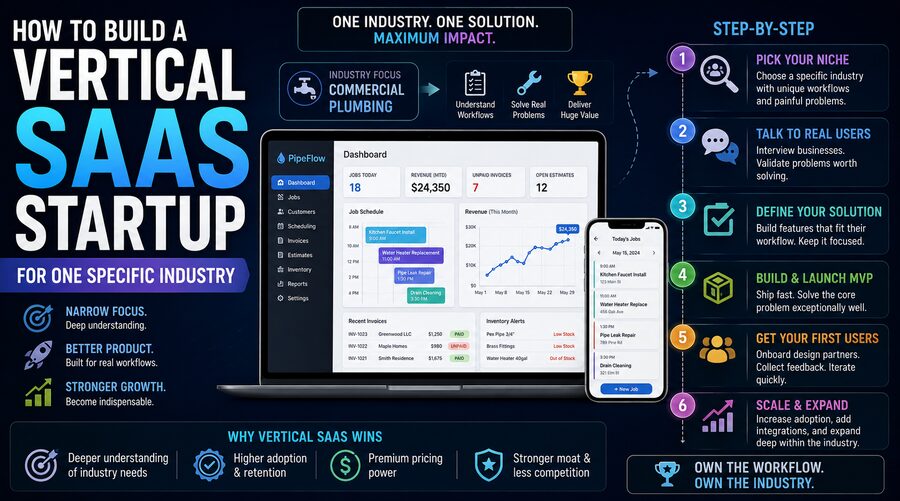
A vertical SaaS startup focuses on the needs of one specific industry, profession, or business category. Instead of building a generic invoicing platform for all businesses, a vertical SaaS company might build invoicing, scheduling, compliance, and customer-management software specifically for dental clinics, construction contractors, veterinary practices, property managers, freight brokers, or fitness studios.
That narrow focus can become a major competitive advantage.
Vertical SaaS founders can build deeper industry knowledge, solve more specialized problems, create stronger customer relationships, and eventually become an essential operating system for a particular type of business. 🧠📊
However, success usually requires much more than choosing an industry and building software. The strongest vertical SaaS companies understand workflows, economics, regulations, customer behavior, and distribution within their chosen market.
Here is how the process works.
🎯 What Is Vertical SaaS?
Vertical SaaS is software designed specifically for a particular industry or niche.
Examples of potential vertical markets include:
- 🦷 Dental practices
- 🏗️ Construction companies
- 🏨 Hotels
- 🚚 Logistics businesses
- ⚖️ Law firms
- 🏥 Medical clinics
- 💇 Salons
- 🏠 Property managers
- 🐾 Veterinary practices
- 🚜 Agricultural businesses
A horizontal SaaS product, by contrast, serves many industries.
For example, generic:
- Email software
- Accounting software
- Project management tools
- Team chat platforms
- Video conferencing
can be used by almost any organization.
Vertical SaaS goes deeper into one industry’s specialized needs.
A construction platform may understand subcontractors, change orders, job costing, site documentation, permits, and project bidding.
A veterinary SaaS product may understand appointments, patient records, prescriptions, vaccination schedules, billing, and inventory.
That specialization is the core idea.
🔍 Step 1: Choose an Industry With Painful Problems
A vertical SaaS opportunity usually begins with a real business problem, not with a software feature.
The best industries often have workflows that are:
- Repetitive
- Manual
- Expensive
- Error-prone
- Highly regulated
- Dependent on spreadsheets
- Dependent on phone calls or email
- Poorly served by existing software
Imagine an industry where employees spend hours every week copying information from PDFs into spreadsheets.
That is a potential software opportunity.
Another strong signal is when companies rely on outdated desktop software because there are few modern alternatives.
The key question is:
“What painful operational problem does this industry repeatedly experience?”
The more painful, frequent, and expensive the problem is, the more valuable a solution may become. 💡
🧑💼 Step 2: Talk to Customers Before Building
One of the biggest startup mistakes is building software before understanding how the industry actually works.
Founders often assume they understand a problem after reading about it online.
That is rarely enough.
Talk directly with:
- Business owners
- Managers
- Frontline employees
- Administrators
- Finance teams
- Customers
- Industry consultants
Ask them to show you their actual workflow.
For example:
“How do you schedule a new customer?”
“What happens after an order comes in?”
“Where do errors usually occur?”
“Which software do you currently use?”
“What do you still manage in spreadsheets?”
“What takes the most time every week?”
You want to understand the workflow in detail.
A useful rule is:
Observe behavior, not just opinions.
A customer may say, “We need better reporting,” but after observing their business, you might discover the deeper problem is that their data is scattered across six systems.
🗺️ Step 3: Map the Industry Workflow
Once you understand your target customers, map their entire operational process.
For example, a home-services company might operate like this:
Lead ➡️ Quote ➡️ Schedule ➡️ Job ➡️ Invoice ➡️ Payment ➡️ Follow-up
Each stage may contain problems.
Perhaps quotes take too long.
Maybe schedules are maintained manually.
Perhaps technicians cannot see customer history.
Maybe invoices are forgotten.
A workflow map helps you identify where software can create the most value.
It also helps you understand which features should come first.
🧩 Step 4: Find the “Wedge” Product
A vertical SaaS startup usually should not build an entire industry operating system on day one.
Instead, it needs a wedge.
A wedge is one narrow product that solves an urgent problem well enough to get customers into the system.
Examples might include:
- Scheduling
- Compliance tracking
- Quoting
- Inspection reports
- Inventory management
- Billing
- Customer intake
- Document automation
Suppose contractors struggle to generate professional estimates.
You might begin with:
Fast estimating software for contractors
Once customers depend on the product for estimates, you can later expand into:
Scheduling ➡️ Job management ➡️ Invoicing ➡️ Payments ➡️ Payroll
The wedge helps you enter the market.
Expansion creates the larger business. 🚪➡️🏢
💰 Step 5: Understand the Economics of Your Customer
A good vertical SaaS founder understands how customers make money.
Suppose your target customer earns $500,000 annually.
If your software can:
- Save $20,000 in labor
- Recover $30,000 in missed invoices
- Generate $50,000 in additional sales
then charging several hundred dollars per month may be easy to justify.
But if your target customer earns only $40,000 per year and margins are tiny, even a $100 monthly subscription may feel expensive.
Study:
- Average business revenue
- Gross margins
- Employee count
- Customer acquisition cost
- Typical software budgets
- Transaction volumes
The better you understand the customer’s economics, the easier pricing becomes.
📊 Step 6: Estimate the Market From the Bottom Up
Many startup founders make unrealistic market estimates.
Instead of saying:
“The healthcare industry is worth trillions, so our market is huge,”
build a bottom-up estimate.
Suppose your target market contains:
50,000 businesses
and the average customer could realistically pay:
$400 per month
Then potential annual recurring revenue would be:
50,000 × $400 × 12 = $240 million
That is a more useful starting point.
You can then segment the market.
For example:
- Small companies
- Mid-sized businesses
- Enterprises
Each may have different pricing and requirements.
🛠️ Step 7: Build the Smallest Useful Product
Your first product should solve one important problem completely.
Do not try to include every feature customers mention.
Imagine launching software with:
- CRM
- Accounting
- Payroll
- Marketing
- Scheduling
- Inventory
- Analytics
- Payments
all at once.
The product will likely take too long to build and may not do anything particularly well.
Instead, focus on the shortest path to measurable customer value.
A minimum viable product might solve:
One customer type + One painful workflow + One measurable outcome
For example:
“We help independent dental clinics reduce appointment no-shows.”
That is far easier to validate than:
“We are building an AI-powered operating system for healthcare.”
👨💻 Step 8: Build With Industry-Specific Workflows
Vertical SaaS becomes defensible when it reflects how the industry actually operates.
A generic CRM might have:
Contacts ➡️ Deals ➡️ Tasks
A vertical system may need:
Patients ➡️ Appointments ➡️ Treatment plans ➡️ Insurance claims
or:
Properties ➡️ Leases ➡️ Tenants ➡️ Maintenance requests
or:
Shipments ➡️ Carriers ➡️ Loads ➡️ Proof of delivery
The more your product uses the industry’s language and workflow, the more natural it feels to customers.
Industry specificity increases adoption because users do not have to force generic software into specialized processes.
🧾 Step 9: Build Compliance Into the Product
Many vertical SaaS markets are attractive precisely because they are complicated.
Regulation creates pain, and pain creates demand for software.
Depending on the industry, you may need to support:
- Audit logs
- Data retention
- Privacy controls
- Electronic signatures
- Licensing requirements
- Safety documentation
- Industry-specific reporting
Do not treat compliance as an afterthought.
In some industries, compliance can become one of your biggest competitive advantages. 🔐
🔌 Step 10: Integrate With Existing Systems
Your customers probably already use other software.
Instead of expecting them to replace everything immediately, integrate with critical systems.
Common integrations might include:
- Accounting platforms
- Payment processors
- Payroll services
- SMS
- Calendar systems
- Banking
- Industry databases
Integrations can significantly reduce switching friction.
A new vertical SaaS product often wins not by replacing every tool immediately, but by becoming the central system connecting them.
💳 Step 11: Consider Embedded Payments
One of the most powerful business models in vertical SaaS is combining software subscriptions with financial transactions.
Suppose your customers use the platform to generate invoices.
You can also allow them to accept payments directly through the software.
Instead of earning only subscription revenue, the platform may earn revenue from payment processing.
This creates multiple revenue streams:
Subscription revenue + Payments revenue
Some vertical SaaS businesses later add:
- Financing
- Insurance
- Banking products
- Payroll
- Cards
These additional services can dramatically increase revenue per customer.
However, financial products introduce additional compliance, operational, and risk-management requirements.
💵 Step 12: Price Based on Value
Avoid pricing only according to what competitors charge.
Instead, understand the economic value you create.
Common vertical SaaS pricing models include:
- Per location
- Per employee
- Per user
- Per transaction
- Percentage of payments
- Usage-based pricing
- Tiered subscription plans
For example:
Starter: $99/month
Professional: $299/month
Multi-location: $799/month
Enterprise customers may receive custom pricing.
The strongest pricing metric usually grows as the customer receives more value.
📣 Step 13: Build Industry-Specific Distribution
Distribution is often easier in vertical markets because customers gather in predictable places.
They may belong to:
- Trade associations
- Industry conferences
- Professional groups
- Certification organizations
- Facebook communities
- Local business networks
- Trade publications
You can build distribution around these channels.
For example, if you sell software to veterinarians, attending veterinary conferences may produce highly concentrated access to your target buyers.
This is very different from horizontal SaaS, where the potential customer base may be spread across nearly every industry.
📞 Step 14: Founder-Led Sales Comes First
Early vertical SaaS founders should usually talk directly to customers.
Do not immediately outsource sales.
Founder-led sales teaches you:
- Why customers buy
- Why they hesitate
- Which objections occur repeatedly
- Which features matter
- How customers describe the problem
These conversations improve both the product and your marketing.
In the earliest stage, even unsuccessful sales calls provide valuable information.
📈 Step 15: Track the Right Metrics
As the business grows, monitor metrics such as:
💰 Monthly Recurring Revenue
How much recurring subscription revenue is generated each month?
🔁 Churn
How many customers cancel?
❤️ Retention
How long do customers remain active?
📊 Expansion Revenue
Do customers pay more over time?
🎯 Customer Acquisition Cost
How much does it cost to acquire a customer?
💎 Lifetime Value
How much revenue does the average customer generate before leaving?
Vertical SaaS can become especially attractive when customers integrate the product deeply into daily operations.
Once the software becomes business-critical, switching costs may increase and churn may decrease.
🏗️ Step 16: Expand From Tool to Operating System
A strong vertical SaaS company often begins with one product and gradually becomes a broader platform.
Imagine starting with:
Appointment scheduling
Then adding:
CRM ➡️ Billing ➡️ Payments ➡️ Inventory ➡️ Reporting ➡️ Payroll
Eventually, customers may run much of their business through your platform.
This creates a powerful position.
The product becomes not just another application but the system of record for the industry.
🧠 Vertical Data Can Become a Moat
As your platform grows, it may accumulate highly specialized industry data.
For example:
- Pricing benchmarks
- Customer behavior
- Operational efficiency data
- Scheduling patterns
- Revenue trends
- Inventory usage
Aggregated and responsibly handled data can help improve:
- Benchmarking
- Forecasting
- Automation
- Risk analysis
- AI features
The important point is that your product gains knowledge specific to one industry’s workflow.
Generic competitors may struggle to replicate that depth.
🤖 Use AI Where It Solves a Real Industry Problem
AI can enhance vertical SaaS, but simply adding a chatbot rarely creates strong differentiation.
Instead, identify specialized workflows where AI can save meaningful time.
Examples include:
- Turning calls into structured records
- Extracting information from documents
- Drafting industry-specific reports
- Categorizing customer requests
- Detecting anomalies
- Predicting scheduling demand
- Automating repetitive administrative work
The best AI features are usually deeply connected to customer workflow rather than added as a marketing layer.
⚠️ Avoid Over-Customization
Early customers may ask for highly specific custom features.
It can be tempting to build everything they request.
But too much customization can turn a SaaS startup into a consulting company.
A useful question is:
“Would at least 30% of our target customers benefit from this feature?”
If only one customer needs it, consider whether it belongs in the core product.
You want configurable software, not hundreds of separate versions.
🛡️ Build Trust Early
Vertical SaaS often manages business-critical information.
Customers may depend on your system for:
- Payments
- Scheduling
- Customer records
- Compliance
- Operations
Trust therefore matters enormously.
Invest in:
- Security
- Backups
- Reliability
- Clear support
- Data-export capabilities
- Transparent pricing
- Good onboarding
A small industry community can spread both positive and negative reputations quickly.
🔄 Create a Tight Customer Feedback Loop
Your best product ideas often come from observing customers use the software.
Build a continuous loop:
Customer conversation ➡️ Product improvement ➡️ Usage data ➡️ Feedback ➡️ New improvement
Early-stage founders should stay close to users.
Support tickets are not merely problems to solve; they are signals about where the product is confusing or incomplete.
📚 Build Industry Expertise as a Competitive Advantage
Vertical SaaS companies often win because customers feel:
“These people understand our business.”
That understanding should appear throughout the company.
Your website should use the industry’s language.
Your sales team should understand its economics.
Your product should reflect its workflow.
Your customer success team should know its operational challenges.
Over time, deep domain knowledge becomes difficult for generic software companies to match.
🚀 A Simple Vertical SaaS Startup Roadmap
A practical sequence might look like:
1. Choose one industry 🎯
2. Interview 30–50 potential customers 🗣️
3. Identify one painful recurring workflow 🔍
4. Build a narrow MVP 🛠️
5. Sell it manually to the first customers 📞
6. Measure retention and usage 📊
7. Improve onboarding and reliability ⚙️
8. Add adjacent workflows 🧩
9. Integrate payments or other services 💳
10. Expand toward a complete industry platform 🏗️
The sequence matters.
Do not attempt step ten before proving steps one through six.
🌟 The Bigger Picture
Building a vertical SaaS startup is fundamentally about becoming exceptionally useful to one specific industry.
The strongest opportunities often exist where businesses are still operating with spreadsheets, outdated software, disconnected systems, or manual workflows.
A successful founder learns the industry deeply, chooses one painful entry point, builds a focused product, and sells directly to early customers.
From there, the company can gradually expand.
The long-term progression often looks like:
Single tool ➡️ Workflow platform ➡️ System of record ➡️ Industry operating system
As the product becomes more deeply embedded, the company can add adjacent software modules, payments, financial products, automation, analytics, and AI.
But the foundation remains the same: solve a real problem for a clearly defined customer better than anyone else. 🎯
Vertical SaaS is attractive because specialization can create strong customer loyalty, deep domain expertise, efficient distribution, and valuable industry data.
Instead of asking:
“How can we build software for everyone?”
the better question is:
“What would it take to build the best software in the world for this one type of business?”
Answer that question well, and a narrow niche can become the foundation of a very large company. 🚀💻