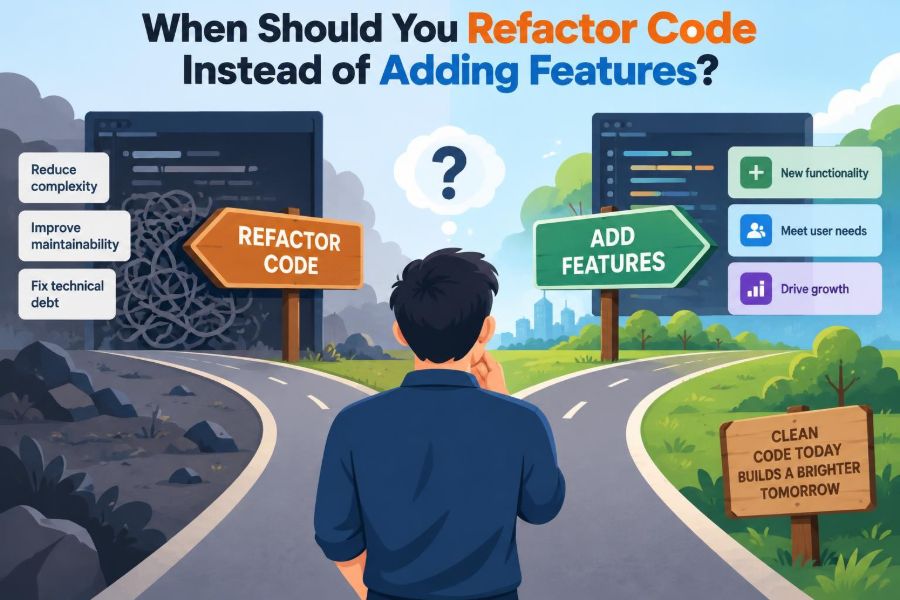

A product team is ready to ship a small request: add a new billing rule, show one more status in the dashboard, or support another kind of user. The request sounds contained. Then an engineer opens the relevant module and finds conditionals nested inside conditionals, duplicated validation, and tests that fail for reasons nobody can quickly explain.
The immediate temptation is understandable: add the feature in the fastest place possible, get the release out, and clean things up later. Sometimes that is exactly the responsible decision. Deadlines, customer commitments, and incident recovery are real constraints.
But sometimes the “small” feature is exposing a design that can no longer safely absorb change. Adding code without reshaping that design can turn one request into a recurring source of defects, slow reviews, and increasingly fearful deployments.
The practical question is not whether refactoring is good. It is when refactoring creates enough near-term value to justify pausing feature work. Answering it well is a core engineering judgment. 🧭
🧩 1. Understand the Real Trade-Off
Feature work changes what a system can do. Refactoring changes how the system is organized while aiming to preserve what it does. In practice, the two are often connected: a feature may require a safer structure before it can be implemented cleanly.
The choice is not “business value versus engineering quality.” Poor structure can directly reduce business value by making estimates unreliable, defects more likely, and future requests expensive. The real trade-off is between shipping now and maintaining the ability to ship reliably later.
🧱 2. Define Refactoring Precisely
Refactoring is a disciplined change to internal code structure that preserves externally observable behavior. Renaming an unclear method, extracting a policy object, replacing duplicated logic, and separating a database concern from domain logic can all be refactorings.
It is not a catch-all label for rewriting, redesigning, adopting a new framework, or changing product behavior. Those efforts may be useful, but they carry different risks and need different planning.
// Before: policy and workflow are tangled
if (customer.isPremium && order.total > 100) { ... }

// After: behavior is preserved, responsibility is named
if (discountPolicy.appliesTo(customer, order)) { ... }
🔍 3. Treat Feature Requests as Design Tests
A new request reveals whether the current model matches the way the business is evolving. If a feature naturally fits into an existing extension point, adding it may be straightforward. If it requires editing unrelated files, copying branches, or bypassing established rules, the design is signaling strain.
Ask: does this request fit the concepts already present in the code? If the answer is consistently no, the problem is not merely a difficult ticket. The code may need a better model of the domain.
🚦 4. Notice When a “Small” Feature Has a Large Blast Radius
A feature has a large blast radius when a supposedly local change affects many modules, data paths, APIs, permissions, jobs, or user interfaces. Broad impact is not automatically bad, but it should trigger investigation before coding starts.
- One new status requires changes in many separate switch statements.
- A pricing adjustment touches checkout, invoices, reporting, and support tools.
- A new role requires scattered permission checks throughout the application.
- A field addition requires manually updating multiple representations of the same entity.
When the same concept is represented in many disconnected places, a focused refactor can reduce both current and future risk.
🪢 5. Refactor When Duplication Obscures a Rule
Duplicated code is not always a problem. Two similar-looking blocks may intentionally evolve independently. The warning sign is duplicated business knowledge: the same eligibility rule, tax calculation, authorization decision, or state transition repeated in several locations.
Before adding another copy for the next feature, centralize the rule behind a meaningful abstraction. This makes future changes more consistent and gives reviewers one place to inspect the behavior.
Do not abstract merely because text looks alike. First establish that the duplicated code represents the same concept and should change for the same reasons.
🧠 6. Watch for Concepts the Code Cannot Name
Many refactoring opportunities begin as awkward language. Developers say things such as “the special customer thing,” “the odd flag combination,” or “that helper that decides everything.” These phrases often point to an unnamed domain concept.
If a feature depends on that concept, give it an explicit representation: perhaps a value object, policy, state, command, or service with a domain-oriented name. Good names reduce the amount of code readers must hold in their heads.
🧯 7. Stop When Every Change Feels Dangerous
Fear is useful operational data. If experienced developers routinely say, “I do not know what this will break,” the issue is not lack of bravery. It is lack of visibility, isolation, tests, or all three.
Refactoring is warranted when fear repeatedly slows ordinary work. Start by improving observability and characterization tests around the risky area, then make small structural changes. Avoid responding to fear with a large, speculative rewrite.
🧪 8. Assess Whether You Can Prove Behavior Was Preserved
The safety of a refactor depends on feedback. Automated tests, type checking, static analysis, contract tests, monitoring, and code review each provide part of that feedback. Their absence does not make refactoring impossible, but it changes the order of work.
If tests are weak, first capture the current behavior with characterization tests. These tests do not claim the behavior is ideal; they document what the system presently does so that a structural change does not accidentally alter it.
🛠️ 9. Strengthen the Safety Net Before Moving Walls
When a code path is important but poorly covered, adding feature code immediately may deepen the problem. A short preparation phase can be the better investment: identify critical inputs, failure paths, permissions, boundary conditions, and integrations.
Useful safety-net work
- Add tests at a stable public boundary rather than private implementation details.
- Record expected behavior for troublesome production cases.
- Verify error handling, retries, and data-validation paths.
- Add metrics or logs that make rollout behavior visible.
This is not ceremonial test writing. It is what makes later changes explainable and reversible.
📏 10. Compare the Cost of the Next Feature With the Cost of Structure
A feature does not need a major refactor simply because the code is imperfect. Estimate the cost of implementing it directly, including testing, review complexity, likely defect risk, and the cleanup it creates. Then estimate a narrow refactor that removes the specific obstacle.
| Situation | Usually favor adding the feature | Usually favor refactoring first |
|---|---|---|
| Change frequency | One-off or unlikely to evolve | Same area changes repeatedly |
| Risk | Isolated and well understood | Cross-cutting or hard to test |
| Design fit | Fits an existing model | Requires special-case branching |
| Time pressure | Immediate, with a safe follow-up plan | Delay now prevents repeated slowdowns |
The best decision is often a small refactor that unlocks the feature, not an attempt to perfect the entire subsystem.
🔁 11. Look for Repeated Change Patterns
One difficult implementation can be accidental. Three similar difficult implementations are a pattern. If each new payment method, report type, notification channel, or workflow state requires the same sequence of edits, the system is asking for an extension mechanism.
Use change history carefully. It is more meaningful to ask “what changes together?” than to ask “which file is ugly?” Files that change together may contain responsibilities that should be coordinated—or may reveal a boundary that needs redesigning.
🎯 12. Refactor Toward the Feature, Not Toward an Ideal
Refactoring can become procrastination when it chases abstract elegance. Keep the work tied to a concrete change: extract the rule needed for a new pricing tier, isolate the state transition needed for cancellation, or separate formatting from calculation for a new output.
A useful scope statement is: “Make this area easy to extend in this specific direction.” That gives the team a stopping condition and limits architectural ambition.
🧹 13. Use the Boy Scout Rule Carefully
Leaving code slightly cleaner than you found it is valuable when the cleanup is local, understandable, and safe. Renaming misleading variables, deleting dead branches, and simplifying a nearby condition can improve a feature change without becoming a separate project.
Do not use a feature ticket as cover for broad unrelated cleanup. Large incidental diffs hide behavioral changes, complicate reviews, and make rollback harder. Separate commits or pull requests can preserve clarity when both kinds of work are needed.
🗺️ 14. Distinguish Local Mess From Architectural Debt
Local mess is contained: an overly long method, an unclear name, or a duplicated conversion near one boundary. Architectural debt crosses boundaries: circular dependencies, shared mutable state, unclear ownership, incompatible data models, or a module that knows too much about every other module.
Local mess can often be addressed while delivering the feature. Architectural debt may need a staged plan because changing it affects teams, deployments, data, and interfaces. Calling both “refactoring” can conceal very different commitments.
📦 15. Refactor Before Adding Another Special Case
Special cases are sometimes correct. A legal requirement, partner limitation, or transitional compatibility rule may genuinely need one. The concern arises when a new feature adds another boolean flag, another nullable field, or another branch to a chain already encoding several hidden states.
At that point, model the variation explicitly. A state machine, policy object, configuration model, or distinct type can make invalid combinations harder to express and valid behavior easier to trace.
🧭 16. Let Domain Boundaries Guide the Work
Code becomes difficult to change when one module mixes concepts with different reasons to change. For example, a checkout service may combine pricing policy, inventory reservation, payment execution, email wording, and database persistence.
Refactoring boundaries does not require creating many tiny classes. It means identifying cohesive responsibilities and giving each a clear role. The next feature should be able to point to the responsibility it changes rather than forcing edits throughout a workflow.
⏱️ 17. Account for Deadlines Without Surrendering Design
A hard deadline can justify a tactical implementation, especially when the alternative threatens an important commitment. The responsible version of this choice makes the debt visible: document the shortcut, add a targeted test, and create a concrete follow-up item with an owner and priority discussion.
“We will fix it later” is not a plan. A plan identifies what needs changing, why it was deferred, what risk remains, and what event will trigger the work.
🧾 18. Make the Decision Visible to Stakeholders
Product managers and other partners do not need every internal detail, but they need an honest account of trade-offs. Explain the impact in terms of delivery confidence: a short refactor may reduce regression risk, make estimates more dependable, or avoid repeating work for a likely set of requests.
Avoid presenting refactoring as a mysterious technical preference. Describe the concrete constraint, the narrow intervention, the expected benefit, and the consequence of not doing it.
🪜 19. Prefer Incremental Refactoring Over Big Rewrites
Large rewrites delay feedback and often recreate old behavior incompletely. Existing systems contain edge cases learned through production use, even when those cases are poorly documented. Incremental work lets teams preserve that knowledge while improving the structure.
Common techniques include introducing a new interface beside the old path, migrating one caller at a time, wrapping a legacy component, or routing a small percentage of traffic through new behavior where appropriate. Each step should be testable and reversible.
🔀 20. Separate Behavior Changes From Structural Changes When Possible
A change is easier to review when it has one primary purpose. First reshape code while tests confirm current behavior. Then add the new behavior in a follow-up change. Reviewers can reason about each step without disentangling a redesign from a new product rule.
This separation is not always practical, particularly during urgent fixes. When it is not, make the distinction clear in the code review description and test plan.
🧷 21. Keep Interfaces Stable During Migration
When refactoring a component used by many callers, preserve a stable boundary whenever feasible. Place adaptation at the edge, then migrate internals or callers gradually. This reduces coordination costs and gives the team room to validate each stage.
Stable interfaces are not permanent promises. They are temporary seams that make change manageable. Once migration is complete, remove compatibility layers that no longer serve a purpose.
📉 22. Recognize False Reasons to Refactor
Not every discomfort is a signal to stop feature work. Engineers should be alert to refactoring driven by novelty, personal style, or imagined future requirements rather than demonstrated needs.
- The code is unfamiliar, but understandable after a short investigation.
- A newer library looks attractive, but does not solve a current delivery problem.
- The abstraction would serve only one known use case.
- A rewrite feels cleaner, but there is no migration or validation strategy.
Good refactoring reduces an observed cost. It should not simply replace one set of preferences with another.
🧑🤝🧑 23. Use Code Review as a Decision Point
Code review can reveal whether a feature patch is carrying too much accidental complexity. Reviewers should ask whether a new branch belongs in the current location, whether a rule is now duplicated, and whether the tests describe behavior at the right level.
Constructive review does not always mean demanding a refactor. It may mean accepting a tactical patch while recording the exact structural concern. The goal is shared judgment, not enforcing perfection through review comments.
📚 24. Learn From Incidents and Rework
Production incidents, escaped defects, slow fixes, and reverted releases offer evidence about where design is failing. After restoring service, look beyond the immediate bug: was the behavior duplicated, was a boundary unclear, did tests miss a meaningful scenario, or did an ownership gap lead to unsafe change?
Use these lessons to prioritize focused improvements. Refactoring after an incident should address a contributing condition, not become a reflexive rewrite of everything involved.
🧮 25. Build a Lightweight Decision Checklist
Before implementation, a team can ask a few repeatable questions. The point is not to turn judgment into a formula; it is to surface assumptions early.
- Does the feature fit the current domain model?
- Will it duplicate a rule or add another special-case branch?
- Has this area changed repeatedly or caused recent defects?
- Can we test and observe the change with confidence?
- What is the smallest structural improvement that reduces the obstacle?
- What deadline or customer constraint limits the work?
If several answers point to structural strain, refactor first or include a narrowly scoped refactor in the feature plan.
🗣️ 26. Explain the Work in Terms of Outcomes
Engineers often gain support by connecting internal improvements to outcomes everyone values: fewer regressions, faster onboarding, clearer estimates, easier compliance changes, and safer releases. Be specific without pretending certainty about the future.
For example: “This request currently requires updating three versions of the same validation rule. We can centralize that rule first, which should make this change and the next related change easier to verify.” That is more persuasive than “the code needs cleaning.”
🏁 27. The Core Principle: Preserve Future Options
Refactor instead of immediately adding a feature when the feature exposes a structural problem that will make the change unsafe, duplicative, or predictably expensive—and when a focused improvement can reduce that cost with acceptable risk.
Do not wait for flawless architecture, and do not treat every deadline as permission to compound debt. Build the smallest safe change that delivers the needed behavior while preserving the system’s capacity to adapt.
The best refactoring decision is the one that helps today’s feature land safely without making tomorrow’s feature harder than it needs to be. 🧭🛠️🚀