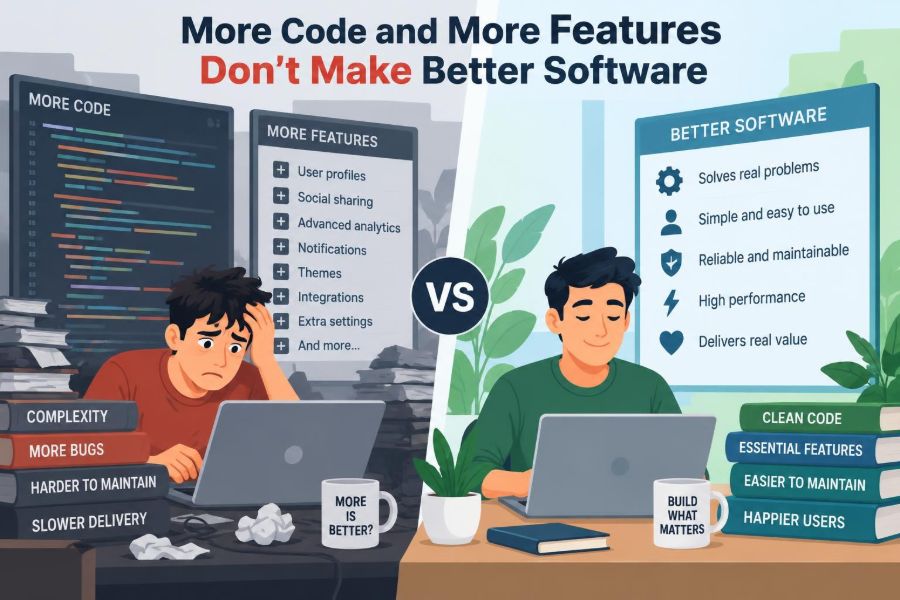

A team releases a new version of its app. The release notes are long: more settings, more integrations, more dashboard widgets, more automation rules. Yet users still struggle to complete the task they opened the app to do.
Meanwhile, a smaller competitor adds almost nothing visible. It removes a confusing step, makes one screen faster, and fixes a failure that occurred at the worst possible moment. Its users notice immediately.
Software teams often feel pressure to demonstrate progress through visible output: tickets closed, lines changed, features announced. Those measures are easy to count. Whether the product has become clearer, safer, or more valuable is harder to see.
That gap creates a persistent myth: that more code and more features naturally mean better software. They can sometimes create value, but only when they solve a real problem at an acceptable cost.
🧭 What “Better Software” Actually Means
Better software is not the software with the largest codebase or the longest menu. It is software that helps its intended users achieve meaningful outcomes reliably, efficiently, and safely.
The exact definition depends on context. A payroll system needs correctness and auditability. An emergency-alert service needs dependable delivery. A note-taking tool may win through speed and low friction. Each product has a different quality profile.
Useful complexity is complexity that earns its place. A feature is valuable when its benefit to users and the organization outweighs the ongoing cost of building, understanding, operating, and supporting it.
📏 Why Lines of Code Are a Poor Measure of Progress
Lines of code measure volume, not value. A hundred lines may implement a fragile workaround; ten lines may remove an entire category of errors.
Code also varies dramatically in purpose. Validation logic, tests, generated files, configuration, and a new user workflow cannot be compared meaningfully by length alone. A short change to a database query can reduce a page load from frustrating to routine.
Sometimes the most valuable pull request is mostly deletion. Removing obsolete branches, duplicate logic, or an unused dependency lowers the number of things that can go wrong.
🧱 Every Feature Creates a Permanent Obligation
A feature does not end when it is deployed. It creates an obligation to maintain behavior, answer questions, investigate defects, update documentation, and keep the feature compatible with future changes.
Consider a hypothetical “export to five formats” request. The initial implementation may appear modest. Over time, each format can need template changes, encoding fixes, permission checks, browser testing, customer support, and security review.
This is often called the cost of ownership: the total effort required throughout a feature’s useful life, not merely the effort to ship version one.
🧠 Feature Creep Makes Decisions Harder
Feature creep occurs when a product accumulates capabilities without a sufficiently clear product purpose. Individual requests may sound reasonable, but their combined effect can make the product harder to learn and navigate.
Every option asks a user to interpret a label, predict an outcome, and decide whether it applies. That mental effort is cognitive load. A crowded interface can turn a simple task into a sequence of small uncertainties.
More choice is helpful when users genuinely need meaningful alternatives. It is harmful when choices differ only in implementation details the user should never have to understand.
🎯 Start With the Job, Not the Feature Request
Users often ask for solutions in the language of what they can see: “Add a button,” “Give me a report,” or “Create a new status.” The underlying need may be different.
For example, a manager requesting a weekly report may really need confidence that stalled work is visible. A new report is one possible answer; a clearer warning on the existing work queue may be better.
Ask what someone is trying to accomplish, what prevents them from doing it now, and how success would be recognized. This reframes a request from a prescribed output into a problem worth solving.
🔍 Separate Symptoms From Root Causes
Adding a feature to treat a symptom can conceal the actual problem. If customers repeatedly export data to spreadsheets, the issue may not be “missing export formats.” It may be that filtering, sharing, or visibility in the product is inadequate.
Root-cause investigation does not require endless research. Support tickets, observed user sessions, error logs, product analytics, and conversations with affected users can reveal whether a pattern is real and where it begins.
Building against the cause often produces a smaller, more durable solution than adding another layer around the symptom.
🧪 Validate the Smallest Useful Assumption
Before committing to a large build, identify the most uncertain assumption. Is the problem frequent? Will people use the proposed workflow? Does the solution reduce the delay or error it targets?
Validation can take modest forms: a prototype, a manual service process, a limited release, a usability test, or an instrumented improvement to the current flow. The right method depends on the risk and the consequences of being wrong.
A prototype that reveals confusion is not wasted work. It can prevent months of effort on a polished feature that solves the wrong problem.
🪜 Prefer the Minimum Viable Change
“Minimum” does not mean careless, incomplete, or low quality. A minimum viable change is the smallest safe intervention that can produce a meaningful learning or user benefit.
If users abandon account setup because one form field is unclear, improving the label and validation message may be the right first change. Rebuilding the entire onboarding system would be disproportionate unless evidence points to deeper issues.
Small changes are easier to review, test, reverse, and understand. They also reduce the chance that several unrelated alterations obscure what actually caused an improvement or regression.
⚖️ Simple Is Not the Same as Simplistic
Simple software may contain substantial engineering behind the scenes. A payment flow with one obvious action can require careful work on security, retries, accessibility, and failure handling.
Simplistic software ignores legitimate needs. It might remove a necessary permission setting, hide an essential warning, or assume every customer follows the same process. That is not disciplined simplicity; it is denial of the domain.
The goal is to make the user-facing experience as simple as the real problem allows, while keeping the underlying system understandable enough to change safely.
🛠️ Code Complexity Has a Compounding Cost
Each condition, dependency, abstraction, and integration expands the system engineers must reason about. Complexity makes changes slower because developers must discover interactions before they can modify one part with confidence.
A feature can be locally correct and still create global trouble. A new notification type, for instance, may touch preferences, queues, templates, permissions, rate limits, observability, and support procedures.
Complexity is not always avoidable. The discipline is to introduce it deliberately, document the reason, and avoid adding it merely because an implementation is interesting or available.
🕸️ Dependencies Expand the Failure Surface
Adding a library, service, or external integration can save development time, but it also adds assumptions beyond the team’s direct control. Versions change, APIs are retired, credentials expire, and upstream outages occur.
The failure surface is the set of ways a system can fail. More components and connections generally create more possible failure paths, especially when error handling is unclear.
Before adding a dependency, weigh its maintenance activity, security implications, operational needs, license constraints, and the difficulty of replacing it later. “We can install it quickly” is only one part of the decision.
🚦 More Paths Mean More Testing
Features create combinations. A new setting may interact with existing roles, device types, language preferences, data states, and subscription levels. Testing only the happy path leaves many of those intersections unexplored.
This does not mean every combination deserves exhaustive testing. Teams should focus on high-risk paths, boundaries, permissions, known failure modes, and the journeys users rely on most.
Still, the relationship matters: a broader product surface generally requires broader test design. Underestimating that work is a common reason seemingly small features produce unexpected regressions.
🔐 Security and Privacy Are Feature Costs Too
Features that collect, display, export, share, or automate data can introduce security and privacy risks. A convenience option such as “share by link” raises questions about authorization, expiration, revocation, logging, and accidental disclosure.
Security review is not a reason to reject every data-related feature. It is a reminder that product capability and protective controls must evolve together.
When a request creates a new data flow, teams should understand what data moves, who can access it, where it is stored, and what happens when a user’s access changes.
📚 Documentation Is Part of the Product
A feature that cannot be discovered or understood may offer little practical value. Documentation includes help articles, interface language, error messages, onboarding, examples, and guidance for support teams—not only technical manuals.
Documentation also exposes ambiguity. If a team cannot explain when to use a feature, what it changes, and what its limits are, the behavior may not be clear enough yet.
Ignoring this work creates hidden operational debt. Users improvise, support agents invent workarounds, and engineers later inherit behavior nobody can confidently describe.
🧑💼 Support Load Reveals Product Friction
Support requests are not automatically evidence that a feature is bad; some domains are inherently complex. But repeated questions about the same action often signal confusing terminology, poor feedback, unreliable behavior, or a mismatch with user expectations.
A new capability can increase support demand even if it works technically. Users may need help selecting options, interpreting outcomes, recovering from mistakes, or understanding eligibility rules.
Review recurring support themes alongside product decisions. A low-usage feature with a high support burden deserves a candid reassessment.
📈 Measure Outcomes, Not Activity
Counting releases, story points, commits, or features can help teams understand workload. These are activity measures, not proof that users are better off.
Outcome measures connect changes to a purpose. Depending on the product, that might mean successful task completion, fewer failed attempts, faster recovery from an error, reduced manual handling, or reliable use of a critical workflow.
Metrics require interpretation. A rise in clicks could indicate engagement, but it could also indicate that users are lost. Combine quantitative signals with direct observation and context.
🧩 Use Product Metrics With Care
A metric becomes dangerous when it is treated as the goal rather than a signal. If a team is rewarded only for feature adoption, it may make features more prominent even when they distract from a user’s main task.
Define a metric’s intended meaning before using it. Also identify a counter-metric: if checkout becomes faster, for example, watch whether payment errors or support contacts rise.
| Question | Useful signal | Possible misleading interpretation |
|---|---|---|
| Did the flow improve? | Successful completion with fewer failures | More clicks can look like engagement |
| Is the feature valuable? | Repeat use for its intended task | One-time exploration can look like adoption |
| Did we reduce effort? | Less time or fewer manual steps | Speed alone may hide mistakes |
🧹 Deletion Is a Legitimate Engineering Achievement
Deleting code can remove defects, reduce attack surface, simplify tests, and make architecture easier to explain. It is not a failure to build; it is maintenance of a living system.
Deletion should be evidence-informed. Check usage, contracts, migration needs, and downstream consumers before removing an endpoint or workflow. Feature flags and staged retirement can reduce risk where uncertainty remains.
Teams that celebrate only additions create an incentive to preserve dead weight. Healthy teams recognize cleanup as delivery of reliability and future speed.
🗃️ Retire Features Deliberately
Feature retirement is a product change, not merely a technical cleanup. Some users may depend on an old workflow, even if overall usage is low.
A responsible retirement plan usually includes identifying affected users, offering a clear alternative where appropriate, communicating changes, monitoring the transition, and removing supporting code after the migration period.
Not every feature deserves indefinite preservation. Keeping a weak, expensive capability can divert attention from the workflows that serve more people better.
🏗️ Architecture Should Serve Change, Not Admiration
Engineers naturally care about elegant designs. Elegance is valuable when it makes the system easier to understand, test, operate, or adapt. It becomes costly when abstraction is built for hypothetical futures that never arrive.
Premature generalization is a common example. A team may create a highly configurable framework for three anticipated variants when one clear implementation would solve the present need. The framework then becomes harder to learn than the original problem.
Design for likely change, not every imaginable change. Revisit boundaries when real repetition and real variation appear.
🔄 Avoid Rebuilding What Can Be Improved
When a system is frustrating, a rewrite can feel like the cleanest answer. Sometimes it is justified, especially when a platform is unsupported or critical constraints cannot be met. But rewrites carry migration, compatibility, and knowledge-transfer risks.
Incremental improvement can often deliver value sooner: isolate a slow component, replace one unstable dependency, clarify one workflow, or add tests around a risky area before changing it.
The useful question is not “Should we rewrite?” but “What specific limitation prevents the required outcome, and what is the least risky way to remove it?”
👥 Different Users Need Different Degrees of Power
A common response to feature overload is to remove advanced controls. That can harm professional users whose work genuinely requires detail, automation, or customization.
Progressive disclosure offers a better balance. Present the common path clearly, then reveal advanced controls when users need them. Defaults should support typical work without making less common work impossible.
Role-based interfaces, sensible presets, and well-designed advanced modes can protect simplicity without pretending every user has the same needs.
🧭 Product Strategy Provides a Filter
Without a clear strategy, every plausible request competes on urgency, seniority, or volume of opinion. A strategy gives teams a way to ask whether a proposal fits the audience, problem space, and intended advantage of the product.
“No” is not an anti-customer answer when it protects coherence. It should be accompanied by reasoning: the need is out of scope, the evidence is weak, the trade-off is unacceptable, or another solution better serves the underlying job.
A visible decision framework also makes prioritization less personal and more consistent.
🗣️ Say No Without Ignoring the Need
Rejecting a requested feature bluntly can damage trust. Agreeing to every request damages the product. The middle path is to acknowledge the problem while staying open about constraints and alternatives.
A useful response might be: “We understand that reconciling these records is slow. Before adding another report, we are examining whether the existing view can highlight unmatched items directly.”
This communicates respect without promising a predetermined solution. It also invites the requester to help validate whether the real pain has been understood.
🧑🔧 Engineers Influence Scope Through Questions
Scope is not determined only by product managers. Engineers see implementation constraints, operational risks, data dependencies, and maintenance costs that may not be visible in a request.
Constructive engineering input is not simply saying “this is hard.” It explains the trade-off and proposes options: a smaller release, a safer constraint, a phased rollout, or an alternative design that reaches the same user outcome.
Good questions turn technical knowledge into product judgment: What happens when this fails? Who owns it? What existing path could we improve instead?
🤝 Cross-Functional Review Catches Blind Spots
Feature decisions improve when product, design, engineering, support, security, and operations contribute at the right time. Each group sees different costs and user consequences.
Design may identify an overloaded workflow. Support may know where users become confused. Operations may anticipate monitoring needs. Engineering may expose hidden coupling. None of these perspectives alone defines the correct answer.
Cross-functional review does not require a large meeting for every small change. It means involving relevant expertise before commitments become expensive to reverse.
🚀 Release Gradually When Uncertainty Is High
A gradual release can limit blast radius—the scope of harm if something behaves badly. Teams may begin with internal users, a small customer segment, or an optional setting, then observe behavior before broader rollout.
This approach is particularly useful for workflows involving money, permissions, irreversible actions, or unfamiliar behavior. It gives teams time to refine documentation, monitor errors, and respond to feedback.
Gradual rollout is not a substitute for testing. It is a way to manage uncertainty that remains after reasonable preparation.
🧯 Design for Reversal and Recovery
Some decisions are easy to reverse; others affect stored data, public contracts, or customer workflows for years. Treat irreversible choices with greater care and validation.
Recovery matters too. If a user makes a mistake, can they undo it? If an integration fails, can the system retry safely? If a rollout causes harm, can the team disable it quickly?
Reversible designs create room for learning. They do not eliminate risk, but they reduce the penalty for discovering that an assumption was wrong.
🧾 A Practical Feature Decision Checklist
Before committing to a new capability, teams can use a short set of questions to expose assumptions. The checklist should guide judgment, not replace it.
- What user problem are we solving, and for whom?
- What evidence suggests the problem is frequent or costly enough to address?
- What is the smallest change that could improve the outcome?
- What new code, data, dependencies, support work, and operational burden will this create?
- Which existing features, workflows, or users could be affected?
- How will we know whether the change helped?
- Can we release gradually, reverse it, or remove it if it does not earn its cost?
If several answers are vague, the team may need discovery rather than implementation.
🌱 Build a Culture That Rewards Restraint
Organizations get the behavior they celebrate. If only launches receive recognition, people will naturally favor additions. If teams also value reduced incidents, clearer flows, deleted complexity, and prevented work, product quality has more room to improve.
Leaders can reinforce this by asking about outcomes in reviews, funding maintenance work, and treating thoughtful rejection as a valid result. A roadmap should include simplification, reliability, and retirement—not only expansion.
Restraint is not a lack of ambition. It is the discipline to concentrate effort where it creates the most durable value.
🏁 The Core Principle: Earn Every Addition
More code can be justified. More features can be essential. New capabilities enable businesses, solve real user problems, and make previously impossible work possible.
But additions are not automatically improvements. They bring choices, interactions, obligations, and risks. The burden is to show that the value they create is greater than the complexity they impose.
Great software is not the product that contains the most; it is the product in which every meaningful part has a clear reason to exist. That principle leads teams toward clearer experiences, healthier systems, and more intentional engineering decisions.
Build what solves a real problem, keep what continues to earn its cost, and remove what no longer serves the people or system around it. That is not doing less carelessly; it is making software better with purpose. ⚙️🧹🚀